
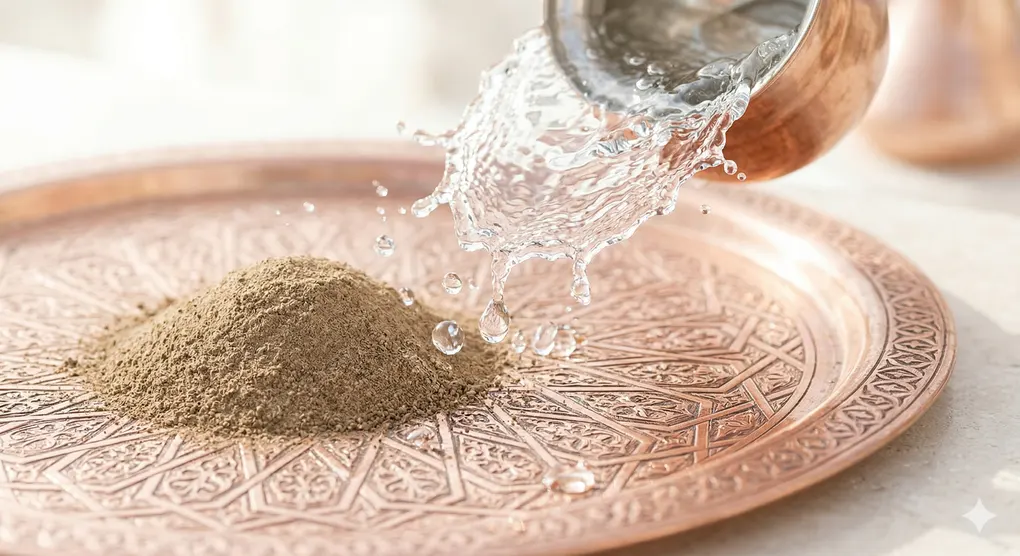
In Islamic teachings, cleanliness is an inseparable component of faith. One of the most critical aspects of this cleanliness that must be thoroughly understood relates to impurities (najis). Knowing the various types of najis is absolutely essential to ensure that our acts of worship are legally valid and accepted.
This article will comprehensively explain the categories of impurities in Islam, their specific divisions, practical examples, and the precise Shari’ah-compliant methods to purify them, providing a solid foundation for anyone seeking a deeper understanding of Islam.
What is Najis? Why is it Crucial to Know?
Najis refers to any physical substance that is considered dirty and legally impure according to Islamic law, which directly prevents the validity of the ritual prayer (Salah) and other acts of devotion that necessitate a state of purity. Recognizing the definition of najis is the primary step in guaranteeing that our bodies, garments, and places of worship remain pristine.
If a believer remains unaware of the different categories of impurities and the proper methods for removing them—such as the fundamental practice of istinja—their obligatory acts of worship may be rendered invalid and incomplete.
The Foundational Division: Tangible (‘Ainiyah) and Intangible (Hukmiyah) Najis
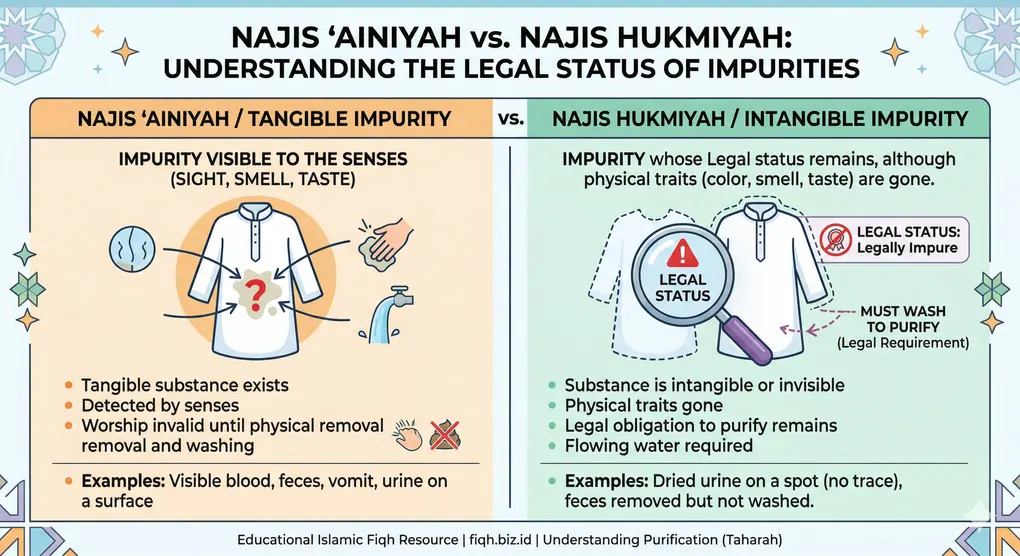
Broadly speaking, scholars of Islamic jurisprudence divide impurities into two primary classifications based on their physical presence:
Tangible Impurity (Najis ‘Ainiyah)
Najis ‘Ainiyah is an impurity whose physical substance or traits are still present and can be perceived by the senses (visible to the eye, detectable by smell, or noticeable by taste). The classical text Al-Fiqh al-Manhaji states:
النجاسة العينية: هي كل نجاسة لها جرم مشاهد، أولها صفة ظاهرة من لون أو ريح، كالغائط أو البول أو الدم
Translation: Tangible Impurity (‘Ainiyah): This is every impurity that possesses an observable body, or possesses an apparent trait such as color or smell, like feces, urine, or blood.
Examples of ‘Ainiyah impurities include visible human waste, wet urine, menstrual blood, or vomit where the physical substance remains apparent.
Intangible Impurity (Najis Hukmiyah)
Najis Hukmiyah is a state of impurity where the physical substance, smell, color, and taste have completely disappeared, often because it has dried up or faded away. However, its legal status as an impurity remains firmly attached to the affected area until it is properly washed with water. Al-Fiqh al-Manhaji further clarifies:
والنجاسة الحكمية: كل نجاسة جفت وذهب أثرها، ولم يبق لها أثر من لون أو ريح، وذلك مثل بول أصاب ثوباً ثم جف، ولم يظهر له أثر
Translation: Intangible Impurity (Hukmiyah): This is every impurity that has dried and its physical trace has vanished, leaving no residual color or smell. An example of this is urine that strikes a garment and then dries, leaving no visible trace.
Even though the area appears physically clean, a surface contaminated with Hukmiyah impurity must still be ritually purified with flowing water.
The 3 Types of Najis Based on Purification Severity
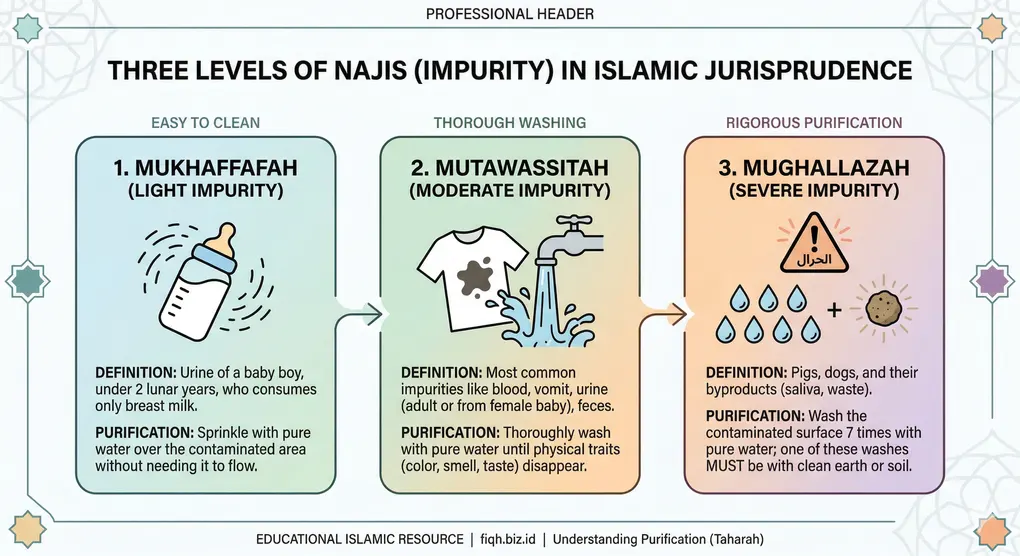
Beyond the physical presence, the most crucial classification of impurities revolves around the specific method required for purification. In this framework, there are three types of najis: Mughallazah (Severe), Mukhaffafah (Light), and Mutawassitah (Moderate).
Severe Impurity (Najis Mughallazah)



Najis Mughallazah is the heaviest category of impurity in Islam, requiring a highly specific and rigorous purification process. This category strictly encompasses dogs and pigs.
النجاسة المغلظة: وهي نجاسة الكلب والخنزير، ودليل تغليظها أنه لا يكفي غسلها بالماء مرة كباقي النجاسات، بل لا بد من غسلها سبع مرات إحداهن بالتراب، كما مر في حديث “ولوغ الكلب” وقيس عليه الخنزير لأنه أسوأ حالاً منه
Translation: Severe Impurity (Mughallazah): This is the impurity of dogs and pigs. The evidence for its severity is that washing it once with water is insufficient, unlike other impurities. Rather, it must be washed seven times, one of which must be with earth, as mentioned in the hadith regarding a “dog licking a vessel.” The pig is analogized to the dog because its condition is even worse.
The primary examples of severe impurity (Mughallazah) include anything originating from dogs and pigs, such as their saliva, excrement, urine, blood, flesh, or any moist body part touching another surface. To purify this, the affected area must be washed seven times. One of these seven washes must be mixed with pure earth or dust, which serves as the required purification medium.
Light Impurity (Najis Mukhaffafah)
Najis Mukhaffafah is the lightest category of impurity, boasting the easiest purification method. It exclusively applies to the urine of a male infant.
النجاسة المخففة: وهي بول الصبي الذي لم يأكل إلا اللبن ولم يبلغ سنه حولين، ودليل كونها مخففة أنها يكفي رشها بالماء، بحيث يعم الرش جميع موضع النجاسة من غير سيلان
Translation: Light Impurity (Mukhaffafah): This is the urine of a baby boy who has not consumed anything (other than breast milk) and has not yet reached two years of age. The evidence for it being light is that it is sufficient to sprinkle water over it, ensuring the sprinkling covers the entire area of the impurity without the water needing to flow.
An example of light impurity (Mukhaffafah) is strictly the urine of a baby boy under two lunar years old whose sole source of nutrition is breast milk or formula. If he begins eating solid foods, or if it is the urine of a baby girl (regardless of her diet), the urine is classified as a moderate impurity. To purify it, one simply sprinkles pure water evenly over the affected area without needing to make the water flow.
Moderate Impurity (Najis Mutawassitah)
Najis Mutawassitah is the standard, moderate category encompassing all other types of najis that are neither Mughallazah nor Mukhaffafah. This is the broadest category.
النجاسة المتوسطة: وهي غير الكلب والخنزير، وغير بول الصبي الذي لم يطعم إلا لبن، وذلك مثل بول الإنسان، وروث الحيوان، والدم. وسميت متوسطة لأنها لا تظهر بالرش، ولا يجب فيها تكرار الغسل إذا زالت عينها بغسلة واحدة
Translation: Moderate Impurity (Mutawassitah): This refers to anything other than dogs and pigs, and other than the urine of a baby boy fed only milk. Examples include human urine, animal dung, and blood. It is termed “moderate” because sprinkling is insufficient, yet repeated washing is not obligatory if the physical substance is removed with a single wash.
Examples of moderate impurities include:
- Human urine (adults and baby girls) and feces.
- Animal dung (excluding dogs and pigs).
- Blood, including menstrual, postpartum, and flowing wound blood.
- Pus and vomit.
- Madzi (pre-seminal fluid). It is highly beneficial to understand the difference between mani and madzi to know what necessitates washing versus a full bath.
- Wadi (thick fluid excreted after urination).
- Carcasses of animals that died without a valid Islamic slaughter (excluding fish and locusts).
- Intoxicating beverages (Khamr).
The method to purify Najis Mutawassitah requires washing the area with absolute water (Ma’ Mutlaq) until the physical substance, color, and smell are completely eradicated.
This requirement is derived from prophetic traditions. Regarding human waste, Imam al-Bukhari recorded from Anas bin Malik (RA) that the Prophet (ﷺ) would use water to wash himself after relieving his physical needs, firmly establishing the evidence for istinja. Regarding Madzi, Ali bin Abi Talib (RA) was instructed by the Prophet (ﷺ) to “wash his private part and perform wudu” (Bukhari and Muslim).
فدلت هذه الأحاديث على نجاسة الأشياء المذكورة، وقبس ما لم يذكر منها على ما ذكر
Translation: Therefore, these hadiths indicate the impurity of the mentioned substances, and whatever is not explicitly mentioned is analogized to what is mentioned.
The Importance of Ritual Purity (Thaharah) in Worship
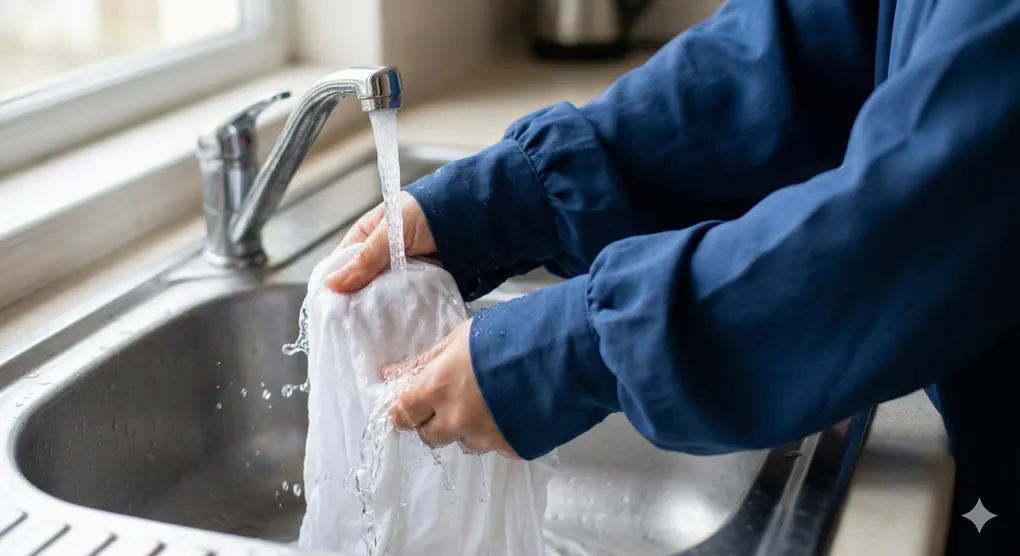
Understanding the types of najis and the precise procedures for removing them is the cornerstone of Thaharah (ritual purity) in Islam. Many essential acts of devotion, such as the ritual prayer and circumambulating the Kaaba, mandate that the practitioner is free from both major and minor states of impurity. Consequently, removing physical filth is a divine obligation. For a complete understanding of how this ties into other rituals, one should study the true meaning of wudu.
Conclusion
Mastering the divisions of impurities equips a believer to execute their worship correctly. By distinguishing between tangible (Ainiyah) and intangible (Hukmiyah) impurities, and accurately applying the purification rules for severe (Mughallazah), light (Mukhaffafah), and moderate (Mutawassitah) impurities, we guarantee the sanctity of our bodies and our environments. This meticulous attention to cleanliness ensures that we fulfill the prerequisites for acts requiring ablution and stand before Allah (SWT) in a state of immaculate purity.
Frequently Asked Questions (FAQ)
What is the difference between Ainiyah and Hukmiyah impurities?
Najis Ainiyah refers to an impurity that still has a visible physical substance, color, smell, or taste. Najis Hukmiyah is an impurity whose physical traits have completely vanished (like dried, odorless urine), but the area remains legally impure until washed with water.
Does touching a dog invalidate my wudu?
Touching a dog does not invalidate your wudu. However, if you touch a dog and either your hand or the dog’s coat is wet, your hand becomes contaminated with Najis Mughallazah. You must wash your hand seven times (one of which with earth) to purify it, but you do not need to repeat your entire wudu.
Is the urine of all babies considered a light impurity (Mukhaffafah)?
No. Only the urine of a male infant under the age of two lunar years, whose sole source of nutrition is breast milk, is considered Mukhaffafah. The urine of female infants, or male infants who have begun eating solid foods, is classified as a moderate impurity (Mutawassitah).
Reference
Mustafa al-Khin, Mustafa al-Bugha, and Ali al-Syarbaji, al-Fiqh al-Manhaji ‘alā Madhhab al-Imām al-Shāfi‘ī, vol. 1 (Damascus: Dār al-Qalam, 1992), pp. 40–42.


