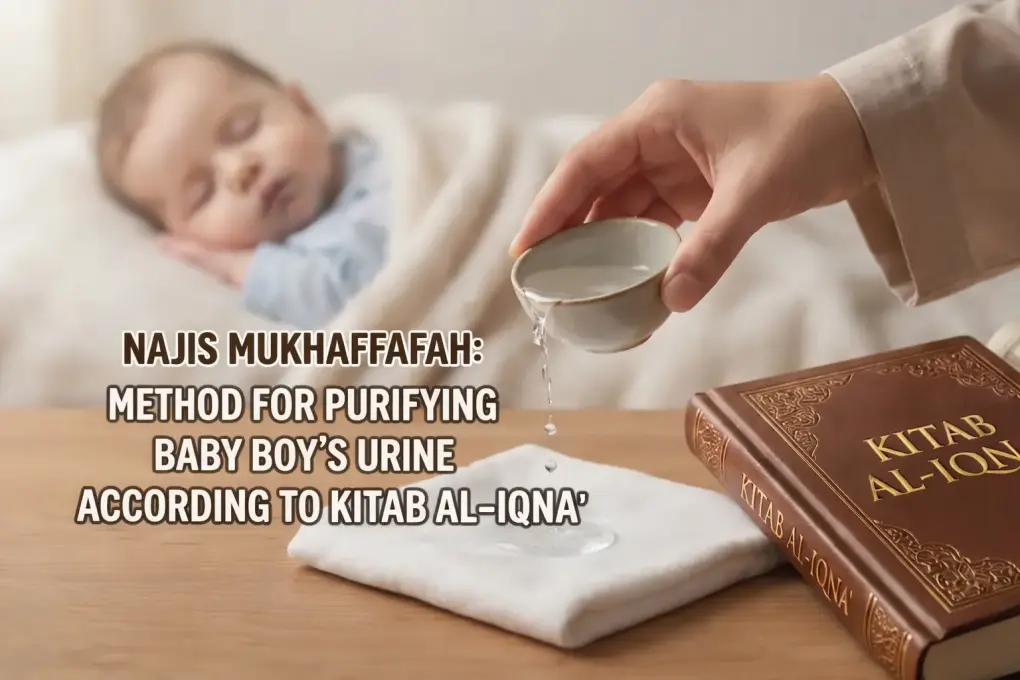
Najis mukhaffafah is an impurity for which Shafi’i fiqh gives a lighter purification method. Its central example is the urine of a baby boy, but only when all of the stated conditions are met.
This concession does not mean that the urine is pure before it is cleaned. It only changes the method of purification: water may be sprinkled so that it covers the affected area, without requiring the water to flow.
For the wider subject, see the complete guide to najis in Islam and the three types of najis. When publishing the English version, connect these links to their English Polylang translations.
What Is Najis Mukhaffafah in Shafi’i Fiqh?
The meaning of mukhaffafah and “light impurity”
The word mukhaffafah carries the meaning of something made lighter. In the law of impurity, it refers to an impurity whose purification method is lighter than the method that requires a normal wash with flowing water.
Therefore, najis mukhaffafah is not a name for every small or seemingly mild form of dirt. It remains an impurity that must be purified, but in a particular case it is purified through naḍḥ, meaning the sprinkling of water.
Imam al-Khaṭīb al-Shirbīnī introduces this subject with the heading:
القَوْلُ فِي النَّجَاسَةِ الْمُخَفَّفَةِ وَإِزَالَتِهَا
Translation: “The discussion of lightened impurity and its removal.”[1]
Where it sits among the types of najis
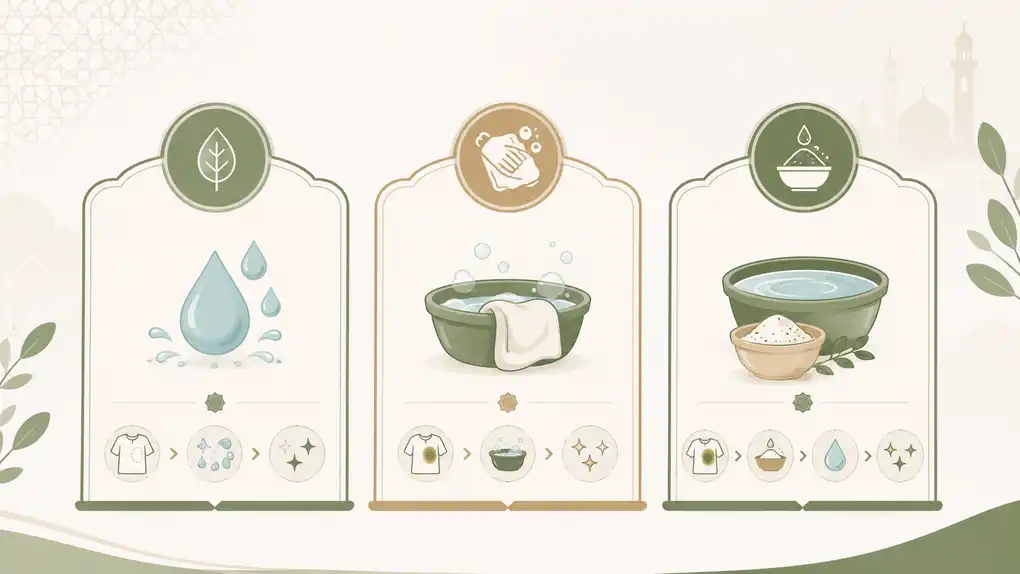
In Shafi’i fiqh, discussions of impurity are commonly arranged by their purification methods. Light impurity is discussed alongside medium and severe impurity, yet each category has its own ruling.
| Category | Common example | General purification method |
|---|---|---|
| Mukhaffafah | Baby boy urine that meets all conditions | Sprinkle water until it covers the affected place |
| Mutawassithah | Urine in general | Wash until the impurity is removed |
| Mughallazhah | Dog, pig, and their offspring | Seven washes, one using soil |
This table is a practical map, not permission to label every baby’s urine as light impurity. The example of najis mukhaffafah is narrowly defined.
The main example of najis mukhaffafah


Asnā al-Maṭālib states:
وَيَكْفِي فِي تَطْهِيرِ بَوْلِ صَبِيٍّ لَمْ يَطْعَمْ غَيْرَ اللَّبَنِ لِلتَّغَذِّي، لَا صَبِيَّةٍ وَلَا خُنْثَى، نَضْحٌ بِالْمَاءِ بِشَرْطِ غَلَبَتِهِ وَإِنْ لَمْ يَسِلْ
Translation: “For purifying the urine of a baby boy who has not consumed anything other than milk for nourishment—not a baby girl and not a khunthā—sprinkling water is sufficient, provided that the water prevails over the affected place, even if it does not flow.”[2]
The passage establishes three limits: the child is male, he has not consumed anything besides milk for nourishment, and the water must cover the affected place. Without these limits, sprinkling cannot simply be used.
Conditions for Baby Boy Urine to Be Najis Mukhaffafah
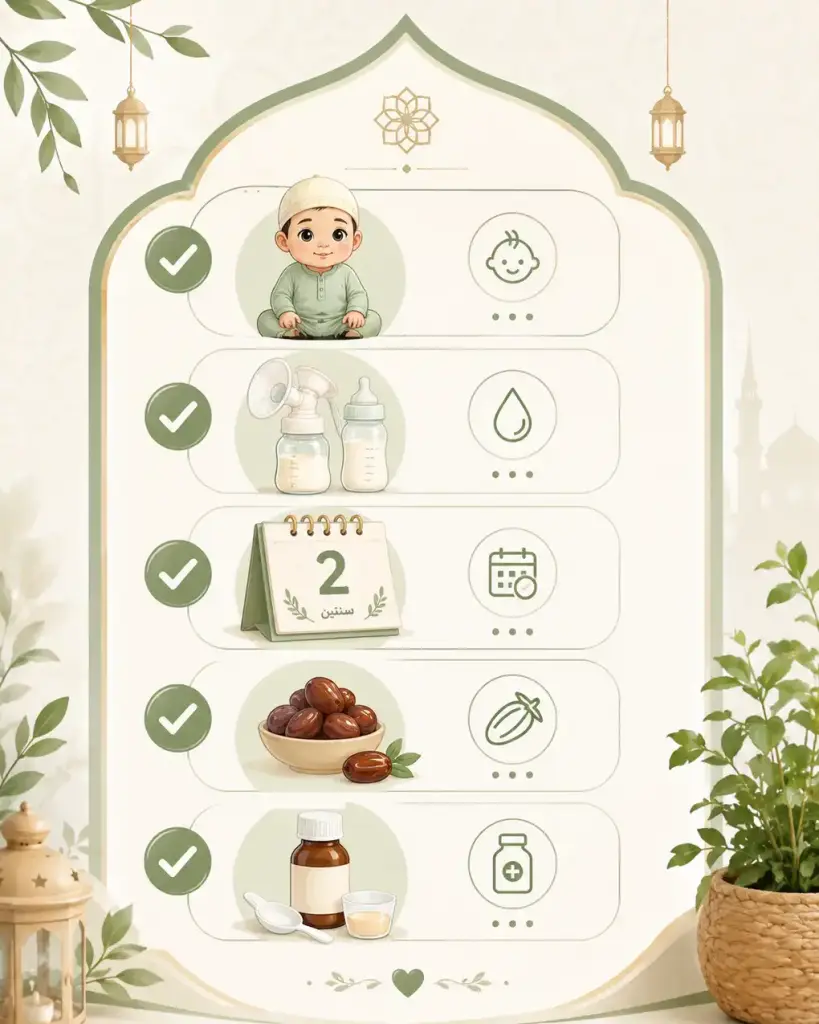
The child must be a baby boy
This concession applies to a baby boy. A baby girl’s urine is not purified by sprinkling alone, and neither is the urine of a khunthā.
Imam al-Khaṭīb al-Shirbīnī explains:
بِخِلَافِ الصَّبِيَّةِ وَالْخُنْثَى لَا بُدَّ فِي بَوْلِهِمَا مِنَ الْغَسْلِ عَلَى الْأَصْلِ وَيَتَحَقَّقُ بِالسَّيَلَانِ
Translation: “Unlike the baby girl and the khunthā, their urine must be washed according to the original ruling, and washing is achieved by the flow of water.”[3]
So, when the affected item has baby girl urine or khunthā urine on it, it must be washed in the normal way. Sprinkling by itself is not enough.
No nourishment other than milk
The wording in the text is that the child has not consumed anything other than milk for nourishment. The legal issue is not merely whether something has entered the child’s mouth; it is whether it serves as nourishment.
Asnā al-Maṭālib uses a clear condition:
لَمْ يَطْعَمْ غَيْرَ اللَّبَنِ لِلتَّغَذِّي
Translation: “He has not consumed anything other than milk for nourishment.”[4]
Once a child routinely receives complementary food as nourishment, such as porridge or puréed family food, sprinkling is no longer sufficient. The affected part must be washed normally.
The source text used here speaks of “milk” and “food for nourishment”; it does not separately address every modern infant drink. This article therefore does not assign a stand-alone ruling to specific modern products that the text does not name.
Before completing two years
The sprinkling concession applies before the child completes two years. After that time, nursing is treated like food in this discussion.
Al-Iqnāʿ states:
وَبِقَبْلِ مُضِيِّ حَوْلَيْنِ مَا بَعْدَهُمَا إِذِ الرَّضَاعُ حِينَئِذٍ كَالطَّعَامِ
Translation: “With the condition that two years have not passed; after that, nursing at that time is like food.”[5]
Thus, a boy older than two years does not use this concession. His urine is purified through a normal wash, as is urine generally.
Tahnik and medicinal treatment do not remove the concession
Tahnik with dates and treatment given to improve the child’s condition are not treated as nourishment. They therefore do not automatically turn the urine into a case that must be washed normally.
Imam al-Khaṭīb al-Shirbīnī writes:
وَخَرَجَ بِقَيْدِ التَّغَذِّي تَحْنِيكُهُ بِنَحْوِ تَمْرٍ وَتَنَاوُلُهُ نَحْوَ سَفُوفٍ لِإِصْلَاحٍ فَلَا يَمْنَعَانِ النَّضْحَ
Translation: “Excluded by the condition of nourishment are tahnik with something such as dates and taking something such as powdered medicine for treatment; neither prevents sprinkling.”[6]
Tahnik, medicinal syrup, vitamin drops, and powdered medicine given for treatment are therefore not simply equated with food that nourishes. The relevant distinction is the purpose of nourishment.
How to Purify Najis Mukhaffafah by Sprinkling Water
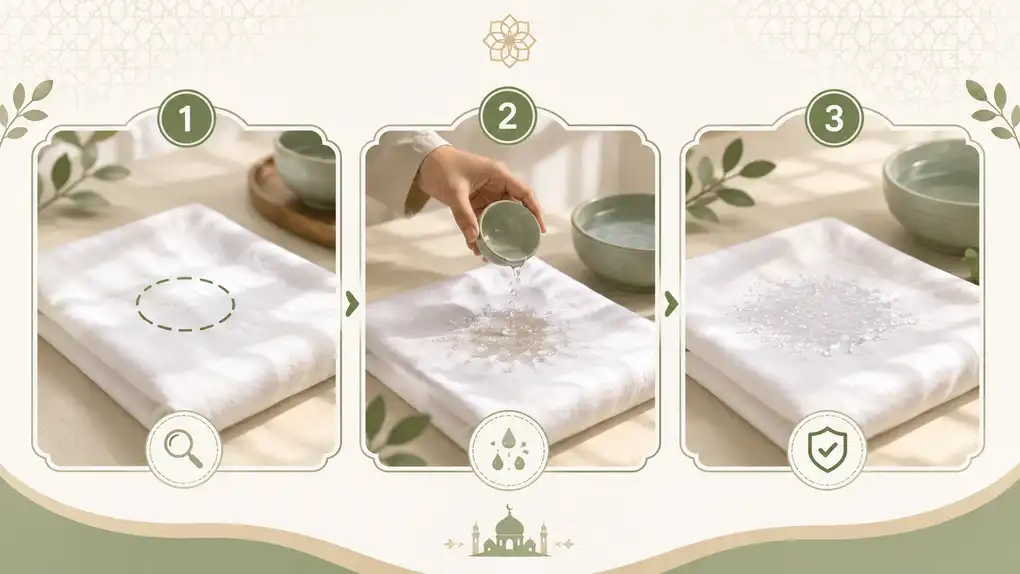
What does naḍḥ mean?
Naḍḥ means sprinkling water over the place affected by urine. The sprinkling is not merely one small damp spot; it must reach the entire affected area.
Imam al-Khaṭīb al-Shirbīnī explains:
فَإِنَّهُ يَطْهُرُ بِرَشِّ الْمَاءِ عَلَيْهِ بِأَنْ يُرَشَّ عَلَيْهِ مَا يَعُمُّهُ وَيَغْمُرُهُ بِلَا سَيَلَانٍ
Translation: “It becomes pure by sprinkling water over it: water that reaches all of it and covers it, without flowing.”[7]
“Prevails over” in the legal explanation means that the water reaches all the places affected by urine. The water does not need to drip, flow away, or be wrung from the fabric.
Practical steps for clothes, fabric, and bedding
Here is a practical method for purifying najis mukhaffafah on clothing, a baby carrier, a blanket, or bedding.
- Confirm that the conditions apply.
The child must be male, must not have consumed anything besides milk for nourishment, and must be under two years old. - Identify the affected area.
Purify the affected part only. There is no need to wash an entire garment or blanket when the location is known. - Remove any visible pooled urine.
Absorb or remove it first so that the water can properly reach the affected place. - Sprinkle pure water across the full area.
Ensure that the water reaches and covers the affected part. Flowing water is not required. - Check for remaining characteristics of the impurity.
When an odor or color remains and can be removed without undue difficulty, continue cleaning until it is gone.
No fixed number of sprinklings or wringing of the garment is required here. Do not add conditions that are absent from the discussion of naḍḥ.
Must the water flow?
No. Water used to clean najis mukhaffafah does not need to flow.
However, “not flowing” does not mean water may touch only a small part of the affected place. The water must still reach and cover the whole area affected by the urine.
Al-Iqnāʿ further states:
وَلَا بُدَّ فِي النَّضْحِ مِنْ إِزَالَةِ أَوْصَافِهِ كَبَقِيَّةِ النَّجَاسَاتِ
Translation: “In sprinkling, its characteristics must still be removed as with the rest of the impurities.”[8]
Therefore, wiping with tissue alone does not replace the use of water. When a detectable characteristic remains and can be removed, cleaning should continue until it disappears.
For a garment-focused guide, see how to clean light impurity on baby clothes. When publishing the English version, map this link to its English Polylang translation.
Common mistakes
Avoid these mistakes:
- Wiping the urine with tissue but not using water.
- Using sprinkling after the child has begun taking food for nourishment.
- Treating a baby girl’s urine the same as a baby boy’s urine.
- Assuming all baby urine is light impurity.
- Treating najis mukhaffafah in the same way as dog or pig impurity.
- Sprinkling water over only part of the area while leaving other affected parts untouched.
How It Differs from Baby Girl Urine and Other Impurities
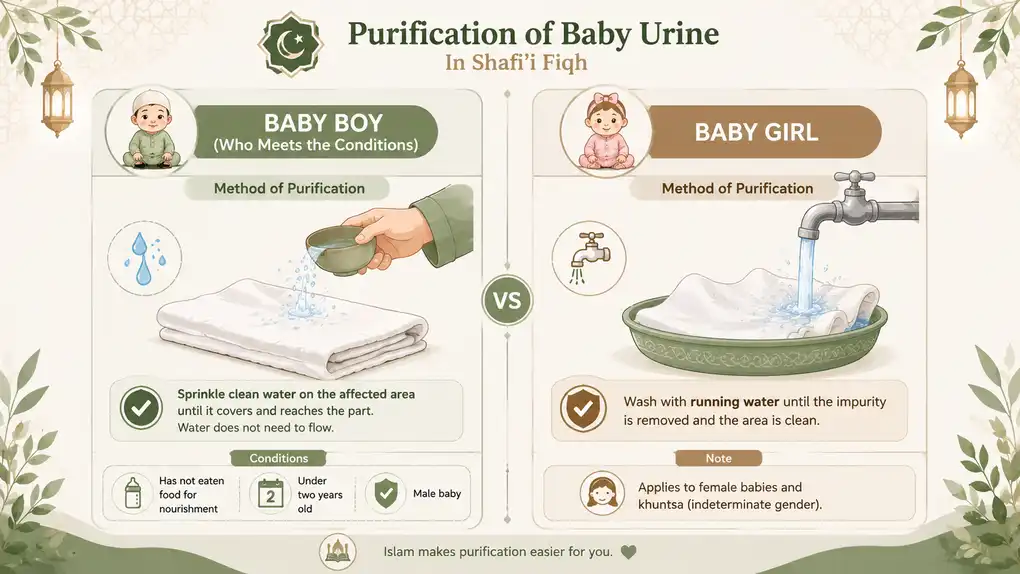
Baby boy urine and baby girl urine
The distinction is not based only on outward cleanliness. Fiqh assigns different purification methods through textual evidence and scholarly explanation.
Al-Iqnāʿ cites the hadith:
يُغْسَلُ مِنْ بَوْلِ الْجَارِيَةِ وَيُرَشُّ مِنْ بَوْلِ الْغُلَامِ
Translation: “The urine of a baby girl is washed, while the urine of a baby boy is sprinkled.”[9]
In the commentary, Imam al-Khaṭīb al-Shirbīnī also records two explanations given by scholars: baby boys were carried more often, and their urine was regarded as thinner. These are explanatory points reported in the text, not independent tests for making a legal ruling.[10]
A baby boy who has begun eating
Once a baby boy receives food for nourishment, the sprinkling concession no longer applies. His urine is then washed like a case of medium impurity.
The change does not occur because the child’s sex changes. It occurs because the condition for the concession no longer exists. In practical terms, a child who has started complementary feeding is not purified by sprinkling alone.
A quick comparison of the three categories
| Type of impurity | Example | Purification method |
|---|---|---|
| Mukhaffafah | Baby boy urine that meets all conditions | Sprinkle water so it covers the area; it need not flow |
| Mutawassithah | Baby girl urine; baby boy urine after nourishment from food or after two years | Wash until the impurity is removed |
| Mughallazhah | Dog, pig, and their offspring | Seven washes with water; one of them uses soil |
Regarding mughallazhah impurity, Asnā al-Maṭālib states:
لَا يَطْهُرُ مُتَنَجِّسٌ بِكَلْبٍ وَخِنْزِيرٍ وَفَرْعِ كُلٍّ مِنْهُمَا … إِلَّا بِسَبْعٍ مِنَ الْغَسَلَاتِ بِالْمَاءِ إِحْدَاهُنَّ بِالتُّرَابِ
Translation: “An item made impure by a dog, a pig, or their offspring is not purified except by seven washes with water, one of them using soil.”[11]
This shows why sprinkling is reserved for a very limited case. Each type of impurity has its own method of purification.
Applying the ruling to affected items
Where the conditions for najis mukhaffafah are present, sprinkling can be used on:
- a parent’s or baby’s clothing;
- a baby carrier;
- blankets and bedding;
- carpets;
- prayer mats;
- reachable portions of a mattress.
Focus on the place actually affected. There is no need to wash the entire item when the affected spot is known.
FAQ About Najis Mukhaffafah
What is najis mukhaffafah?
Najis mukhaffafah is an impurity given a lighter purification method. Its main example is the urine of a baby boy who has not consumed anything besides milk for nourishment and who is under two years old.
It must still be purified. The concession is that water may be sprinkled until it covers the affected area.
Is baby boy urine that comes from milk-only feeding cleaned by sprinkling?
Yes, when the child is male, has not consumed anything besides milk for nourishment, and is under two years old. The water must reach the entire area affected by urine.
Tahnik and medicine given for treatment do not automatically remove this concession.[6]
Does the water have to flow when purifying najis mukhaffafah?
No. The water does not have to flow. It is sufficient to sprinkle it until it reaches and covers the affected place.
Water is still required. Wiping with tissue alone does not replace the prescribed sprinkling of water.
Is baby girl urine also cleaned by sprinkling?
No. Baby girl urine must be washed in the normal way, meaning water flows across the affected place.
The same applies to khunthā urine. Sprinkling is a concession specific to a baby boy who meets the stated conditions.
What is the ruling when a baby boy has started complementary food?
After a baby boy begins taking complementary food for nourishment, sprinkling is no longer sufficient. Wash the affected place normally until the impurity is removed.
The same is true after he reaches two years of age, because nursing at that time is treated as food in this discussion.[5]
Footnotes
References
- Al-Syarbīnī, Syams al-Dīn Muḥammad bin Aḥmad. Al-Iqnāʿ fī Ḥall Alfāẓ Abī Syujaʿ. Edited by Maktab al-Buḥūts wa al-Dirāsāt, Dār al-Fikr. Beirut: Dār al-Fikr, vol. 1, p. 90.
- Zakariyā al-Anṣārī, Asnā al-Maṭālib fī Sharḥ Rawḍ al-Ṭālib, with ḥāsyiyah (marginal gloss) by Aḥmad al-Ramlī, edited by Muḥammad az-Zuhrī al-Ghamrāwī (Cairo: al-Maṭbaʿah al-Maymānīyah, 1313 AH; repr. Dār al-Kitāb al-Islāmī), vol. 1, pp. 20-21.


