
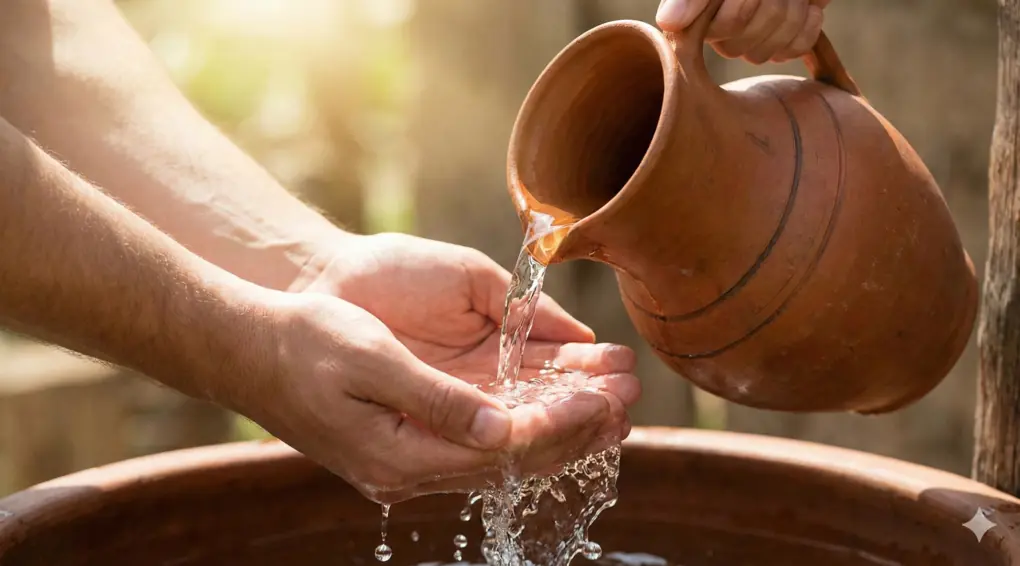
Absolute water (al-mā’ al-muṭlaq) is water that is still called “water” without a binding added name. In Shafi‘i fiqh, this is the water described as pure and purifying: pure in itself and valid for wudu, obligatory ghusl, and removing impurity.
This topic is a key foundation in the chapter of taharah. Many acts of worship depend on whether the water used for purification is valid or not.
What Is Absolute Water?
In simple terms, absolute water is water that remains under its original unrestricted name: water. It has not become another liquid such as rose water, tea, coffee, or syrup.
Imam Zakariyya al-Ansari explains:
وهو العاري عن إضافة لازمة
“It is water free from a binding addition.”[1]
This means the water does not have an added name that removes it from being plain water. As long as people still call it “water,” and no change removes its unrestricted status, it remains absolute water.
Why Is Absolute Water Called Pure and Purifying?
Absolute water is called pure and purifying because it has two qualities:
- It is pure in itself.
- It can purify other things.
Asna al-Mathalib states:
المطهر للحدث والخبث الماء المطلق
“The purifier of ritual impurity and filth is absolute water.”[2]
This means absolute water can remove ritual impurity and clean physical impurity. This is what makes it different from water that is pure but no longer purifying, such as used water (musta‘mal) according to Shafi‘i details.
Qur’anic Evidence for Water as a Means of Purification
Allah says:
وَأَنزَلْنَا مِنَ السَّمَاءِ مَاءً طَهُورًا
“We sent down from the sky purifying water.”[3]
The phrase مَاءً طَهُورًا shows that the water sent down from the sky has a purifying quality.
Allah also says:
وَيُنَزِّلُ عَلَيْكُم مِّنَ السَّمَاءِ مَاءً لِّيُطَهِّرَكُم بِهِ
“He sends down upon you water from the sky to purify you with it.”[4]
This verse shows that water is not merely clean; it is also a legally valid means of purification.
For the parent topic, see types of water for purification.
The Status of Absolute Water in the Shafi‘i School
In the Shafi‘i school, absolute water is the main means of purification. Ritual impurity and physical impurity are not removed by other liquids.
Imam Zakariyya al-Ansari states:
لا يجوز رفع حدث، ولا إزالة نجس إلا بالماء المطلق
“It is not permissible to remove ritual impurity or remove filth except with absolute water.”[5]
Therefore, wudu, obligatory ghusl, and removing impurity are not valid with tea, broth, syrup, rose water, or any other liquid that is no longer called water without restriction.
Fiqh Evidence That Only Absolute Water Purifies
Allah says:
فَلَمْ تَجِدُوا مَاءً فَتَيَمَّمُوا
“If you do not find water, then perform tayammum.”[6]
This verse shows that the normal means of purification is water. Tayammum is used only when water is unavailable or when one has an excuse not to use water.
For that reason, other liquids do not replace absolute water in taharah.
Why Other Liquids Cannot Replace Absolute Water
Asna al-Mathalib states:
الماء المطلق أي لا غيره من تراب تيمم، وحجر استنجاء، وأدوية دباغ، وشمس، وريح، ونار
“Absolute water, not anything else: not the soil of tayammum, the stone of istinja, tanning substances, the sun, wind, or fire.”[7]
The explanation is:
- Soil may be used for tayammum, but only as a substitute when there is an excuse.
- Stones may be used for istinja, but not for wudu or obligatory ghusl.
- Liquids other than water are not valid for lifting ritual impurity.
- Absolute water remains the main means of purification.
For the broader foundation, see the meaning of taharah in Islam.
Absolute Water, Wudu, Ghusl, and Istinja
Absolute water is used in many acts of purification:
- Wudu, to remove minor ritual impurity.
- Obligatory ghusl, to remove major ritual impurity.
- Washing impurity, whether from the body, clothing, or place of prayer.
- Istinja with water, after relieving oneself.
This is why the topic of absolute water should be understood before studying a complete guide to wudu and the correct way to perform obligatory ghusl.
Types of Absolute Water
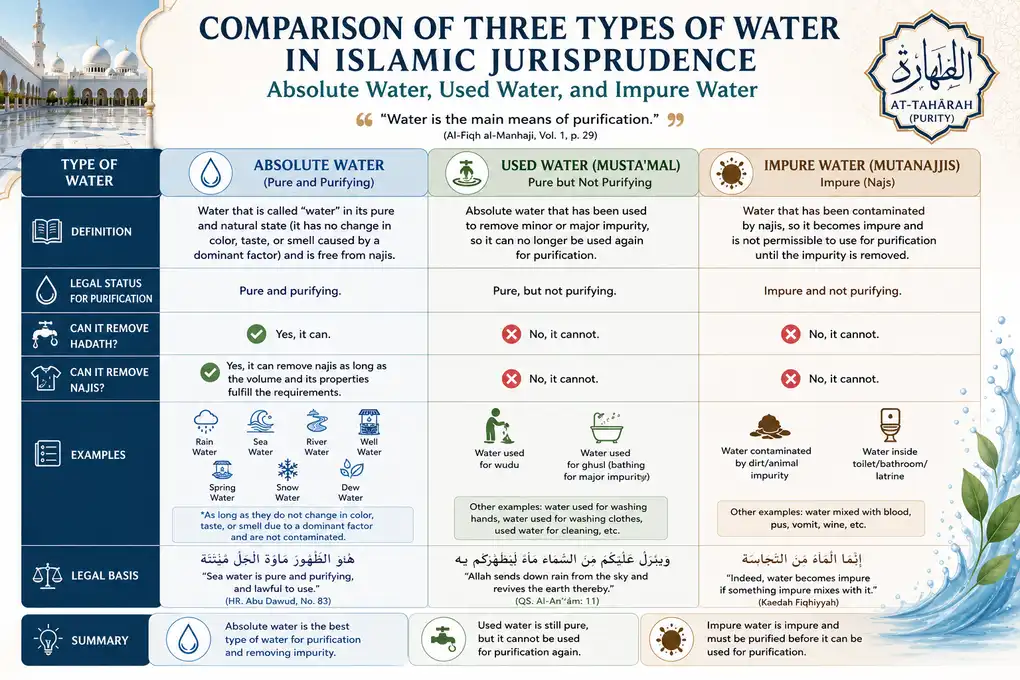
Absolute water includes water that descends from the sky or emerges from the earth. A fiqh text states:
المياه: جمع ماء، وهي ماء السماء، وماء البحر، وماء البئر، وماء النهر، وماء العين، وماء الثلج
“Waters include rainwater, seawater, well water, river water, spring water, and snow water.”[8]
Based on the scholars’ discussion, examples of types of absolute water include:
- Rainwater
- Seawater
- River water
- Well water
- Spring water
- Snow water
- Dew water
For a shorter list, see seven types of water for purification.
Rainwater
Rainwater is one of the clearest examples of absolute water. Its evidence is the Qur’anic phrase describing water from the sky as مَاءً طَهُورًا.[3]
As long as it is not affected by impurity and has not become another liquid, rainwater is valid for wudu, obligatory ghusl, and removing impurity.
Seawater
Seawater remains absolute water even though it tastes salty. The Messenger of Allah ﷺ said:
هُوَ الطَّهُورُ مَاؤُهُ الْحِلُّ مَيْتَتُهُ
“Its water is purifying, and its dead creatures are lawful.”[9]
The salty taste of seawater is part of its natural state and does not remove its unrestricted status.
River Water


River water is absolute water. If it becomes slightly muddy because of soil or mud carried by the current, it remains valid as long as it is still called water and has not changed due to impurity.
Well Water
Well water is also absolute water. As long as impurity does not affect its qualities, it is valid for purification.
Spring Water
Water from a natural spring is absolute water. Its status is like river water and well water because it comes from a natural source.
Snow Water
Snow that melts into water is absolute water. Since it originates from water sent down from the sky, it is valid for purification once it melts and can flow over the limb being washed.
Dew Water
Collected dew is also absolute water. Although it is usually small in amount, it remains pure and purifying if it can be used.
Are Tap Water and Bottled Water Absolute Water?
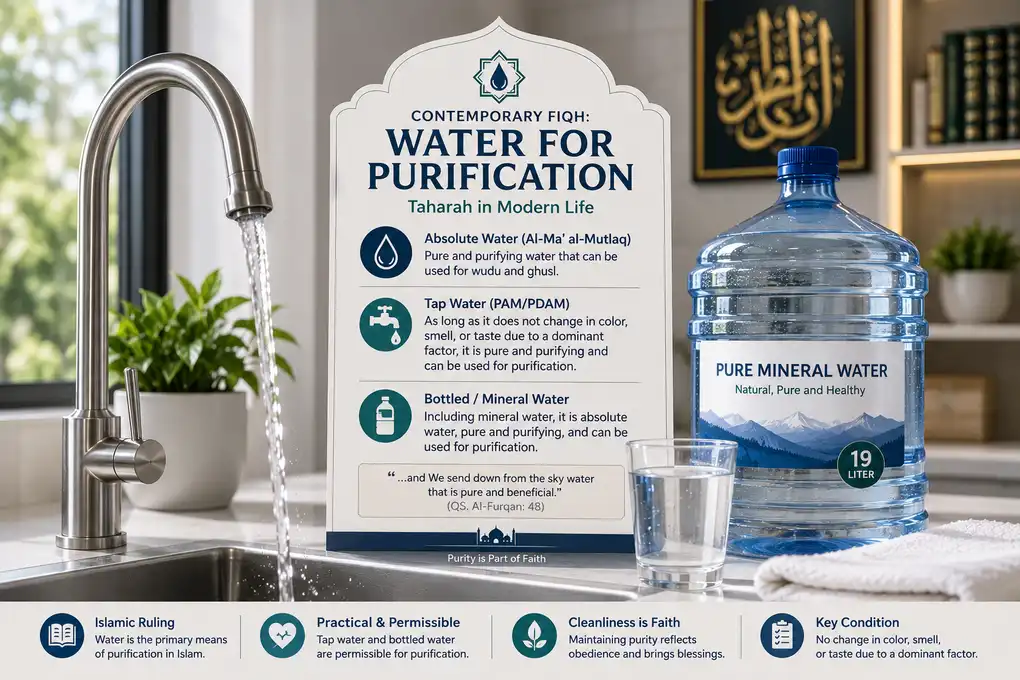
Tap water, refill-gallon water, and modern filtered water are originally absolute water. Filtration does not change the reality of water into another liquid.
The practical rule is:
As long as it is still called “water” without restriction and has not become another liquid, it remains absolute water.
Tap Water
Tap water usually comes from rivers, reservoirs, springs, or groundwater. As long as treatment does not remove the name “water,” it is valid for wudu, obligatory ghusl, and cleaning impurity.
Refill-Gallon Water
Refill-gallon water is valid for wudu as long as it remains ordinary water. Filtering and packaging do not remove it from being absolute water.
Modern Filtered Water
Water from RO, carbon filters, UV treatment, or sediment filters remains absolute water if it has not become another liquid.
Conditions for Water to Remain Absolute Water
Not every clean-looking water is automatically valid for purification. Water must remain under its original name as water.
Imam Zakariyya al-Ansari explains:
الماء المتغير طعما أو لونا أو ريحا بمخالطة طاهر يستغنى عنه تغيرا يمنعه الإطلاق غير طهور
“Water whose taste, color, or smell changes due to mixing with a pure substance that can normally be avoided, in a way that prevents it from being called unrestricted water, is no longer purifying.”[10]
This shows that a change in color, smell, or taste can affect the water’s status when the change causes it to no longer be called water without restriction.
Changes That Are Tolerated
The Shafi‘i school tolerates changes that are difficult to avoid.
Change Due to Mud or Soil
Imam Zakariyya al-Ansari states:
وكذا إن تغير كثيرا بملح مائي، وتراب مطروح فإنه طهور
“Likewise, if it changes greatly due to water-salt or soil, it remains purifying.”[11]
River water that becomes muddy due to soil is usually still valid for purification as long as it is still called water.
Change Due to Algae
He also mentions:
كطحلب
“Such as algae.”[12]
Algae that naturally grows in water does not remove the status of absolute water because it is difficult to avoid.
Change Due to Naturally Fallen Leaves
Asna al-Mathalib states:
وأوراق شجر تناثرت وتفتتت
“Leaves of trees that fall and break apart into the water.”[13]
Leaves that naturally fall into a river, pond, or spring do not automatically remove the water’s unrestricted status.
Changes That Remove the Status of Absolute Water
Water loses its unrestricted status when a pure mixture changes its name and qualities. Examples include:
- Rose water
- Tea
- Coffee
- Syrup
These liquids may remain pure if their ingredients are pure, but they are not valid for wudu or obligatory ghusl because they are no longer called water without restriction.
Absolute Water vs. Pure but Non-Purifying Water
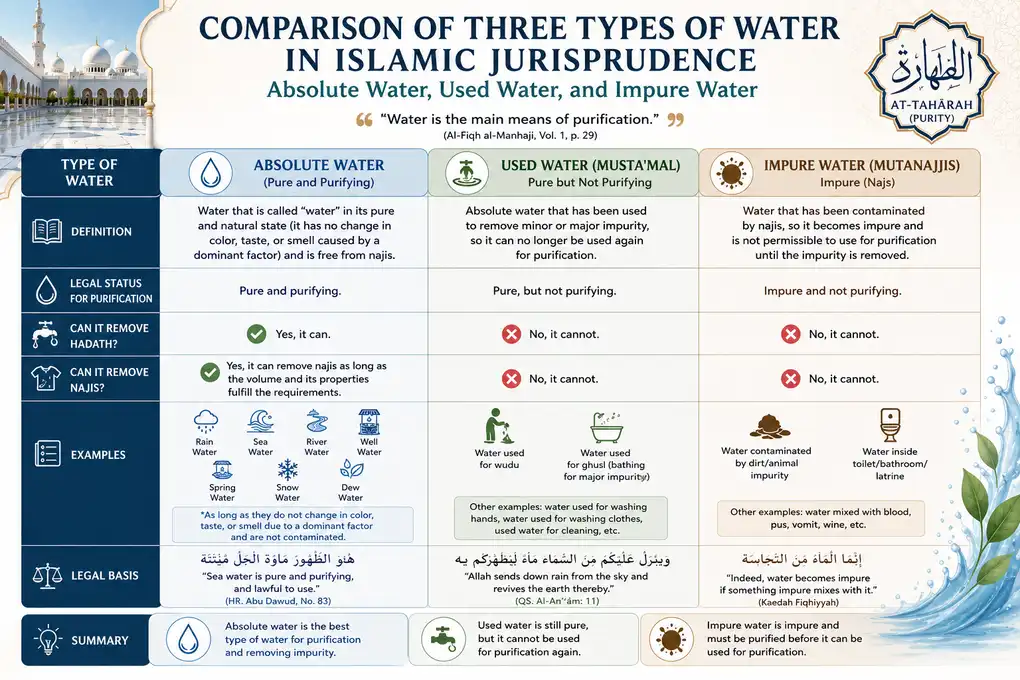
In the Shafi‘i school, water is divided into categories. Three common categories are:
| Type of Water | Status | Wudu | Obligatory Ghusl |
|---|---|---|---|
| Absolute water | Pure and purifying | Valid | Valid |
| Used water (musta‘mal) | Pure but not purifying | Not valid | Not valid |
| Impure water | Impure | Not valid | Not valid |
Used Water (Musta‘mal)
Imam Zakariyya al-Ansari says:
لا قليل مستعمل في فرض من رفع حدث أو خبث فلا يطهر شيئا
“A small amount of water used for an obligatory removal of ritual impurity or filth does not purify anything.”[14]
An example is a small amount of water that has been used for wudu and has separated from the limb. It is pure, but it is not purifying according to the well-known view in the Shafi‘i school.
Impure Water
Asna al-Mathalib has a specific chapter:
باب بيان النجاسة والماء النجس
“Chapter on explaining impurity and impure water.”[15]
Impure water is water affected by filth. Its details relate to water amount, changes in qualities, and the discussion of two qullahs.
For details on impurity, see the ruling of impurity in Islam.
Contemporary Questions About Absolute Water
Tap Water for Wudu
Tap water from public treatment systems is generally valid for wudu. Treatment does not change its status as long as it is still plain water.
Bottled Mineral Water
Bottled mineral water remains valid for wudu or obligatory ghusl as long as it has not become another liquid.
RO Water and Filtered Water
Filtered water and RO water are valid for purification. Filtration cleans water; it does not turn it into something other than water.
Stored Rainwater
Rainwater stored in a tank, bucket, or container remains absolute water as long as it is not affected by impurity and does not become another liquid.
Heated Water
Heated water remains valid for purification. Asna al-Mathalib states:
ولا متسخن بالنار
“Nor is water heated by fire disliked.”[16]
Thus water heated by a stove, electric heater, or modern water heater remains valid for wudu and obligatory ghusl.
AC Water and Condensation
Condensed water is originally pure because it comes from vapor that condenses. Imam Zakariyya al-Ansari mentions water vapor returning to water:
أو كان بخاره
“Or if it is its vapor.”[17]
In practice, however, one should still consider the cleanliness of the AC channel and the possibility of contamination.
Wisdom Behind Using Absolute Water for Purification
Allah made water a means of purification because it is suitable for cleaning the body, clothes, and prayer area. Water also reminds a servant to maintain outward and inward purity.
Al-Fiqh al-Manhaji explains that Islam gives great care to cleanliness through wudu, ghusl, clean clothing, bodily hygiene, and proper manners.[18]
Preserving Bodily Cleanliness
Wudu repeated throughout the day keeps commonly exposed limbs clean, such as the face, hands, head, and feet.
Preserving Health
Al-Fiqh al-Manhaji mentions one wisdom of purification:
المحافظة على الصحة
“Preserving health.”[19]
Cleanliness is one of the means by which the body is protected from disease.
Preparing for Worship
A Muslim stands before Allah in prayer while pure. Absolute water is therefore a way to prepare outwardly before facing Allah.
Outward and Inward Purity
Allah says:
إِنَّ اللَّهَ يُحِبُّ التَّوَّابِينَ وَيُحِبُّ الْمُتَطَهِّرِينَ
“Indeed, Allah loves those who repent and loves those who purify themselves.”[20]
The verse joins repentance and purification. The outward self is washed with water, while the inward self is cleansed through repentance.
The Messenger of Allah ﷺ said:
الطُّهُورُ شَطْرُ الإِيمَانِ
“Purification is half of faith.”[21]
FAQ About Absolute Water
What is absolute water in Islam?
Absolute water is water still called water without a binding added name. Examples include rainwater, seawater, river water, well water, spring water, snow water, and dew water.
Is bottled mineral water absolute water?
Yes. Bottled mineral water is absolute water as long as it is still ordinary water and has not become another liquid.
Can muddy water be used for wudu?
Yes. A change caused by mud, soil, algae, or unavoidable natural causes does not remove the status of absolute water as long as it is still called water.
Why is rose water not absolute water?
Because it has a binding added name. It is called “rose water,” not water without restriction.
Can used wudu water be reused for wudu?
According to the well-known Shafi‘i view, a small amount of water used to remove ritual impurity becomes musta‘mal. It is pure, but not purifying.
Is seawater valid for wudu and obligatory ghusl?
Yes. Seawater is valid for wudu and obligatory ghusl based on the hadith:
هُوَ الطَّهُورُ مَاؤُهُ الْحِلُّ مَيْتَتُهُ.
What is the ruling on water mixed with a little soap?
If the soap is little and does not remove the name “water,” the water remains absolute water. If the change dominates so that it is no longer called water, it is not valid for purification.
Footnotes
References
- Zakariyā al-Anṣārī, Asnā al-Maṭālib fī Sharḥ Rawḍ al-Ṭālib, with ḥāsyiyah by Aḥmad al-Ramlī, edited by Muḥammad az-Zuhrī al-Ghamrāwī (Cairo: al-Maṭbaʿah al-Maymānīyah, 1313 AH; repr. Dār al-Kitāb al-Islāmī), vol. 1, pp. 5-9.
- Al-Khin, Muṣṭafā, Muṣṭafā Dīb al-Bughā, and ʿAlī al-Syarbajī. Al-Fiqh al-Manhajī ʿalā Madzhab al-Imām al-Syāfiʿī. Damascus: Dār al-Qalam li al-Ṭibāʿah wa al-Nasyr wa al-Tawzīʿ, 4th ed., 1413 AH/1992 CE, vol. 1, pp. 27-30.


