The types of ṭahārah in fiqh do not only refer to bathing or washing the body. In the Shāfiʿī madhhab, ṭahārah is closely tied to whether certain acts of worship are valid, especially prayer.
That is why this discussion should begin with a simple question: what exactly needs to be purified?
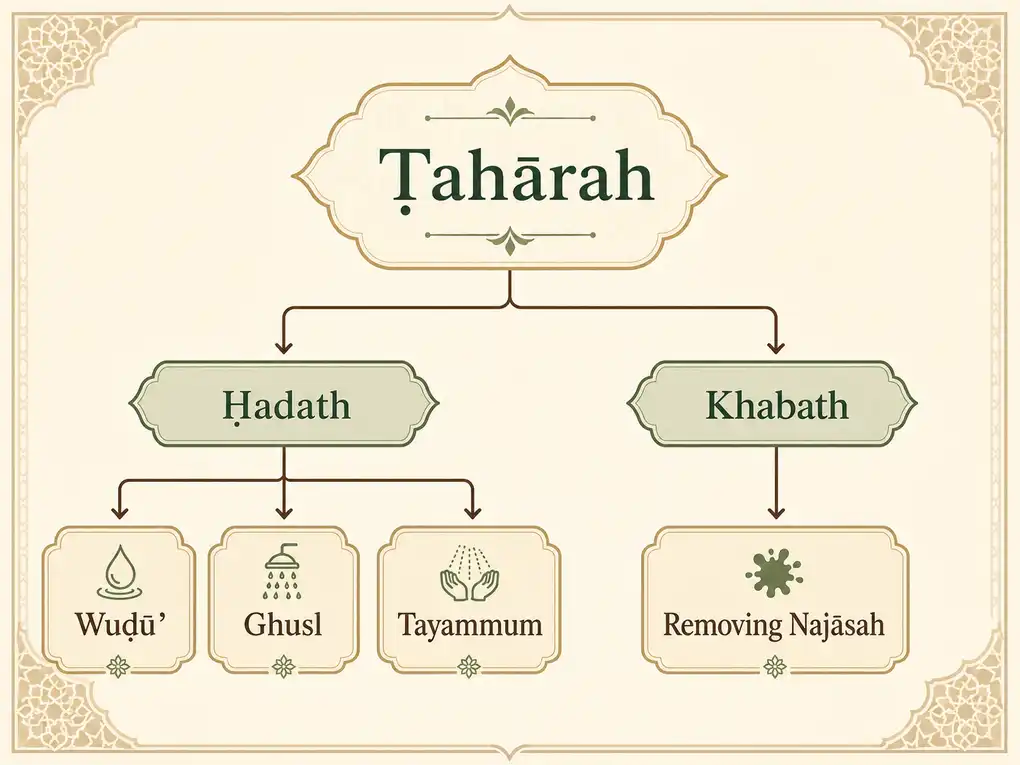
In the chapter of ṭahārah, there are two main targets of purification:
- Ḥadath, which is a legal state attached to a person.
- Khabath, which refers to najāsah attached to the body, clothing, place, or an object.
This division forms the basis for understanding the main types of ṭahārah. From here, we can tell when a person must perform wuḍūʾ, when they must perform obligatory ghusl, and when they only need to remove najāsah.
For the broader map of this chapter, readers may refer to the complete guide to ṭahārah. This article focuses on one key point: ṭahārah from ḥadath and ṭahārah from khabath.
The Meaning of Ṭahārah in Language and Sharīʿah
Linguistically, ṭahārah means cleanliness and freedom from filth. This filth may be physical, such as najāsah, or moral, such as faults and blameworthy traits.
Shaykh Zakariyyā al-Anṣārī says in Asnā al-Maṭālib:
وهي لغة النظافة، والخلوص من الأدناس حسية كالأنجاس أو معنوية كالعيوب… وشرعا رفع حدث أو إزالة نجس أو ما في معناهما، وعلى صورتهما كالتيمم، والأغسال المسنونة، وتجديد الوضوء، والغسلة الثانية، والثالثة
“Ṭahārah, linguistically, is cleanliness and freedom from filth, whether physical filth such as najāsah or moral filth such as faults. In Sharīʿah, ṭahārah means lifting ḥadath, removing najāsah, or matters that are similar in meaning and form to them, such as tayammum, recommended ghusl, renewing wuḍūʾ, and the second and third washings.”[1]
This definition gives a clear direction. Ṭahārah is an act of purification that relates directly to a person’s legal state or to the place used for worship.
So, when we ask, “What are the two main divisions of ṭahārah?” the answer is:
- ṭahārah from ḥadath;
- ṭahārah from khabath or najāsah.
These two categories appear often in the chapters of wuḍūʾ, ghusl, tayammum, istinjāʾ, and najāsah.
Ṭahārah from Ḥadath
Ḥadath is a legal state attached to a person that prevents the validity of certain acts of worship until purification is performed.
Ḥadath is not a physical substance. A person who loses wuḍūʾ does not become physically impure. Rather, they enter a legal state that requires purification before performing worship such as prayer.
In Asnā al-Maṭālib, ḥadath is explained as follows:
المطهر للحدث، وهو هنا أمر اعتباري يقوم بالأعضاء يمنع صحة الصلاة حيث لا مرخص
“The purifier of ḥadath; ḥadath here is a legal consideration attached to the limbs, preventing the validity of prayer where there is no legal concession.”[2]
The word iʿtibārī means a legal status, not a visible object. Therefore, removing it is not done merely by washing a visibly dirty part of the body. It must be removed through the form of purification set by the Sharīʿah.
In practical terms, ḥadath is divided into two:
- minor ḥadath, purified by wuḍūʾ;
- major ḥadath, purified by ghusl.
When there is a valid excuse for not using water, tayammum may replace wuḍūʾ or ghusl, according to its conditions.
Minor Ḥadath
Minor ḥadath is a legal state that requires wuḍūʾ before prayer.
In the discussion of wuḍūʾ, Asnā al-Maṭālib explains:
وفي الشرع استعمال الماء في أعضاء مخصوصة مفتتحا بنية
“In Sharīʿah, wuḍūʾ is the use of water on specific limbs, beginning with intention.”[3]
From this, wuḍūʾ is not merely washing the face and hands. Wuḍūʾ is an act of worship that purifies a person from minor ḥadath. For this reason, intention is a core element in the Shāfiʿī madhhab.
Examples of minor ḥadath in daily life include:
- urinating;
- defecating;
- passing wind;
- sleeping in a way that invalidates wuḍūʾ;
- losing consciousness.
When someone experiences minor ḥadath, the original method of purification is wuḍūʾ. If water is unavailable or cannot be used due to a valid excuse, the person moves to tayammum.
For more detail, see the explanation of ḥadath in fiqh and the complete guide to wuḍūʾ.
Major Ḥadath
Major ḥadath is a legal state that requires obligatory ghusl before prayer.
In Asnā al-Maṭālib, ghusl is explained as follows:
والغسل… لغة سيلان الماء على الشيء وشرعا سيلانه على جميع البدن
“Ghusl, linguistically, is the flowing of water over something. In Sharīʿah, it is the flowing of water over the entire body.”[4]
Because major ḥadath relates legally to the entire body, its purification is obligatory ghusl, not merely wuḍūʾ.
Examples of causes of major ḥadath include:
- janābah;
- the end of menstruation;
- the end of postnatal bleeding;
- childbirth, according to the details of fiqh;
- the death of a Muslim, in the chapter of funeral rites.
In major ḥadath, water must reach all parts of the body that must be washed. If a person cannot use water for a valid Sharʿī reason, they should refer to the detailed guide on tayammum.
Ṭahārah from Khabath: Removing Najāsah
Khabath refers to najāsah that prevents the validity of prayer when it is attached to the body, clothing, or place, as long as there is no legal concession.
In Asnā al-Maṭālib, it is stated:
والخبث، وهو مستقذر يمنع صحة الصلاة حيث لا مرخص
“Khabath is something considered filthy by Sharīʿah and prevents the validity of prayer where there is no legal concession.”[2]
Khabath is different from ḥadath. Khabath is najāsah that must be removed from its location.
If clothing is touched by urine, the clothing itself must be purified. The wuḍūʾ of the person wearing it is not automatically invalidated simply because their clothing has najāsah on it.
This is the basic difference between ḥadath and najāsah:
- ḥadath is purified through wuḍūʾ or ghusl;
- najāsah/khabath is purified by removing the najāsah from its place.
For a related discussion, see the explanation of najāsah and its difference from ḥadath.
Absolute Water as the Main Medium of Ṭahārah
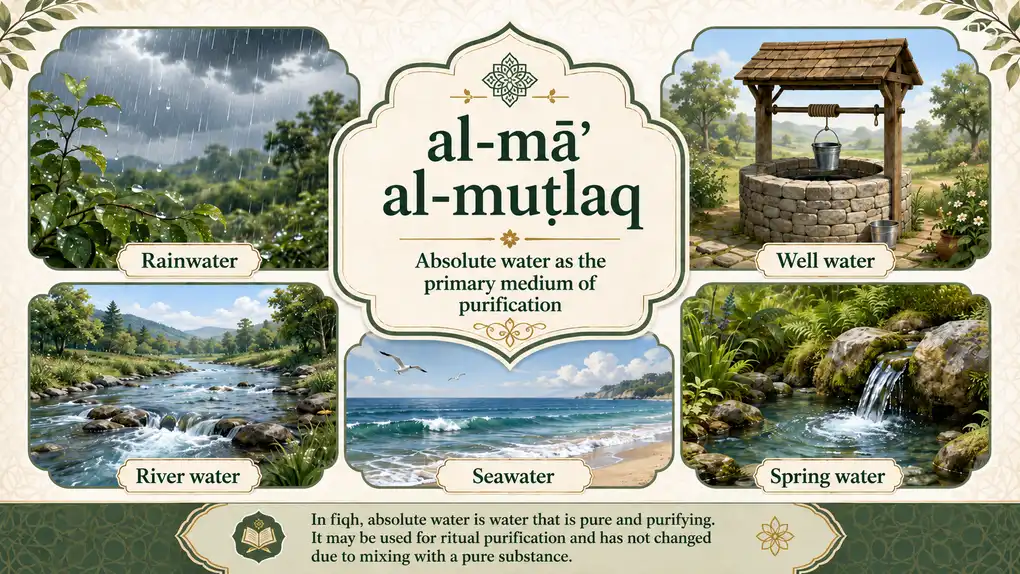
In principle, purification from both ḥadath and khabath is performed with absolute water, or al-māʾ al-muṭlaq.
In Asnā al-Maṭālib, it is stated:
لا يجوز رفع حدث، ولا إزالة نجس إلا بالماء المطلق
“It is not permissible to lift ḥadath or remove najāsah except with absolute water.”[2]
Absolute water is water that is still called “water” without a binding additional name, such as tea water. Examples include rainwater, well water, river water, seawater, spring water, and similar types.
For this reason, the discussion of types of water used for purification is closely connected to this article. You may also read about the reality and legal meaning of al-māʾ al-muṭlaq.
Tayammum: A Substitute for Purifying Ḥadath When There Is an Excuse
Tayammum is part of the discussion of ṭahārah because it substitutes for wuḍūʾ or ghusl when water is unavailable or cannot be used.
In Asnā al-Maṭālib, it is stated:
وشرعا إيصال التراب إلى الوجه واليدين بشرائط مخصوصة
“In Sharīʿah, tayammum is to convey earth or dust to the face and both hands with specific conditions.”[5]
Tayammum relates to ḥadath. It does not remove physical najāsah from clothing, the body, or the floor. If clothing is affected by najāsah, that najāsah must still be removed when one is able.
So, the correct statement is: tayammum replaces wuḍūʾ or obligatory ghusl when there is a valid excuse. It is not a replacement for washing clothing affected by najāsah.
Types of Najāsah in Ṭahārah from Khabath
In practice, ṭahārah from khabath is often discussed through the types of najāsah. The common division used in fiqh lessons is:
- najāsah mukhaffafah;
- najāsah mutawassiṭah;
- najāsah mughallaẓah.
This division does not make the ruling of najāsah difficult. Rather, it helps us know how each type should be purified.
Najāsah Mukhaffafah
Najāsah mukhaffafah is light najāsah. The well-known example in Shāfiʿī fiqh is the urine of a baby boy who has not consumed anything besides milk as his main nourishment.
In Asnā al-Maṭālib, it is stated:
ويكفي في تطهير بول صبي لم يطعم غير اللبن… نضح بالماء بشرط غلبته، وإن لم يسل
“It is sufficient, in purifying the urine of a baby boy who has not consumed anything besides milk, to sprinkle water over it, on the condition that the water dominates the place of najāsah, even if it does not flow.”[6]
Its method of purification is lighter than ordinary najāsah. However, this ruling is not applied in the same way to a baby girl in the Shāfiʿī madhhab.
Najāsah Mutawassiṭah
Najāsah mutawassiṭah is medium najāsah. It refers to najāsah other than najāsah mukhaffafah and mughallaẓah. This is the type most often encountered.
Examples include urine, feces, madhy, and wady. Asnā al-Maṭālib mentions:
وعذرة… وبول… وروث… ومذي… وودي
“Feces, urine, animal droppings, madhy, and wady.”[8]
This type of najāsah is generally purified by removing its substance and traces, such as taste, color, and smell, according to the details of fiqh.
Najāsah Mughallaẓah
Najāsah mughallaẓah is heavy najāsah. In the Shāfiʿī madhhab, the main discussion concerns dogs, pigs, and their offspring.
In Asnā al-Maṭālib, it is stated:
لا يطهر متنجس بكلب، وخنزير، وفرع كل… إلا بسبع من الغسلات بالماء إحداهن بالتراب
“An object affected by a dog, pig, or the offspring of either is not purified except by seven washings with water, one of which is mixed with earth.”[9]
Because this najāsah has a specific method of purification, it is not treated like najāsah mutawassiṭah.
Najāsah Viewed from Its Physical Presence and Traces
The types of najāsah above may also be viewed from another angle:
- najāsah ʿayniyyah, which is najāsah whose physical presence or traces remain;
- najāsah ḥukmiyyah, which is najāsah whose taste, color, and smell are no longer visible, although the place is known to have been affected by najāsah.
In Asnā al-Maṭālib, it is stated:
النجاسة إما عينية، وهي التي تحس أو حكمية، وهي بخلافها كبول جف، ولم يوجد له أثر، ولا ريح
“Najāsah is either ʿayniyyah, which is najāsah whose characteristics can still be perceived, or ḥukmiyyah, which is the opposite, such as urine that has dried and no trace or smell is found.”[7]
This distinction matters because the method of purification differs. Najāsah ʿayniyyah requires removing the substance and traces of najāsah, while najāsah ḥukmiyyah is purified by washing the affected place with water.
The Difference Between Ḥadath and Khabath/Najāsah
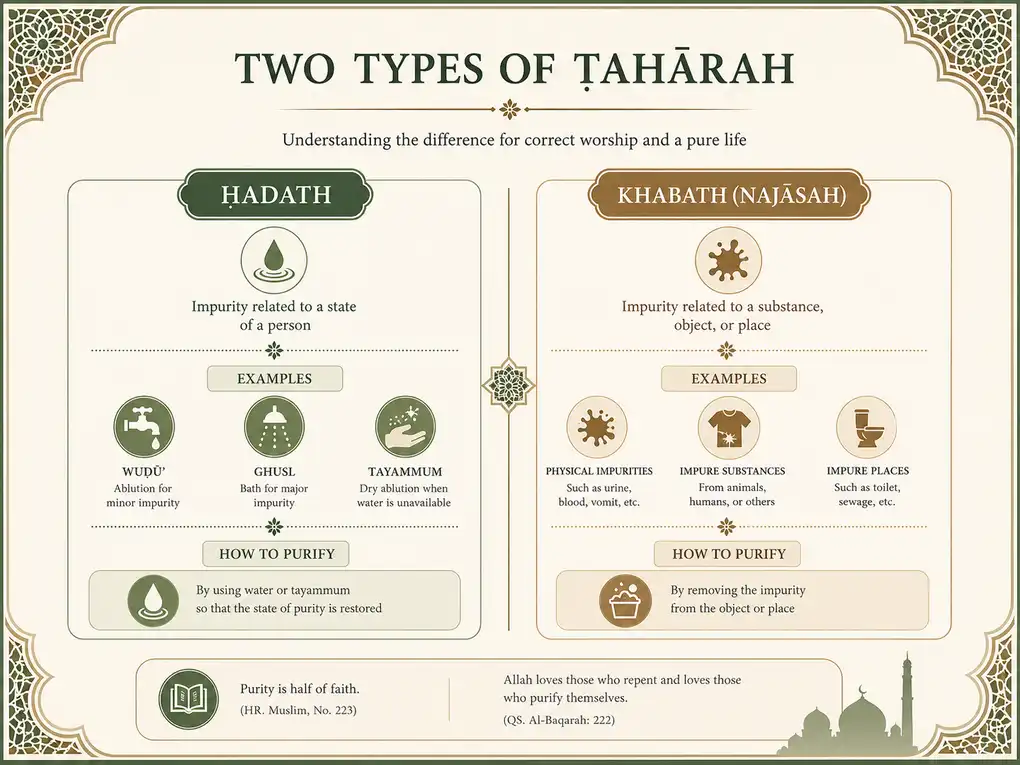
Many people assume that ḥadath and najāsah are the same. In fact, they differ in their reality, location, method of purification, and the role of intention.
| Aspect | Ḥadath | Khabath/Najāsah |
|---|---|---|
| Reality | A legal state | A substance or trace considered filthy by Sharīʿah |
| Location | Attached to a person | Attached to the body, clothing, place, or object |
| Examples | Losing wuḍūʾ, janābah, end of menstruation or postnatal bleeding | Urine, blood, feces |
| Method of purification | Wuḍūʾ or ghusl | Removing najāsah from its place |
| Intention | Required | Not required for the removal of najāsah |
| Substitute when there is an excuse | Tayammum | Water is used, except in special cases such as wine becoming vinegar and the tanning of carrion hide |
From this table, the question “What is purification from ḥadath and najāsah called?” can be answered simply: both fall under ṭahārah.
However, the method is not the same. A person who loses wuḍūʾ needs wuḍūʾ. Clothing affected by najāsah needs to be cleansed from najāsah.
Everyday Examples
Urinating
Urinating causes minor ḥadath. A person must perform wuḍūʾ before prayer.
If urine touches the body, clothing, or floor, then there is najāsah that must be removed. A simple order is: perform istinjāʾ first, remove the najāsah, then perform wuḍūʾ.
Sleeping
Sleep that invalidates wuḍūʾ falls under minor ḥadath. However, sleeping does not automatically make the body or clothing impure.
If no najāsah touches the clothing, wuḍūʾ is enough before prayer.
Emission of Semen


The emission of semen causes major ḥadath and requires obligatory ghusl. A detailed discussion is available in the guide to obligatory ghusl.
However, the state of major ḥadath is not the same as najāsah attached to clothing. If the clothing is clean, what must be done is ghusl to lift major ḥadath.
Clothing Touched by Blood or Feces
If clothing is touched by blood or feces, the clothing is what must be cleaned. The person wearing it does not automatically lose wuḍūʾ.
They may still have wuḍūʾ, but their prayer is not valid if the najāsah on the clothing has not been removed and it is not from the type of najāsah that is excused.
A Person in Janābah While Their Clothing Is Clean
A person in janābah is in a state of major ḥadath. They must perform ghusl before prayer.
However, their body does not automatically become impure merely because of janābah. What must be lifted is the major ḥadath.
Practical Map of the Types of Ṭahārah
| Type of Ṭahārah | Cause | Method of Purification | Example |
|---|---|---|---|
| Ṭahārah from minor ḥadath | Losing wuḍūʾ | Wuḍūʾ or tayammum | Passing wind, sleeping |
| Ṭahārah from major ḥadath | Janābah, end of menstruation or postnatal bleeding | Ghusl or tayammum | Janābah, end of menstruation |
| Ṭahārah from khabath/najāsah | Being affected by najāsah | Removing the najāsah | Clothing touched by blood |
| Ṭahārah similar in meaning | Sunnah act or substitute | Tayammum, recommended ghusl, renewing wuḍūʾ | No water, Friday ghusl |
This map can be used before prayer:
- Do I have minor ḥadath?
- Do I have major ḥadath?
- Is my body, clothing, or prayer place affected by najāsah?
- Is water available and usable?
- If water cannot be used, are the conditions of tayammum fulfilled?
With this approach, the chapter of ṭahārah becomes easier to arrange. Not every condition requires ghusl. Not every impurity is solved with wuḍūʾ.
Common Mistakes in Understanding Ḥadath and Khabath
Thinking That Every Ḥadath Is Najāsah
Ḥadath is not najāsah. A person who loses wuḍūʾ does not become physically impure.
They only need wuḍūʾ if they want to pray.
Thinking That Removing Najāsah Is the Same as Wuḍūʾ
Wuḍūʾ lifts minor ḥadath. Wuḍūʾ does not automatically remove najāsah from clothing.
If clothing is affected by najāsah, that clothing must be cleaned.
Thinking That Tayammum Removes Najāsah
Tayammum is a substitute for wuḍūʾ or ghusl when there is a valid excuse. Tayammum does not remove physical najāsah from clothing, the body, or the place of prayer.
Najāsah must still be washed when one is able.
Declaring Something Najis Too Quickly When in Doubt
The original ruling of things is purity until there is a strong sign or certainty that najāsah has affected them. Ordinary doubt should not trap a person in waswasah.
If one is certain that najāsah is present, then it should be removed according to its type.
FAQ on the Types of Ṭahārah: Ḥadath and Khabath
What are the main types of ṭahārah?
The most basic types of ṭahārah are ṭahārah from ḥadath and ṭahārah from khabath/najāsah.
Ṭahārah from ḥadath is performed through wuḍūʾ, ghusl, or tayammum. Ṭahārah from khabath is performed by removing najāsah from the body, clothing, place, or object.
What is the difference between ḥadath and najāsah?
Ḥadath is a legal state attached to a person. Examples include losing wuḍūʾ or being in janābah.
Najāsah is a substance or trace considered filthy by Sharīʿah. Examples include urine, feces, and blood, according to the details of fiqh.
Does a person with ḥadath become physically impure?
No. A person with ḥadath does not automatically become physically impure.
They only need to lift the ḥadath according to its type: wuḍūʾ for minor ḥadath, ghusl for major ḥadath, or tayammum when there is a valid excuse.
Why does purification from ḥadath require intention?
Because purification from ḥadath is an act of worship. Wuḍūʾ and obligatory ghusl are performed to lift a legal state, not merely to clean the body.
As for removing najāsah, intention is not required for the najāsah to be removed. If the najāsah is removed in a valid way, the place becomes pure.
If someone has both ḥadath and najāsah, which comes first?
Remove the najāsah first, then perform wuḍūʾ or ghusl according to the situation.
A simple example is after urinating: a person performs istinjāʾ to remove najāsah, then performs wuḍūʾ if they want to pray.
Can tayammum replace every type of ṭahārah?
Tayammum can replace wuḍūʾ or ghusl when its conditions are fulfilled.
However, tayammum does not remove physical najāsah. If clothing is affected by najāsah, the najāsah must still be removed when one is able.
Is khabath the same as najāsah?
In the discussion of ṭahārah, khabath is commonly used to refer to najāsah that prevents the validity of prayer when it is attached to the body, clothing, or place.
So, when this article mentions khabath, it means najāsah that must be removed from its location.
Footnotes
Reference
Zakariyā al-Anṣārī, Asnā al-Maṭālib fī Sharḥ Rawḍ al-Ṭālib, with ḥāsyiyah by Aḥmad al-Ramlī, edited by Muḥammad az-Zuhrī al-Ghamrāwī (Cairo: al-Maṭbaʿah al-Maymānīyah, 1313 H; repr. Dār al-Kitāb al-Islāmī), juz 1, p. 4-83.


