
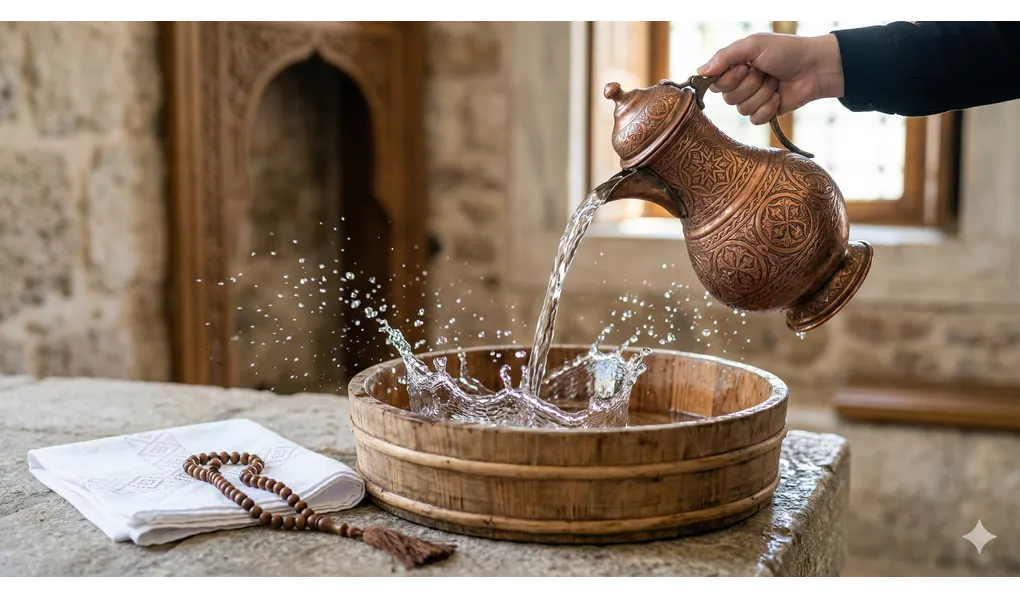
If you open the pages of classical fiqh books, you will find one commonality: before discussing the procedures of the magnificent prayer, scholars always begin with a discussion about water. Why does this simple liquid occupy such an irreplaceable position in Islamic law?
Introduction: Water as a Means of Purification in Islam
Why Is Water the Main Tool for Purification?
In Shafi’i fiqh, water is the basic means for lifting ritual impurity (hadath) and removing physical impurity (najāsah). For this reason, the discussion of the types of water used for purification is usually placed at the beginning of the chapter on ṭahārah.
To understand the legal status of water, we first need to understand the meaning of ṭahārah in Islam. Imam Zakariyya al-Anshari explains:
وهي لغة النظافة، والخلوص من الأدناس حسية كالأنجاس أو معنوية كالعيوب … وشرعا رفع حدث أو إزالة نجس
“Linguistically, ṭahārah means cleanliness and being free from filth, whether physical filth such as najāsah or non-physical filth such as defects. In Islamic law, ṭahārah means lifting hadath or removing najāsah.”[1]
The Position of Ṭahārah in Islamic Law
Ṭahārah is not merely bodily cleanliness. It is a condition for the validity of many acts of worship, especially prayer.
Al-Fiqh al-Manhaji states that Islam gives great care to cleanliness through the command to perform wuḍū’, ghusl, clean one’s clothing, and maintain bodily hygiene. One of the proofs is the verse:
إِنَّ اللهَ يُحِبُّ التَّوَّابِينَ وَيُحِبُّ الْمُتَطَهِّرِينَ
“Indeed, Allah loves those who repent and loves those who purify themselves.”[2]
Thus, water for ṭahārah is not only a technical matter. It is directly tied to a Muslim’s readiness to stand before Allah.
Qur’anic Evidence for the Purifying Nature of Water
The Qur’an mentions water as a means of purification:
وَيُنَزِّلُ عَلَيْكُم مِّنَ السَّمَاءِ مَاءً لِّيُطَهِّرَكُم بِهِ
“And He sends down upon you water from the sky to purify you with it.”[3]
Imam Zakariyya al-Anshari cites this verse when explaining that what purifies hadath and khabath is absolute water (mā’ muṭlaq). This becomes an important basis for discussing water used for purification.
Why Is Water the Legal Basis for Purifying Hadath and Najāsah?



In the Shafi’i school, the main tool for lifting hadath and removing najāsah is absolute water. Imam Zakariyya al-Anshari writes:
المطهر للحدث … والخبث … الماء المطلق أي لا غيره
“The purifier of hadath and khabath is absolute water, not anything else.”[4]
This means that other materials, such as soil for tayammum or stones for istinjā’, have specific legal functions. They do not replace water in every form of purification.
For this reason, when the Shafi’i jurists discuss water for purification, they begin with water that is still simply called “water,” without a binding descriptive addition.
The Meaning of Absolute Water According to Shafi’i Scholars
Imam Zakariyya al-Anshari defines absolute water as:
وهو العاري عن إضافة لازمة
“It is water that is free from a binding attribution.”[5]
In other words, it is still called water in a general sense. It is not “rose water,” “tea water,” or “broth.” As long as it is still called ordinary water and has not been changed by something that removes its absoluteness, it is considered pure water in Islam and may be used for purification.
From this foundation comes the discussion of the seven types of water for purification: rainwater, seawater, river water, well water, spring water, snow water, and dew water.
The Meaning of the Seven Types of Water for Purification

What Are the Seven Types of Water in Shafi’i Fiqh?
The phrase seven types of water for purification refers to seven natural sources of water that fall under absolute water. This water is pure and purifying as long as it has not changed in a way that removes the name “water.”
In Shafi’i fiqh, not every liquid may be used for purification. The liquid used for wuḍū’, ghusl, and removing najāsah must be absolute water.
Definition of Absolute Water
Imam Zakariyya al-Anshari explains:
وهو العاري عن إضافة لازمة
“Absolute water is water that is free from a binding attribution.”[6]
This means that the water is still called “water” in a general sense. Examples include rainwater, seawater, river water, well water, spring water, snow water, and dew water.
This differs from “rose water” or “tea water.” Such names bind the water to another substance, so it is no longer absolute water.
For a more specific discussion, see the meaning of absolute water.
The Basis for the Sevenfold Division in Fiqh Books
Al-Fiqh al-Manhaji mentions several types of water used for purification:
المياه: جمع ماء، وهي ماء السماء، وماء البحر، وماء البئر، وماء النهر، وماء العين، وماء الثلج
“The word waters is the plural of water. It includes water from the sky, seawater, well water, river water, spring water, and snow water.”[7]
In fiqh works, water from the sky includes water that descends from above, such as rainwater and dew water. For this reason, the list commonly taught in pesantren is known as the seven types of water:
- Rainwater
- Seawater
- River water
- Well water
- Spring water
- Snow water
- Dew water
All of these fall under pure and purifying water as long as they remain upon the original nature of absolute water.
The Relation Between Absolute Water, Wuḍū’, and Ghusl
Absolute water is used to lift minor hadath through wuḍū’ and major hadath through ghusl. The same type of water is also the legal basis for removing najāsah.
Imam Zakariyya al-Anshari states:
لا يجوز رفع حدث، ولا إزالة نجس إلا بالماء المطلق
“It is not permissible to lift hadath or remove najāsah except with absolute water.”[8]
So when someone asks about the kinds of water used for purification, the answer does not stop at the water’s source. What matters most is that the water remains absolute, has not been altered by a pure mixture that removes its name, and has not been affected by najāsah.
Rainwater (ماء المطر)

Rainwater as Pure and Purifying Water
Among the seven types of water for purification, rainwater has a special position. The Qur’an clearly mentions water that descends from the sky as a means of purification for human beings.
Because it comes directly from Allah’s creation without a mixture that removes its original nature, rainwater for purification falls under absolute water. Therefore, it may be used for wuḍū’, ghusl, and removing najāsah.
Qur’anic Evidence for Rainwater
Allah Most High says:
وَيُنَزِّلُ عَلَيْكُم مِّنَ السَّمَاءِ مَاءً لِّيُطَهِّرَكُم بِهِ
“And He sends down upon you water from the sky to purify you with it.” (Qur’an, al-Anfāl: 11)[9]
Another verse frequently cited by the scholars is:
وَأَنزَلْنَا مِنَ السَّمَاءِ مَاءً طَهُورًا
“And We sent down from the sky purifying water.” (Qur’an, al-Furqān: 48)[10]
This verse shows that rainwater has the quality of ṭahūr, meaning pure in itself and able to purify something else.
The Ruling on Purifying Oneself with Rainwater
According to the Shafi’i school, performing wuḍū’ with rainwater is valid as long as the water remains absolute water.
A person may:
- Perform wuḍū’ while rain is falling.
- Collect rainwater for wuḍū’.
- Perform ghusl with rainwater.
- Remove najāsah with rainwater.
There is no legal difference between rainwater and other sources of absolute water as long as the qualities of the water remain intact.
Does Collected Rainwater Remain Pure?
Many people ask whether rainwater collected in a tank, container, or reservoir may still be used for purification.
The answer is yes, as long as no change occurs that removes the water’s absoluteness.
Rainwater stored in a jar, tank, water reservoir, or pool remains absolute water if its color, taste, and smell are not dominantly changed, and if it is not affected by najāsah.
Thus, it remains pure and purifying water.
For the full conditions related to water in wuḍū’, see the valid conditions of wuḍū’.
Conditions That Make Rainwater Unusable for Purification
Although rainwater is originally pure, several situations may change its ruling.
1. It Changes Due to a Dominant Pure Mixture
Imam Zakariyya al-Anshari says:
الماء المتغير طعما أو لونا أو ريحا بمخالطة طاهر يستغنى عنه … غير طهور
“Water whose taste, color, or smell changes due to mixing with a pure substance that water does not need is no longer purifying.”[11]
Examples include:
- Rainwater mixed with syrup.
- Rainwater mixed with coffee.
- Rainwater mixed with a large amount of fragrance.
2. It Is Affected by Najāsah
If najāsah enters the water and affects its qualities, the water may no longer be used for purification.
Examples include:
- A dead animal decomposes in the water tank.
- Human waste enters the reservoir.
- The water’s smell changes due to najāsah.
3. It Changes into Another Liquid
If people no longer call it “water,” its status as absolute water is lost.
Examples include:
- It becomes tea.
- It becomes coffee.
- It becomes broth.
In such cases, it cannot be used to lift hadath.
Summary of the Ruling on Rainwater
Rainwater is one of the main sources of absolute water in the Shafi’i school. As long as it retains its original nature and is not affected by najāsah or by a mixture that removes the name “water,” it is valid for wuḍū’, ghusl, removing najāsah, and other forms of ṭahārah.
Thus, the basic ruling of rainwater is that it is pure and purifying (ṭahūr).
Seawater (ماء البحر)

The Ruling on Purifying Oneself with Seawater
Some people assume that seawater cannot be used for purification because it tastes salty. This assumption is not correct according to the Shafi’i school.
Seawater is one of the seven types of water for purification mentioned by the jurists. As long as it is still called water and has not changed due to najāsah or another mixture that removes its absoluteness, it remains absolute water that is pure and purifying.
Therefore, wuḍū’ with seawater and ghusl with seawater are valid.
The Hadith on the Purity of Seawater
The most well-known proof in this issue is the hadith of Abu Hurayrah, may Allah be pleased with him:
هُوَ الطَّهُورُ مَاؤُهُ الْحِلُّ مَيْتَتُهُ
“Its water is pure and purifying, and its dead creatures are lawful.”[12]
This hadith is strong evidence that the question of whether seawater is pure or not is clear in the Shafi’i school. Its ruling is pure and purifying.
Why Does Salty Water Remain Absolute Water?
One may ask, “Hasn’t seawater changed because it is salty?”
The salty taste of the sea does not come from a mixture that removes the name water. Seawater was created with this natural quality.
For this reason, the scholars do not consider natural saltiness a change that destroys the absoluteness of water.
Even though it is salty, people still call it “seawater,” not another liquid that has left the reality of water. Therefore, seawater remains pure and purifying water.
The Ruling on Wuḍū’ and Ghusl in the Sea
Based on the hadith above, every form of ṭahārah that is valid with absolute water is also valid with seawater.
This includes:
- Performing wuḍū’ at the beach.
- Performing wuḍū’ on a ship.
- Performing ghusl in the sea.
- Removing najāsah with seawater.
- Lifting minor and major hadath.
Therefore, someone in the middle of the sea is not required to search for fresh water as long as seawater is available and usable.
This discussion is also related to tayammum when there is no fresh water. As long as seawater exists and can be used, tayammum is not allowed because valid water is present.
Common Doubts About Seawater
Does Sea Salt Make Wuḍū’ Invalid?
No. The salt naturally present in the sea is part of the sea’s original character. It does not remove the status of absolute water.
Is Ghusl in the Sea Valid?
Yes. As long as the entire body is reached by water and the pillars of ghusl are fulfilled, ghusl with seawater is no different from ghusl with well water or river water.
Can Very Turbid Seawater Still Be Used?
Turbidity does not always remove purity. Seawater that is turbid because of sand, waves, or coastal mud is originally still pure as long as no najāsah changes the qualities of the water.
Can Polluted Seawater Still Be Used for Purification?
This case requires detail.
If pollution clearly changes one of the main qualities of the water due to najāsah or a dominant foreign substance, then its ruling follows the Shafi’i legal rules on changed water.
If the change does not remove the name water and does not meet the criteria of najāsah affecting the water, then the original ruling of purity remains.
River Water (ماء النهر)
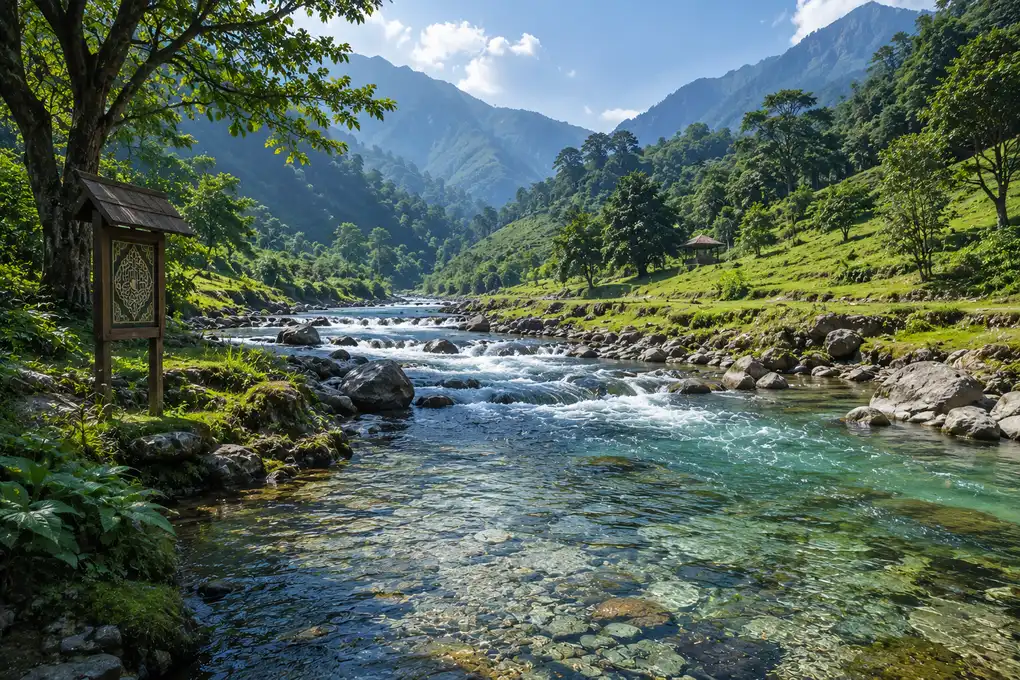
Is It Permissible to Purify Oneself with River Water?
Yes. River water for purification is valid according to the Shafi’i school as long as the water remains absolute water.
River water is one of the seven types of water for purification mentioned by the jurists. In classical fiqh works, river water is placed alongside rainwater, seawater, well water, and other natural sources that may be used to lift hadath and remove najāsah.
Al-Fiqh al-Manhaji states:
وهي ماء السماء، وماء البحر، وماء البئر، وماء النهر، وماء العين، وماء الثلج
“Water used for purification includes water from the sky, seawater, well water, river water, spring water, and snow water.”[13]
Therefore, a person may perform wuḍū’, ghusl, or remove najāsah with river water that meets the conditions of purity.
The Characteristics of River Water in Fiqh
One of the main qualities of a river is that it flows. In Shafi’i fiqh, flowing water has specific rulings when it comes into contact with najāsah.
Imam Zakariyya al-Anshari explains:
الماء الجاري … متفاصل جريانه حكما وإن اتصلت حسا
“Flowing water is considered, in legal ruling, as separate portions, even if it appears physically connected.”[14]
This explanation is important in the discussion of flowing water for wuḍū’ and the ruling of najāsah falling into a river.
In other words, jurists do not always treat the entire river as one single legal unit in every case.
Flowing Water and the Effect of Najāsah
Many people ask: what if najāsah falls into a river?
In the Shafi’i school, the answer requires detail.
If najāsah enters a river but does not change the color, smell, or taste of the water, then the water is originally still pure.
If najāsah causes a clear change in one of those qualities, then the portion affected by the change is ruled impure.
Therefore, not every river that comes into contact with najāsah automatically becomes unusable for purification.
This discussion is closely connected to the ruling on small and large quantities of water, because the amount of water and the state of flow affect the legal details.
When Does River Water Remain Pure?
In general, river water remains usable for purification in several situations.
First, it is not changed by najāsah. As long as the color, smell, and taste remain as normal, the original ruling of purity remains.
Second, the change occurs due to natural factors. Imam Zakariyya al-Anshari explains:
ولا بما لا يستغنى الماء عنه في ممره ومقره كطحلب
“Water does not lose its purity due to something that is difficult to avoid in its passage or resting place, such as algae.”[15]
Therefore, a river changed by natural mud, algae, fallen leaves, or soil at its bed remains pure as long as the name water is not lost.
Third, it is still called water. Even if somewhat cloudy, people still call it river water, not another liquid.
Examples of River Water That Changes Color or Smell
A River Becomes Muddy After Rain
Heavy rain often carries soil and mud into rivers. Its ruling remains pure, it may still be used for wuḍū’, and it remains absolute water. The change occurred due to something difficult to avoid in the flow of water.
A River Changes Color Due to Impure Waste
If impure waste causes the water to clearly change in smell, color, or taste, then the water may not be used for purification. Wuḍū’ and ghusl with such water are not valid.
Many Leaves Fall into the River
Imam Zakariyya al-Anshari mentions:
وأوراق شجر تناثرت وتفتتت
“Leaves that fall from trees and break apart while mixing with the water do not harm the purity of the water.”[16]
Therefore, a river with many fallen leaves is originally still pure.
Well Water (ماء البئر)
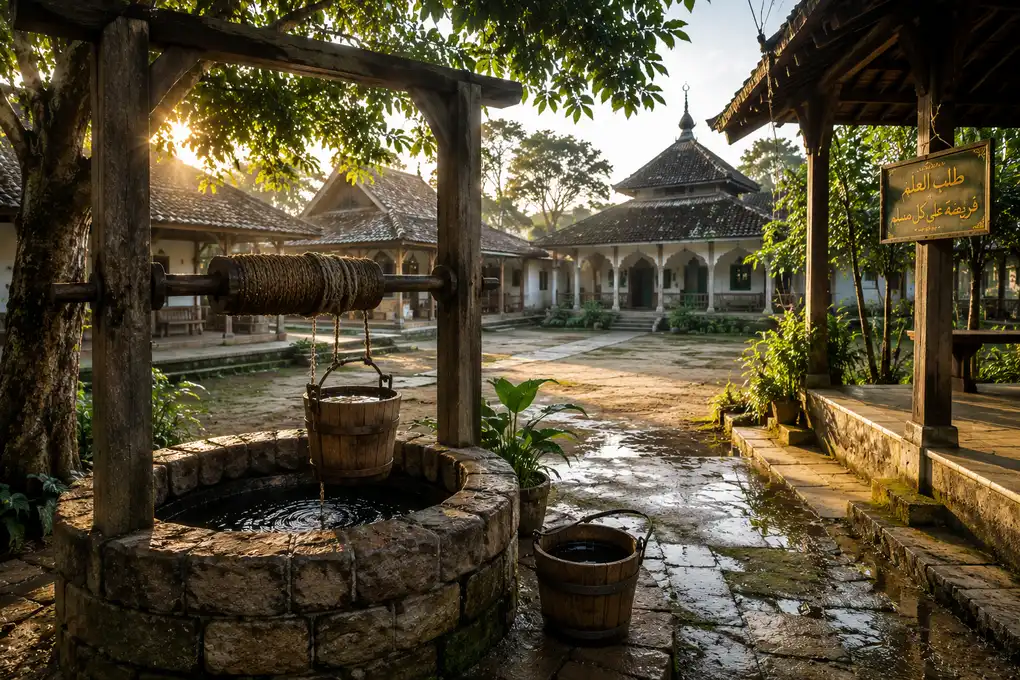
The Ruling on Purifying Oneself with Well Water
From the time of the Messenger of Allah ﷺ until today, well water has been one of the most common sources of water used by Muslims for purification. Since it comes from the ground and appears naturally, well water is one of the seven types of water for purification in Shafi’i fiqh.
As long as it meets the conditions of absolute water, well water for wuḍū’ and ghusl is valid.
Al-Fiqh al-Manhaji includes well water among the waters used for purification:
وهي ماء السماء، وماء البحر، وماء البئر، وماء النهر، وماء العين، وماء الثلج
“Water used for purification includes water from the sky, seawater, well water, river water, spring water, and snow water.”[17]
Thus, the original ruling of well water is that it is pure and purifying.
Well Water in Muslim Life
Before modern water networks, most Muslims obtained water from wells.
Well water was used for wuḍū’, ghusl, removing najāsah, and daily needs.
This shows that clean water for purification does not have to come from modern water systems. Well water that meets the conditions of Islamic law is sufficient for worship.
The Ruling on Clear Well Water
If well water is clear, has no smell of najāsah, has no taste changed by najāsah, and has no color changed by najāsah, then it remains pure.
Imam Zakariyya al-Anshari explains that absolute water remains pure even if it changes due to its own location or something difficult to avoid:
ولا بما لا يستغنى الماء عنه في ممره ومقره
“Water does not lose its purity due to something that cannot be avoided in its passage or place of gathering.”[18]
Therefore, a slight change caused by soil components or the natural condition of the well does not automatically remove the water’s purity.
Well Water Affected by Najāsah
A common issue is when something impure falls into a well, such as a dead mouse, animal droppings, impure waste, or another impure object.
If najāsah causes a change in the color, smell, or taste of the water, then the water may not be used for purification.
If the water is large in quantity and najāsah does not change its qualities, then its ruling follows the detailed fiqh discussion on water quantity and two qullahs.
For a detailed discussion, see water affected by najāsah.
How to Determine the Purity of Well Water
In daily practice, there are several simple ways to assess well water.
First, notice the smell. If a clear smell of najāsah appears, the water must be examined further.
Second, observe the color. A color change caused by najāsah matters. If the change comes from soil or natural minerals, the original ruling of purity remains.
Third, consider the taste. A taste changed by najāsah affects the ruling of the water.
Fourth, identify the cause of the change. The Shafi’i school distinguishes between change caused by najāsah and change caused by natural factors.
Common Examples
If well water becomes yellowish because of soil or natural mineral content, the water remains pure, valid for wuḍū’, and valid for ghusl.
If leaves and algae are present in the well, then as long as the water does not become another liquid and the change is not caused by najāsah, it remains pure.
If a dead animal decomposes in the well and causes a change in smell, color, or taste, then the water may not be used for purification until it is cleaned according to fiqh guidelines.
Spring Water (ماء العين)
Spring Water as a Source of Absolute Water
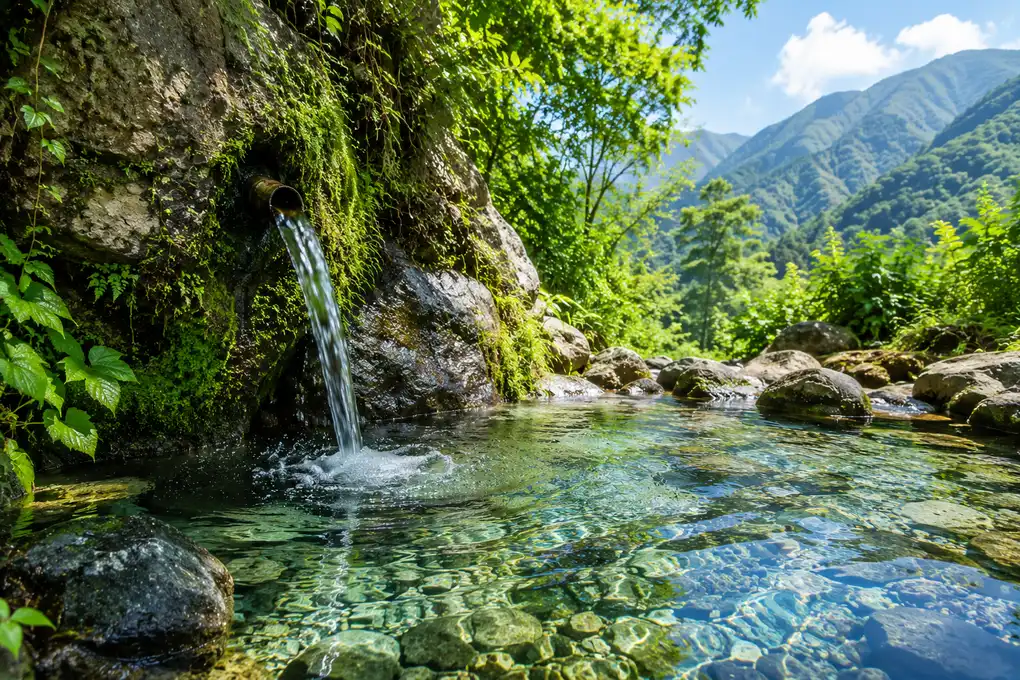
Among the seven types of water for purification, spring water is one of the closest to the original created state of water. It comes directly from within the earth without human processing.
For this reason, the scholars include spring water for purification under absolute water, meaning water that is pure in itself and purifies something else.
Al-Fiqh al-Manhaji states:
وهي ماء السماء، وماء البحر، وماء البئر، وماء النهر، وماء العين، وماء الثلج
“Water used for purification includes water from the sky, seawater, well water, river water, spring water, and snow water.”[19]
Therefore, the original ruling of spring water is that it is pure and purifying.
The Meaning of Spring Water in Fiqh
In fiqh terminology, ماء العين (mā’ al-‘ayn) refers to water that flows or emerges from its source within the earth.
Springs may be found in mountains, foothills, valleys, rocky areas, and places that contain underground water.
Because it comes from a natural source, this water is included under absolute water.
The Ruling on Purifying Oneself with Spring Water
According to the Shafi’i school, natural spring water may be used for wuḍū’, ghusl, removing najāsah, and every form of ṭahārah that requires water.
This is because spring water remains a type of absolute water.
A general proof is the statement of Allah Most High:
وَأَنزَلْنَا مِنَ السَّمَاءِ مَاءً طَهُورًا
“And We sent down from the sky purifying water.”[20]
And His statement:
وَيُنَزِّلُ عَلَيْكُم مِّنَ السَّمَاءِ مَاءً لِّيُطَهِّرَكُم بِهِ
“And He sends down upon you water from the sky to purify you with it.”[21]
The scholars explain that all water that comes from the sky or emerges from the earth while remaining upon its original nature is water that may be used for purification.
The Difference Between Spring Water and Modern Bottled Water
Some people ask whether there is a difference in ruling between spring water and bottled drinking water.
Originally, bottled water sourced from springs follows the ruling of its source. The difference lies in what happens after the water is collected.
Direct spring water comes from a natural source, is not mixed with anything that removes its nature as water, and is absolute water.
Bottled water may pass through storage, filtration, or the addition of certain minerals. As long as this process does not change the reality of the water and people still call it “water,” it remains absolute water.
Therefore, many bottled mineral waters are still valid for wuḍū’ and ghusl.
Is Mineral Water Absolute Water?
In general, yes.
Mineral water commonly sold today is usually still absolute water because it has not become another liquid.
As long as people call it mineral water, drinking water, or spring water, and not tea, coffee, or syrup, its original ruling remains that of absolute water.
If, however, a mixture changes its color, taste, or smell dominantly until it is no longer called ordinary water, then its status as absolute water needs to be reconsidered.
For more detail, see the characteristics of absolute water.
Snow Water (ماء الثلج)

The Ruling on Purifying Oneself with Snow Water
For Muslims living in tropical countries, the discussion of snow water for purification may feel uncommon. However, Shafi’i scholars still include it in the chapter of ṭahārah because snow is one of the forms of water mentioned in fiqh books.
Snow water is part of the seven types of water for purification and is considered absolute water as long as it remains upon its original nature.
Al-Fiqh al-Manhaji states:
وهي ماء السماء، وماء البحر، وماء البئر، وماء النهر، وماء العين، وماء الثلج
“Water used for purification includes water from the sky, seawater, well water, river water, spring water, and snow water.”[22]
Thus, snow that comes from water has the same ruling as other sources of absolute water.
Snow as Frozen Water
In reality, snow is not a new substance different from water. It is water that has frozen due to very low temperature.
Imam Zakariyya al-Anshari explains that water is still legally considered water even if it undergoes a certain change in form that does not remove its reality:
ولو كان ماء ينعقد بجوهره ملحا
“Even if water changes in a certain form, as long as it remains within the reality of water, the ruling of water remains attached to it.”[23]
Therefore, when snow melts back into water, it remains absolute water.
Evidence for the Purity of Snow Water
The general basis for the purity of snow water is the evidence showing that water descending from the sky is a means of purification.
Allah Most High says:
وَأَنزَلْنَا مِنَ السَّمَاءِ مَاءً طَهُورًا
“And We sent down from the sky purifying water.”[24]
He also says:
وَيُنَزِّلُ عَلَيْكُم مِّنَ السَّمَاءِ مَاءً لِّيُطَهِّرَكُم بِهِ
“And He sends down upon you water from the sky to purify you with it.”[25]
The scholars include snow under water that comes from the sky; therefore, it is pure and purifying water.
How to Use Snow Water for Wuḍū’ and Ghusl
For purification to be valid, water must flow or wet the body part that must be washed.
If snow has melted into water, a person may perform wuḍū’ with it, perform ghusl with it, and remove najāsah with it.
If the snow is still solid and is merely rubbed onto the body without producing flowing water that wets the limbs of wuḍū’, then the required washing has not been achieved.
Therefore, snow should be melted or used in a way that produces water flowing over the body parts that must be washed.
For details on ghusl, see the valid conditions of ghusl.
Issues Faced by Muslims in Snowy Countries
Many Muslims who live in cold regions face long snowy seasons. In such conditions, the discussion of snow in fiqh becomes important.
If snow is available and can still be melted, then it takes priority over tayammum.
If the water is extremely cold, Imam Zakariyya al-Anshari states:
ويكره شديد حرارة وشديد برودة
“It is disliked to use water that is extremely hot or extremely cold.”[26]
This dislike is because it may prevent proper washing.
However, if there is no other option and it does not harm the body, purification is still performed with that water. If using water truly harms the person and it cannot be warmed, then the detailed rulings of tayammum apply.
Dew Water (ماء الندى)
Can Dew Water Be Used for Purification?
Yes. Dew water for purification may be used according to the Shafi’i school as long as it meets the conditions of absolute water.
Although its amount is usually small and not as much as rainwater or river water, the scholars still include dew in the discussion of pure and purifying water. Dew is a natural form connected to the water Allah created.
For this reason, dew water is part of the types of water for purification discussed in fiqh books.
The Meaning of Dew Water According to the Scholars
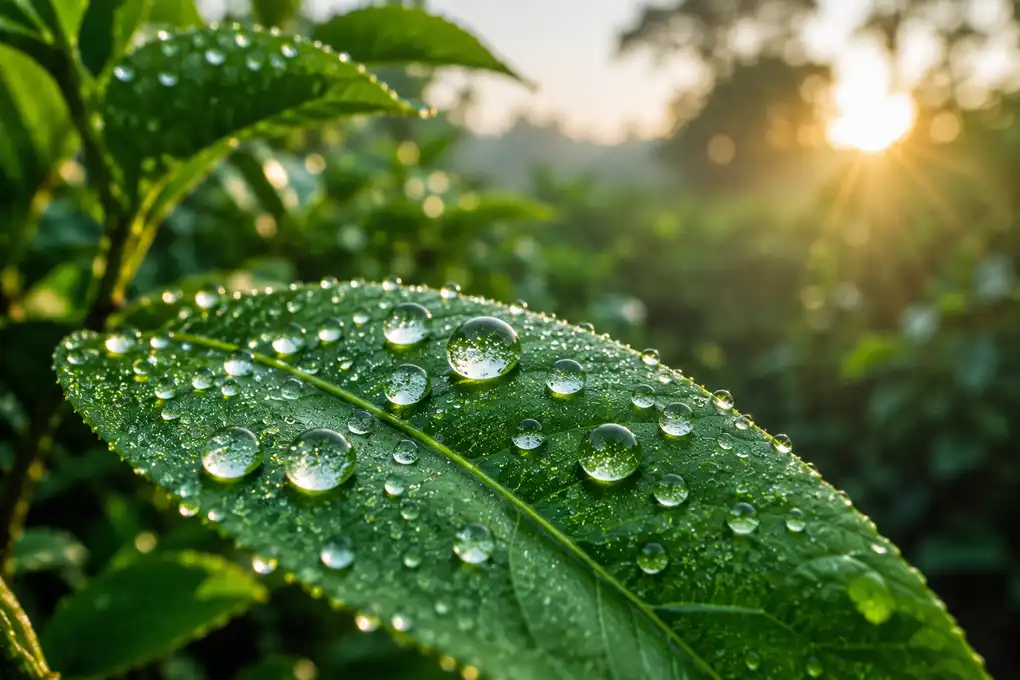
Dew (الندى) is the tiny drops of water that appear on leaves, grass, stones, or other surfaces due to the cooling of air at night and near dawn.
Although its form differs from rain, its reality is still water.
Shafi’i scholars include dew under the category of water that comes from the sky, so it follows the ruling of absolute water as long as it is not mixed with something that removes the name water.
The general basis is the statement of Allah Most High:
وَأَنزَلْنَا مِنَ السَّمَاءِ مَاءً طَهُورًا
“And We sent down from the sky purifying water.”[27]
And His statement:
وَيُنَزِّلُ عَلَيْكُم مِّنَ السَّمَاءِ مَاءً لِّيُطَهِّرَكُم بِهِ
“And He sends down upon you water from the sky to purify you with it.”[28]
Why Is Dew Considered Absolute Water?
Dew is originally still called water. It is not tea, rose water, coffee, or another mixed liquid.
Therefore, as long as dew remains upon its original nature, it is absolute water and may be used for purification.
This is why scholars include dew in the list of types of water used for purification.
Conditions for Using Dew Water for Purification
Although dew is pure, its use in practice requires several conditions.
First, the amount must be sufficient. For wuḍū’ and ghusl, water must wet the body parts that must be washed.
Second, it must not be mixed with najāsah. If dew mixes with najāsah and its qualities change, it cannot be used for purification.
Third, it must remain water. Dew must still be in a form that can be used to wash the body.
Examples of Using Dew Water
If a traveler in a very dry region finds dew gathered on leaves or stones, and its amount is enough to wash the limbs of wuḍū’, then that water is valid for purification.
If dew is collected in a container until it becomes enough water, it is valid for wuḍū’, removing najāsah, and ghusl if the amount is sufficient.
If the dew is too little to wash the body parts, the ruling returns to the legal rules for the absence of water. In some cases, this connects to when water is very difficult to obtain.
The Place of Dew Water Among the Seven Types of Water
With the discussion of dew complete, the seven sources of absolute water known in Shafi’i fiqh are:
- Rainwater.
- Seawater.
- River water.
- Well water.
- Spring water.
- Snow water.
- Dew water.
They share one core ruling: as long as they remain absolute water, all of them are valid for lifting hadath and removing najāsah.
Summary Table of the Seven Types of Water in the Shafi’i School
Complete Summary of the Seven Types of Water in the Shafi’i School
After discussing each source of water used for purification, here is a summary for easier reading.
In the Shafi’i school, these seven types of water are absolute water, meaning water that is pure in itself and purifies something else, as long as it has not changed in a way that removes its absoluteness.
Table of the Seven Types of Water and Examples
| No. | Type of Water | Arabic Name | Legal Status | Example |
|---|---|---|---|---|
| 1 | Rainwater | ماء المطر | Pure and purifying | Rain falling from the sky |
| 2 | Seawater | ماء البحر | Pure and purifying | Sea water, ocean water |
| 3 | River water | ماء النهر | Pure and purifying | Rivers, natural streams |
| 4 | Well water | ماء البئر | Pure and purifying | Dug wells, drilled wells |
| 5 | Spring water | ماء العين | Pure and purifying | Mountain springs |
| 6 | Snow water | ماء الثلج | Pure and purifying | Melted snow |
| 7 | Dew water | ماء الندى | Pure and purifying | Dew collected as water |
What the Seven Types of Water Have in Common
Although their sources differ, all types of water for purification share several points.
First, they are all absolute water. They are still called water in common usage.
Therefore, all of them may be used for wuḍū’, ghusl, removing najāsah, and other acts of worship that require ṭahārah.
Second, they come from Allah’s natural creation. Some come from the sky, such as rain, snow, and dew. Others emerge from the earth, such as rivers, wells, and springs. One is found in the sea: seawater.
Third, they lose their function for purification if they leave the status of absolute water. All of these types follow the same legal principle.
Common Mistakes in Understanding Absolute Water
Some people assume that salty water cannot be used for purification. Yet the Messenger of Allah ﷺ clearly affirmed the purity of seawater.
Others assume that cloudy water is automatically impure. In reality, water made cloudy by natural mud, soil, algae, or fallen leaves may still be used as long as it does not lose the status of absolute water.
Another mistake is treating every liquid like water. Coffee, tea, syrup, or broth are no longer absolute water, even though they contain water.
Some people also assume that bottled water is never valid for wuḍū’. Originally, bottled mineral water remains valid for purification as long as it is still absolute water and has not become another liquid.
How This Table Relates to Absolute Water
The table above is part of the larger discussion of absolute water.
To understand the details of changed water, used water, water affected by najāsah, and other branches, read the complete guide to water for purification.
The Difference Between Absolute Water and Water That Cannot Be Used for Purification
Not Every Water Can Be Used for Purification
After understanding the seven types of water for purification, one important point remains: not every water that looks clean may be used to lift hadath or remove najāsah.
In Shafi’i fiqh, water is divided into categories. Some may be used for purification, while others may not.
Al-Fiqh al-Manhaji explains:
وتنقسم المياه إلى أربعة أقسام: طاهر مطهر، وطاهر مطهر مكروه، وطاهر غير مطهر، ومتنجس
“Water is divided into four categories: pure and purifying, pure and purifying but disliked, pure but not purifying, and water affected by najāsah.”[29]
Therefore, understanding absolute water alone is not enough. We must also know the types of water that can no longer be used for ṭahārah.
Absolute Water: Pure and Purifying Water
Absolute water is water that remains upon its original nature. Examples include rainwater, seawater, river water, well water, spring water, snow water, and dew water.
As long as they do not change due to something that removes their absoluteness, these waters remain valid for wuḍū’, ghusl, and removing najāsah.
Pure but Not Purifying Water
The next category is pure but not purifying water.
This water remains pure in itself, but it is not valid for lifting hadath.
Used Water (Mā’ Musta’mal)
The most well-known example is used water (mā’ musta’mal).
Imam Zakariyya al-Anshari says:
لا قليل مستعمل في فرض من رفع حدث أو خبث فلا يطهر شيئا
“A small amount of water that has been used for an obligatory act of lifting hadath or removing najāsah does not purify anything.”[30]
Examples include water from the first obligatory wash in wuḍū’, water used for ghusl, and water used to remove najāsah.
For the full discussion, see used water.
Changed Water (Mutaghayyir)
There is also water that changes because it mixes with a pure substance.
Imam Zakariyya al-Anshari explains:
الماء المتغير طعما أو لونا أو ريحا بمخالطة طاهر يستغنى عنه … غير طهور
“Water whose taste, color, or smell changes due to mixing with a pure substance that water does not need is no longer purifying.”[31]
This type is known as changed water (mā’ mutaghayyir).
Examples include tea, coffee, syrup, and rose water that has changed dominantly. Although pure, this water is no longer valid for wuḍū’ or ghusl.
For more detail, see water whose qualities have changed.
Water Affected by Najāsah
The final category is water affected by najāsah (mā’ mutanajjis).
If najāsah enters water and causes a change in color, smell, or taste, the water may no longer be used for purification.
Imam Zakariyya al-Anshari opens a special chapter with the words:
باب بيان النجاسة والماء النجس
“Chapter on explaining najāsah and impure water.”[32]
Examples include well water whose smell changes because of a dead animal, pond water whose color changes because of impure waste, and water whose taste changes due to najāsah.
In such cases, the water no longer functions as a means of purification.
Quick Comparison of Water Categories
| Type of Water | Pure | Purifying | Valid for Wuḍū’ |
|---|---|---|---|
| Absolute water | Yes | Yes | Yes |
| Sun-heated water (musyammas) | Yes | Yes | Yes, disliked under certain conditions |
| Used water (musta’mal) | Yes | No | No |
| Changed water (mutaghayyir) | Yes | No | No |
| Najāsah-affected water (mutanajjis) | No | No | No |
This table shows why fiqh discusses not only the source of water, but also its condition after certain changes occur.
Conclusion and FAQ on the Seven Types of Water for Purification
Closing
In the Shafi’i school, the main tool for lifting hadath and removing najāsah is absolute water. The basis is Imam Zakariyya al-Anshari’s statement:
الماء المطلق أي لا غيره
“What is used for purification is absolute water, not anything else.”[33]
From the discussion above, the seven types of water for purification are:
- Rainwater (ماء المطر)
- Seawater (ماء البحر)
- River water (ماء النهر)
- Well water (ماء البئر)
- Spring water (ماء العين)
- Snow water (ماء الثلج)
- Dew water (ماء الندى)
All seven are pure and purifying water as long as they retain the status of absolute water and are not affected by anything that removes that status.
A Muslim needs to understand this topic because wuḍū’, ghusl, and many forms of ṭahārah are not valid unless the water used meets the conditions set by Islamic law.
FAQ: Frequently Asked Questions
Can all water be used for purification?
No.
In Shafi’i fiqh, only water that is absolute water may be used to lift hadath and remove najāsah.
Water that has changed into tea, coffee, syrup, or another liquid cannot be used for wuḍū’ or ghusl.
What are the seven types of water for purification?
The seven types are:
- Rainwater
- Seawater
- River water
- Well water
- Spring water
- Snow water
- Dew water
All of them are absolute water that is pure and purifying.
Can seawater be used for wuḍū’?
Yes.
The Messenger of Allah ﷺ said:
هُوَ الطَّهُورُ مَاؤُهُ الْحِلُّ مَيْتَتُهُ
“Its water is pure and purifying, and its dead creatures are lawful.”[34]
This hadith is the basis for the validity of wuḍū’ and ghusl with seawater.
Does collected rainwater remain pure?
Yes, as long as it is not affected by najāsah, its color, smell, and taste are not changed by a dominant mixture, and it is still called water.
In that state, collected rainwater remains absolute water.
Can bottled mineral water be used for wuḍū’?
In general, yes.
As long as it is still absolute water and has not turned into another liquid, it remains pure and purifying.
Is well water still pure if a dead animal falls into it?
The ruling requires detail.
If the dead animal changes the color, smell, or taste of the water, the water may not be used for purification.
If no change occurs and the relevant fiqh conditions are met, the ruling follows the detailed discussions of the scholars.
What is the difference between absolute water and used water?
Absolute water is water that may still be used for purification.
Used water (mā’ musta’mal) is water that has been used for an obligatory act of lifting hadath or removing najāsah, so it may not be reused for purification according to the details of the Shafi’i school.
Can dew water be used for wuḍū’?
Yes.
If its amount is sufficient to wash the limbs of wuḍū’ and it remains absolute water, dew may be used for purification.
Therefore, dew is one of the seven purifying types of water.
Does cloudy water automatically make wuḍū’ invalid?
No.
Water that becomes cloudy because of natural mud, soil, algae, or fallen leaves may still be used as long as it does not lose the status of absolute water.
Why is learning the rulings of water important in fiqh?
Because nearly all acts of worship connected to ṭahārah depend on the purity and purifying ability of water.
Mistakes in understanding the types of water may cause wuḍū’ to be invalid, ghusl to be invalid, and prayer to be invalid.
For this reason, scholars usually begin the chapter of ṭahārah with the discussion of water before discussing wuḍū’, ghusl, tayammum, and najāsah.
Footnotes
References
- Zakariyā al-Anṣārī, Asnā al-Maṭālib fī Sharḥ Rawḍ al-Ṭālib, with ḥāsyiyah by Aḥmad al-Ramlī, edited by Muḥammad az-Zuhrī al-Ghamrāwī (Cairo: al-Maṭbaʿah al-Maymānīyah, 1313 AH; repr. Dār al-Kitāb al-Islāmī), vol. 1, pp. 4-229.
- Al-Khin, Muṣṭafā, Muṣṭafā Dīb al-Bughā, and ʿAlī al-Syarbajī. Al-Fiqh al-Manhajī ʿalā Madzhab al-Imām al-Syāfiʿī. Damascus: Dār al-Qalam li al-Ṭibāʿah wa al-Nasyr wa al-Tawzīʿ, 4th ed., 1413 AH/1992 CE, vol. 1, pp. 28-30.


