
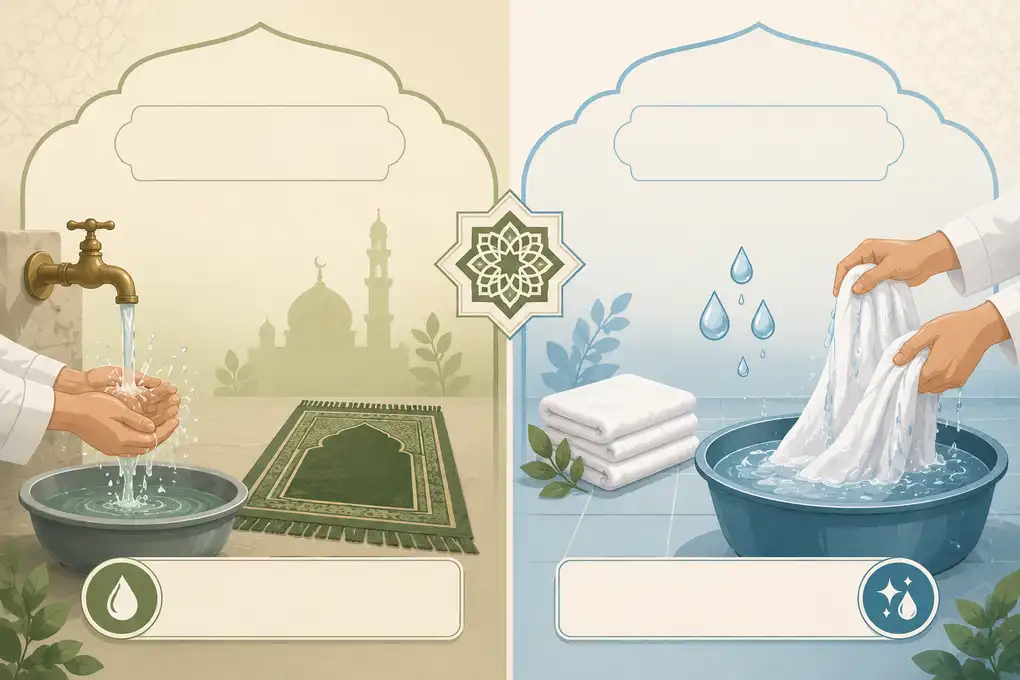
The difference between hadath and najis should be clear before deciding whether a person needs wudu, an obligatory bath, or simply needs to wash clothing or a prayer space. Both belong to the subject of thaharah—ritual purification—but they differ in their nature, cause, location, and method of purification.
In brief, hadath is a legal state affecting a person that prevents certain acts of worship until it is removed. Najis is a specific impure substance that must be removed from the body, clothing, the prayer area, or another affected object.
This article follows the Shafi’i school of jurisprudence. Detailed subtopics are linked to their own articles so that each ruling can be read in its proper context.
Hadath and Najis within Thaharah
Thaharah has two central purposes: lifting hadath and removing najis. Imam Zakariyya al-Anshari wrote:
وَشَرْعًا رَفْعُ حَدَثٍ أَوْ إِزَالَةُ نَجَسٍ أَوْ مَا فِي مَعْنَاهُمَا
Meaning: “In Sacred Law, thaharah is the lifting of hadath, the removal of najis, or what carries the same meaning as either of them.”[1]
Purification is therefore more than washing one’s hands or taking a bath. It concerns a worshipper’s legal state and the cleanliness of what is used in worship.
See the types of thaharah for the wider structure of purification in Islamic law.
An Initial Comparison: Hadath Is Not Najis
| Point of comparison | Hadath | Najis |
|---|---|---|
| Nature | A legal state affecting a person | A specific substance or material |
| Physical form | It may have no visible sign | It may be visible, smellable, coloured, or remain only as a legal trace |
| Location | It concerns the worshipper’s state | It may affect the body, clothing, place, water, or another object |
| How it is removed | Wudu, obligatory ghusl, or tayammum when legally permitted | Removal with pure and purifying water according to the kind of najis |
| Relation to wudu | Minor hadath invalidates wudu; major hadath requires ghusl | Contact with an external najis does not, by itself, invalidate wudu |
| Relation to prayer | Prayer is not valid before hadath is lifted | Prayer is not valid when unexcused najis remains on the body, clothing, or prayer space |
Hadath and najis are often mentioned together because both matter for the validity of prayer. Yet a person may have one without the other.
For example, a person who sleeps in a position that invalidates wudu has hadath even if nothing impure touches their clothing. Conversely, clothing that is contaminated with urine becomes impure, while the wearer’s wudu does not automatically end.
The Meaning of Hadath in Fiqh
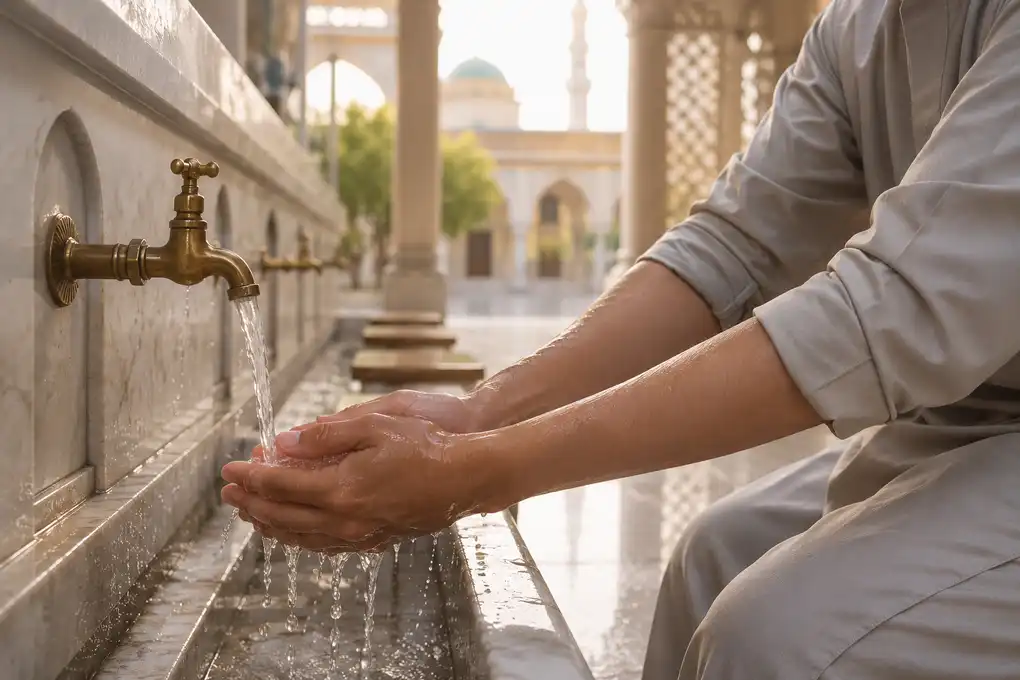
Imam Zakariyya al-Anshari explains hadath in these words:
وَهُوَ هُنَا أَمْرٌ اعْتِبَارِيٌّ يَقُومُ بِالْأَعْضَاءِ يَمْنَعُ صِحَّةَ الصَّلَاةِ حَيْثُ لَا مُرَخِّصَ
Meaning: “Here, hadath is a legal state associated with the limbs that prevents the validity of prayer where no legal concession exists.”[2]
The phrase amr i‘tibari means that hadath is not a physical stain that can be identified by colour or smell. It is a legal state. Wiping the body, applying perfume, or changing clothes does not remove it.
The same work also uses hadath for what makes wudu or ghusl obligatory:
وَيُطْلَقُ … عَلَى مَا يُوجِبُ الْوُضُوءَ وَعَلَى مَا يُوجِبُ الْغُسْلَ فَيُقَالُ حَدَثٌ أَصْغَرُ وَحَدَثٌ أَكْبَرُ
Meaning: “The term hadath is also used for what necessitates wudu and what necessitates ghusl; thus one speaks of minor hadath and major hadath.”[3]
Minor Hadath
Minor hadath is removed through wudu. In Shafi’i jurisprudence, the nullifiers of wudu fall into four main groups:
نَوَاقِضُ الْوُضُوءِ … أَرْبَعَةٌ
Meaning: “The nullifiers of wudu are four.”[3]
They are:
- Something exiting the front or back private passage, including urine, faeces, and wind.
- Loss of awareness, such as fainting, intoxication, insanity, or sleep that does not meet the stated exception.
- Skin-to-skin contact between an unrelated man and woman, under the conditions of the Shafi’i school.
- Touching a human private part with the inner surface of the palm.
Sleep, skin contact, and touching the private parts each have detailed conditions. Read what invalidates wudu for the applied rulings of the Shafi’i school.
Major Hadath
Major hadath requires obligatory ghusl. The emission of semen is connected to ghusl rather than merely renewing wudu.
Imam Zakariyya al-Anshari writes concerning semen:
أَوِ الْمَنِيُّ … فَلَا يَنْقُضُ الْوُضُوءَ لِأَنَّهُ أَوْجَبَ أَعْظَمَ الْأَمْرَيْنِ وَهُوَ الْغُسْلُ بِخُصُوصِهِ
Meaning: “As for semen, its emission does not invalidate wudu because it necessitates the greater of the two matters: ghusl specifically.”[3]
This needs to be read carefully. The emission of semen can make ghusl obligatory, but human semen is not classified as najis in the Shafi’i school. One event can therefore involve major hadath without making the semen itself physically impure.
For the steps and causes, read the guide to obligatory ghusl. When water cannot lawfully be used, see tayammum.
The Meaning of Najis in Fiqh
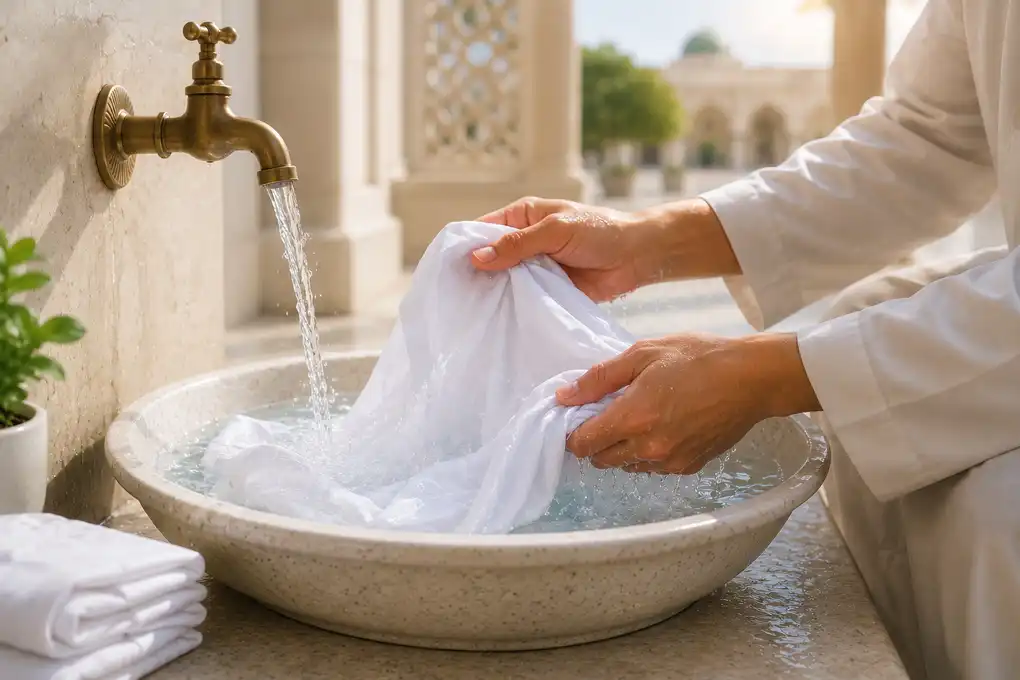
Najis is a specific substance given the ruling of impurity by Sacred Law. It is not identical to everything people regard as dirty or unpleasant.
Shaykh Muhammad ibn Qasim al-Ghazzi writes in Fath al-Qarib:
وَالنَّجَاسَةُ لُغَةً الشَّيْءُ الْمُسْتَقْذَرُ، وَشَرْعًا كُلُّ عَيْنٍ حَرُمَ تَنَاوُلُهَا عَلَى الْإِطْلَاقِ حَالَةَ الِاخْتِيَارِ مَعَ سُهُولَةِ التَّمْيِيزِ، لَا لِحُرْمَتِهَا وَلَا لِاسْتِقْذَارِهَا وَلَا لِضَرَرِهَا فِي بَدَنٍ أَوْ عَقْلٍ
Meaning: “Linguistically, najasah is something regarded as repulsive. In Sacred Law, it is every distinct substance whose consumption is absolutely prohibited in ordinary circumstances and can be readily distinguished, not because of its inviolability, not merely because it is repulsive, and not because it harms the body or mind.”[4]
This definition shows why the legal meaning of najis cannot be reduced to personal disgust. Tears, mucus, sweat, and saliva follow the ruling of the living being from which they come. Since human beings are pure, these fluids are not najis in their normal state.[11]
Likewise, the human corpse is not judged najis because of human dignity. Human semen is also excluded from the legal definition of najis in the explanation of Fath al-Qarib.[4][5]
Common Examples of Najis

Common examples include urine, faeces, blood, pus, madhy, wady, vomit, carrion other than the recognised exceptions in fiqh, and intoxicating wine.[11]
Shaykh Ibn Qasim states:
وَكُلُّ مَائِعٍ خَرَجَ مِنَ السَّبِيلَيْنِ نَجِسٌ … إِلَّا الْمَنِيَّ
Meaning: “Every liquid that exits from the two passages is najis, except semen.”[5]
Animal urine and droppings also require attention. Fath al-Qarib states that all urine and animal droppings must be washed, including those from animals whose meat is lawful to eat.[5]
See the definition of najis for the limits of the term and the types of najis for the detailed classifications.
Categories of Najis and Why They Change the Method of Purification
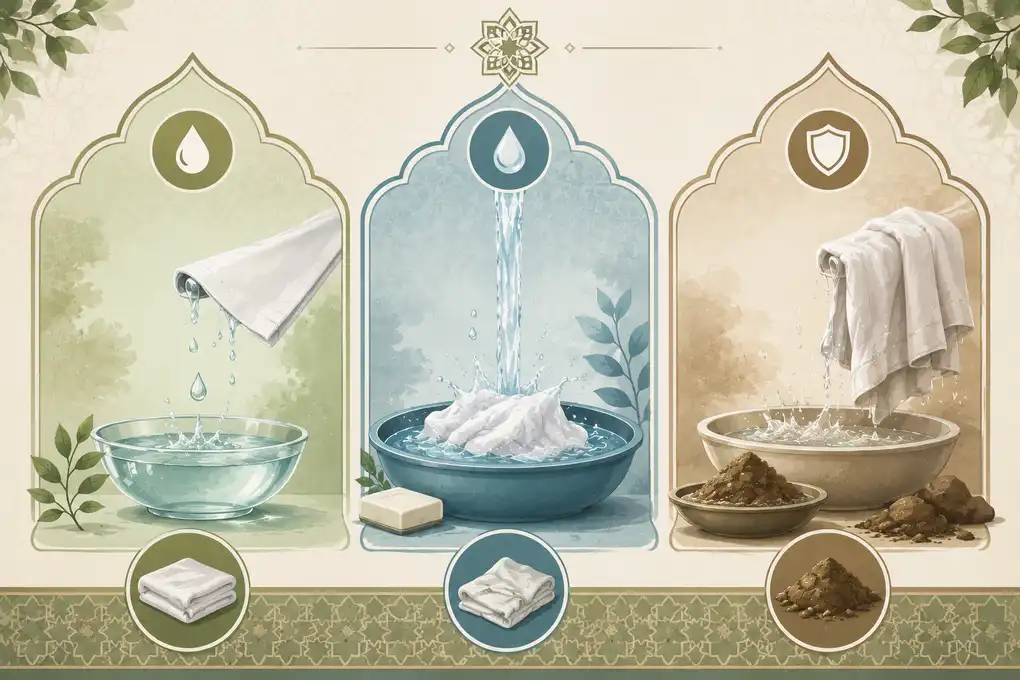
In introductory Shafi’i fiqh, the types of najis are often taught through three categories: mukhaffafah, mutawassitah, and mughallazhah. The category determines the method of cleansing.
Mukhaffafah: Light Najis
Najis mukhaffafah, or light impurity, concerns the urine of a baby boy who has not eaten anything other than milk as nourishment. It is purified by sprinkling water thoroughly over the affected area; flowing water is not required.
وَيَكْفِي فِي تَطْهِيرِ بَوْلِ صَبِيٍّ لَمْ يُطْعَمْ غَيْرَ اللَّبَنِ لِلتَّغَذِّي … نَضْحٌ بِالْمَاءِ بِشَرْطِ غَلَبَتِهِ وَإِنْ لَمْ يَسِلْ
Meaning: “To purify the urine of a baby boy who has not eaten anything other than milk for nourishment, sprinkling water is sufficient, provided that the water predominates even if it does not flow.”[6]
Mutawassitah: Intermediate Najis
Najis mutawassitah, or intermediate impurity, is the category most often encountered. It may be ‘ainiyah or hukmiyah.
النَّجَاسَةُ إِمَّا عَيْنِيَّةٌ، وَهِيَ الَّتِي تُحَسُّ أَوْ حُكْمِيَّةٌ، وَهِيَ بِخِلَافِهَا كَبَوْلٍ جَفَّ وَلَمْ يُوجَدْ لَهُ أَثَرٌ وَلَا رِيحٌ
Meaning: “Najis is either ‘ainiyah, which is perceptible to the senses, or hukmiyah, which is the opposite, such as urine that has dried with no trace or smell remaining.”[7]
- Najis ‘ainiyah: the substance or one of its properties remains. Remove the substance and work to remove any readily removable taste, colour, and smell.
- Najis hukmiyah: the substance is no longer perceptible. It is sufficient to run water over the part known to have been affected.
وَيُطَهَّرُ الْمُتَنَجِّسُ فِي الْحُكْمِيَّةِ بِجَرَيَانِ الْمَاءِ عَلَيْهِ وَلَوْ لَمْ يُعْصَرْ
Meaning: “An object affected by hukmiyah najis becomes pure when water is run over it, even if it is not wrung out.”[7]
See how to purify intermediate najis for the practical steps.
Mughallazhah: Severe Najis
Najis mughallazhah, or severe impurity, concerns dogs, pigs, and the offspring of either of them. It requires seven washes with water, one of which is performed with pure soil.
لَا يَطْهُرُ مُتَنَجِّسٌ بِكَلْبٍ وَخِنْزِيرٍ وَفَرْعِ كُلٍّ مِنْهُمَا … إِلَّا بِسَبْعٍ مِنَ الْغَسَلَاتِ بِالْمَاءِ إِحْدَاهُنَّ بِالتُّرَابِ
Meaning: “An object contaminated by a dog, pig, or the offspring of either is not purified except through seven washes with water, one of which uses soil.”[8]
The soil must be pure, reach the affected place, and be mixed with water in the washing process.[8]
Six Differences between Hadath and Najis
1. Their basic nature
Hadath is a legal state connected to the worshipper. Najis is a specific substance or material.
A person with hadath may have no physical dirt on their body. Conversely, a garment may become contaminated while its wearer still has valid wudu.
2. Their causes
Minor hadath occurs through a nullifier of wudu. Major hadath occurs through a cause that makes ghusl obligatory.
Najis is present because an impure substance touches something or is found in a particular place. Urine on the floor, blood on clothing, and animal droppings on footwear are examples.
3. Their location
Hadath concerns a person’s legal state. Najis can be present on the body, clothing, footwear, a prayer mat, the ground, a container, or water.
That is why ghusl or wudu does not automatically remove najis that remains on clothing. The najis must be removed from the affected place.
4. How each is removed
Minor hadath is lifted by wudu. Major hadath is lifted by obligatory ghusl. Tayammum may substitute for water in conditions recognised by Sacred Law.
Najis is removed according to its category. Some cases require sprinkling water, some need washing until the relevant properties disappear, and some require seven washes with soil.
5. Their effect on wudu
Does najis break wudu? No, not when the only event is external contact with najis.
The details of the event still matter. While cleaning oneself after using the toilet, touching the private part with the inner palm can separately invalidate wudu in the Shafi’i school. The cause is not the najis itself, but the act of touching the private part under that ruling.[3]
6. Their effect on prayer
Hadath that has not been lifted prevents prayer. Unexcused najis also prevents the validity of prayer when it remains on the body, clothing, or prayer space.
Imam Zakariyya al-Anshari writes:
يَحْرُمُ بِالْحَدَثِ صَلَاةٌ … وَطَوَافٌ
Meaning: “Because of hadath, prayer and tawaf are prohibited.”[9]
Elsewhere, he explains that khabath, or najis, prevents the validity of prayer when no legal concession applies.[2]
Hadath and Najis May Be Separate or Combined
Hadath without najis
A person who sleeps in a way that invalidates wudu needs to renew wudu, but does not need to wash their clothing if no najis is present.
The emission of semen is another example. It requires obligatory ghusl under the relevant conditions, while human semen is judged pure in the Shafi’i school.[3][4]
Najis without hadath
Someone may have wudu and then have urine from a baby or animal droppings land on their clothing. Their wudu does not end merely because the external najis touched the garment.
They only need to clean the affected area in the required way. Once the garment is pure, they may pray with their existing wudu.
Hadath and najis together
Urinating is a clear example. The urine itself is najis and must be removed. Its exit from one of the two passages also invalidates wudu.[3][5]
The order may be kept simple:
- Remove najis from the body, clothing, or affected area.
- Make wudu to lift minor hadath.
- Confirm that the prayer area and clothing are free from unexcused najis.
- Pray after the conditions have been met.
A Practical Check Before Prayer
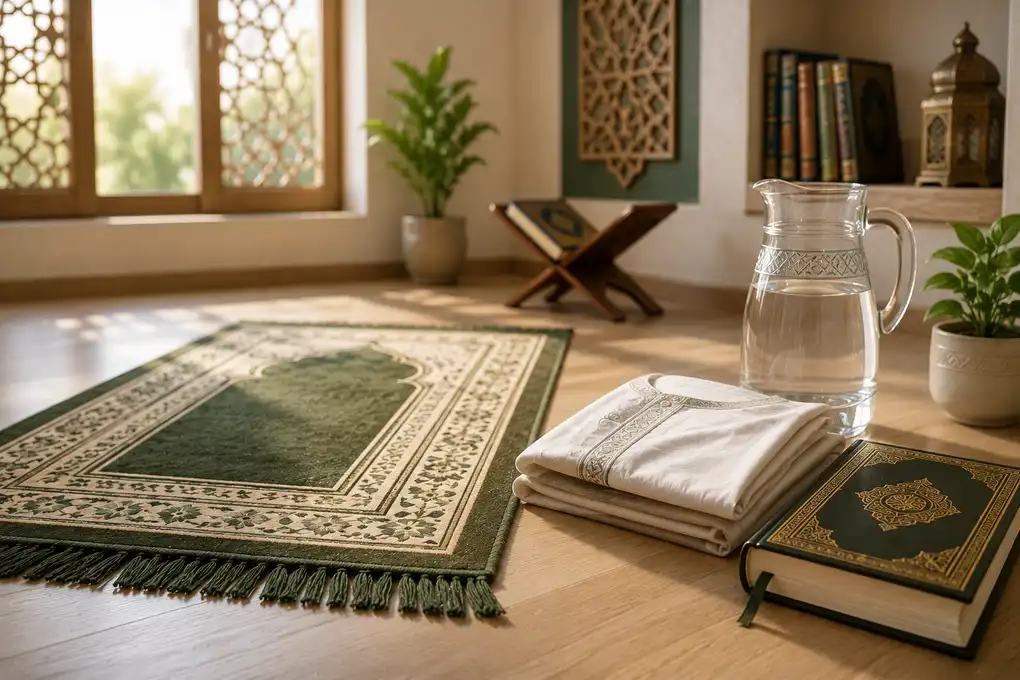
Before praying, make a reasonable check rather than repeating inspections without evidence.
- Check for known najis. If urine, faeces, blood, or another najis is seen or known to be present, clean the affected part.
- Check the state of wudu. Renew wudu when a nullifier has occurred.
- Check whether ghusl is required. If there is a cause of major hadath, perform obligatory ghusl before prayer.
- Check clothing and the prayer space. The body, clothing, and place of prayer must be free of unexcused najis.
- Do not judge something impure on mere suspicion. The original ruling for things is purity.
Imam Zakariyya al-Anshari states:
فَالْجَمَادُ طَاهِرٌ عَلَى الْأَصْلِ فِيهَا إِذِ الْأَصْلُ فِيهَا الطَّهَارَةُ
Meaning: “Inanimate things are pure by their original ruling, because the original ruling concerning them is purity.”[10]
This rule prevents both carelessness toward known najis and needless doubt that makes purification burdensome.
Practical Examples
Case 1: Sleeping while travelling
A person falls asleep in a position that does not meet the exception for seated sleep. No najis is seen on their clothes or body.
They need to renew wudu. They do not need to wash clothing merely because they slept.
Case 2: Clothing is contaminated by animal droppings after wudu
The person’s wudu does not automatically end. The affected part of the clothing must be washed because it has najis on it.
After the najis is removed, the person may pray with their existing wudu as long as no separate nullifier has occurred.
Case 3: Urinating
This event contains two rulings: urine is najis, and the exit of urine invalidates wudu.
Clean the urine first, then make wudu. Neither step replaces the other.
Case 4: Semen is emitted
The emission of semen can make ghusl obligatory. In the Shafi’i school, human semen is pure, so the case is not treated like urine or faeces.[3][4]
Case 5: A small amount of blood on clothing
A small amount of blood or pus has a stated concession in Fath al-Qarib. Prayer may remain valid within the limits explained by the jurists.[12]
Even so, when the blood can easily be washed away, washing it before prayer is the more careful course.
FAQ: Hadath and Najis
What is the difference between hadath and najis in one sentence?
Hadath is a legal state lifted by wudu or obligatory ghusl. Najis is a substance that must be removed from the body, clothing, the prayer space, or another affected object.
Hadath concerns the worshipper’s state; najis concerns a substance present on something.
Does touching najis break wudu?
No. External contact with najis does not, by itself, invalidate wudu.
However, a separate nullifier may occur in the same situation. For example, touching the private part with the inner palm while cleaning oneself has its own ruling in the Shafi’i school.
How are minor and major hadath removed?
Minor hadath is lifted by wudu. Major hadath is lifted by obligatory ghusl. Tayammum stands in for water when the legal conditions are fulfilled.
Najis is not removed by wudu or ghusl alone. The impure substance must be removed according to its category.
Does najis on clothing make prayer invalid even after wudu?
Yes, when unexcused najis remains on the clothing. Wudu lifts hadath; it does not remove najis from clothing.
Wash the affected part until it is pure, then pray with valid wudu.
Closing Note
Knowing the difference between hadath and najis makes purification precise. Hadath is lifted by wudu, obligatory ghusl, or tayammum when permitted. Najis is removed from the affected place through the method appropriate to its category.
When an event occurs, ask two questions: Is there najis that must be cleaned? Is there hadath that must be lifted? These questions identify the next step before prayer.
References
Muḥammad ibn Qāsim al-Ghazzī, Fatḥ al-Qarīb al-Mujīb fī Sharḥ Alfāẓ al-Taqrīb = al-Qawl al-Mukhtār fī Sharḥ Ghāyat al-Ikhtiṣār, ed. Bassām ʿAbd al-Wahhāb al-Jābī, 1st ed., vol. 1 (Beirut: al-Jafān wa-al-Jābī, Dār Ibn Ḥazm, 2005), pp. 55-58.
Zakariyā al-Anṣārī, Asnā al-Maṭālib fī Sharḥ Rawḍ al-Ṭālib, with ḥāsyiyah (marginal gloss) by Aḥmad al-Ramlī, edited by Muḥammad az-Zuhrī al-Ghamrāwī (Cairo: al-Maṭbaʿah al-Maymānīyah, 1313 AH; repr. Dār al-Kitāb al-Islāmī), vol. 1, pp. 4-58.


