

The act of sacrifice (Udhiyah) in Islam extends far beyond the ritual slaughter; it is a profound mechanism for sharing goodness, cultivating empathy, and alleviating poverty. Proper Qurban meat distribution is a fundamental pillar that reflects both the social and spiritual dimensions of Islamic worship. To perform this act correctly, one must first grasp the foundational meaning and ruling of Qurban, which ensures the worship is executed with sincerity and absolute faith in Allah.
This comprehensive article explains the precise rules of Qurban meat distribution based on the orthodox Shafi’i jurisprudence. By understanding these legal stipulations, Muslims can seamlessly integrate this beautiful practice into their broader understanding of the pillars of Islam and ensure their sacrifice is accepted by the Almighty.
The Legal Rulings of Qurban Meat Distribution: Recommended vs. Obligatory
The guidelines for distributing the meat vary significantly depending on the legal status of the sacrifice itself. Islamic jurisprudence divides the sacrifice into two categories: recommended (Sunnah) and obligatory (Wajib).
Distribution for a Recommended (Sunnah) Qurban
In the Shafi’i school of thought, if the sacrifice is a highly recommended act (Sunnah Muakkadah), the individual offering the sacrifice (the Mudhahhi or Shohibul Qurban) is legally permitted to consume a portion of the meat to seek divine blessings. According to the authoritative text Al-Fiqh al-Manhaji (Vol. 1, p. 235):
“إن كانت الأَضحية مسنونة: جاز له أن يأكل قليلاً منها للبركة، ويتصدق بالباقي، وله أن يأكل ثلثها، ويتصدق بثلثها، ويتصدق بثلثها على الفقراء، ويهدي ثلثها لأصحابه وجيرانه وإن كانوا أغنياء.”
Translation: If the Udhiyah is a recommended Sunnah, it is permissible for him to eat a little of it for blessings and give the rest in charity. He may also eat one-third of it, give one-third in charity to the poor, and gift one-third to his friends and neighbors, even if they are wealthy.
This ruling establishes a beautiful balance between personal gratitude, communal charity, and social bonding.
Distribution for an Obligatory (Wajib) Qurban
Conversely, if the sacrifice becomes obligatory—for instance, if a person makes a solemn vow (Nazr) or specifically designates a particular animal for Qurban—the ruling changes entirely. The person offering the sacrifice, as well as any dependents they are legally obliged to financially support, are strictly prohibited from consuming any part of the meat. Al-Fiqh al-Manhaji clarifies:
“إن كانت الأَضحية واجبة: بأن كانت منذورة أو معينة على ما أوضحنا لم يجز للمضحي ولا لأحد من أهله الذين تجب عليه نفقتهم، الأكل منها، فإن أكل أحدهم منها شيئاً غرم بدله أو قيمته.”
Translation: If the Udhiyah is obligatory, such as being vowed or specified as we have explained, it is not permissible for the one sacrificing, nor any of his family members whose maintenance is obligatory upon him, to eat from it. If any of them eats anything from it, they must compensate for it with its equivalent or its value.
The Methodology of Qurban Meat Distribution
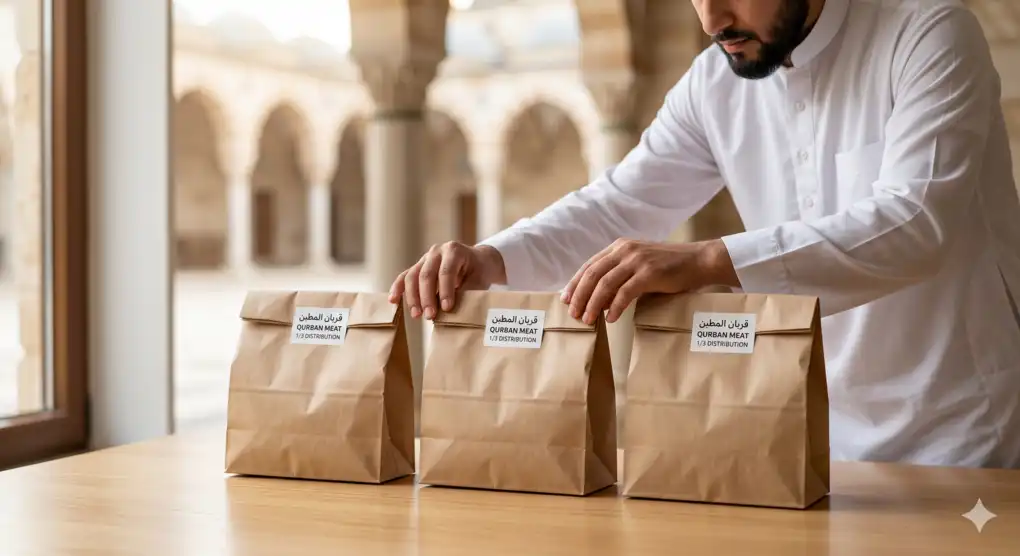
The Recommended One-Third Proportion


For a Sunnah Qurban, the most excellent and widely practiced method of Qurban meat distribution is the “Rule of Thirds” (1/3, 1/3, 1/3). Applying proper etiquette before Qurban includes planning this distribution fairly:
- One-third for the Mudhahhi (the one sacrificing): This portion is kept for personal and familial consumption to attain the blessings of the ritual.
- One-third for the destitute and poor: This portion is given as an absolute transfer of ownership (Tamlik). Because they fully own it, the poor are legally permitted to eat, store, or even sell this meat to fulfill their other needs.
- One-third for neighbors and relatives: This portion is given as a gift (Hadiyah). It can be given to wealthy neighbors to foster brotherhood. However, recipients of this gift portion are only allowed to consume it; they may not sell it.
The classical text emphasizes this distinction regarding ownership:
“إلا أنّ ما يعطي للغني منها ما يكون على سبيل الهدية للأكل، فليس لهم أن يبيعوها، وما يعطي للفقير يكون على وجه التمليك، يأكلها أو يتصرف بها كما يشاء.”
Translation: However, what is given to the wealthy from it is by way of a gift for consumption, so they do not have the right to sell it. But what is given to the poor is by way of transferring ownership; they may eat it or dispose of it as they wish.
Distributing the Head, Trotters, and Offal

The rules of distribution apply equally to the animal’s head, trotters (feet), and offal (internal organs). The person sacrificing may consume them or distribute them according to the proportions above. Importantly, these parts cannot be sold. Traditionally, they are given away as charity, ensuring that no part of the blessed animal is wasted.
Distributing Cow and Sheep Meat
The proportions remain identical regardless of the animal type, provided the animal meets all the strict requirements of Qurban. However, the volume differs. A standard cow yielding 100-150 kg of clean meat would be divided into three portions of roughly 33-50 kg each. A sheep yielding 15 kg would be divided into 5 kg portions.
Scriptural Evidence (Dalil) for the Distribution
The foundational evidence for these distribution rules is derived directly from the Holy Qur’an, Surah Al-Hajj, verse 36:
“والبدن جعلناها لكم من شعائر الله لكم فيها خير فاذكروا اسم الله عليها صواف فإذا وجبت جنوبها فكلوا منها واطعموا البائس الفقير”
Translation: “And the camels and cattle We have appointed for you as among the symbols of Allah; for you therein is good. So mention the name of Allah upon them when lined up [for sacrifice]; and when they are [lifeless] on their sides, then eat from them and feed the needy and the beggar.”
Key Terminology Explained in Al-Fiqh al-Manhaji:
- الْبُدْنَ (Al-Budn): Plural of badanah, referring to camels (and by analogy, all Qurban animals).
- شَعَائِرِ اللَّهِ (Sha’a’irillah): The symbols or rites of the religion of Allah.
- صَوَافَّ (Shawaff): Standing lined up on three legs (during the slaughter).
- وَجَبَتْ جُنُوبُهَا (Wajabat Junubuha): Fallen to the ground (lifeless).
- الْبَائِسَ (Al-Ba’is): The severely destitute person.
The Strict Prohibition on Selling Qurban Meat and Skin
A critical rule in orthodox Islamic jurisprudence is the absolute prohibition on selling any part of the sacrificial animal by the person offering the sacrifice. This includes the meat, the bones, and the skin (hide).
The Mudhahhi may use the skin for personal benefit (e.g., making a rug) or give it in charity, but selling it or giving it to the butcher as payment for their labor is strictly forbidden. Al-Fiqh al-Manhaji states:
“هذا، وللمضحي أن يتصدق بجلد أضحيته، أو ينتفع هو به. ولكن ليس له أن يبيعه أو أن يعطيه للجزار أجرة ذبحه، لأن ذلك نقصٌ من الأضحية يفسدها. ولما رواه البيهقي (٩/ ٢٩٤) عن النبي – صلى الله عليه وسلم – قال: “من باع جلد أضحيته فلا أضحية له”.”
Translation: The one sacrificing may give the skin of his Udhiyah in charity or benefit from it himself. But he does not have the right to sell it or give it to the butcher as a wage for slaughtering, because that is a reduction from the sacrifice that corrupts it. And due to what Al-Baihaqi narrated from the Prophet ﷺ, who said: “Whoever sells the skin of his Udhiyah, there is no Udhiyah for him.”
Conclusion
The intricate rules of Qurban meat distribution perfectly encapsulate the wisdom of Qurban—blending pure devotion to Allah with profound social equity. By adhering strictly to the Shafi’i fiqh guidelines of the “Rule of Thirds,” avoiding the consumption of obligatory sacrifices, and refraining from selling any part of the animal, a Muslim ensures their worship remains pure, highly rewarded, and a source of joy for the entire community.
Frequently Asked Questions (FAQ)
Can I give Qurban meat to my wealthy neighbors?
Yes, if your sacrifice is a recommended (Sunnah) Qurban, you can give a portion of the meat to your wealthy neighbors or relatives as a gift. However, they are only allowed to consume it and cannot sell it.
Is it permissible to pay the butcher with the meat or skin of the Qurban?
No. According to Islamic law, it is strictly prohibited to use any part of the sacrificed animal, including its meat or skin, as payment or wages for the butcher’s services. The butcher must be paid separately with money.
What should I do if I made a vow (Nazr) to perform Qurban?
If your Qurban is due to a vow (obligatory/Wajib), you and your financial dependents are not allowed to eat any of the meat. The entire animal must be distributed in charity to the poor and needy.
Conceptual Reference:
Al-Khin, Muṣṭafā, Muṣṭafā Dīb al-Bughā, and ʿAlī ash-Sharbajī. Al-Fiqh al-Manhaji ʿalā Madhhab al-Imām ash-Shāfiʿī. Vol. 1. Damascus: Darul Qalam, 1992.


