
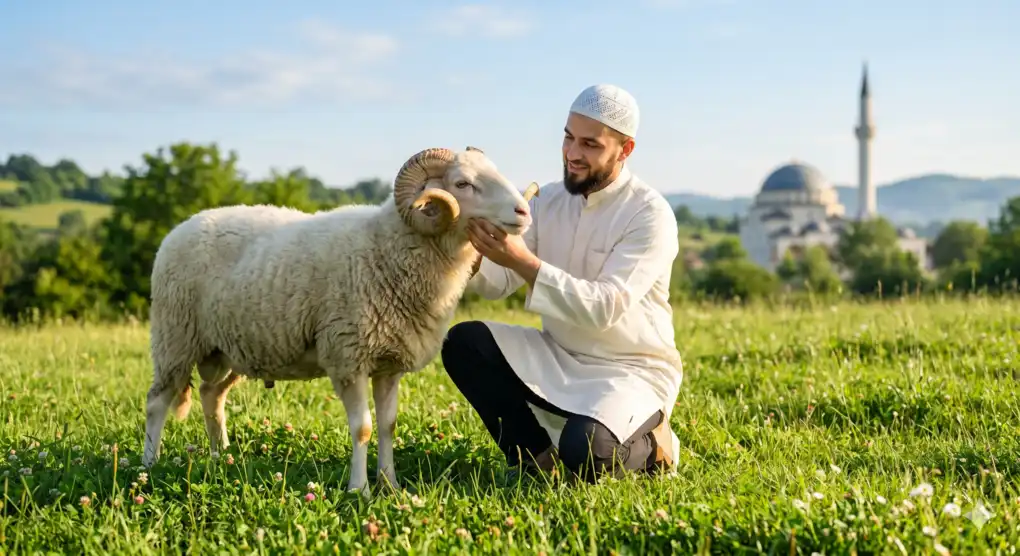
Performing the sacrifice, or Udhiyah, is a highly regarded act of worship executed by Muslims during the festive days of Eid al-Adha. This profound ritual not only demonstrates absolute submission to Allah but also carries immense social value through the systematic feeding of the impoverished. However, for this sacred act to be legally valid and spiritually accepted, specific requirements of Qurban must be meticulously fulfilled. These parameters cover the type of animal, its age, its physical condition, and the correct distribution of its meat.
By understanding the foundational meaning and ruling of Qurban, believers can ensure their worship aligns perfectly with Islamic jurisprudence (fiqh). This article provides a detailed academic exposition of these requirements, drawing authoritative insights from the classical Shafi’i text, Al-Fiqh al-Manhaji (Vol. 1, pp. 233-234).
What is Qurban and Why is it Significant?
Qurban refers to the ritual slaughter of specific livestock during Eid al-Adha and the subsequent days of Tashriq (11th–13th of Dhu al-Hijjah) as a dedicated act of devotion to the Almighty. The historical foundation of this worship traces back to the monumental trial of Prophet Ibrahim (Abraham), who demonstrated an unwavering belief in Allah by showing his readiness to sacrifice his beloved son, Ismail, before Allah mercifully replaced him with a ram.
Fulfilling this ritual properly unlocks the profound wisdom of Qurban, transforming a physical sacrifice into a catalyst for spiritual purification and communal solidarity.
The Primary Requirements of Qurban: Eligible Animals
According to Islamic law, not all animals are permissible for sacrifice. The requirements of Qurban strictly dictate that the offering must be from the An’am (grazing livestock). Al-Fiqh al-Manhaji (Vol. 1, p. 233) elucidates:
“لا تصح الأَضحية إلا أن تكون من إبل، أو بقر، أو غنم ومنه الماعز. لقوله تعالى: {ولكل أمة جعلنا منسكاً ليذكروا اسم الله على ما رزقهم من بهيمة الأنعام} [الحج: ٣٤]، والأنعام لا ترج عن هذه الأصناف الثلاثة، ولأنه لم ينقل عن النبي – صلى الله عليه وسلم – ولاعن أحد من الصحابة التضحية بغيرها.”
Translation: The Udhiyah is not valid unless it is a camel, a cow, or a sheep, which includes goats. This is based on the statement of Allah the Exalted: “And for every nation We have appointed a rite of sacrifice that they may mention the name of Allah over what He has provided for them of [sacrificial] animals” [Al-Hajj: 34]. The term ‘animals’ (An’am) does not extend beyond these three categories. Furthermore, it has not been transmitted from the Prophet ﷺ, nor from any of the Companions, that they sacrificed anything else.
The hierarchy of preference among these animals is also established:
- Camels: The most superior due to their substantial meat yield.
- Cows/Bulls: The second in preference.
- Sheep/Goats: The most accessible and commonly sacrificed option.
Group Participation: How Many People per Cow?
Islamic jurisprudence provides clear allowances for shared sacrifices concerning larger animals. A single sheep or goat suffices for one person (and by extension, their household for the reward). However, a cow or a camel can be shared. Al-Fiqh al-Manhaji references a Hadith from Sahih Muslim:
“ويجوز أن يضحي بالبعير والبقرة الواحدة عن سبعة…”
“It is permissible to sacrifice one camel or one cow on behalf of seven people…”
This was practiced by the Companions alongside the Prophet ﷺ during the year of Hudaibiyah, establishing a definitive standard for communal participation.
Are Female Animals Allowed?
A common misconception surrounds the gender of the sacrificial animal. The requirements of Qurban do not discriminate between male and female animals. Terms like Badanah (camel) or Baqarah (cow) encompass both genders. Thus, sacrificing a female sheep or cow is entirely valid, provided it meets all other age and health stipulations.
Age Requirements for Qurban Animals
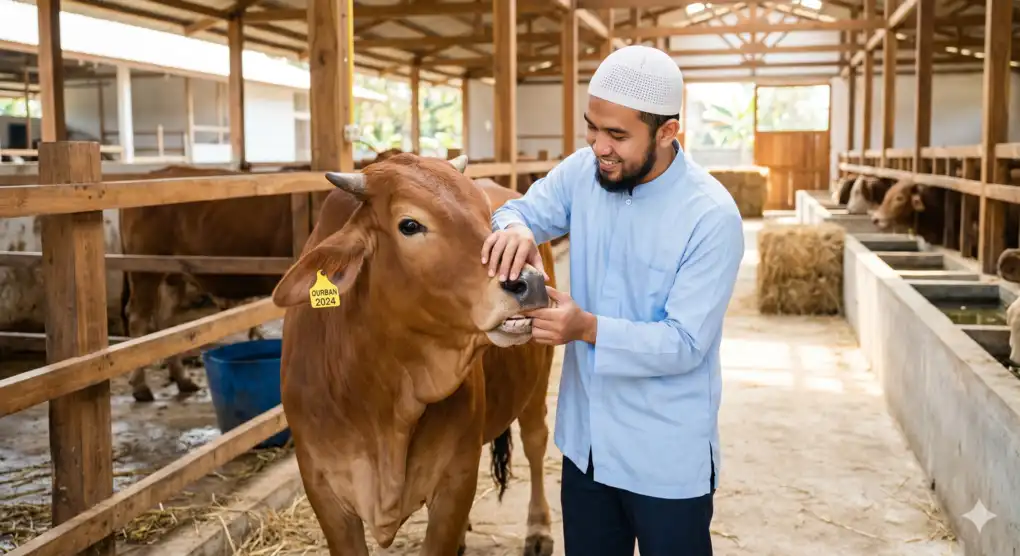
For an animal to be deemed legally suitable, it must reach a specific level of physical maturity. Al-Fiqh al-Manhaji details these strict age thresholds:
“السن: وشرط الإبل أن يكون قد طعن في السادسة من العمر. وشرط البقر والمعز أن يكون قد طعن في الثالثة. أما شرط الضأن فهو أن يكون قد طعن في الثانية، أو أجدع – أي سقطت أسنانه الأمامية- ولو لم يبلغ سنة.”
Translation: Age: The condition for a camel is that it has entered its sixth year. The condition for cows and goats is that they have entered their third year. As for sheep, the condition is that it has entered its second year, or is ‘Jadha”—meaning its front teeth have fallen out—even if it has not completed a full year.
This specific exemption for the Jadha’ sheep is supported by authentic Prophetic traditions, ensuring that the sacrificed animal is sufficiently mature to yield high-quality sustenance for the community.
Physical Conditions of Qurban Animals
Another critical pillar within the requirements of Qurban involves the physiological integrity of the livestock. The animal must be in prime condition, unblemished by severe defects. The jurisprudential text states:
“السلامة: ثم يشترط بالنسبة لهذه الأصناف الثلاثة كلها: أن تكون سالمة من العيوب التي من شأنها أن تسبب نقصاناً في اللحم…”
Translation: Soundness: It is then stipulated for all these three categories that they be free from defects that would cause a reduction in the meat. Thus, an emaciated sheep—one whose marrow has depleted due to severe leanness—is not valid, nor is one with a clear limp, a blind eye, sickness, or a partially cut ear.
This standard is directly derived from the Hadith recorded by Tirmidhi and Abu Dawud, which explicitly invalidates animals that are visibly blind, severely sick, noticeably lame, or perilously emaciated.
Strict Prohibitions and Analogous Defects

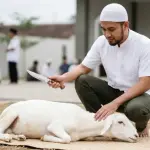
The scholars of the Shafi’i school extend this ruling via analogy (qiyas). Any physical trauma or defect that mirrors the severity of the aforementioned four conditions—such as a missing limb or a severe wound that drastically reduces the meat—renders the animal impermissible for Udhiyah.
Proper Time and Sunnah Practices
Beyond the animal itself, the human element is equally crucial. A pure concept of intention (niyyah) separates a mundane slaughter from a divine act of worship. Furthermore, the sacrifice must strictly occur within the designated time of slaughter (after the Eid prayer until the sun sets on the 13th of Dhu al-Hijjah).
Adhering to the Prophetic Sunnah during the slaughtering process maximizes the spiritual reward. This includes facing the Qiblah, using a sharpened blade to minimize the animal’s suffering, and understanding the ruling of reciting the Basmalah and Takbir at the moment of sacrifice.
Rules for Meat Distribution

The ultimate socio-economic goal of this ritual is charity. The orthodox requirements of Qurban strongly recommend dividing the yielded meat into three distinct portions:
- One-third to be retained by the family offering the sacrifice.
- One-third to be gifted to relatives, friends, and neighbors.
- One-third to be distributed exclusively as charity to the poor and needy.
Adhering strictly to the stipulations of Qurban meat distribution ensures that the communal joy of Eid reaches the most vulnerable members of society.
Differences Between Qurban and Aqiqah
While both rituals involve animal sacrifice and share similar physiological prerequisites for the livestock, they serve different theological purposes and are bound by different timings. For a deeper comparative understanding of these two distinct rites, one may explore the extensive literature surrounding Aqiqah and Qurban.
Conclusion
Mastering the requirements of Qurban is a fundamental obligation for any Muslim intending to perform this magnificent rite. By ensuring the livestock belongs to the permissible categories, meets the strict age thresholds, and is completely free from debilitating physical defects, a believer upholds the sanctity of the Shariah. When executed with profound sincerity and coupled with the equitable distribution of meat, the Udhiyah transcends a mere ritual, becoming a profound testament of faith, gratitude, and robust social responsibility.
Frequently Asked Questions (FAQ)
Can a sheep be shared among several people for Qurban?
No. According to Islamic jurisprudence, one sheep or goat is only sufficient for one person (and yields the reward for their dependent household). Only cows and camels can be shared among up to seven individuals.
What happens if an animal gets injured right before the slaughter?
If an animal was purchased in a healthy condition and accidentally sustains a defect that invalidates it (like a broken leg) shortly before the slaughter, some scholars state it is still valid for the one offering a recommended Qurban, though replacing it is preferred. For a vowed (nadzar) Qurban, different strictures apply.
Is it necessary to slaughter the animal with my own hands?
While it is a highly recommended Sunnah to slaughter the animal yourself if you are capable, it is entirely permissible to delegate the task to a skilled Muslim butcher, provided you maintain the correct intention and ideally witness the slaughter.
Conceptual Reference:
Al-Khin, Muṣṭafā, Muṣṭafā Dīb al-Bughā, and ʿAlī ash-Sharbajī. Al-Fiqh al-Manhaji ʿalā Madhhab al-Imām ash-Shāfiʿī. Vol. 1. Damascus: Darul Qalam, 1992.


