

Embarking on the sacred journey to Mecca is a profound manifestation of a believer’s faith in Allah. However, this spiritual endeavor requires strict adherence to established jurisprudential rules. Central to this is formulating the proper Ihram intention for Hajj and Umrah. As the foundational pillar of the pilgrimage, the absence of a valid intention renders the entire worship ritually void.
This article provides a detailed academic exposition on the formulations of the intention for Hajj, Umrah, proxy pilgrimage (Badal), and the precise procedures at the Miqat. We will examine the Arabic recitations, their transliterations, and meanings, firmly grounded in the classical Shafi’i text Al-Muqaddimah Al-Ḥaḍramiyyah authored by Imam Abu Bakr BaFadl.
What is the Ihram Intention?
In Islamic jurisprudence, understanding the legal definition of intention is paramount. The Ihram is an explicit declaration of intent to commence the rites of Hajj or Umrah. It signifies that a pilgrim has officially entered the state of nusuk (ritual worship), thereby subjecting themselves to the specific prohibitions and restrictions associated with Ihram.
According to Al-Muqaddimah Al-Ḥaḍramiyyah (p. 146), Ihram is defined as the intention to perform Hajj, Umrah, or both simultaneously. A pilgrim can form an absolute (general) intention and subsequently specify it for a particular rite. The formulation of the intention corresponds directly to the nature of the pilgrimage: one intention is designated exclusively for Umrah, another for Hajj, and a combined declaration for those performing Hajj Qiran. Furthermore, Islamic law dictates that pilgrims must declare this intention at designated geographical boundaries known as Miqat, adhering to the legal foundation of Hajj and Umrah.
The Importance of Intention in the Pilgrimage
The intention serves as the core distinguishing factor between mundane actions and acts of worship. Without a valid inner resolve, mere physical actions—such as donning the two seamless white garments or circumambulating the Kaaba—hold no ritual weight. Therefore, comprehending the meaning of Hajj necessitates mastering the precise way to formulate the intention, ensuring the pilgrim meets all the obligatory conditions for Hajj and Umrah.
Pronunciation and Specific Formulations of the Ihram Intention
While the intention fundamentally resides in the heart, the Shafi’i school highly recommends vocalizing the intention to align the tongue with the heart, thereby reinforcing the pilgrim’s spiritual commitment. Below are the precise formulations based on Al-Muqaddimah Al-Ḥaḍramiyyah:
1. Ihram Intention for Umrah

For individuals undertaking the minor pilgrimage, the formulation is:
نَوَيْتُ الْعُمْرَةَ وَأَحْرَمْتُ بِهَا لِلّٰهِ تَعَالَى
Transliteration: Nawaitul ‘umrata wa aḥramtu bihā lillāhi ta‘ālā.
Meaning: I intend to perform Umrah and I enter the state of Ihram for it for the sake of Allah the Exalted.
This specific phrasing assists pilgrims in focusing their minds entirely on the minor pilgrimage.
2. Ihram Intention for Hajj
For those embarking strictly on the major pilgrimage (Hajj Ifrad), the intention is:
نَوَيْتُ الْحَجَّ وَأَحْرَمْتُ بِهِ لِلّٰهِ تَعَالَى
Transliteration: Nawaitul ḥajja wa aḥramtu bihi lillāhi ta‘ālā.
Meaning: I intend to perform Hajj and I enter the state of Ihram for it for the sake of Allah the Exalted.
Pilgrims recite this intention upon reaching their respective Miqat, such as Yalamlam or Dzul Hulaifah.
3. Intention for Hajj and Umrah (Qiran)




When a pilgrim chooses to perform both rituals concurrently without breaking the state of Ihram (Hajj Qiran), the Ihram intention for Hajj and Umrah combines both elements:
نَوَيْتُ الْحَجَّ وَالْعُمْرَةَ وَأَحْرَمْتُ بِهِمَا لِلّٰهِ تَعَالَى
Transliteration: Nawaitul ḥajja wal ‘umrata wa aḥramtu bihimā lillāhi ta‘ālā.
Meaning: I intend to perform Hajj and Umrah, and I enter the state of Ihram for both for the sake of Allah the Exalted.
4. Proxy Intention (Umrah Badal)
If a person performs the pilgrimage on behalf of someone else—typically a deceased relative or an individual physically incapable of making the journey—they must utilize the proxy formulation:
نَوَيْتُ الْعُمْرَةَ عَنْ فُلَانٍ وَأَحْرَمْتُ بِهَا لِلّٰهِ تَعَالَى
Transliteration: Nawaitul ‘umrata ‘an fulān wa aḥramtu bihā lillāhi ta‘ālā.
Meaning: I intend to perform Umrah on behalf of [Name of the Person] and I enter the state of Ihram for it for the sake of Allah the Exalted.
For a proxy Hajj (Hajj Badal), the pilgrim simply replaces the word “Umrah” with “Hajj”.
Procedures for Declaring Intention at the Miqat
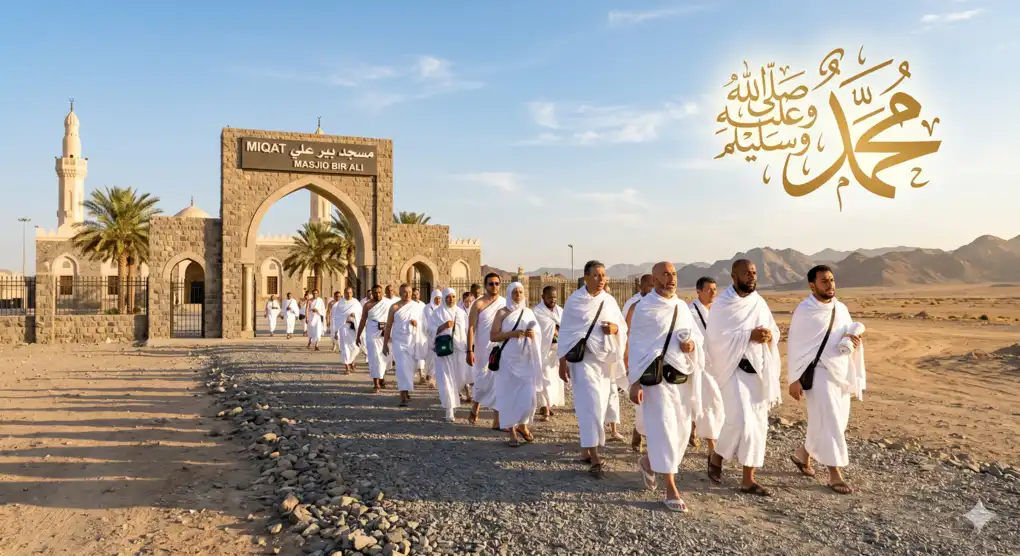
The ritual of entering Ihram is strictly tethered to the Miqat. For instance, residents of Medina declare their intention at Dzul Hulaifah, while those arriving from the Levant (Sham) do so at Juhfah.
Before making the verbal declaration, it is a recommended Sunnah to perform a ritual bath (ghusl), apply permissible fragrance to the body (not the garments), and don the Ihram clothing. Once the pilgrim establishes the intention, they transition immediately into reciting the Talbiyah.
The Talbiyah Recitation:
“لَبَّيْكَ اللَّهُمَّ لَبَّيْكَ، لَبَّيْكَ لَا شَرِيكَ لَكَ لَبَّيْكَ، إِنَّ الْحَمْدَ وَالنِّعْمَةَ لَكَ وَالْمُلْكَ لَا شَرِيكَ لَكَ”
Labbaikallahumma labbaik, labbaika la syarika laka labbaik, innal hamda wan-ni‘mata laka wal mulka la syarika lak.
Meaning: “Here I am, O Allah, here I am responding to Your call. Here I am, You have no partner, here I am. Verily, all praise, grace, and sovereignty belong to You. You have no partner.”
The Shafi’i scholars recommend repeating the Talbiyah three times. Men should raise their voices during the recitation. Following this, it is highly encouraged to reflect upon the virtues of sending blessings upon the Prophet (ﷺ), beseech Allah for His pleasure and Paradise, and seek refuge from the Hellfire.
Original Text Reference from Al-Muqaddimah Al-Ḥaḍramiyyah
To ensure academic and jurisprudential authenticity, the following is the original Arabic excerpt from Al-Muqaddimah Al-Ḥaḍramiyyah (page 146) which serves as the primary reference for these rulings:
فصل فِي بَيَان الْإِحْرَام الْإِحْرَام نِيَّة الْحَج أَو الْعمرَة أَو هما وَينْعَقد مُطلقًا ثمَّ يصرفهُ لما شَاءَ وَيسْتَحب التَّلَفُّظ بِالنِّيَّةِ فَيَقُول نَوَيْت الْحَج أَو الْعمرَة وأحرمت بِهِ لله تَعَالَى وَإِن حج أَو اعْتَمر عَن غَيره قَالَ نَوَيْت الْحَج أَو الْعمرَة عَن فلَان وأحرمت بِهِ لله تَعَالَى وَيسْتَحب التَّلْبِيَة مَعَ النِّيَّة والإكثار مِنْهَا وَرفع الصَّوْت بهَا للرجل إِلَّا فِي أول مرّة فيسر بهَا وَينْدب أَن يذكر مَا أحرم بِهِ وصيغتها لبيْك اللَّهُمَّ لبيْك لبيْك لَا شريك لَك لبيْك إِن الْحَمد وَالنعْمَة لَك وَالْملك لَا شريك لَك ويكررها ثَلَاثًا ثمَّ يُصَلِّي على النَّبِي صلى الله عَلَيْهِ وَسلم ثمَّ يسْأَل الله تَعَالَى الرِّضَا وَالْجنَّة والاستعاذة من النَّار ثمَّ دَعَا بِمَا أحب وَإِذا رأى الْمحرم أَو غَيره شَيْئا يُعجبهُ أَو يكرههُ قَالَ لبيْك إِن الْعَيْش عَيْش الْآخِرَة
English Translation:
“Chapter on the Explanation of Ihram: Ihram is the intention for Hajj, or Umrah, or both. It can be initiated in an absolute manner and later directed to whatever [specific rite] one wills. It is recommended to vocalize the intention by saying: ‘I intend Hajj (or Umrah) and I enter Ihram for it for Allah the Exalted.’ If one performs Hajj or Umrah on behalf of another, they say: ‘I intend Hajj (or Umrah) on behalf of [Name] and I enter Ihram for it for Allah the Exalted.’ It is recommended to recite the Talbiyah alongside the intention, to recite it frequently, and for men to raise their voices with it, except for the first time where it is done softly. It is recommended to mention what one has entered Ihram for. Its phrasing is: ‘Labbaik Allahumma labbaik…’ > One repeats it three times, then sends blessings upon the Prophet ﷺ, then asks Allah the Exalted for His pleasure and Paradise, and seeks refuge from the Fire, then supplicates with whatever they desire. If the person in Ihram or anyone else sees something that amazes or displeases them, they say: ‘Labbaik, indeed true life is the life of the Hereafter.'”
Conclusion
Mastering the correct formulation of the intention is an uncompromisable prerequisite for the pilgrimage. By meticulously learning the Ihram intention for Hajj and Umrah—whether for oneself or as a proxy—pilgrims safeguard the validity of their worship. Ensuring these declarations are made at the designated Miqat in accordance with authentic Shafi’i jurisprudence allows believers to fully reap the immense spiritual rewards and virtues of performing the Hajj pilgrimage.
Frequently Asked Questions (FAQ)
Is it mandatory to speak the Ihram intention out loud?
No, speaking the intention out loud is not strictly mandatory. In Islamic jurisprudence, the heart is the true seat of intention. However, the Shafi’i school strongly recommends (Sunnah) vocalizing the Arabic phrasing to help the tongue affirm what the heart has resolved, thereby increasing focus and minimizing doubts.
What happens if I cross the Miqat without making the Ihram intention?
If a pilgrim deliberately or accidentally crosses the designated Miqat boundary without forming the intention for Hajj or Umrah, they must return to the Miqat to make the intention. If they proceed and perform the rites without returning, they are obligated to offer a penalty (Dam), which generally involves the slaughtering of a sheep in Mecca, to compensate for the violation.
Can I change my intention from Umrah to Hajj after entering the state of Ihram?
This depends on the specific circumstances and the type of pilgrimage you initially intended. If you entered Ihram with an absolute or general intention without specifying, you can specify it later. However, if you explicitly formed an intention for Umrah (Tamattu), you generally complete the Umrah, exit Ihram, and form a new intention for Hajj on the 8th of Dzulhijjah. Transforming intentions mid-ritual requires careful adherence to detailed fiqh regulations, and consulting a qualified scholar is highly advised.
Conceptual Reference Notes:
Extracted and translated from ʿAbd Allāh ibn ʿAbd al-Raḥmān Bāfaḍl, Al-Muqaddimah Al-Ḥaḍramiyyah (Masāʾil at-Taʿlīm), ed. Mājid al-Ḥamawī (Damascus: Al-Dār al-Muttaḥidah, 1993), 146.


