
Water plays a fundamentally crucial role in the life of every Muslim. Beyond being the essential source of life, water is the central element in the ritual of self-purification. Without legally valid water, ablution (wudu) and the major ritual bath (ghusl) will not be accepted, which ultimately invalidates the performance of prayers.
Therefore, understanding the concept of thaharah (purification) and the types of water in Islam is mandatory. Doubts often arise in our minds: “Can leftover wudu water in a bucket be used again?”, “Is tea permissible for ablution?”, or “What exactly is musta’mal water?”.
This article will comprehensively explore the various categories of water based on their purity status according to the Shafi’i school of thought (referencing classical texts like al-Fiqh al-Manhaji and Asna al-Matalib). This ensures your acts of devotion are peaceful, valid, and aligned with Shari’ah. Since purity is a prerequisite, comprehending the true definition of prayer becomes an absolute necessity for every practicing believer.
The 7 Natural Sources of Water for Purification
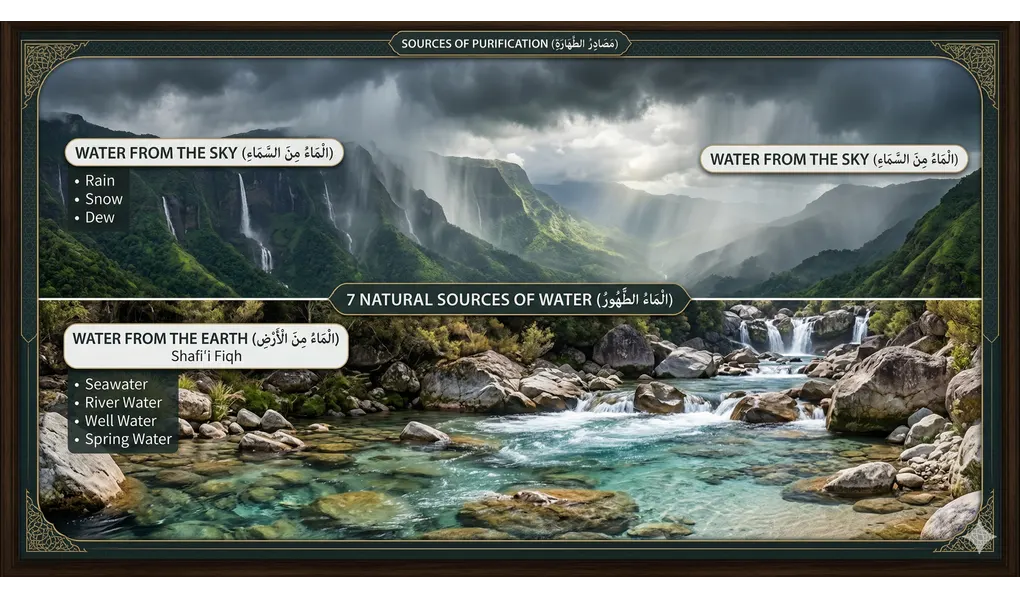
Before discussing the legal rulings, we must identify the natural sources of water that are intrinsically pure. Broadly speaking, water that can be used for purification originates from two main sources: the sky and the earth.
1. Water from the Sky
Allah SWT states in the Holy Quran:
“{وَأَنزَلْنَا مِنَ السَّمَاءِ مَاءً طَهُوراً}”
“And We send down from the sky pure and purifying water.” (QS. Al-Furqan: 48).
This category includes:
- Rainwater: The most pristine and blessed source of water.
- Snowwater: Water that descends in a frozen state and melts.
- Dewwater: Droplets formed from condensed water vapor.
2. Water from the Earth
- Seawater: It is pure and purifying, even though it tastes salty and its naturally deceased marine life is lawful (halal) to consume.
- River Water: Naturally flowing fresh water.
- Well Water: Groundwater that is drawn or collected.
- Spring Water: Water that naturally emerges from the ground.
These seven sources essentially constitute pure water that has not undergone any alteration in its original attributes, making them completely valid for purification.
The 4 Categories of Water in Islamic Jurisprudence
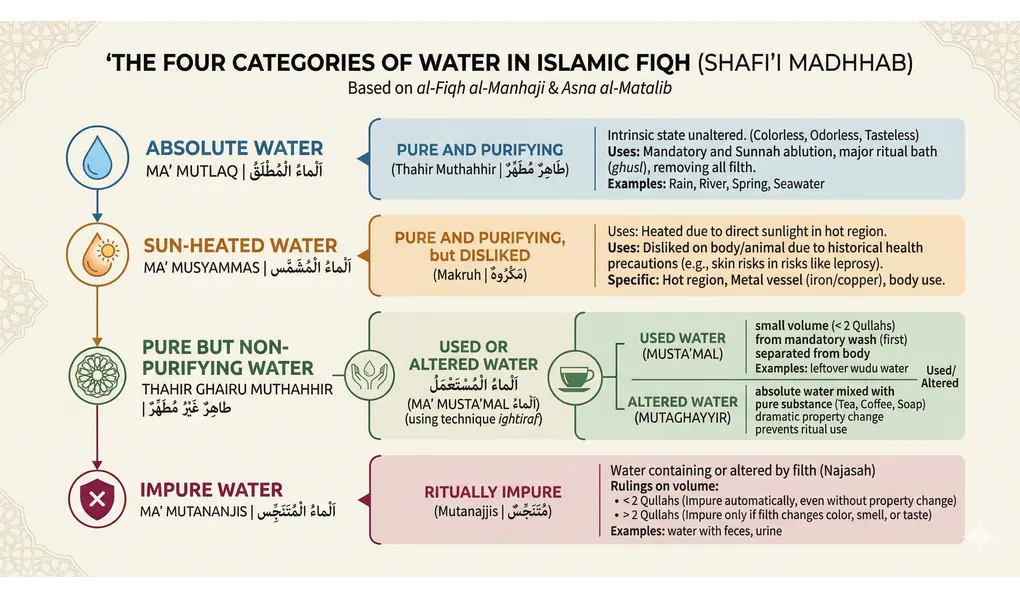
Scholars of Islamic jurisprudence categorize water into four primary classifications based on its legal strength for use in worship. This theological understanding is vital to distinguish between ritually pure water and ordinary water.
1. Absolute Water (Ma’ Mutlaq)

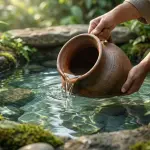
Water flowing directly from natural sources is the perfect example of Absolute Water: pure, clear, and unaltered in its original state, making it valid for purification. This is the highest tier in the hierarchy of water, also known as Thahir Muthahhir (Pure and Purifying).
To grasp the essence of absolute water, one must understand that it is water remaining in its original state of creation (colorless, odorless, tasteless) and has not been mixed with anything that permanently changes its inherent name.
- Primary Characteristic: It can simply be called “Water” without any restrictive modifiers. Shaykh Zakariyya al-Ansari explains that absolute water is free from a “binding attribution” (idhafah lazimah). For example, rainwater is just called “water.” Conversely, if you remove the word “tea” from “tea water,” the meaning becomes ambiguous.
- Legal Ruling for Use: It is valid and obligatory to use for wudu, the major ritual bath (ghusl janabah), and removing impurities. Consequently, using absolute water is highly critical to fulfill the validity conditions of wudu.
The Polemic of Ice and Steam: Do They Remain Absolute Water? Does melted ice or condensed steam remain absolute water? The answer is: Yes, it remains pure and purifying. Imam al-Nawawi affirmed that a change in physical state (freezing or evaporating) does not strip water of its absolute status. Thus, condensed water droplets from a pot lid are legally valid for wudu.
2. Sun-Heated Water (Ma’ Musyammas)
This category represents water that is pure and purifying, yet its use on the physical body is disliked (Makruh).
- Definition: Water that becomes excessively hot due to direct exposure to sunlight in regions with extremely hot climates.
- Conditions for being Makruh: The ruling of makruh only applies if three strict conditions are met simultaneously:
- It is located in an extremely hot climate.
- It is stored in a metal container (like iron or copper) prone to rust, excluding gold or silver.
- It is used directly on the human or animal body, due to historical medical precautions regarding skin diseases like leprosy.
3. Pure but Non-Purifying Water (Thahir Ghairu Muthahhir)
The substance of this category is inherently pure (it is permissible to drink, and if it spills on clothes, they do not become impure), but it cannot be used for ritual purification. This category is divided into two:
a. Used Water (Ma’ Musta’mal)
Questions frequently arise regarding the exact definition of musta’mal water and why it cannot be used for purification.
- Definition: Musta’mal water is a small volume of water (less than two qullahs, approximately 216 liters) that has already been utilized for an obligatory purification ritual (such as the first mandatory wash in wudu or the obligatory ghusl), and this water has subsequently separated from the body parts.
- Conditions for Water to be Musta’mal:
- Small Volume: It must be less than two qullahs. Large bodies of water, like swimming pools, do not become musta’mal.
- Result of Obligatory Worship: It must be the runoff from fulfilling the obligatory acts of wudu. Runoff from the second or third recommended washes (sunnah) does not become musta’mal, though some scholars advise avoiding it.
- Separation from the Body: Water is only judged as musta’mal after it drips and separates from the body. While it is still flowing on the skin during washing, it remains pure and purifying.
- Evidence: The Prophet (ﷺ) prohibited this, stating: “None of you should bathe in stagnant water while in a state of sexual impurity (junub).” (Sahih Muslim). This indicates that using a small amount of water for an obligatory bath removes its “purifying” capability.
b. Altered Water (Ma’ Mutaghayyir)
This is absolute water that has been mixed with other pure substances (such as tea, coffee, soap, or syrup) to the extent that one of its primary attributes (color, taste, or smell) drastically changes, resulting in a change of its name.
While you can legally consume it, it is entirely invalid for ablution. To understand the deeper nuances, you can study the specific rulings concerning altered water.
4. Impure Water (Ma’ Mutanajjis)
This refers to water that has been contaminated by filth (najasah). Before identifying its rulings, one must clearly understand the definition of najis in Islamic law. The ruling depends heavily on the volume of the water:
- Small Amount (Less than 2 Qullahs): It automatically becomes impure the moment a primary impurity falls into it, even if its color, smell, or taste remains completely unchanged.
- Large Amount (More than 2 Qullahs): It does not become impure if filth falls into it, unless one of its properties (color, smell, or taste) visibly changes due to that specific impurity. You can explore the various types of impurities in Islam to better identify what contaminates water.
Summary Table: Usage Guidelines for Types of Water in Islam
To simplify comprehension, here is a practical guide regarding the various types of water and their permissibility:
| Water Type | Drinking & Cooking | Washing Clothes (Normal Dirt) | Wudu & Obligatory Bath | Removing Impurities (Najasah) |
| Absolute Water | ✅ Permissible | ✅ Permissible | ✅ Valid | ✅ Valid |
| Sun-Heated Water | ✅ Permissible | ✅ Permissible | ✅ Valid (Makruh) | ✅ Valid (Makruh) |
| Used Water (Musta’mal) | ✅ Permissible | ✅ Permissible | ❌ Invalid | ❌ Invalid |
| Altered Water (Tea/Coffee) | ✅ Permissible | ✅ Permissible | ❌ Invalid | ❌ Invalid |
| Impure Water (Mutanajjis) | ❌ Haram (Forbidden) | ❌ Forbidden | ❌ Invalid | ❌ Invalid |
Important Details: Preventing Doubts During Wudu
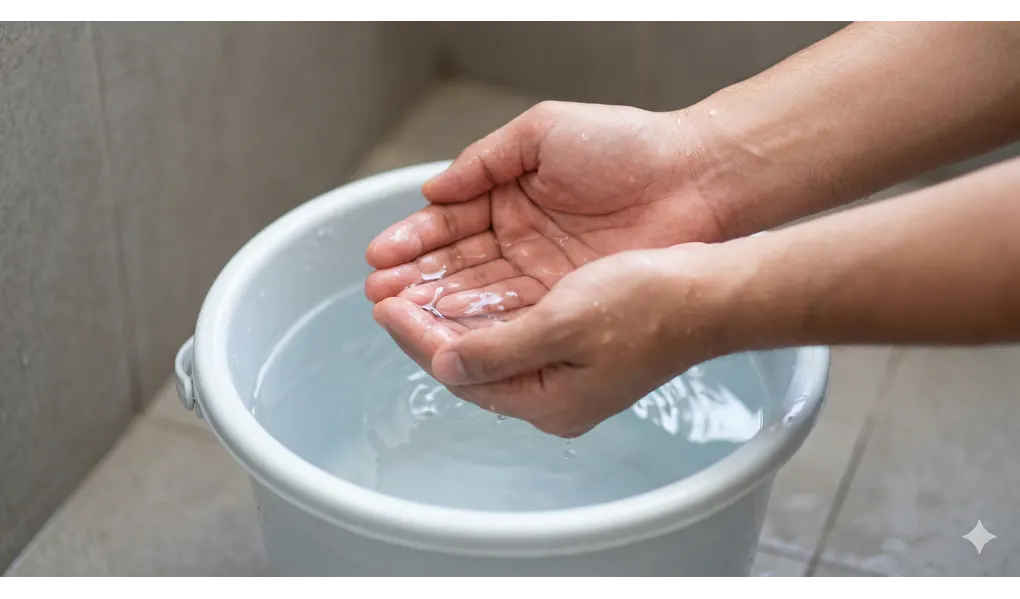
In practical daily life, confusion often occurs when using water from small containers (less than 216 liters). Here are essential tips to ensure your wudu remains valid:
- The Scooping Technique (Ightiraf): If you perform wudu from a small bucket, when you dip your hand into the water (after washing your face), you must firmly intend in your heart merely to “scoop” the water, not to “wash” your hand inside the bucket. With this specific intention, the water in the bucket does not become musta’mal.
- Beware of Splashes: Ensure that water splashing off your face or arms does not fall back into the pure bucket, as those specific splashes carry the musta’mal status.
Frequently Asked Questions (FAQ)
Is musta’mal water considered impure (najis) if it gets on my clothes?
No. Musta’mal water is legally pure (thahir). If your clothes are splashed with someone else’s used wudu water, your clothes remain clean, and it perfectly meets the conditions for a valid prayer.
What can musta’mal water be used for?
It can be used for any daily secular necessities that are not ritual worship. You can use it to wash vehicles, water plants, mop the floor, or even drink it (provided it is medically clean and safe).
Can I use musta’mal water for istinja (cleaning private parts after relieving oneself)?
No, you cannot. Using it for the concept of istinja is invalid because istinja is the act of removing physical impurities (najasah), which strictly requires the use of pure and purifying Absolute Water.
What is the fundamental difference between musta’mal and mutaghayyir water?
Musta’mal is water previously used for obligatory purification (its physical attributes usually haven’t changed). Mutaghayyir is water that has drastically changed its attributes (color/taste/smell) because it was mixed with a pure substance, like tea leaves or soap. Both share the same ruling: they are pure in themselves but cannot purify other things.
Conclusion
Understanding the types of water in Islam within Islamic jurisprudence is incredibly vital to ensure the legal validity of our worship. Always ensure you are utilizing Absolute Water (Ma’ Mutlaq) for your ritual purification. If your water supply is limited, exercise caution to prevent the water from becoming musta’mal by managing splashes or utilizing larger containers that exceed the two qullahs threshold. This foundational knowledge acts as the ultimate key to a valid thaharah, ensuring that the prayers we establish are rightfully accepted by Allah SWT.
Academic References
- al-Bughā, Muṣṭafā Dīb, ʿAlī al-Sharbajī, and Muṣṭafā al-Khin. al-Fiqh al-Manhajī ʿalá Madhhab al-Imām al-Shāfiʿī. Vol. 1. Damascus: Dār al-Qalam, 1992.
- al-Anṣārī, Zakariyā. Asnā al-Maṭālib fī Sharḥ Rawḍ al-Ṭālib. With a ḥāshiyah by Aḥmad al-Ramlī. Edited by Muḥammad al-Zuhrī al-Ghamrāwī. Cairo: al-Maṭbaʿah al-Maymānīyah, 1313 AH. Reprinted by Dār al-Kitāb al-Islāmī.


