
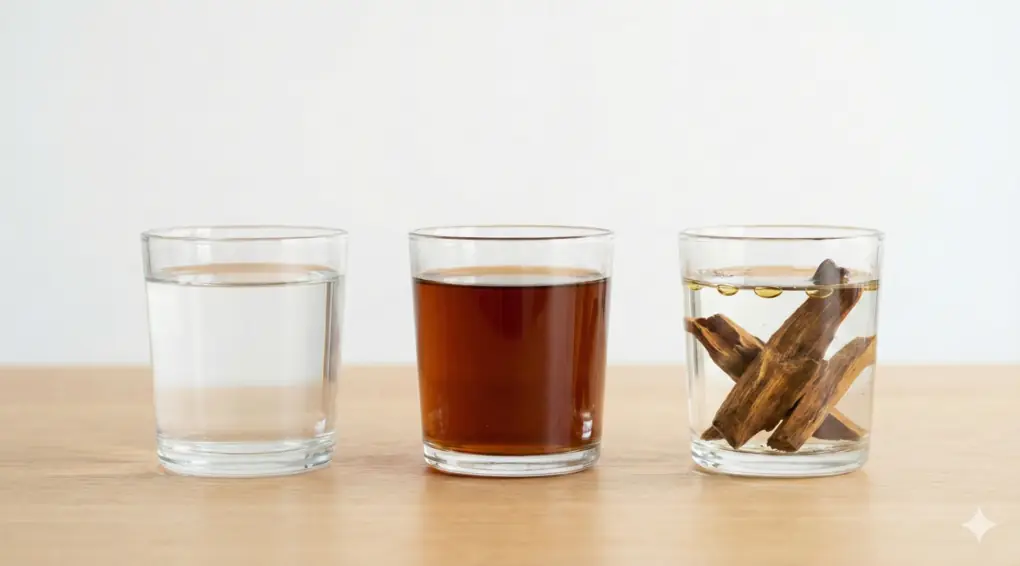
Water in a bathroom tank may carry a slight soap scent. Pond water may look green because of algae. River water may turn cloudy after rain. Such situations often raise a practical question: can this water still be used for wudu or obligatory bathing?
In Shafi’i purification law, the answer does not rest only on whether the water looks clean or changed. The cause of the change, the relationship between the substance and the water, and whether the water still qualifies as mutlaq water all matter.
This article explains mutaghayyir water in one place: its definition, the difference between mukhalith and mujawir, the method of taqdir, excused natural changes, familiar examples, and the ruling on wudu and ghusl.
What Is Mutaghayyir Water?
Linguistically, المتغيّر (al-mutaghayyir) means “that which has changed.” In purification law, it refers to water whose taste, colour, or smell has changed.
Imam Zakariyya al-Anshari writes:
«الماء المتغير طعما أو لونا أو ريحا بمخالطة طاهر يستغنى الماء عنه … تغيرا يمنعه الإطلاق غير طهور لأنه غير مطلق»
Meaning: “Water whose taste, colour, or smell changes through mixing with a pure substance that water can do without, in a way that prevents it from being called water without qualification, is not purifying because it is no longer mutlaq water.”[1]
Thus, mutaghayyir water is water changed by a pure substance in a way that removes its status as unrestricted or absolute water. A person no longer calls it simply “water,” but tea water, coffee, syrup water, or soapy water.
That name is not the sole legal test. The central question is whether the change truly prevents the water from being called mutlaq water. Still, the new name is often a useful practical sign.
When the changing substance is pure, mutaghayyir water does not automatically become impure. It may remain pure in itself, but it is no longer pure and purifying. Therefore, it cannot remove ritual impurity or cleanse najasah.
Where Does Mutaghayyir Water Fit among the Types of Water?
The following four categories must be kept distinct:
| Type of Water | Main Feature | Legal Status | Valid for Wudu and Ghusl? |
|---|---|---|---|
| Mutlaq water | Still called water without a binding qualifier | Pure and purifying | Yes |
| Mutaghayyir water | Changed by a pure mixture until it is no longer mutlaq | Pure but non-purifying | No |
| Musta’mal water | A small amount of water already used for obligatory purification | Pure but non-purifying | No |
| Impure water | Affected by najasah according to fiqh details | Impure | No |
Imam Zakariyya al-Anshari defines mutlaq water as:
«وهو العاري عن إضافة لازمة»
Meaning: “It is water free from a binding added qualification.”[2]
Rainwater, well water, river water, seawater, spring water, snow water, and dew water are mutlaq water in their original state. For a fuller explanation of these sources, read the seven types of water used for purification.
Mutaghayyir water must not be treated as identical to musta’mal water. Both can be pure but non-purifying, yet their legal causes are different.
The Three Properties Examined
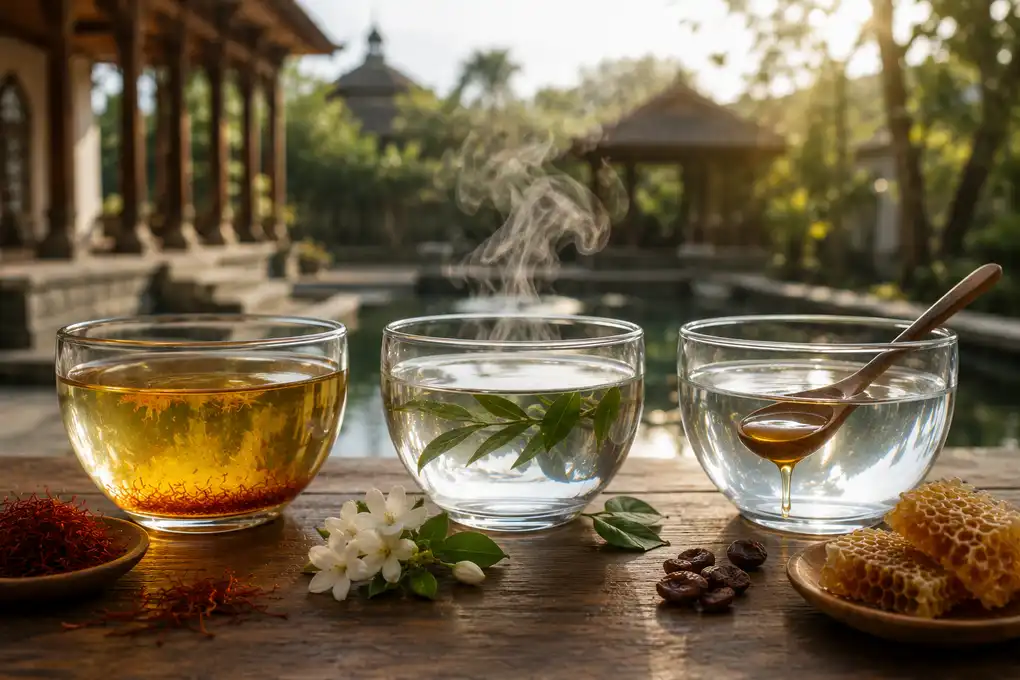
Shafi’i jurists examine change in three properties:
- Colour, such as water becoming brown through tea or coffee.
- Smell, such as water becoming strongly scented through dissolved perfume.
- Taste, such as water becoming sweet through syrup or bitter through another substance.
All three properties do not need to change at once. A legally consequential change in one property can be enough.[1]
A slight change by a pure substance, however, does not automatically alter the ruling. Imam Zakariyya al-Anshari states:
«ولا يضر تغير يسير بطاهر، ولو مخالطا لتعذر صون الماء عنه، ولبقاء إطلاق الاسم»
Meaning: “A slight change caused by a pure substance does not harm, even if it is mixed in, because protecting water from every slight effect is difficult and the unrestricted name of water remains.”[3]
Therefore, a tiny soap residue or a trace of perfume that produces no material change does not automatically turn water into mutaghayyir water.
Mukhalith: A Substance That Mixes into Water
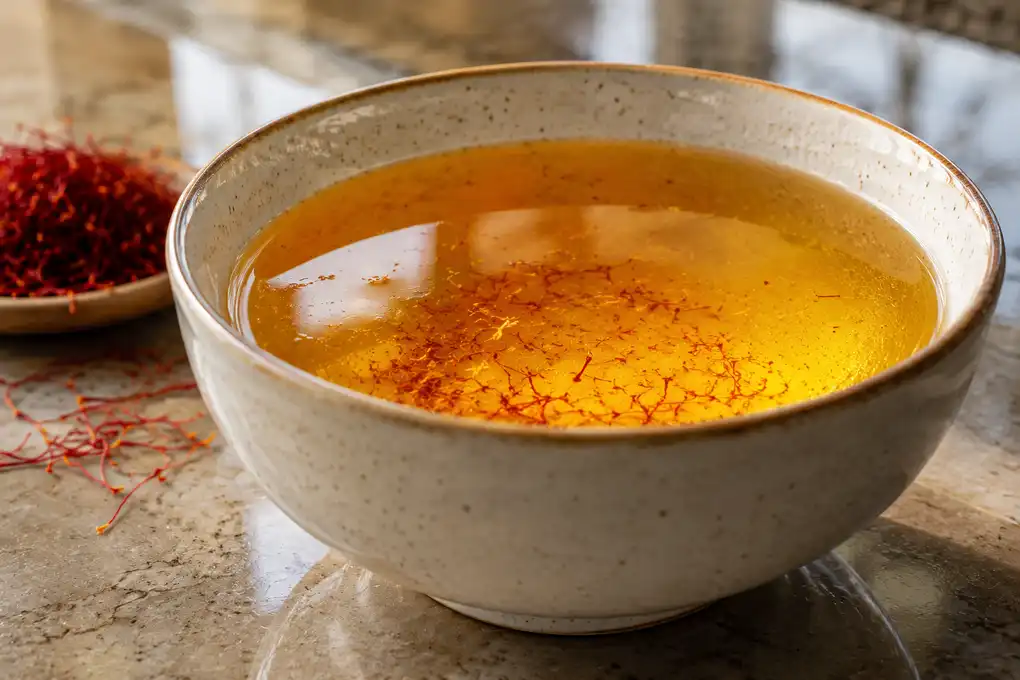
Mukhalith refers to a substance that mixes into and combines with water. The source text contrasts الخليط—a mixture—with a substance merely adjacent to the water.[4]
A mukhalith substance can affect the ruling when:
- the substance is pure; and
- it changes the water enough that the unrestricted name of water no longer applies.
The text gives the examples:
«كالمني، والزعفران»
Meaning: “Such as semen and saffron.”[1]
In everyday applications, the same principle may apply to tea, coffee, syrup, liquid soap, liquid fragrance, herbal infusions, liquid medicine, or dissolved colouring.
Examples of Mutaghayyir Water Caused by Mukhalith
The following are examples when the change is clear:
- tea water;
- coffee water;
- syrup water;
- soapy water with clear foam or scent;
- rose water or water mixed with liquid fragrance;
- herbal infusions and leaf decoctions;
- pool water with dissolved colouring that clearly changes its colour;
- flower-infused water when the flowers break down or dissolve and affect the water.
These examples do not mean that any trace of such a substance immediately prevents purification. When the mixture is minimal and does not produce a consequential change, the original ruling remains.[3]
Taqdir: When the Change Cannot Be Seen
Sometimes a pure substance mixes with water but shares the same apparent characteristics. The source text gives the example of rose water whose fragrance has disappeared. In such a case, jurists use taqdir, a legal estimate.
Imam Zakariyya al-Anshari writes:
«فلو لم يغيره الطاهر المذكور لموافقته الماء في صفاته كماء الورد المنقطع الرائحة فرضناه مخالفا له فيها … وسطا في الصفات كلون العصير، وطعم الرمان، وريح الأذن»
Meaning: “If the pure substance does not change the water because it resembles water in its properties, such as rose water whose fragrance has ceased, it is assumed to differ from water by a moderate standard: like the colour of juice, the taste of pomegranate, and the smell of the ear.”[3]
Taqdir is not an invitation to speculation. It is used for cases that cannot be assessed by ordinary observation because the mixture resembles water in colour, smell, or taste.
If the mixture makes no difference in direct observation or legal estimation, the text states:
«فلو لم يؤثر فيه الخليط حسا أو فرضا استعمله كله»
Meaning: “If the mixture has no effect on it, perceptibly or by estimation, all of the water may be used.”[3]
Mujawir: A Substance Merely Adjacent to Water
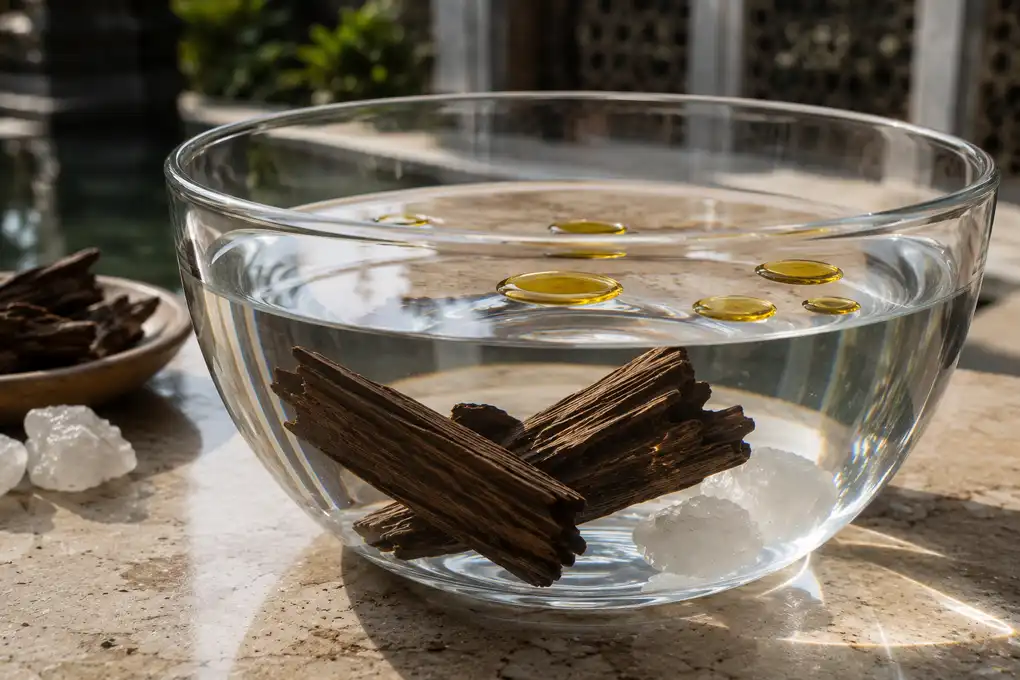
Mujawir means a substance beside or adjacent to water, rather than a substance that has mixed into it. It remains distinguishable from the water or can be separated from it.
Imam Zakariyya al-Anshari explains:
«ولا يضر تغير كثير بمجاوره كعود، ودهن، ولو مطيبين، وكافور صلب»
Meaning: “Even a substantial change caused by something adjacent to water does not harm, such as wood, oil—even when scented—and solid camphor.”[4]
He also provides a criterion:
«والمجاور ما يتميز في رأي العين، وقيل ما يمكن فصله بخلاف الخليط»
Meaning: “An adjacent substance is what can be distinguished by sight. It is also said to be what can be separated, unlike a mixture.”[4]
Examples include floating oil, scented wood, and solid camphor. These substances may affect the smell around the water, but they do not dissolve into it.
Consequently, water that smells of solid camphor nearby does not automatically become mutaghayyir. The same applies to scented oil floating on the surface. This differs from liquid perfume that dissolves throughout the water.
Excused Changes in Water
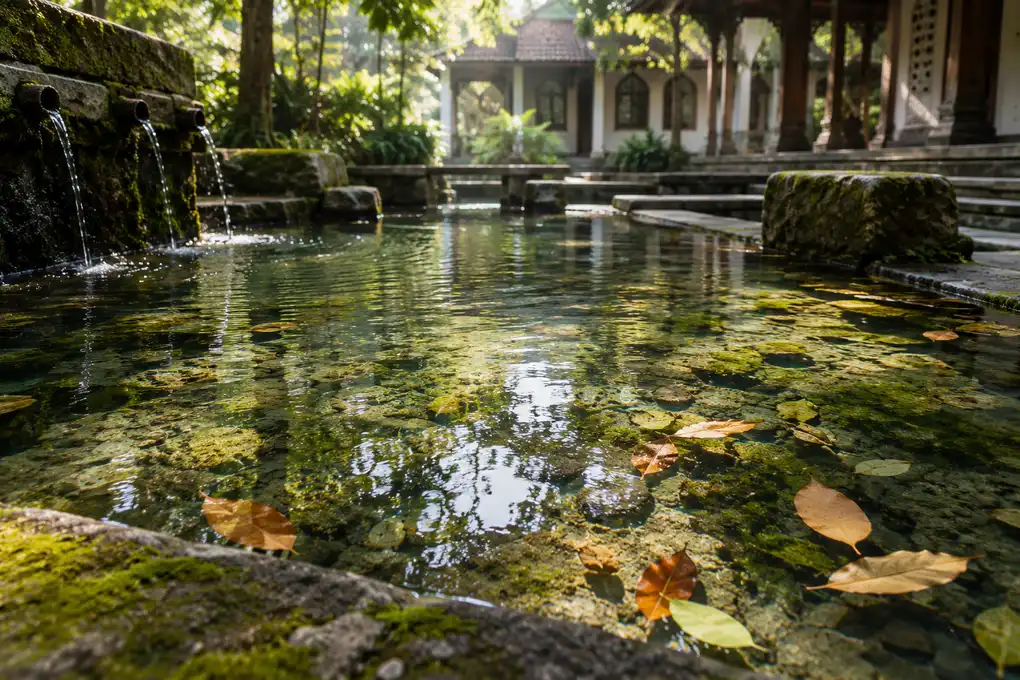
Some changes do not remove the status of mutlaq water because they are difficult to avoid. This principle helps prevent unnecessary doubt about well water, pond water, and river water.
Water Left Standing for a Long Time
Water may change in smell after remaining in a tank, pond, or container for a long period. Imam Zakariyya al-Anshari says:
«ولا بمكث»
Meaning: “Nor [does it lose its ruling] due to remaining still for a long time.”[5]
Water that has stood for a long time does not automatically become mutaghayyir. Its change must be distinguished from a change caused by an external pure substance that mixes into it.
Algae, Soil, and Water’s Course
Naturally growing algae, soil at the bottom of a river, and elements from the water’s course are generally excused.
«ولا بما لا يستغنى الماء عنه في ممره، ومقره كطحلب»
Meaning: “Nor [does it lose its ruling] because of what water cannot avoid in its course and place of settlement, such as algae.”[5]
Cloudy river water after rain or well water with a slight earthy quality does not automatically become unusable. The source explains:
«ولأن تغيره به مجرد كدورة، وهي لا تسلب الطهورية»
Meaning: “Its change by soil is merely cloudiness, and cloudiness does not remove purifying status.”[5]
There is a limit: when water changes so extensively that it is no longer called water but wet mud, it cannot be used for purification.[5]
Naturally Fallen Leaves


Leaves that fall naturally, break down, and mix with water are excused when they are difficult to avoid.
«وأوراق شجر تناثرت، وتفتتت»
Meaning: “And tree leaves that have scattered and broken apart.”[5]
This differs from leaves deliberately boiled, crushed, or added as a mixture. When a leaf is intentionally used as an ingredient and materially changes the water, the water can become mutaghayyir.
Intact leaves floating on the water do not automatically affect the ruling because they remain closer to mujawir substances that can be separated.[5]
Water Salt and Soil
The text also states:
«وكذا إن تغير كثيرا بملح مائي، وتراب مطروح فإنه طهور»
Meaning: “Likewise, if water changes considerably through water salt or added soil, it remains purifying.”[5]
The “water salt” in this passage has a specific legal context. The safer practical point is not to classify every cloudy or salty water as mutaghayyir.
Seawater remains pure and purifying. The Prophet ﷺ said:
«هُوَ الطَّهُورُ مَاؤُهُ الْحِلُّ مَيْتَتُهُ»
Meaning: “Its water is pure and purifying, and its dead animals are lawful.”[6]
Wudu and Ghusl with Mutaghayyir Water
Both wudu and obligatory ghusl require mutlaq water. Imam Zakariyya al-Anshari writes:
«لا يجوز رفع حدث، ولا إزالة نجس إلا بالماء المطلق»
Meaning: “Ritual impurity may not be removed, and najasah may not be cleansed, except with mutlaq water.”[2]
Therefore, wudu with tea water, coffee water, syrup water, soapy water, or scented water that has materially changed is not valid. Such water no longer performs the function of purification.
The same applies to obligatory ghusl. The water used for the obligatory act must remain mutlaq water. Soap may be used for bodily cleaning, but the water used to remove major ritual impurity must still qualify as mutlaq water.
Mutaghayyir water should not be equated with impure water. Water changed by a pure substance can remain pure in itself, although it cannot purify. Water changed by najasah belongs to a separate discussion on impure water and how it may be purified.
A Quick Method for Assessing Changed Water
When water changes in colour, smell, or taste, ask five questions:
- Did the change come from a pure substance or from najasah?
- Did the substance dissolve and combine with the water as mukhalith?
- Or is it merely beside the water as mujawir?
- Is the change slight, or has it removed the unrestricted name of water?
- Is the change difficult to avoid, such as algae, soil, fallen leaves, water’s course, or long standing?
This method makes the issue easier to apply without falling into unnecessary doubt. Tea water and clearly soapy water are not mutlaq water. Water scented by solid camphor nearby does not automatically change its ruling. Well water with a slight earthy quality and river water clouded by natural mud are also not automatically mutaghayyir.
FAQ
What is mutaghayyir water?
Mutaghayyir water is water whose colour, smell, or taste changes through a pure substance that can be avoided, and the change removes its status as mutlaq water.
It is not automatically impure, but it cannot be used for wudu, obligatory ghusl, or removing najasah.
What is the difference between mukhalith and mujawir?
Mukhalith is a substance that dissolves into or combines with water. If it materially changes the water, it can make the water mutaghayyir.
Mujawir is a substance merely adjacent to water and still distinguishable or separable, such as floating oil, scented wood, or solid camphor.
Can soapy water be used for wudu?
No, when the soap materially changes the water so that it is called soapy water. In that condition, the water is no longer mutlaq.
When soap residue is minimal and does not materially change the water, the original ruling remains.
Are tea and coffee water mutaghayyir?
Yes, when tea or coffee clearly changes the water’s colour, smell, or taste. The water does not automatically become impure, but it is not used for purification.
Is water changed by algae or fallen leaves still valid for purification?
Generally, yes. Algae, soil, naturally fallen leaves, and changes caused by the water’s course or place of settlement are excused when difficult to avoid and when the water is still called water.
Is dew water mutaghayyir?
Not in its original state. Dew is naturally occurring water and remains mutlaq water unless it mixes with something that materially changes its properties.
Footnotes
Reference
Zakariyā al-Anṣārī, Asnā al-Maṭālib fī Sharḥ Rawḍ al-Ṭālib, with a ḥāshiyah by Aḥmad al-Ramlī, edited by Muḥammad az-Zuhrī al-Ghamrāwī (Cairo: al-Maṭbaʿah al-Maymānīyah, 1313 AH; repr. Dār al-Kitāb al-Islāmī), vol. 1, pp. 5-9.


