Understanding the Levels of Niyyah in Salah: A Shafi’i Fiqh Guide
Illustration representing the levels of intention in prayer based on the classical fiqh books Safinatun Naja and Nailur Raja.

Have you ever experienced doubt during your opening takbir? Wondering if your heart’s intention is correct and if your prayer is truly valid? These questions frequently arise among Muslims because intention is the fundamental foundation of worship. Without the proper intention, the physical movements of prayer are merely routine exercise. In the study of Shafi’i … Read more
Complete Guide to Salat al-Tawbah Nasuha: Evidence, Procedure, and Supplications According to Kitab Al-Bujairimi

A Muslim man or woman in modest attire (hijab and covering the aurat) sitting in a quiet, sunlit corner of a mosque or prayer room. They are in a state of deep reflection or holding their hands in a quiet dua.

Every human being is susceptible to error. In the framework of Islamic jurisprudence (fiqh), it is understood that no one is immune to sin, whether committed intentionally or inadvertently. However, the hallmark of a true believer is the immediate return to Allah’s grace after a transgression. The doors of Divine forgiveness are perpetually open, and … Read more

5 Conditions for a Valid Prayer According to Fathul Qarib: A Complete Guide

Illustration showing the five conditions for valid prayer according to the classical fiqh book Fathul Qarib.

Have you ever felt doubtful after completing your worship, wondering, “Was my prayer valid?” or “Are my clothes truly pure?” These questions naturally arise because every Muslim profoundly desires their worship to be accepted by Allah SWT. Prayer (Salah) is not merely a sequence of standing, bowing, and prostrating. There is an essential “entry ticket” … Read more

The Complete Guide to Proper Sujud: Posture and Supplications in Prayer

Muslim man performing sujud in prayer illustrating the proper method and recitation according to the Shafiβ€˜i school of Islamic jurisprudence.

Prostration (Sujud) is not merely the physical act of placing one’s forehead on the floor. Within Islamic prayer, it represents the most sacred moment where a servant is intimately close to their Lord. However, we often find ourselves wondering: are we performing a proper Sujud? Are the supplications we recite accurate? Understanding the correct methodology … Read more

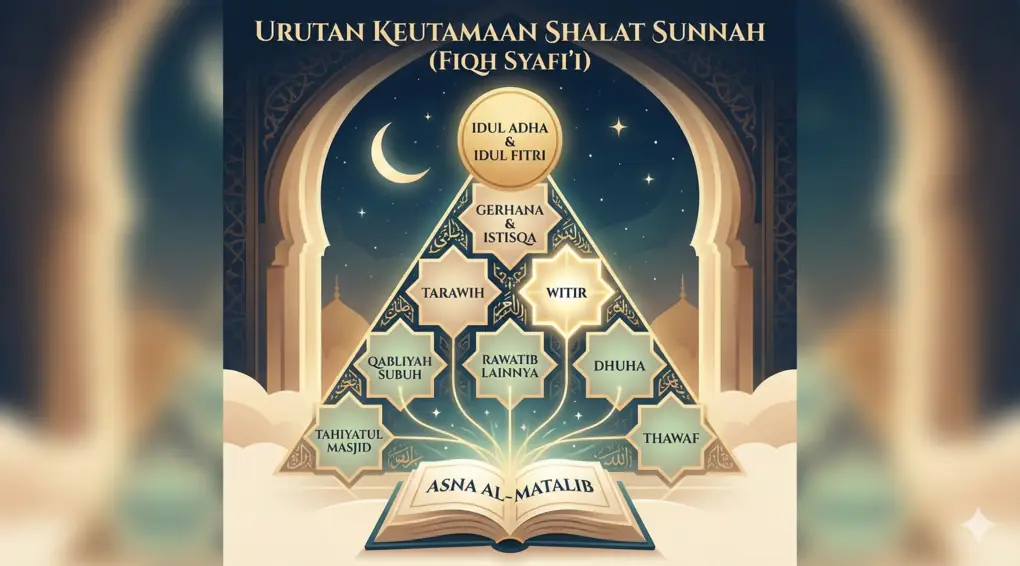
The Hierarchy of Sunnah Prayers: Priorities in the Shafi’i Madhhab

An infographic pyramid diagram displaying the hierarchy of merit for Sunnah prayers according to Shafi'i Fiqh, sourced from the book Asna al-Matalib. The highest rank at the peak features Eid al-Adha and Eid al-Fitr. The middle tier includes Eclipse prayers (Kusuf), Rain prayer (Istisqa), Tarawih, and Witr. The base level contains Qabliyah Subuh, other Rawatib, Duha, Tahiyatul Masjid, and Tawaf prayers. The background features Islamic architecture and a night sky.

Have you ever felt that time is too short while your desire to increase worship is immense? In our daily lives, we are often faced with choices. During Ramadan, for instance, should one prioritize Tarawih prayers or ensure the completion of the Ba’diyyah Isha (post-Isha sunnah)? Or in the morning, is the Dhuha prayer more … Read more

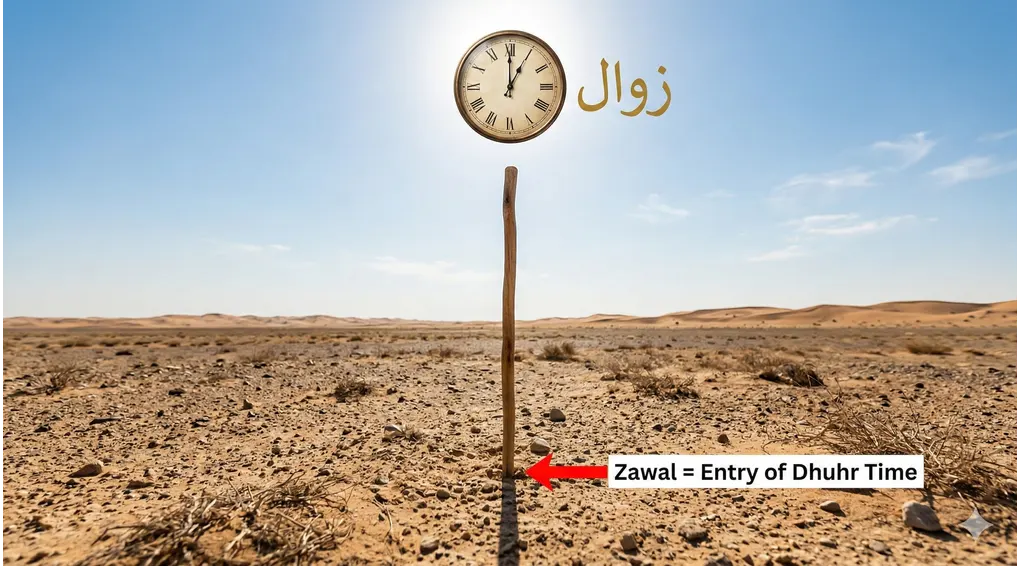
Dhuhr Prayer Time: From Natural Signs to the Final Limits

A realistic illustration of a wooden stick standing in an open field at high noon (zawal) with a shadow beginning to lengthen towards the east, featuring an analog clock and Arabic text "Zawal" in the sky.

Have you ever wondered if the Dhuhr prayer time has officially begun just by looking at the sun directly overhead? In our modern era, digital schedules are incredibly helpful. However, understanding the natural signs used to determine prayer times is a fundamental and invaluable skill. Relying on nature is not merely a backup plan for … Read more

Salah or Fasting: Which is the Best Physical Worship According to Fiqh?

Illustration comparing prayer and fasting as acts of worship in Islamic jurisprudence, symbolized by a balance scale with the Quran and dates.

Have you ever wondered, when you have free time, whether it is better to perform more voluntary prayers or observe more voluntary fasting? When seeking closeness to Allah, many believers wonder what constitutes the best physical worship. This question frequently arises in the minds of those who wish to elevate their spiritual rank but feel … Read more

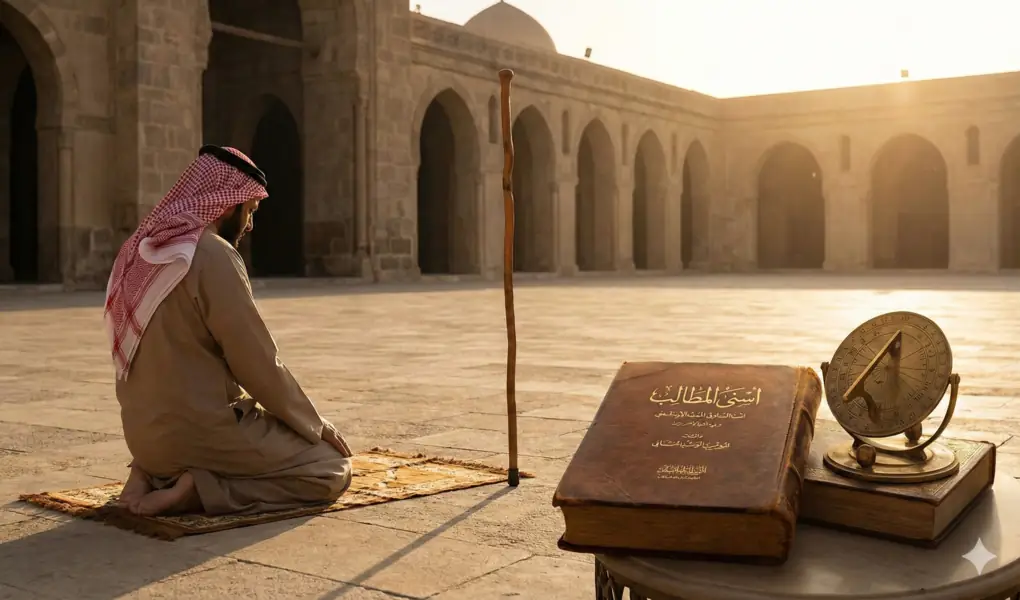
Asr Prayer Time Guide: Shafi’i Fiqh Explanation (Asna al-Matalib)

A Muslim man in traditional attire is performing the αΉ£alāh in the courtyard of an ancient mosque at sunset, with a shadow-indicating staff, an ancient book inscribed with " Ψ£Ψ³Ω†Ω‰ Ψ§Ω„Ω…Ψ·Ψ§Ω„Ψ¨ " (Asna al-Matalib), and a sundial before him.

For Muslims, knowing the time limits of prayer is not merely a matter of looking at a digital clock or hearing the Adhān from an application. Understanding the signs of nature, such as the movement of the sun and the length of shadows, is a fundamental and highly valuable science. Specifically within the Shafi’i School … Read more

The True Meaning of Salawat and Its Ruling: The Key to Valid Prayer

An illustration of an open classical Islamic manuscript glowing with light, displaying the Arabic calligraphy **β€œαΉ’allallāhu ΚΏalayhi wa sallam”** and text explaining the meaning and ruling of sending blessings upon the Prophet, set against a reverent mosque atmosphere.

We frequently hear the call to send blessings, especially whenever the name of Prophet Muhammad ο·Ί is mentioned. For some, this might be perceived as a mere verbal routine or lip service. However, have you ever considered that this invocation carries profound legal weight in Islamic jurisprudence? Understanding the true meaning of Salawat is not … Read more

The End of Maghrib Time: Asna al-Matalib’s Explanation on Shafaq Ahmar

Illustration showing the final time limit of Maghrib prayer based on the disappearance of the red twilight (syafaq ahmar).

Have you ever felt anxious while performing the Maghrib prayer, fearing that the time was running out? A common assumption circulates within society that the Maghrib time is incredibly narrowβ€”only sufficient for the Adhan and Iqamah, ablution (wudu), performing five rak’ahs of prayer, and eating a quick bite. Once completed, the time is supposedly over. … Read more