
Have you ever wondered if the Dhuhr prayer time has officially begun just by looking at the sun directly overhead? In our modern era, digital schedules are incredibly helpful. However, understanding the natural signs used to determine prayer times is a fundamental and invaluable skill. Relying on nature is not merely a backup plan for when our phone batteries die; it is a profound way to ensure the legal validity of our worship according to traditional Islamic jurisprudence (fiqh).
This article will comprehensively explore the Dhuhr prayer time, from its exact starting point to its final deadline. We will base our analysis on the authoritative classical texts of the Shafi’i school, specifically Asna al-Matalib and the Hasyiyah (marginalia) of Imam Ar-Ramli.
When Does the Dhuhr Prayer Time Actually Begin?
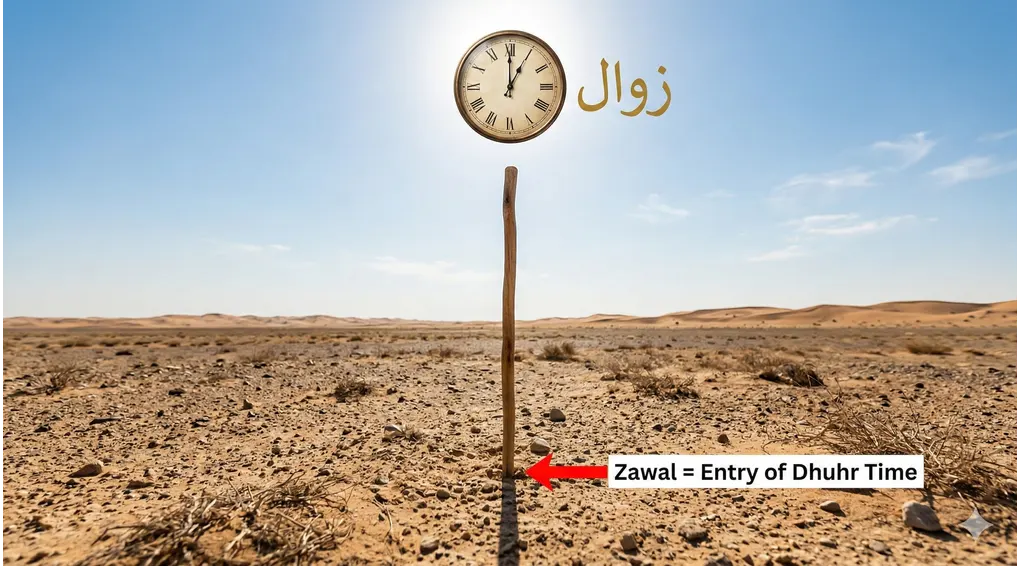
Zawal (the sun’s decline from its zenith) is the absolute definitive sign that the Dhuhr prayer time has entered. You do not need to wait for the shadow to significantly lengthen; the very moment the sun shifts westward, the time has begun.
Many people ask about the exact clock time for Dhuhr. The answer fluctuates daily due to the earth’s changing position relative to the sun. However, the physical benchmark in Fiqh remains perfectly consistent.
The text Asna al-Matalib clarifies this moment precisely:
قوله: (وَأَوَّلُ وَقْتِ الظُّهْرِ زَوَالُ الظِّلِّ) يَعْنِي زِيَادَتَهُ بَعْدَ اسْتِوَاءِ الشَّمْسِ أَيْ انْتِهَائِهَا إلَى وَسَطِ السَّمَاءِ
“And the beginning of the time for Dhuhr is the shifting of the shadow, meaning its increment after the sun’s culmination, which is its arrival at the exact middle of the sky.”
Therefore, the primary indicator is Zawal. This is the moment when the sun “slips” or shifts slightly to the west after reaching its highest point (the zenith).
If you place a stick vertically on an open, flat ground at high noon, its shadow will reach its shortest point (or disappear entirely, depending on your latitude). The instant that shadow begins to reappear or lengthen towards the east, the Dhuhr prayer time has officially started, bringing with it the obligation to prepare for worship.
The Myth of Waiting for the Sandal-Strap Shadow
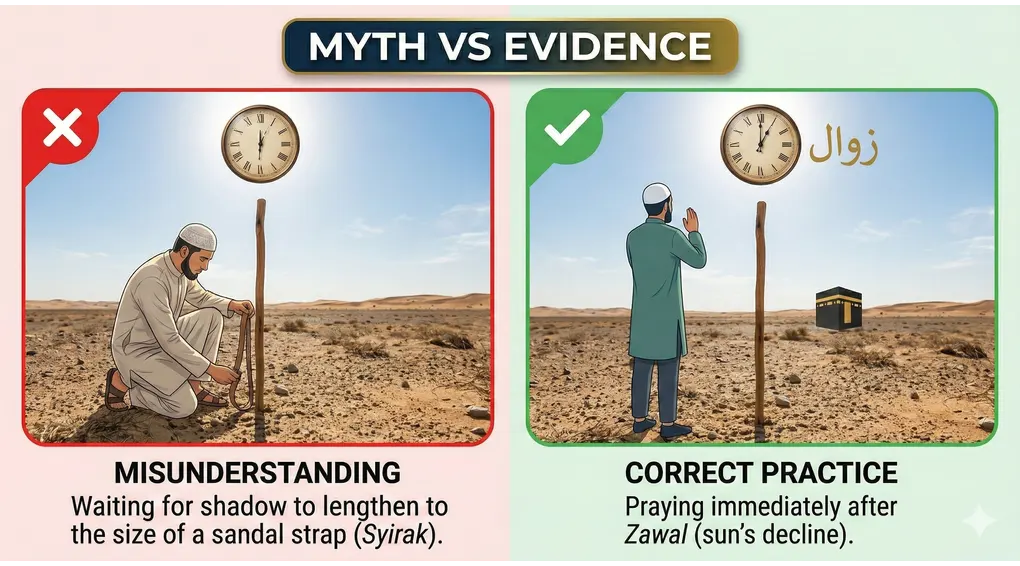
A common misconception in some communities dictates that one must wait until the shadow lengthens to the size of a sandal strap (syirak) before praying Dhuhr. Imam Ar-Ramli rectifies this misunderstanding in his marginalia:
وَهُوَ يَقْتَضِي جَوَازَ فِعْلِ الظُّهْرِ إذَا زَالَتْ الشَّمْسُ وَلَا يَنْتَظِرُ بِهَا وُجُوبًا وَلَا نَدْبًا مَصِيرَ الْفَيْءِ مِثْلَ الشِّرَاكِ
“This necessitates the permissibility of performing Dhuhr immediately when the sun declines (zawal), and one does not wait—neither as an obligation nor as a recommendation—for the shadow to become the length of a sandal strap.”
This means that the moment you are certain the sun has passed its absolute peak, the time has entered. Delaying the prayer is unnecessary.
Until What Time is Dhuhr Valid?
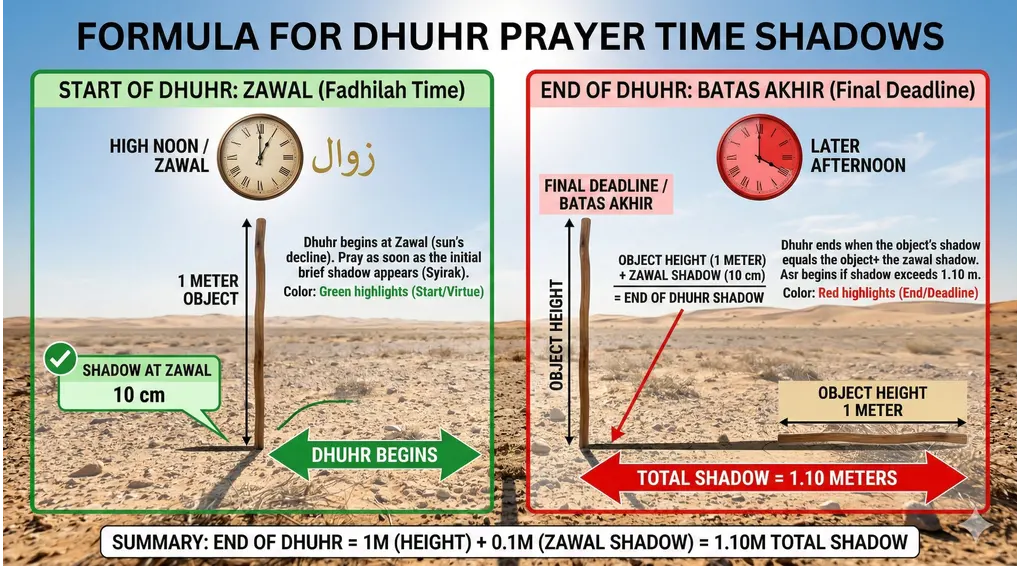
This leads to the most frequently asked question: when does the Dhuhr prayer time end? Does it stretch until 3 PM or 4 PM? Instead of relying on clock hours, which vary by geographical location, Islamic jurisprudence provides an exact formula using shadows.
(إِلَى أَنْ يَصِيرَ ظِلُّ الشَّيْءِ مِثْلَهُ غَيْرَ ظِلِّ الِاسْتِوَاءِ)
“Until the shadow of an object becomes equal to it, excluding the shadow of the zenith.”
The formula is elegantly simple: End of Dhuhr = Height of the Object + Length of the Shadow at High Noon (Zawal).
For example, imagine your yard fence is exactly 1 meter tall. Check the fence’s shadow precisely at noon. In regions near the equator, there is often a slight residual shadow, let’s say 10 centimeters. The time for Dhuhr will expire when the fence’s shadow reaches 1 meter + 10 cm = 110 centimeters.
Once the shadow exceeds this combined length, the Asr prayer time has officially begun.
Friday Prayer Considerations
On Fridays, the standard Dhuhr prayer is replaced by the Jumu’ah (Friday) prayer for obligated males. The starting time for Jumu’ah is identical to the regular Dhuhr prayer time. When the preacher ascends the pulpit and the muadhin calls the adhan, it signifies that the time has entered and attending the prayer is strictly obligatory. Trade and mundane work must immediately cease.
The Importance of Absolute Certainty (Yaqin)
This point is crucial yet frequently overlooked. The legal validity of our prayer heavily relies on absolute certainty (yaqin) regarding the time. Imam Ar-Ramli issues a strict warning:
فَلَوْ شَرَعَ فِي التَّكْبِيرِ قَبْلَ ظُهُورِ الزَّوَالِ ثُمَّ ظَهَرَ أَيْ الزَّوَالُ عَقِبَ التَّكْبِيرِ فِي أَثْنَائِهِ لَمْ يَصِحَّ الظُّهْرُ
“If one were to begin the takbir before the manifestation of the zawal (time entry), and then the zawal became apparent immediately following the takbir or during it, the Dhuhr prayer is invalid.”
Imagine guessing, “I think it’s time for Dhuhr,” and beginning your prayer. Even if your guess turns out to be factually correct, your prayer remains legally invalid according to Fiqh. Why? Because at the moment of the opening Takbir, you lacked absolute certainty. Thus, confirming the time is one of the most vital conditions for the validity of prayer. Always verify the natural signs or a trusted schedule before praying.
Phases of the Dhuhr Prayer Time
To facilitate better time management for worship, scholars divide the Dhuhr prayer time into several distinct phases. Here is the breakdown according to the majority of scholars and Al-Qadhi Husain:
| Time Category | Brief Explanation | Estimated Shadow Limit |
| Time of Virtue (Fadhilah) | The earliest time, immediately after the adhan. | The object’s shadow is less than 1/4 of its height. |
| Time of Choice (Ikhtiyar) | A highly acceptable window for performing the prayer. | The shadow is between 1/4 and 1/2 of the object’s height. |
| Time of Permissibility (Jawaz) | The time where prayer is still valid without incurring sin. | The shadow is more than 1/2 up to the exact height of the object. |
| Time of Excuse (‘Udzur) | Exclusively for those combining prayers (Jamak Ta’khir). | Performed during the time of Asr. |
This table illustrates that while the Dhuhr prayer time is relatively long, delaying it to the absolute end (Jawaz) is not the optimal choice unless pressed by unavoidable circumstances.
Frequently Asked Questions (FAQ)
How do I determine the Dhuhr prayer time on a cloudy day?
If the sun is entirely obscured, you may rely on a calibrated clock aligned with a trusted Islamic prayer schedule. If you are in the wilderness without instruments, scholars state you must exercise ijtihad (personal judgment) based on routine instincts—such as feeling hunger or finishing a habitual task—though this requires practice and specific knowledge.
Does the Dhuhr time include the prohibited times for prayer?
No. The moment the sun is exactly at its peak (istiwa) is actually a prohibited time for prayer (with exceptions like Fridays or within the Haram of Mecca). However, the instant the sun declines (zawal), that prohibition lifts, and the Dhuhr prayer time begins.
If I pray at the very end of Dhuhr, and Asr time enters during my second rak’ah, is my prayer valid?
Yes, it is perfectly valid. If you manage to complete at least one full rak’ah within the designated time of Dhuhr, the entire prayer is considered ada’ (performed on time), not qadha (made up). However, deliberately delaying the prayer to this extreme limit without a valid excuse is considered sinful (Waktu Hurmah).
Why do classical Fiqh manuals start the chapter on prayer times with Dhuhr instead of Fajr?
Imam Ar-Ramli explains that Dhuhr was the very first prayer that the Angel Jibril practically demonstrated to Prophet Muhammad ﷺ at the Kaaba, even though the obligation for the five daily prayers descended earlier during the Night Journey (Isra’ Mi’raj).
Conclusion
Understanding how to determine the Dhuhr prayer time by observing natural signs provides immense spiritual tranquility. We are no longer anxious about whether a smartphone application is malfunctioning. By grounding our worship in the enduring wisdom of classical texts, we ensure our prayers are both punctual and legally sound. Always strive to verify the sun’s position or consult a reliable schedule to establish your prayers perfectly on time.
Reference
al-Anṣārī, Zakariyā. Asnā al-Maṭālib fī Sharḥ Rawḍ al-Ṭālib. Dengan ḥāsyiyah Aḥmad al-Ramlī. Disunting oleh Muḥammad az-Zuhrī al-Ghamrāwī. Kairo: al-Maṭbaʿah al-Maymānīyah, 1313 H. Dicetak ulang oleh Dār al-Kitāb al-Islāmī.


