

Have you ever heard someone initiate a conversation with the phrase, “I don’t mean to speak ill of them, but this is just a fact…”? Be extremely cautious; such “savior” sentences frequently serve as the gateway to one of the most severely underestimated major sins humanity commits: Ghibah (backbiting).
In Islam, safeguarding the tongue is fundamentally one of the master keys to salvation in both this world and the Hereafter. However, what exactly is ghibah? Why is ghibah so vehemently prohibited by the religion, to the terrifying extent that it is explicitly equated with devouring the putrid, dead flesh of a human being?
This comprehensive article will thoroughly dissect the precise definition of ghibah in Islam, present authentic hadiths (complete with Arabic text and meanings), and dissect highly practical methods to avoid backbiting, entirely based on the profound explanations of Imam Al-Ghazali in his legendary magnum opus, Ihya’ ‘Ulum al-Din. To understand how this fits into the broader framework of Islamic law, you can explore the 4 primary sources of Islamic law.
What is the True Meaning of Ghibah in Islam?
A massive number of people mistakenly equate ghibah (backbiting) with fitnah (slander). They defensively argue, “But wait, I am just stating the facts!” In reality, it is precisely because it is a fact that it is classified as ghibah.
The Definition of Ghibah According to the Messenger of Allah ﷺ
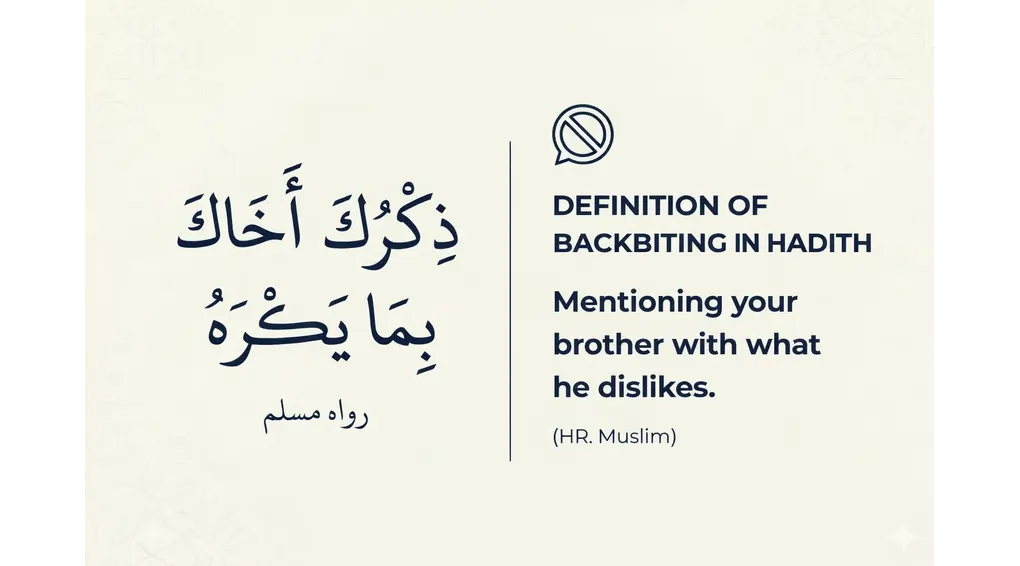
The true meaning of ghibah is discussing others regarding matters they would despise if they were to hear it. This definition is not the mere fabrication of later scholars; it is the direct, authoritative speech of Prophet Muhammad ﷺ.
In an authentic (sahih) hadith narrated by Imam Muslim, the Messenger of Allah ﷺ asked his companions:
أَتَدْرُونَ مَا الْغِيبَةُ? قَالُوا: اللهُ وَرَسُولُهُ أَعْلَمُ, قَالَ: ذِكْرُكَ أَخَاكَ بِمَا يَكْرَهُ
“Do you know what ghibah is?” They replied, “Allah and His Messenger know best.” He said, “It is mentioning your brother with that which he dislikes.”
A companion then inquired, “What if what I say about him is actually true?” The Prophet ﷺ responded:
إِنْ كَانَ فِيهِ مَا تَقُولُ, فَقَدِ اغْتَبْتَهُ, وَإِنْ لَمْ يَكُنْ فِيهِ فَقَدْ بَهَتَّهُ
“If what you say about him is true, then you have backbitten him (committed ghibah). And if it is not true, then you have slandered him (committed buhtan).” (Narrated by Muslim)
The Boundaries of Ghibah According to Imam Al-Ghazali
Imam Al-Ghazali, in Ihya’ ‘Ulum al-Din, profoundly clarifies and expands upon this definition. He writes the definitive boundary of ghibah:
اعْلَمْ أَنَّ حَدَّ الْغِيبَةِ أَنْ تَذْكُرَ أَخَاكَ بِمَا يَكْرَهُهُ لَوْ بَلَغَهُ
“Know that the strict boundary of ghibah is that you mention your brother with things he would dislike if they were to reach him.”
The scope is terrifyingly vast, encompassing flaws relating to:
- Physicality: Being short, having dark skin, or having a squint.
- Lineage: Being the child of a lowly person, or coming from a backward village.
- Character: Being stingy, arrogant, or quick-tempered.
- Religion: Rarely praying, or being a transgressor (fasiq).
- Worldly Affairs: Eating too much, sleeping constantly, or wearing ugly clothes.
Therefore, what is meant by ghibah encompasses absolutely everything—from physical attributes to the clothes on their back—that, if the person knew it was being discussed, would cause them emotional pain.
What is the Difference Between Ghibah, Buhtan, and Valid Criticism?
We frequently rationalize our actions by stating, “I am saying this as a critique so they will realize their mistake.” However, Imam Al-Ghazali issues a severe warning. The boundary separating valid criticism (advice/naseehah) from ghibah is as exceptionally thin as the hidden intention within the heart.
Below are the stark differences based on Imam Al-Ghazali’s profound explanations:
| Term | Definition & Conditions | Islamic Legal Status |
| Ghibah | Discussing the factual flaws of another behind their back with the intent to degrade, or merely for casual chatter. | Haram (Major Sin) |
| Buhtan | Discussing the flaws of another that are entirely fabricated/untrue. | Haram (Severe Slander) |
| Naseehah (Critique) | Conveying a brother’s mistake directly to them with the pure intent to correct, done in absolute secrecy and with profound compassion. | Obligatory/Highly Recommended |
Al-Ghazali’s Conditions for Criticism to be Valid Naseehah (Not Ghibah)




In Ihya’ ‘Ulum al-Din, Imam Al-Ghazali inscribes the golden rule for correcting the mistakes of others so one does not plunge into ghibah or the subtle deceptions of Satan:
وَمَهْمَا عَرَفْتَ هَفْوَةَ مُسْلِمٍ بِحُجَّةٍ فَانْصَحْهُ فِي السِّرِّ
“And whenever you come to know of the slip (mistake) of a Muslim with clear proof, then advise him in absolute secrecy.”
Al-Ghazali continues with a deeply psychological warning regarding the true signs of sincere advice:
1. You Must Not Feel Pleasure in Seeing Their Mistake
Do not allow Satan to thoroughly deceive you. If you reprimand someone, ruthlessly interrogate your own heart:
وَلَا تَعِظْهُ وَأَنْتَ مَسْرُورٌ بِاطِّلَاعِكَ عَلَى نَقْصِهِ لِيَنْظُرَ إِلَيْكَ بِعَيْنِ التَّعْظِيمِ وَتَنْظُرَ إِلَيْهِ بِعَيْنِ الِاسْتِحْقَارِ
“And do not advise him while you are secretly pleased by your discovery of his flaw, desiring that he looks at you with an eye of veneration and you look at him with an eye of contempt.” If there is even a sliver of “satisfaction” or feeling “holier” when criticizing, it is not advice; it is destructive arrogance.
2. The Heart Must Feel Genuine Sorrow (Empathy)
Islamic criticism is fundamentally born from sorrow, not an enthusiastic zeal to condemn.
وَلْيَكُنْ قَصْدُكَ تَخْلِيصَهُ مِنَ الْإِثْمِ وَأَنْتَ حَزِينٌ كَمَا تَحْزَنُ عَلَى نَفْسِكَ
“Your sole intention must be to save him from sin, while you are grieving (because he sinned) exactly as you would grieve if that flaw existed within yourself.”
3. Preferring They Change Without Our Intervention
This is the absolute highest pinnacle of sincerity (ikhlas) when criticizing.
وَيَنْبَغِي أَنْ يَكُونَ تَرْكُهُ لِذَلِكَ مِنْ غَيْرِ نُصْحِكَ أَحَبَّ إِلَيْكَ مِنْ تَرْكِهِ بِالنَّصِيحَةِ
“And it should be that his abandonment of that (sin) without your advice is vastly more beloved to you than his abandoning it because of your advice.”
Meaning, if the person realizes their mistake independently without us needing to reprimand them, we should be exponentially happier. If we feel an “itch” to reprimand just so we can be hailed as a hero or a wise sage, that is our own ego (nafs), not Islamic da’wah.
Therefore, openly criticizing someone on social media (which humiliates them), or criticizing laced with a profound sense of superiority, according to Al-Ghazali, is infinitely closer to the gratification of the ego and ghibah than it is to sincere religious advice.
Scriptural Proofs Regarding Ghibah: Quranic Verses and Hadiths
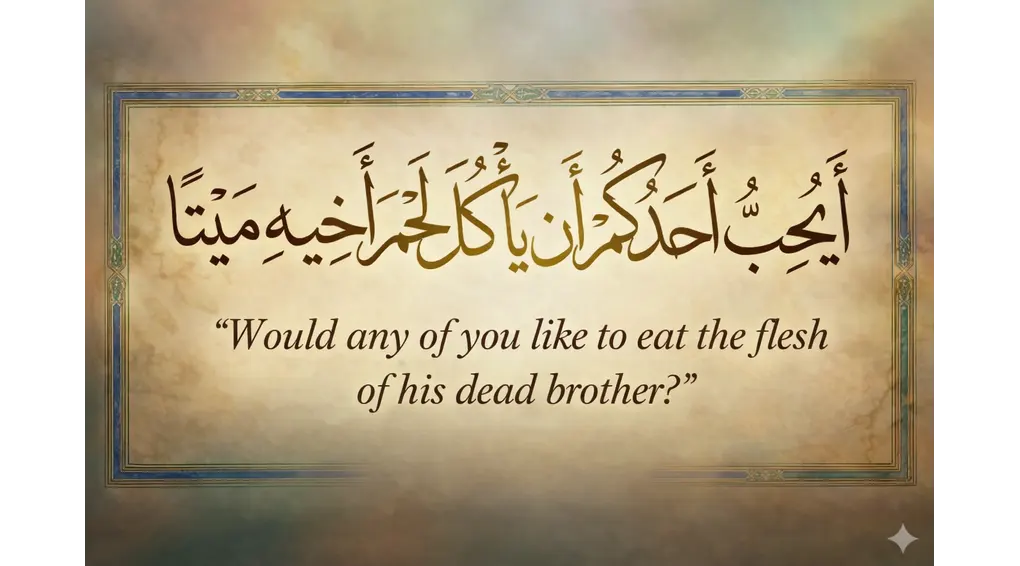
The prohibition of ghibah in Islam is exceptionally severe. Both the Quran and the Hadith utilize highly visual and utterly repulsive metaphors for its perpetrators.
The Quranic Verse on Ghibah
Allah emphatically declares in Surah Al-Hujurat, verse 12:
وَلَا يَغْتَب بَّعْضُكُم بَعْضًا ۚ أَيُحِبُّ أَحَدُكُمْ أَن يَأْكُلَ لَحْمَ أَخِيهِ مَيْتًا فَكَرِهْتُمُوهُ
“And do not backbite one another. Would one of you like to eat the flesh of his dead brother? You would loathe it.”
Imam Al-Ghazali comments on this verse with a piercingly sharp statement:
وَلَا يَزَالُ الْمُنَاظِرُ مُثَابِرًا عَلَى أَكْلِ الْمَيْتَةِ
“And a debater (with ill intentions) persistently and diligently devours the dead flesh (of his brother).”
The Hadith on Ghibah: The Terrifying Tale of Two Fasting Women
There is a specific hadith regarding ghibah quoted by Al-Ghazali in the Ihya’ that is utterly terrifying concerning the horrific effects of ghibah on the worship of fasting.
It is narrated that two women were fasting to the point they were nearly dying of thirst. Prophet Muhammad ﷺ initially hesitated to grant them permission to break their fast, but eventually, he stated:
كَيْفَ تَصُومُ مَنْ ظَلَّ نَهَارَهُ يَأْكُلُ لَحْمَ النَّاسِ
“How can someone be considered fasting who spends their entire day eating the flesh of people?”
The Prophet ﷺ then commanded them to vomit the contents of their stomachs. A shockingly horrific event occurred:
فَقَاءَتْ كُلُّ وَاحِدَةٍ مِنْهُمَا عَلَقَةً مِنْ دَمٍ
“Then each one of them vomited a clot of (flesh and) blood.”
Then the Messenger of Allah ﷺ declared:
“By the One in Whose Hand is my soul, had that (the blood of ghibah) remained in their stomachs, the fire of Hell would have surely consumed them.”
This visceral narrative demonstrates that the grave sin of ghibah can fundamentally obliterate the spiritual reward of fasting, even if chronologically and jurisprudentially, the fast remains technically valid. Recognizing the absolute necessity of adhering to all Islamic pillars is vital; you can review the foundation in Understanding the Pillars of Islam.
Manifestations of Ghibah (It’s Not Just Verbal!)

We frequently assume ghibah is exclusively restricted to verbal chatting. According to Al-Ghazali, examples of ghibah can be executed in numerous, much more subtle ways:
- Writing (Al-Kitabah): Typing negative comments or statuses on social media.
- Body Language/Gestures: Winking, sneering, or mockingly pointing with a hand to degrade someone.
- Impersonation/Mimicry (Al-Muhakah): Imitating the walk of someone who limps or their specific speech impediment. If you wish to understand the severity of this, read our specific article on the Islamic ruling on parody and impersonation.
- The Ghibah of the “Pious”: For example, stating: “Alhamdulillah, Allah has protected us, unlike So-and-so who was struck by that disaster.” The sentence is formulated as a prayer, but the true objective is degradation. This toxic combination amalgamates three major sins: Ghibah, Riya’ (showing off), and Ujub (self-amazement).
The Dangers of Backbiting and Its Negative Impacts
The negative impact of ghibah not only damages social relationships, but destroys our “account” in the afterlife.
- Spiritual Bankruptcy (Muflis): On the Day of Judgement, the rewards of your prayers, fasts, and charity will be transferred to the person you backbit about.
- Taking on the Sins of Others: If your good deeds are exhausted, the sins of those you backbite will be placed upon you.
- Sin More Severe Than Riba: In a hadith narrated by Anas bin Malik Radhiyallahu ‘anhu it is mentioned:وَأَرْبَى الرِّبَا عِرْضُ الْمُسْلِمِ“And the worst of riba is violating the honor of a Muslim.”
How to Avoid Ghibah?
Imam Al-Ghazali provides a rigorous spiritual therapy prescription as a method to successfully avoid the behavior of ghibah:
- Realize You Are “Transferring Your Rewards” Every single time you feel the urge to discuss someone’s flaws, ruthlessly interrogate yourself: “Am I genuinely willing to let the reward of my prayers today be taken by them?”
- Be Intensely Occupied With Your Own Flaws No human being is flawless. The most potent method to avoid ghibah is relentless introspection. The Messenger of Allah ﷺ said:طُوبَى لِمَنْ شَغَلَهُ عَيْبُهُ عَنْ عُيُوبِ النَّاسِ “Blessed is the one who is so intensely occupied by his own flaws that he completely forgets to concern himself with the flaws of others.”
- Remember: Insulting the Physical = Insulting the Creator If you mock someone’s physical appearance (e.g., “They are so ugly”), you are, in reality, directly insulting Allah who exquisitely created them.
- If Angry, Restrain Yourself Al-Ghazali notes that a primary trigger for ghibah is the burning desire to vent explosive anger (tashfi al-ghaizh). The sole cure is restraining that anger entirely for the sake of Allah.
- Reprimand or Leave (For the Listener) If you find yourself in an environment of backbiters, the strict ruling of ghibah applies equally to the silent listener who simply enjoys the gossip. For practical steps on how to extract yourself from such situations, read our comprehensive guide on how to deal with backbiting and gossip.
How to Repent from Ghibah and Its Expiation Prayer (Kafarat)

Ghibah is a uniquely complex sin because it violently violates two distinct rights simultaneously: The Right of Allah (Haqqullah) and the Right of Human Beings (Haqqul Adami). Consequently, the method of repenting from it is absolutely not sufficient by merely weeping on a prayer mat.
Imam Al-Ghazali in Ihya’ ‘Ulum al-Din meticulously explains the mandatory stages of repentance from ghibah as follows:
1. Remorse and Repentance (The Right of Allah)
The absolute first step is to experience profound, crushing remorse (Nadam) for the action and to forge an unbreakable resolve never to repeat it, to obliterate the sin before Allah.
2. Seeking Direct Absolution/Forgiveness (The Right of the Human)
This is the most agonizing condition. Al-Ghazali firmly asserts that the perpetrator of ghibah is obligated to physically approach the person they backbit to beg for their absolution (Istihlal). To understand the intricate details of seeking forgiveness from another human, read our guide on Repenting from Haqqul Adami.
ثُمَّ يَسْتَحِلُّ الْمُغْتَابَ لِيُحِلَّهُ فَيَخْرُجُ مِنْ مَظْلَمَتِهِ
“Then he must seek absolution from the one he backbit so that they may absolve him, and thus he exits from his oppression.”
However, Al-Ghazali provides a highly critical caveat regarding the etiquette of asking for forgiveness. Do not ask for forgiveness merely for the sake of “image building” or to be perceived as a humble, pious person (Riya’), while your heart does not genuinely feel regret.
وَيَنْبَغِي أَنْ يَسْتَحِلَّهُ وَهُوَ حَزِينٌ مُتَأَسِّفٌ نَادِمٌ عَلَى فِعْلِهِ
“And he should seek forgiveness while in a state of sadness, regret, and sorrow over his actions.”
How to Ask for Forgiveness?
Imam Al-Ghazali quoted the words of Atha’ bin Abi Rabah regarding how to confess the sin of ghibah (backbiting) to the victim:
أَنْ تَمْشِيَ إِلَى صَاحِبِكَ فَتَقُولَ لَهُ: كَذَبْتُ فِيمَا قُلْتُ وَظَلَمْتُكَ وَأَسَأْتُ, فَإِنْ شِئْتَ أَخَذْتَ بِحَقِّكَ وَإِنْ شِئْتَ عَفَوْتَ
“You come to your friend and say to him: ‘I have lied in what I said, I have wronged you, and I have done evil. So if you wish, take your right (retaliate), and if you wish, forgive.’“
This opinion is strengthened by the Sahih Hadith of the Messenger of Allah ﷺ:
مَنْ كَانَتْ لِأَخِيهِ عِنْدَهُ مَظْلَمَةٌ فِي عِرْضٍ أَوْ مَالٍ فَلْيَسْتَحِلَّهَا مِنْهُ مِنْ قَبْلِ أَنْ يَأْتِيَ يَوْمٌ لَيْسَ هُنَاكَ دِينَارٌ وَلَا دِرْهَمٌ
“Whoever has wronged his brother in honor (backbiting) or property, let him seek his forgiveness today before a day comes when there will be no Dinar and Dirham.” (Sahih Bukhari)
3. If Unable to Meet (The Person is Deceased/Absent)
What must be done if the person we backbit has already died, moved away and lost contact, or if informing them would actually ignite massive bloodshed or significantly greater enmity? Imam Al-Ghazali provides the definitive solution:
فَإِنْ كَانَ غَائِبًا أَوْ مَيِّتًا فَيَنْبَغِي أَنْ يُكْثِرَ لَهُ الِاسْتِغْفَارَ وَالدُّعَاءَ وَيُكْثِرَ مِنَ الْحَسَنَاتِ
“If the person is absent (ghaib) or dead, then he must abundantly seek forgiveness (istighfar) for them, supplicate for them, and massively multiply his good deeds.”
The Expiation Prayer for Ghibah (Istighfar for the Victim)
There is a specific opinion from Al-Hasan Al-Basri stating that simply making istighfar is sufficient without needing to inform the person (if the potential harm of telling them is catastrophic), based on a hadith narrated by Anas bin Malik (may Allah be pleased with him):
كَفَّارَةُ مَنِ اغْتَبْتَهُ أَنْ تَسْتَغْفِرَ لَهُ
“The expiation (kafarat) for the one you have backbit is that you seek forgiveness for them.”
Therefore, the profound prayer that should be recited every single time you remember the sin of ghibah against someone is:
اللَّهُمَّ اغْفِرْ لَنَا وَلَهُ
Allahummaghfir lanaa wa lahu “O Allah, forgive us and forgive him/her.”
According to Mujahid, expiating for the sin of consuming the flesh of a brother (backbiting) is by praising him (mentioning his good qualities) in the places where you previously slandered him, and by praying for goodness for him.
FAQ (Frequently Asked Questions About Ghibah)
Is recounting the injustice of others considered backbiting?
There are several exceptions to backbiting (ghibah) that are permitted in Islamic law, one of which is Tazhallum (the wronged person reporting to a judge/authority). However, only state the necessary facts according to the legal reality, do not add emotional embellishment.
What if we talk about people without mentioning their names?
If the listener understands who is being referred to (even if the name is disguised with initials or characteristics), it is still ghibah. Al-Ghazali affirmed: “What is forbidden is to make [others] understand (at-tafhim).”
What is the ruling on backbiting on social media?
Equally forbidden, even potentially more dangerous. Verbal backbiting disappears with the wind, but written backbiting on the internet is permanent and can be read by thousands of people. The sin becomes a continuous sin that continues to flow.
Closing
Ghibah in Islam is a subtle yet utterly lethal disease of the heart. It is frequently disguised within casual conversation, lighthearted jokes, or even “religious” discussions. By profoundly understanding that the true definition of ghibah is devouring a putrid corpse, and deeply reflecting upon the severe scriptural prohibitions, we pray we can become vastly more vigilant.
Let us actively replace the toxic habit of discussing others with the beautiful habit of supplicating for them in secret. Remember the golden advice of Al-Ghazali: the ultimate cure for ghibah is robust faith and sacred knowledge. May Allah fiercely protect our tongues.
Reference
Al-Ghazali, Abu Hamid Muhammad bin Muhammad. Iḥyā’ ‘Ulūm ad-Dīn. Beirut: Dar al-Ma’rifah, no date.


