

Many Muslims are still confused about determining the exact time for Fajr prayer. In fact, knowing with absolute certainty that the prayer time has commenced is one of the essential valid conditions (shurut as-sihhah) that must be fulfilled before an individual establishes any obligatory prayer. For those who wish to study the detailed requirements of other valid conditions comprehensively, you can read the Shafi’i school obligatory prayer guide that we have compiled.
Understanding Dawn (Fajr) as the Marker for the Commencement of Fajr Prayer Time
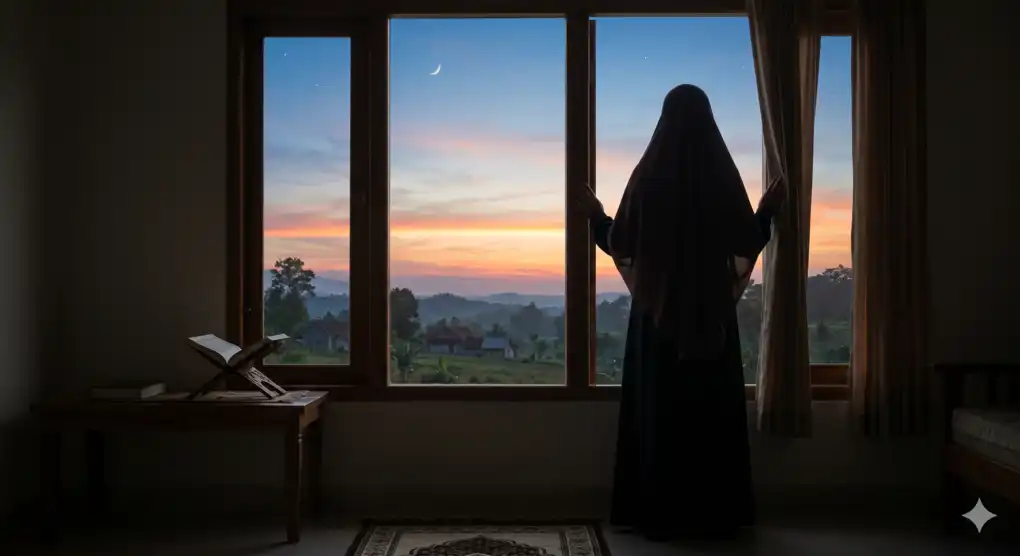
The primary benchmark for this act of worship is not rigidly fixed to digital clock hours. If any Muslim asks what time Fajr prayer is, the Shariah-compliant answer always refers to a natural astronomical phenomenon: the break of dawn. The Messenger of Allah ﷺ provided a very clear and precise formulation regarding the duration of this specific timeframe.
In the foundational reference text of the Shafi’i school, Shaykh al-Islam Zakariyya al-Ansari cites a hadith narrated by Imam Muslim, which serves as the legal bedrock for establishing temporal certainty:
وقت صلاة الصبح من طلوع الفجر ما لم تطلع الشمس
“The time for the morning prayer (Subh) is from the break of dawn as long as the sun has not risen.”[1]
Based on the consensus (ijma’) of the scholars grounded in the textual evidence above, the Fajr prayer time absolutely begins from the moment dawn breaks on the eastern horizon until the final moments just before the solar disc becomes visible. However, we must remain highly meticulous because the light of dawn on the eastern horizon is structurally divided into two distinct phases.
Differences Between Fajar Shadiq and Fajar Kadzib According to Shafi’i Fiqh
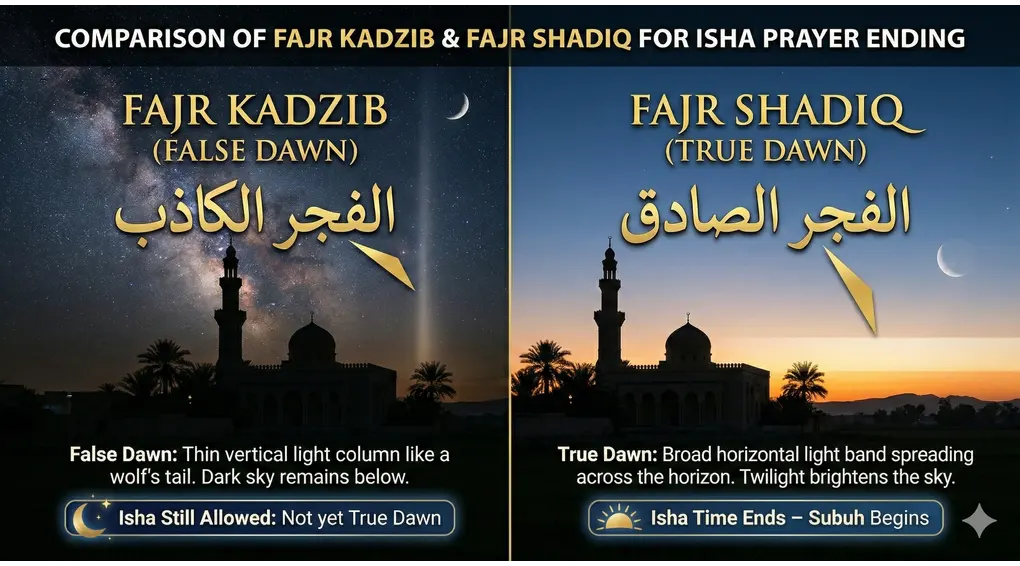
To determine the onset of Fajr time with precision, it is mandatory upon us to recognize the exact physical differences between Fajar Shadiq (the true dawn) and Fajar Kadzib (the false dawn). An error in distinguishing these two manifestations of light can result in the invalidity of the prayer because it was performed before its legally prescribed time had arrived.
What is Fajar Kadzib?
Shaykh al-Islam Zakariyya al-Ansari describes the specific physical architecture of Fajar Kadzib within his classical commentary:
الكاذب وهو ما يطلع مستطيلا بأعلاه ضوء كذنب السرحان وهو الذنب ثم يذهب وتعقبه ظلمة
“The false dawn (al-kadhib) is that which rises vertically; at its uppermost part, there is a light resembling the tail of a wolf (dhanab al-sirhan), then it disappears and is immediately followed by darkness.”[2]
This light appears prematurely before the actual Fajr time. Its structural shape is strictly vertical, beaming straight up into the celestial sphere. Jurists designated it as kadzib (false/liar) because its radiance is only temporary, fading quickly as the horizon returns to pitch-black darkness. The appearance of this perpendicular column of light does not signify the entry of the prayer time whatsoever.
What is Fajar Shadiq?
In stark contrast to the first phase, Fajar Shadiq serves as the true and authentic indicator of the arrival of the morning. The authoritative text Asna al-Mathalib elaborates on its existential characteristics:
ثم يطلع الفجر الصادق مستطيرا بالراء أي منتشرا … والثاني صادقا لأنه يصدق عن الصبح ويبينه
“Then the true dawn (al-sadiq) rises horizontally, spreading (mustathiran)… and this second dawn is named true (sadiq) because it truthfully speaks of the morning and clearly delineates it.”[3]
Fajar Shadiq does not assume the shape of a vertical pillar. Instead, it manifests as a distinct horizontal band of reddish-white light spreading laterally (to the right and left) along the eastern horizon. This light never dims; rather, it gradually intensifies, illuminating the sky as it guides us into the daytime. Only when this expanding horizontal band becomes clearly visible to the naked eye is the Fajr prayer legally valid to be established.
The 4 Divisions of Fajr Prayer Time Limits in the Shafi’i School
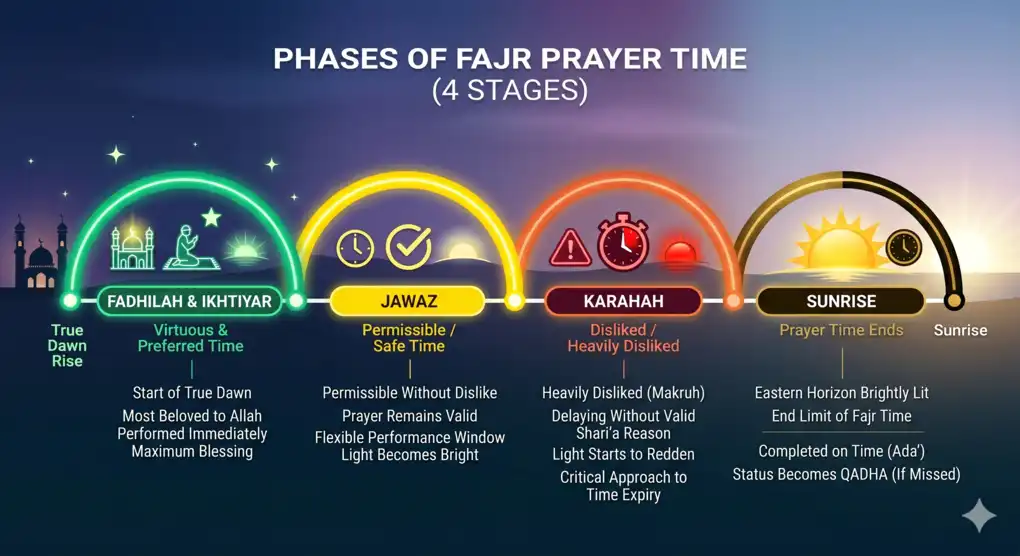
While monitoring the global prayer schedule is a fundamental practical necessity for Muslims worldwide, comprehending the micro-details of its performance phases represents the core of advancing one’s knowledge in the science of fiqh. The jurists of the Shafi’i school have meticulously categorized the boundaries of the Fajr prayer into four distinct temporal phases.
This systematic division of time is engineered so that every Muslim can establish their prayers with maximum precision and attain the highest degree of spiritual reward, as contextualized within the virtues of praying at the beginning of its time. Below are the comprehensive details of these four phases extracted from Asna al-Mathalib.
1. Waktu Fadhilah (The Time of Virtue) and Ikhtiyar (The Preferred Choice)


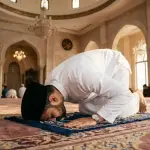
The primary phase is waktu fadhilah, which occurs precisely at the inception of the prayer time—moments immediately following the rise of Fajar Shadiq. Initiating the prayer within this window right after the Adhan has concluded earns the ultimate pleasure and supreme reward from Allah ﷻ. Subsequently, this phase seamlessly transitions into waktu ikhtiyar, which stretches until the morning light begins to gradually command the sky.
Shaykh al-Islam Zakariyya al-Ansari clarifies the legal parameters governing this transition:
والاختيار إلى الأسفار فله الأولى وله وللعصر أربعة أوقات الفضيلة وهي أوله ثم الاختيار إلى الأسفار في الصبح
“And the preferred time (ikhtiyar) extends until al-isfar (the yellowing/brightening of dawn). Thus, the first part is superior for it, and for it as well as for the Asr prayer there are four designated times: the time of virtue (fadhilah) at its very beginning, followed by the preferred time (ikhtiyar) until al-isfar for the morning prayer.”[4]
The phase of al-isfar refers to an environmental state where the sky has brightened sufficiently to allow a person to recognize the facial features of an associate nearby without requiring artificial illumination. Performing the prayer within the fadhilah and ikhtiyar boundaries is highly recommended by Islamic law.
2. Waktu Jawaz (Permissible Without Dislike)
Upon exceeding the al-isfar phase, the timeline enters the second category: waktu jawaz. During this transitional phase, executing the prayer is judged as entirely valid and legally permissible, carrying absolutely no religious dislike (karahah). This permissive window persists across the sky until the eastern horizon projects a pronounced reddish glow shortly before the actual sunrise.
The primary reference texts of the Shafi’i school define this threshold with exact wording:
ثم الجواز إلى الحمرة التي قبل طلوع الشمس
“Then the permissible time (jawaz) continues until the redness that appears prior to the rising of the sun.”[5]
Even though the Shariah grants this legal flexibility and the prayer is technically deemed valid, delaying the performance of an obligatory prayer into the jawaz phase without a legitimate Shariah excuse (udhr shar’i) undeniably diminishes the spiritual perfection of the servant’s reward before Allah ﷻ.
3. Waktu Karahah (Permissible But Disliked)
The third phase represents waktu karahah, a critical window wherein the prayer remains valid but is heavily disliked to perform. This precarious phase begins when the red hue on the eastern horizon turns intensely deep (al-ihmirar), indicating that the upper edge of the solar disc is on the verge of breaking through the horizon. Shaykh al-Islam Zakariyya al-Ansari clarifies that the term asfifar (yellowing) used in certain alternative manuscripts regarding Fajr actually corresponds to this state of intense redness (al-ihmirar).[6]
During this highly constricted period, the Messenger of Allah ﷺ issued a stern warning against those who habitually and intentionally postpone their prayers without a valid reason. He ﷺ stated:
تلك صلاة المنافقين يجلس يرقب الشمس حتى إذا كانت بين قرني الشيطان قام فنقرها أربعا لا يذكر الله فيها إلا قليلا
“That is the prayer of the hypocrites. He sits watching the sun until, when it is between the two horns of Satan, he stands up and pecks four times, remembering Allah therein but little.”[7]
This prophetic reprimand serves as conclusive evidence as to why delaying the prayer to this phase is severely discouraged. A comprehensive understanding of this issue is inextricably linked to the study of the disliked times for prayer, which must be closely monitored to safeguard our worship from spiritual corruption.
The Final Limit of Fajr Prayer: What Time Does It Actually End?
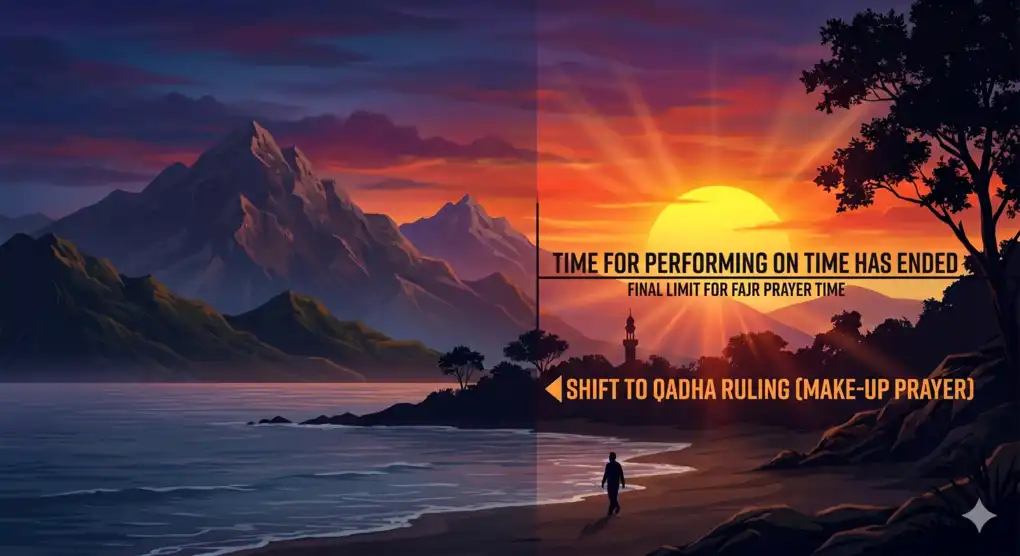
A substantial degree of ambiguity persists among the lay public, who frequently inquire: what is the ultimate cutoff time for Fajr prayer? Or if an individual accidentally oversleeps, until what specific hour can the Fajr prayer be executed as an on-time performance?
The legal answer is absolute: the final boundary of Fajr prayer is the exact millisecond the solar disc (tulu’ ash-shams) begins to breach or ascend over the eastern horizon. If the slightest fraction of the sun becomes visible, the window for on-time performance has completely expired. Any prayer established after this point transitions into the legal status of qada (make-up prayer) and can no longer be classified as ada’ (on-time performance). For an exhaustive breakdown of these technical definitions, please review our guide on the difference between qada and ada prayers.
Practical Rulings on Delaying Fajr Prayer and the Controversy of Shalat Wustha
Is it Permissible to Perform Fajr Prayer at 7 AM?
Questions routinely surface regarding the validity of praying Fajr at 7 AM, a situation typically faced by individuals who fall into an unnaturally deep sleep, miss their alarms, and wake up late. From the perspective of Islamic jurisprudence, if the sun has visibly risen, the legitimate window for this obligation has completely closed.
For an individual who wakes up after 7 AM, the prayer remains strictly mandatory and must be executed immediately upon awakening. However, the legal classification shifts to making up the prayer (qada), rather than an on-time performance (ada’). This practice is directly derived from the clear instructions of the Messenger of Allah ﷺ regarding unintentional sleep:
The text of Asna al-Mathalib records the authentic narration from Sahih al-Bukhari and Sahih Muslim as the definitive legal source for this matter:
من نسي صلاة أو نام عنها فكفارتها أن يصليها إذا ذكرها
“Whoever forgets a prayer or sleeps through it, its expiation (kaffarah) is that he performs it the moment he remembers it.”[8]
In everyday practice, it is vital for Muslims to accurately recognize the modern structural intervals between the initial morning warnings and the true breakdown of dawn. To navigate this technical intersection, you can read our detailed analytical piece explaining the differences between Imsak and Fajr.
Is it True that Fajr Prayer is Shalat Wustha?
An intricate academic debate exists among classical Shafi’i scholars concerning the precise status of this early morning prayer. While the vast majority of Muslims easily recall the exact number of raka’ahs for Fajr, many remain unaware of its historical association with the Shalat Wustha (the Middle Prayer) mentioned in the Qur’an. In his classical, older legal methodology (Qawl Qadim), Imam As-Shafi’i explicitly identified Fajr as the Middle Prayer.
Shaykh al-Islam Zakariyya al-Ansari summarizes the textual logic behind this classical position:
وهي عند الشافعي والأصحاب الصلاة الوسطى لآية {حافظوا على الصلوات} [البقرة: ٢٣٨] إذ لا قنوت إلا في الصبح
“According to As-Shafi’i and his primary companions (ashab), it (Subh) is the Middle Prayer based on the verse {Guard strictly your prayers} [Al-Baqarah: 238], due to the reality that the Qunut supplication is unique to the Subh prayer.”[9]
Nevertheless, this legal stance was subsequently revised and authenticated (tahqiq) by the elite verification scholars of the Shafi’i school. Relying upon highly superior text chains and completely authentic prophetic traditions, Imam An-Nawawi verified that the status of the Middle Prayer is exclusively reserved for the afternoon worship (Asr). This critical correction demonstrates that the ultimate foundation of the Shafi’i school is unyielding submission to the most authentic hadith texts.
قال النووي عن صاحب الحاوي الكبير صحت الأحاديث أنها العصر … ومذهب الشافعي الحديث فصار هذا مذهبه
“Imam An-Nawawi stated, quoting the author of Al-Hawi Al-Kabir: ‘The traditions have been authenticated as sound that it is indeed the Asr prayer… and the definitive madhhab of As-Shafi’i is the authentic hadith, thus this became his official position.'”[10]
If you desire to read a highly detailed review tracking the history and academic geography of this classical debate, please refer to our specialized article dedicated to the study of shalat al-wustha.
Naming Etiquette: Subh, Fajr, or Ghadat?
Beyond merely governing operational components like final deadlines, classical jurists dedicated significant focus to the linguistic etiquette (adab) of naming this prayer. The Shariah instills an ethical protocol regarding verbal selections that are superior (afdhal), ensuring that successive generations inherit the linguistic traditions of the faith with perfect accuracy.
Shaykh al-Islam Zakariyya al-Ansari provides this terminological directive clearly:
والأولى أن تسمى الصبح صبحا وفجرا لا غداة
“And it is preferable that Subh be named Subh and Fajr… not Ghadat.”[11]
This ethical preference is grounded in the reality that the term “Subh” is explicitly deployed within the text of the Holy Qur’an. Concurrently, the term “Fajr” is extensively documented across both the Qur’an and the prophetic Sunnah. Utilizing alternative secular vocabulary like shalat ghadat (the early morning prayer) should be avoided out of literary respect, although Shafi’i jurists stop short of declaring such terminology as religiously disliked (makruh).
FAQ Regarding Fajr Prayer Time
A variety of common questions regarding the Fajr prayer are regularly raised by the public concerning its exact timing and structural boundaries. Hesitation routinely manifests when trying to map out valid timelines through the technical lenses of fiqh. Below is an academic summary of these questions based on the text of Asna al-Mathalib.
What is the visible difference between Fajar Kadzib and Fajar Shadiq?
The physical distinction between the two is highly evident when observing the eastern horizon prior to sunrise. Shaykh al-Islam Zakariyya al-Ansari distinguishes their structural characteristics as follows:
وخرج بالصادق الكاذب وهو ما يطلع مستطيلا بأعلاه ضوء كذنب السرحان… ثم يطلع الفجر الصادق مستطيرا بالراء أي منتشرا
“Excluded from the true (sadiq) dawn is the false (kadhib) dawn, which is that which rises vertically, at its top there is light like the tail of a wolf… Then the true dawn rises spreading [across the horizon].”[12]
- Fajar Kadzib: Its light projects strictly vertically like a narrow pillar. It illuminates temporarily, dims rapidly, and returns the sky to total darkness. This phase does not open the prayer window.
- Fajar Shadiq: Its light glows horizontally, spreading completely across the eastern horizon. Its brightness never fades; rather, it grows increasingly luminous with the arrival of morning.
For those interested in understanding how these natural astronomical shifts correspond with modern digital timepieces, please explore our analytical piece discussing the exact hours entering Fajr.
If I complete one raka’ah of Fajr prayer and the sun rises, is my prayer valid?
Your prayer is legally valid and retains the status of an on-time performance (ada’). This crucial concession provides immense relief to anyone who inadvertently oversleeps. This specific rule of jurisprudence, termed idrak (temporal attainment), is anchored upon an authentic tradition found in Sahih al-Bukhari and Sahih Muslim:
ولو أدرك في الوقت ركعة لا دونها فالكل أداء لخبر الصحيحين من أدرك ركعة من الصلاة فقد أدرك الصلاة
“If he attains a single complete raka’ah within the prayer time, and not less than that, then the entirety of the prayer is performed on time (ada’), due to the narration in the Sahihayn: ‘Whoever catches a single raka’ah of the prayer has indeed caught the prayer.'”[13]
Consequently, the definitive indicator for the expiration of Fajr is the rising of the sun. As long as you have finalized at least one complete raka’ah (including its second prostration) before the solar disc breaches the horizon, your prayer is technically valid within its on-time window.
Is it permissible to engage in casual conversation after Fajr prayer?
The standard ruling governing secular conversations after completing the two obligatory raka’ahs of the dawn prayer is that it is disliked (makruh) if performed without a pressing Shariah need. The Messenger of Allah ﷺ firmly discouraged unnecessary talking during this specific interval to preserve the spiritual blessings of the early morning hours. This is documented as follows:
ويكره النوم قبلها والحديث بعدها لأنه – صلى الله عليه وسلم – كان يكرههما
“And it is disliked to sleep before it (the prayer time) and to speak after it, because the Prophet ﷺ used to dislike both of those actions.”[14]
Islamic scholars draw a legal analogy between chatting before Isha and speaking immediately after Subh. Ending the early part of the day by sleeping or gossiping is viewed unfavorably, as this period is highly recommended for Dhikr (remembrance of Allah ﷻ) and launching productive daily routines.
Footnotes
Reference
Zakariyā al-Anṣārī, Asnā al-Maṭālib fī Sharḥ Rawḍ al-Ṭālib, with ḥāsyiyah by Aḥmad al-Ramlī, edited by Muḥammad az-Zuhrī al-Ghamrāwī (Cairo: al-Maṭbaʿah al-Maymānīyah, 1313 H; repr. Dār al-Kitāb al-Islāmī), juz 1, hlm. 117-122.


