
Understanding the concept of Thaharah (purification) is a fundamental obligation for every practicing Muslim. It serves as the primary gateway to the validity of essential acts of worship, such as the daily prayers (Salah). Consequently, many Muslims actively seek a deeper understanding of the various types of Thaharah, their specific classifications, and how they apply to daily life. This article will provide a comprehensive, academic overview of the different categories of purification, rooted in classical Shafi’i jurisprudence, alongside practical examples for everyday implementation.
The Definition of Thaharah and Its Core Divisions
Linguistically, the Arabic word Thaharah signifies cleanliness and purity. In the technical terminology of Islamic jurisprudence (Fiqh), it refers to the specific ritual process of purifying one’s body, clothing, and place of worship from physical impurities (Najis) and ritual states of impurity (Hadath). This purification is an absolute prerequisite for the validity of certain acts of worship.
To establish this framework, we refer to the classical methodology derived from the sources of Islamic law. The esteemed text Al-Fiqh al-Manhaji explicitly categorizes purification as follows:
أنواع الطهارة الطهارة نوعان: أولاً ـ طهارة من النجس. ثانياً ـ طهارة من الحدث.
الطهارة من النجس: معنى النجس: النجس لغة: كل مستقذر. وشرعاً: مستقذر يمنع صحة الصلاة، كالدم والبول.
Translation: “The types of Thaharah are two: Firstly, purification from physical impurity (Najis). Secondly, purification from ritual impurity (Hadath). Purification from physical impurity: The meaning of Najis: Linguistically, it is anything considered dirty. In Islamic law, it is a filthy substance that prevents the validity of prayer, such as blood and urine.”
The Two Primary Types of Thaharah in Islam
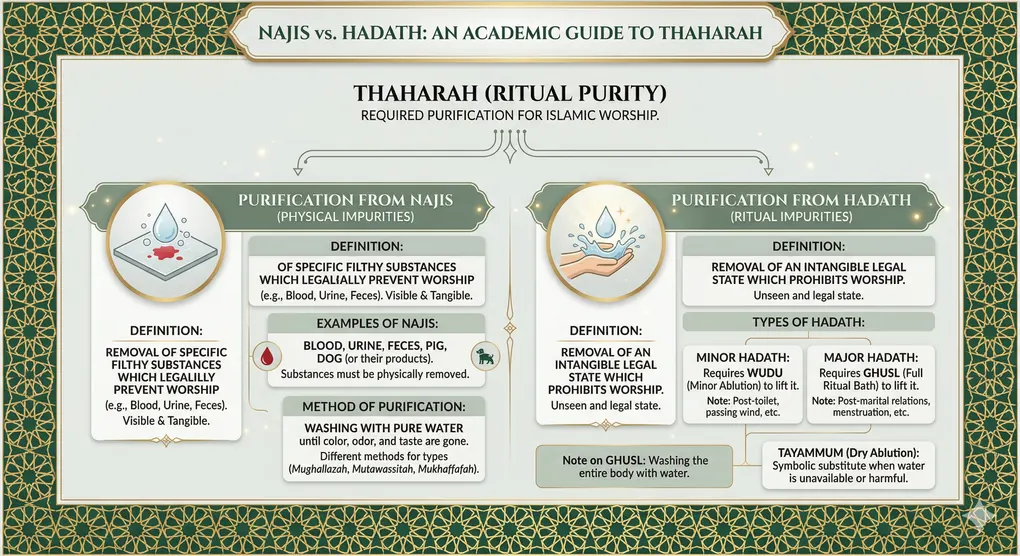
Based on the foundational texts, Islamic law classifies Thaharah into two primary categories:
1. Purification from Physical Impurity (Najis)
This category involves the physical removal of filthy substances from one’s body, garments, or environment. To practice this correctly, one must understand the exact definition of Najis. In Islamic law, Najis encompasses specific substances deemed legally impure, such as flowing blood, human or animal excrement, and canine saliva.
Examples of purification from Najis:
- Washing a garment thoroughly until traces of blood are completely removed.
- Cleansing the mosque floor from animal droppings.
- Washing a body part with water and earth after it comes into contact with dog saliva (a heavy impurity in the Shafi’i school).
2. Purification from Ritual Impurity (Hadath)
Unlike Najis, Hadath is not a visible, physical substance. It is an intangible, legal state of ritual impurity that prevents a Muslim from performing specific acts of worship. Hadath is subdivided into two levels:
- Minor Hadath (Hadath Asghar): This state is lifted by performing Wudu (minor ablution). It is caused by actions such as urination, defecation, or passing wind.
- Major Hadath (Hadath Akbar): This state requires a full ritual bath (Ghusl) to be lifted. It is caused by states such as sexual discharge, menstruation (Haid), or postpartum bleeding (Nifas).
The 4 Specific Modalities of Thaharah
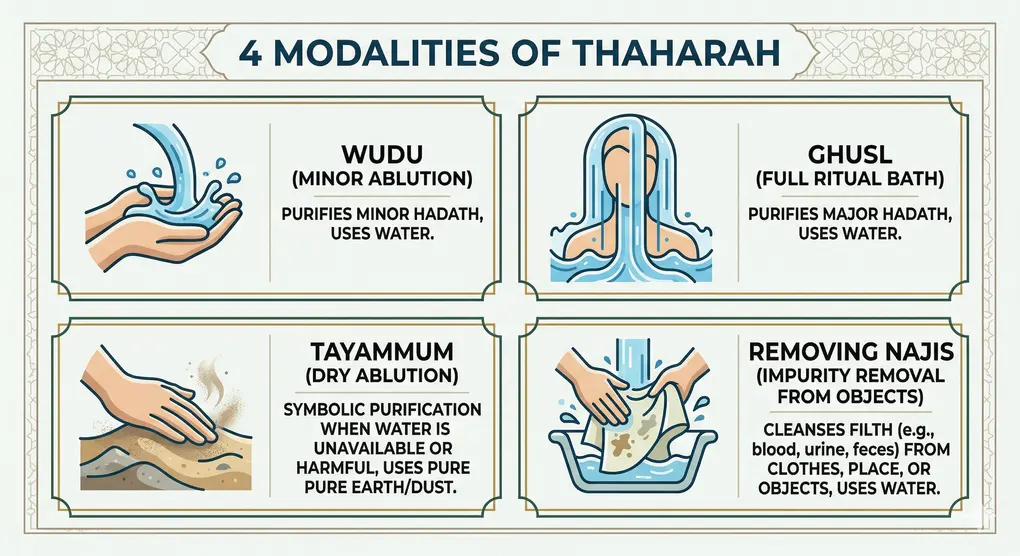
Beyond the two primary divisions, scholars often categorize the practical implementation of Thaharah into four distinct modalities or methods.
1. Wudu (Minor Ablution)




Wudu is the prescribed method to lift a minor ritual impurity using pure water. Understanding the precise meaning of Wudu is essential, as it must be performed before offering prayers, performing Tawaf, or physically interacting with the scripture. For instance, lifting this impurity is mandatory before one applies the ruling on touching the translated Quran.
2. Ghusl (Major Ritual Bath)
Also known as Mandi Wajib, this is the comprehensive washing of the entire body with water. A Muslim must learn the proper procedures for the obligatory bath to ensure they successfully exit the state of major ritual impurity (Janabah).
3. Tayammum (Dry Ablution)
When pure water is entirely unavailable, or if a person is medically incapable of using water, Islamic law provides an alternative. Tayammum involves using pure, dusty earth to symbolically wipe the face and hands. Earth serves as one of the valid purification media under specific extenuating circumstances.
4. Removing Najis (Izalat al-Najasah)
This is the physical act of washing away a tangible impurity. This process strictly requires the use of pure, unadulterated water, emphasizing the importance of knowing the valid types of water in Islam suitable for cleansing.
Practical Examples of Thaharah in Daily Life

Theoretical knowledge must translate into practical application. Here are several everyday examples encompassing the various types of Thaharah:
- Performing Wudu diligently before each of the five daily prayers.
- Performing the major ritual bath (Ghusl) immediately after the cessation of the menstrual cycle.
- Washing an infant’s clothing that has been soiled with urine until the color, smell, and taste of the impurity are gone.
- Performing Tayammum by striking clean earth when traveling in an arid region devoid of water.
- Thoroughly washing one’s hands and tools from blood after the designated time of Qurbani slaughter.
- Inspecting and cleaning a prayer mat (sajadah) from any physical filth before initiating the prayer.
Why is Maintaining Thaharah Essential?
Maintaining a continuous state of ritual purity is a profound manifestation of a believer’s faith. The Prophet Muhammad (ﷺ) explicitly stated, “Purity is half of faith.” (Sahih Muslim). By meticulously observing the rules of Thaharah, a Muslim ensures the legal validity of their worship while cultivating a deep sense of spiritual mindfulness, physical hygiene, and discipline.
Summary Table: Modalities of Thaharah
| Modality of Thaharah | Brief Explanation | Practical Everyday Example |
| Purification from Najis | Removing physical filth from body, clothes, or location. | Washing a shirt stained with animal droppings. |
| Purification from Hadath | Lifting ritual impurity via Wudu, Ghusl, or Tayammum. | Performing Wudu before the Maghrib prayer. |
| Wudu | Using water to lift minor ritual impurity. | Ablution before holding the Mushaf (Quran). |
| Ghusl (Major Bath) | Washing the entire body to lift major ritual impurity. | Bathing after marital relations. |
| Tayammum | Using pure earth when water is absent or harmful. | Performing dry ablution while hospitalized. |
Conclusion
A firm grasp of the types of Thaharah in Islam is indispensable for every practicing Muslim. By distinguishing between physical impurities (Najis) and ritual states (Hadath), and by understanding the proper application of Wudu, Ghusl, and Tayammum, believers can ensure their foundational acts of worship are valid and accepted. Prioritizing both physical cleanliness and spiritual purity allows a Muslim to stand before Allah (SWT) with confidence and reverence.
Frequently Asked Questions (FAQ)
What is the fundamental difference between Najis and Hadath?
Najis refers to a tangible, physical impurity (like blood or urine) that must be washed away from the body, clothes, or prayer area. Hadath is an intangible, ritual state of impurity (caused by actions like using the restroom or sleeping) that must be lifted through specific ritual actions like Wudu or Ghusl.
Can I use any liquid to remove physical impurities (Najis)?
According to the Shafi’i school of jurisprudence, you must use absolute, pure water (Ma’ Mutlaq) to legally remove Najis. Other liquids, such as vinegar, soap water, or juice, cannot lift the legal impurity, even if they physically clean the surface.
When is Tayammum permissible as a type of Thaharah?
Tayammum is permissible only under strict conditions: when a person has searched for water and absolutely cannot find any, when the available water is strictly needed for drinking to survive, or when using water would cause or exacerbate a severe medical condition.
Academic References:
Khin, Muṣṭafā al-, Muṣṭafā Dīb al-Bughā, and ʿAlī ash-Sharbajī. Al-Fiqh al-Manhaji ‘ala Madhhab al-Imam al-Shafi’i. Vol. 1. Damascus: Dar al-Qalam, 1992, p. 38.


