

Purity and cleanliness are integral aspects of faith. Within Islamic teachings, the attention to cleanliness is not solely limited to outward appearance but extends to inner purity from impurities, particularly after relieving oneself. This essential process of cleansing is known as istinja’. A comprehensive understanding of the mandatory ruling, the primary evidence on istinja, and the various methods for its implementation is fundamental for every Muslim.
What is Istinja’ and its Significance in Taharah?
Istinja’ is the act of cleansing the qubul (anterior private part) and dubur (posterior private part) from the filth or impurity that is discharged after urination or defecation. This obligation is an inseparable component of taharah (purification), serving as a prerequisite for the validity of several acts of worship, most notably prayer (Salah). Without valid istinja’, a person’s state of purity remains questionable, and their subsequent acts of worship might not be legally accepted in the Sight of Allah.
A correct understanding of the meaning of istinja’ clarifies that it is the very foundation of personal purity in Islam. Furthermore, in the Shafi’i school, one might ask: does istinja’ require intention? For the physical removal of impurity (izālat al-najāsah), a specific intention is not strictly necessary for the validity of the removal itself, unlike devotional acts such as wudhu (ablution).
The Shari’i Ruling on Istinja’: Mandatory Obligation
Scholars are in unanimous agreement that the legal ruling on istinja’ is wajib (mandatory/obligatory). This obligation applies strictly to every Muslim immediately upon completing urination or defecation. It is not merely a recommended practice; rather, it is a divine command that must be fulfilled to ensure personal purity from najis (impurity).
The significance of this obligation is paramount, as a valid istinja’ directly impacts a person’s state of purity necessary for daily worship. Failure to perform it correctly means the subsequent conditions for the validity of wudhu may not be met, rendering the wudhu and any dependent prayers invalid.
Primary Evidences on Istinja’ from Quran and Hadith
The mandatory nature of istinja’ is not arbitrary. Extensive textual evidence on istinja (dalīl naqlī) is derived directly from the Holy Quran and the authentic Sunnah of the Prophet Muhammad ﷺ. These primary evidences elucidate the paramount importance of purification in Islam and provide practical, divinely inspired guidance on its methodology.
Quranic Verses Elucidating Purity
One of the most prominent Quranic evidences for istinja’ is Allah the Almighty’s statement in Surah At-Taubah, verse 108:
“فِيهِ رِجَالٌ يُحِبُّونَ أَن يَتَطَهَّرُوا ۚ وَاللَّهُ يُحِبُّ الْمُطَّهِّرِينَ” “Within it are men who love to purify themselves; and Allah loves those who purify themselves.” (Quran 9:108)
This verse was revealed concerning the inhabitants of Quba’, who were renowned for their meticulous attention to cleanliness and purification. Prophet Muhammad ﷺ further explained that the people of Quba’ particularly loved performing istinja’ with water. This specific explanation demonstrates that the Quranic verse, while general in its praise of purity, indirectly commends the practice of cleansing oneself with water, the quintessential purifying agent.
Authentic Prophetic Hadith Reinforcing Istinja’
Numerous hadith on istinja’ reinforce the Quranic evidence and provide detailed pernicions regarding the methodology of implementation. Prophetic guidance accounts for various conditions and permissible options, ensuring the foundation of personal purity is accessible under different circumstances.
- Evidence on Istinja’ with Water: It is narrated by Imam Al-Bukhari (149) and Imam Muslim (271) from Anas bin Malik (may Allah be pleased with him):”Rasulullah shallallahu ‘alaihi wa sallam masuk ke tempat buang hajat, lalu aku dan seorang anak laki-laki seusia denganku membawakan bejana kecil berisi air dan tombak pendek, kemudian beliau beristinja’ dengan air.” “Whenever the Messenger of Allah ﷺ entered the lavatory, I and another boy of my age used to carry a small water skin and a spear-headed stick, and he would cleanse himself with water.” This Hadith explicitly demonstrates the practice of the Prophet ﷺ in cleansing himself with water after relieving himself, providing strong prophetic evidence for the excellence of water in purification.
- Evidence on Istinja’ with Stones: It is narrated by Imam Al-Bukhari (155) from Ibn Mas’ud (may Allah be pleased with him):”Nabi shallallahu ‘alaihi wa sallam mendatangi tempat buang air besar, lalu beliau memerintahkan aku untuk membawakannya tiga buah batu.” “The Prophet ﷺ went to answer the call of nature and asked me to bring him three stones.” This Hadith indicates that the Prophet ﷺ also performed istinja’ with stones, signifying that the use of stones (or similar pure solid objects) is permissible and sufficient for purification when necessary.
- Evidence on the Sufficient Number of Stones: It is narrated by Imam Abu Dawud (40) from ‘Aisyah (may Allah be pleased with her), that the Messenger of Allah ﷺ said:
“إذَا ذَهَبَ أحدُكمْ إلى الغائطِ فلْيَذْهَبْ مَعَهُ بِثَلاثَةِ أحجارٍ، يَسْتطِيبُ بِهِن، فَإنّهَا تُجْزِىءُ عَنهُ” “
When any of you goes to answer the call of nature, let him take with him three stones, for that is sufficient for him to cleanse himself.” This Hadith confirms that three stones are permissible and sufficient for removing impurity (najis), provided the exit point of the filth becomes clean.
The Valid Methodologies for Performing Istinja’
Based on the primary evidence on istinja, there are multiple valid methods for its execution, accounting for differing circumstances of water availability in Islam:
1. Cleansing with Water Only (The Most Excellent Method)


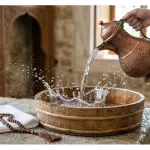
This is considered the most excellent and complete method, as pure and purifying water (absolute water) is superior in removing impurity (najis) physically and trace-wise, ensuring the exit point is thoroughly cleansed. The majority of jurists concur that the scriptural evidence in the Quran and Sunnah emphasizes the primacy of water. The method involves washing both the anterior and posterior private parts with water until they are pure and no trace of the impurity’s odor, color, or taste remains.
2. Cleansing with Stones Only (or a Similar Pure Solid Agent)
It is also permissible to perform istinja’ using only stones, or any other pure, solid, dry, and purifying object. Examples include specific types of tissue, dry leaves that are pure, or small pebbles. The prerequisites are the use of at least three stones or three clean wipes, and the exit point must become entirely pure. Jurists advise that if three wipes are insufficient, one must continue until pure, and it is sunnah to make the total number odd if possible (e.g., five or seven).
3. Combining Stones and Water (The Most Perfect Combination)
This combination is regarded as the most perfect and excellent way. The process begins by physically removing the main body of the impurity (najis) using stones (or tissue), followed by thoroughly rinsing the area with water. Through this method, the physical filth is largely removed by the solid agent, and then the area is purified completely by the water1.
Profound Wisdom and Essential Benefits of Istinja’
Beyond its foundational role in taharah as a prerequisite for valid worship dependent on wudhu, istinja’ encompasses numerous wisdoms and essential benefits, which align with the understanding of Fiqh as a guide for both physical and spiritual well-being:
- Promoting Health and Hygiene: Proper cleansing of the private parts is crucial for preventing urinary tract infections (UTIs), skin irritation, and various diseases. Regular istinja’ significantly reduces the risk of these health issues.
- Enhancing Personal Cleanliness and Comfort: Correct istinja’ ensures the body is completely free from impurity (najis), allowing the individual to feel cleaner, more comfortable, and confident in both daily interactions and during worship.
- Ensuring the Validity of Worship: As stated previously, istinja’ is an absolute condition for the validity of several acts of worship. Without a correct istinja’, the subsequent required states of purity (wudhu, ghusl) are compromised, rendering the dependent acts, such as daily prayers and Tawaf, legally unacceptable.
- Adhering to the Prophetic Sunnah: Performing istinja’ is a direct emulation of the immaculate cleanliness of Prophet Muhammad ﷺ, belief in Allah through following the best example for all Muslims.
Conclusion and Final Fiqh Considerations
The legal ruling on istinja’ is mandatory (wajib) and is an integral component of the practice of cleanliness within Islamic jurisprudence. Extensive and undeniable evidence on istinja derived from the Holy Quran and numerous prophetic Hadiths confirms the paramount importance of this practice for the foundation of personal purity. Whether executed with water, stones, or a combination of both, the ultimate objective of istinja’ is achieving the mandatory state of purity necessary for valid worship to Allah. By correctly understanding and diligently implementing istinja’, every Muslim maintains their personal purity (taharah), ensuring their subsequent acts of worship are accepted and spiritually fulfilling in the sight of Allah2.
Frequently Asked Questions (FAQ)
Is istinja’ obligatory in Islamic law?
Yes, Islamic scholars are in unanimous agreement that the legal ruling on istinja’ is mandatory (wajib). This means every Muslim must perform it after completing urination or defecation.
What is the difference between istinja’ with water and istinja’ with stones?
Istinja’ with water involves washing the private parts until they are pure and free from impurity, odor, color, and taste. Istinja’ with stones (or solid agents like tissue) involves using three stones or clean wipes to physically remove the filth until the area becomes pure. Water is superior in thoroughness.
When is istinja’ required in taharah (purification)?
Istinja’ is required immediately upon completing the discharge of filth (najis) from either the front (qubul) or back (dubur) private parts. It must be performed before subsequent required acts of purification like wudhu (ablution) or ghusl (purificatory bath), rendering the dependent acts valid.
Reference Conceptual Footnotes
- This refers to removing the primary body of filth with an absorbent solid, making the area less contaminated before the application of water, which is a highly recommended practice ensuring complete purification. ↩︎
- Muṣṭafā Dīb al-Bughā al-Maydānī ad-Dimashqī ash-Shāfiʿī, at-Tadh-hīb fī Adillah Matn al-Ghāyah wa-at-Taqrīb al-Mashhūr bi-Matn Abī Shujāʿ fī al-Fiqh ash-Shāfiʿī, 4th ed. (Damascus–Beirut: Dār Ibn Kathīr, 1989), 19–20 ↩︎


