

We constantly hear the reminder, “Don’t forget to say Basmalah!” before commencing any action. This specific term is incredibly familiar, uttered dozens of times daily as a standard routine to initiate our activities. However, have you ever paused for a moment to deeply reflect: what immense power is actually concealed behind this single word, “Basmalah”?
Within the profound treasures of classical Islamic texts (kitab kuning), specifically the Shafi’i fiqh manual I’anah at-Talibin authored by Shaykh Abu Bakr Syatha, it is revealed that this seemingly simple term actually harbors extraordinary cosmic energy. It is the definitive master key that unlocks the gates of the heavens and the earth, a phrase that caused the entire universe to tremble upon its initial revelation.
Before we dive into its profound spiritual secrets, let us first resolve the most fundamental curiosity: What is Basmalah in terms of its literal definition and linguistic origin?
What is Basmalah? Dissecting the Linguistic Definition and Origin
We frequently hear the instruction to “read the basmalah,” but do you know precisely where this word originated? By referencing the authoritative Arabic dictionary (Al-Maany), we discover a fascinating linguistic definition of this term.
Linguistically, Basmalah (بَسْمَلَة) is a noun (isim) that functions as the verbal noun/source (masdar) derived from the verb basmala (بَسمَلَ).
قَرَأَ الْبَسْمَلَةَ : أَيْ قَرَأَ بِسْمِ اللَّهِ الرَّحْمنِ الرَّحِيمِ وَالْكَلِمَةُ اخْتِزَالٌ وَنَحْتٌ لِمُجْمَلِ الْجُمْلَةِ
“He read the Basmalah: meaning he read ‘Bismillahirrahmanirrahim’. The word is a reduction (ikhtizal) and a sculpting (naht) of the entire complete sentence.”
In the intricate science of the Arabic language, this specific phenomenon is termed Naht (نحت). It functions similarly to an acronym; it is a sophisticated method of contracting a lengthy sentence into a single, highly practical new verb or noun.
In the terminology of Islamic jurisprudence (fiqhiyah), what is Basmalah defined as?
حكاية قول ((بسم الله الرحمن الرحيم)) ( على سبيل النحت )1
“Narrating the statement ‘Bismillahirrahmanirrahim’ (by way of sculpting/contraction).”
Therefore, when Islamic scholars or our teachers instruct us to “say the basmalah,” it is essentially a concise code instructing us to recite the complete, sacred phrase: In the name of Allah, the Most Gracious, the Most Merciful. Recognizing this is the first step in understanding the Islamic ruling on reciting Basmalah in various contexts, such as before eating or during the Sunnah acts of Wudu.
Having comprehended its definition, let us now delve into the massive secrets concealed behind this majestic phrase, exactly as expounded in I’anah at-Talibin.
The History of the Heavens: The First Sentence Inscribed by Destiny
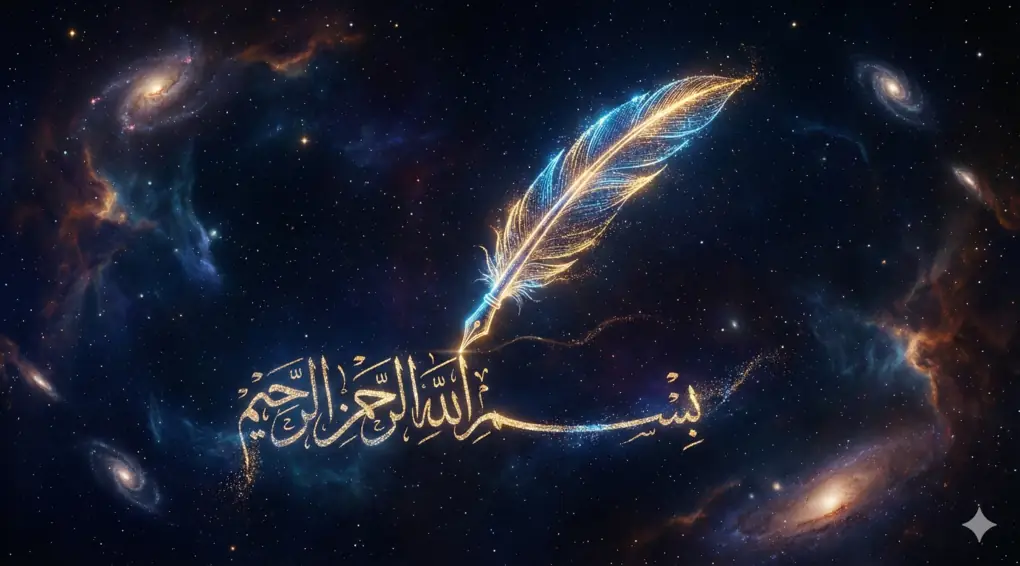
Have you ever pondered what the very first writing in this universe was? Based on authentic narrations documented in I’anah at-Talibin, the Basmalah was the absolute first phrase inscribed by the Qalam (The Pen of Destiny) long before the creation of the cosmos commenced.
Prophet Muhammad ﷺ explicitly stated:
أول ما كتب القلم بسم الله الرحمن الرحيم, فإذا كتبتم كتابا فاكتبوها أوله, وهي مفتاح كل كتاب أنزل
“The first thing inscribed by the Pen was Bismillahirrahmanirrahim. Therefore, whenever you write a document, write it at its beginning, for it is the master key to every Book that has been revealed.”
The sheer majesty of this phrase is also vividly evident from the universe’s reaction upon its initial descent to earth. Shaykh Abu Bakr Syatha paints a profoundly epic scene: the clouds rapidly shifted to the east, the winds completely ceased blowing until a deafening silence descended, the oceans violently surged, and all the animals intensely perked their ears to listen carefully.
Furthermore, Allah swore by His own Supreme Majesty that whoever invokes His name (through the Basmalah) upon a sick person, He will undeniably grant them healing. And His name is never invoked upon a matter except that immense divine blessing (barakah) immediately descends upon it.
The Secret of the Number 19 and the Shield Against Hellfire
One of the most uniquely fascinating facts frequently discussed by classical scholars is the precise number of letters comprising the written phrase Bismillahirrahmanirrahim. If you meticulously count them according to the standard rules of Arabic orthography (rasm), the total is exactly 19 letters.
Fascinatingly, this specific number is not a random coincidence. It is intimately connected to the exact number of guardian angels overseeing Hellfire, which is also 19, exactly as Allah declares in Surah Al-Muddaththir: “Over it are nineteen [angels].”
The text explicitly explains:
عدد حروف البسملة الرسمية تسعة عشر حرفا, وعدد خزنة النار تسعة عشر خازنا
“The number of letters in the official writing of the Basmalah is nineteen letters, and the number of the guardians of the Fire is nineteen guardians.” To fully appreciate this, one must understand the concept of belief in Angels in Islam and specifically the names and duties of the Angels.
Protection from the Zabaniyah Angels
Ibn Mas’ud (may Allah be pleased with him) provided an extraordinary spiritual strategy for anyone desperately desiring salvation from the terrifying strictness of the Zabaniyah (the angels of Hell). He strongly advised us to make the recitation of Basmalah a constant, daily routine. Allah has specifically designated every single letter of the Basmalah to serve as an impenetrable shield against one of those nineteen guardian angels of Hell.
This is a beautiful manifestation of spiritual mathematics: 19 sacred letters to combat 19 fierce guardians. According to narrations, the immense power possessed by those very angels is fundamentally derived from this exact phrase. Consequently, establishing the Basmalah as a daily litany (wird) is an exceptionally intelligent strategy for salvation in the Hereafter.
Do Not Curse Satan; Instead, Recite the Basmalah
We frequently hear individuals cursing when they slip, fall, or experience a bout of bad luck, immediately blaming Satan. They shout, “Curse you, Satan!” or hurl other profanities. Surprisingly, the Prophet ﷺ strictly prohibited this specific reaction.
In I’anah at-Talibin, a narration is cited detailing an incident where a man exclaimed, “May Satan perish!” directly in front of the Prophet.
لا تقل ذلك فإنه يتعاظم عنده… ولكن قل بسم الله الرحمن الرحيم, فإنه يصغر حتى يصير أقل من ذبابة
“Do not say that, for indeed he (Satan) will grow larger (feeling proud)… But instead say ‘Bismillahirrahmanirrahim’, for indeed he will shrink until he becomes smaller than a fly.”
Cursing Satan inadvertently provides him with a platform. It makes him feel important, powerful, and massive. Conversely, by invoking the supreme name of Allah, the Most Gracious, the Most Merciful, we instantly force Satan back into his true, pathetic position: a minuscule, utterly powerless creature in the face of God’s absolute might. This is the most potent, elegant, and spiritually effective method to repel satanic interference. This reliance on Allah’s power is similarly found in the virtues of reciting the Hawqalah (La hawla wa la quwwata illa billah).
The Pinnacle of All Meanings Resides in the Dot of the Letter Ba’
This section may sound slightly esoteric, but it constitutes the very core of Sufi wisdom regarding the profound meaning of Bismillah. The scholars eloquently explain an extraordinary concept known as the “condensation of meaning.”
It is narrated that Allah revealed a total of 104 sacred scriptures to the earth (including those given to Prophets Seth, Abraham, Moses, and Jesus).
- All the profound meanings contained within those 104 scriptures are entirely compiled within the Quran.
- All the meanings of the entire Quran are compiled within Surah Al-Fatihah.
- All the meanings of Surah Al-Fatihah are compiled within the Basmalah.
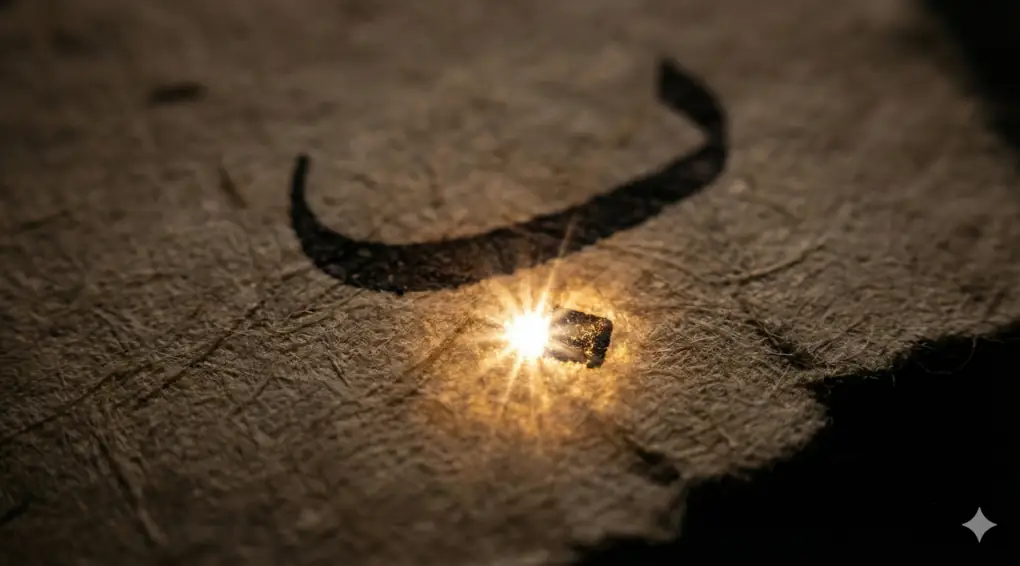
- And at the absolute pinnacle, all the meanings of the Basmalah are compiled within its very first letter, the Ba’ (ب).
Even more specifically, some profound scholars assert that the ultimate meaning resides solely within the single dot located directly beneath the letter Ba’.
ومعانيها مجموعة في بائها, ومعناها: بي كان ما كان, وبي يكون ما يكون
“And its meanings are gathered in its letter Ba’, and its meaning is: By Me (Allah) exists whatever has existed, and by Me will occur whatever will occur.”
The Arabic letter Ba’ intrinsically carries the meaning of Ilshaq (attachment or connection). This jolts us into the realization that the ultimate, grand objective of all sacred knowledge and all acts of worship is the profound “connection” of a humble servant with their Lord. Devoid of this vital connection, all our daily activities become entirely empty and devoid of any true meaning. This connection is why the Basmalah is integrated into the pillars of the daily prayer via Surah Al-Fatihah.
Why the Letter Ba’, and Not Alif?
There is a deeply fascinating philosophical reason why Allah deliberately selected the letter Ba’ as the opening, rather than Alif, even though Alif is the very first letter of the Arabic alphabet.
The profound answer lies in the visual “posture” of the letters themselves. Alif stands rigidly tall and straight, subtly implying pride, arrogance, and haughtiness. Conversely, Ba’ is shaped flat and possesses a dot positioned underneath it (kasrah/broken). This perfectly symbolizes profound humility (tawadhu) and a heart that is completely “broken” out of intense awe and fear of Allah.
أنا عند المنكسرة قلوبهم
“I (Allah) am with those whose hearts are broken (humbled) for My sake.”
To successfully reach Allah, we absolutely cannot approach Him with our chests puffed out in arrogance like the letter Alif. We must approach Him with absolute, crushing humility like the letter Ba’. This is the greatest character lesson embedded within the Basmalah.
The Etiquette of Honoring the Written Word of Bismillah
Beyond its deep philosophical meanings, this classical text also strictly instructs us regarding the proper etiquette (adab) towards the physical, written text itself. Never, ever disrespect a torn scrap of paper bearing the sacred name of Allah that has fallen onto the ground.
A narration from Ali bin Abi Talib (may Allah be pleased with him) states:
فمن رفع كتابا من الأرض فيه البسملة رفع الله اسمه في أعلى عليين2
“Whoever lifts a piece of writing from the ground that contains the Basmalah, Allah will elevate his name to the highest of the high places (Illiyyin).”
The incredibly simple act of picking up a piece of paper inscribed with Bismillahirrahmanirrahim and placing it in a dignified, respectful location can actually serve as the direct cause for the complete forgiveness of our sins and the sins of our parents. This profoundly teaches us to be hyper-sensitive and to deeply respect even the smallest, seemingly insignificant religious symbols.
Conclusion: Make the Basmalah Your Life’s Master Key
The rigorous explanation from I’anah at-Talibin and the linguistic definition of what is basmalah explored above completely shatter the illusion that it is merely a cultural idiom or a dry verbal ritual. It is a Naht (a sculpted contraction) of a majestic, divine sentence that functions simultaneously as a powerful supplication, an impenetrable shield, a profound philosophy of life, and the direct, intimate connection between a servant and the Creator.
Starting today, let us radically transform the way we utter the Basmalah. Pronounce it with the absolute, overwhelming consciousness that you are actively holding the “master key” to the universe, seeking robust protection from the fires of Hell, and utterly humbling yourself before the Almighty.
Any activity genuinely initiated with His sacred name will, Insha’Allah, not only be successfully completed but will also attract an abundance of divine blessings (barakah).
Reference
- Al-Maany Dictionary, entri “بسملة”, Almaany.com, diakses 22 Januari 2026, https://www.almaany.com/ar/dict/ar-ar/بسملة/. ↩︎
- Abū Bakr (al-Mashhūr bi-al-Bakrī) ʿUthmān ibn Muḥammad Shaṭṭā ad-Dimyāṭī ash-Shāfiʿī, Iʿānat aṭ-Ṭālibīn ʿalā Ḥall Alfāẓ Fatḥ al-Muʿīn (Ḥāshiyah ʿalā Fatḥ al-Muʿīn bi-Sharḥ Qurrat al-ʿAyn bi-Muhimmat ad-Dīn), 1st ed. (Beirut: Dār al-Fikr, 1997), 1:9-11. ↩︎


