
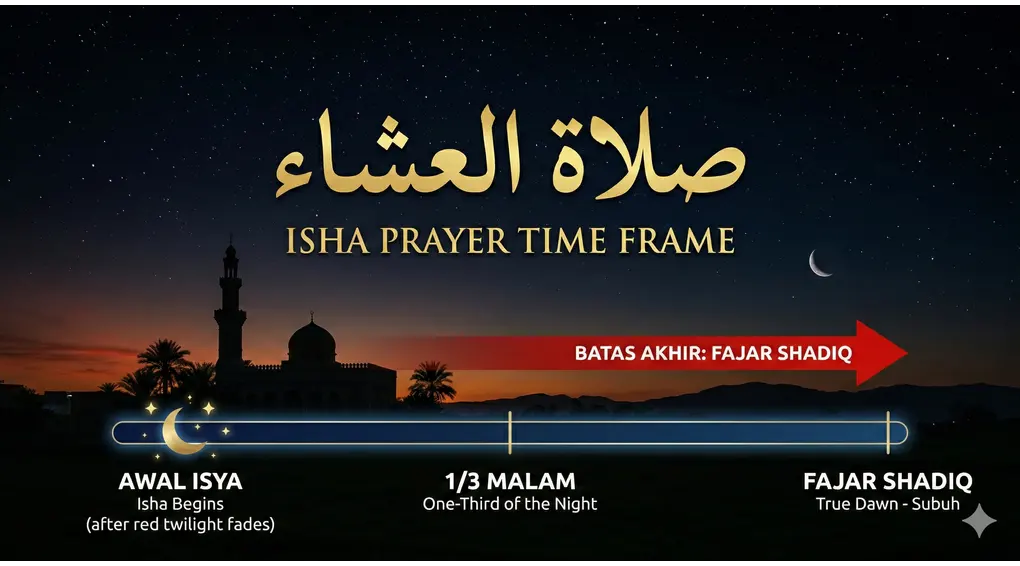
Have you ever returned from work late at night, exhausted, and accidentally fallen asleep before performing your Isha prayer? You wake up at 2:00 or 3:00 AM with a heavy heart, wondering: “Has the Isha prayer time limit passed? Is it still valid for me to pray now?” This common anxiety reflects a deep faith in Allah, yet the answer lies in understanding the structured legal rulings of Islam.
The question of when Isha ends—whether at midnight or the break of dawn—is a frequent topic of discussion among Muslims. To provide clarity, we must look at the primary sources of Islamic jurisprudence (Fiqh). In this article, we refer to the classical Shafi’i text Asnā al-Maṭālib by Syaikhul Islam Zakariyā al-Anṣārī. We will explore the various phases of the Isha prayer time, the significance of natural signs, and how accurate world prayer times are determined in extreme global regions.
The Classical Text: Asnā al-Maṭālib on Isha Timing
Before delving into the technical breakdown, it is essential to examine the foundational text that guides our understanding. Below is the scholarly excerpt from Asnā al-Maṭālib (Vol. 1, p. 117) regarding the Isha period:
قوله: (أول) وقت (العشاء ومن لا عشاء لهم) بأن يكون بنواح لا يغيب فيها شفقهم (يقدرون) قدر ما يغيب فيه الشفق (بأقرب البلاد) إليهم كعادم القوت المجزئ في الفطرة ببلده (والاختيار) أي وقته يمتد (إلى ثلث الليل) لخبر جبريل السابق (والجواز) أي وقته مع الكراهة كما صرح الروياني يمتد (إلى الفجر الصادق) لخبر جبريل مع خبر مسلم «ليس في النوم تفريط إنما التفريط على من لم يصل الصلاة حتى يجيء وقت الأخرى» ظاهره يقتضي امتداد وقت كل صلاة إلى دخول وقت الأخرى من الخمس
أي في غير الصبح لما سيجيء في وقتها وخرج بالصادق الكاذب وهو ما يطلع مستطيلا بأعلاه ضوء كذنب السرحان وهو الذنب ثم يذهب وتعقبه ظلمة ثم يطلع الفجر الصادق مستطيرا بالراء أي منتشرا وسمي الأول كاذبا لأنه يضيء ثم يسود ويذهب والثاني صادقا لأنه يصدق عن الصبح ويبينه وذكر في المجموع للعشاء أربعة أوقات الوقتان المذكوران ووقت فضيلة أول الوقت ووقت عذر وقت المغرب لمن يجمع
When Does Isha Actually End? Four Distinct Phases
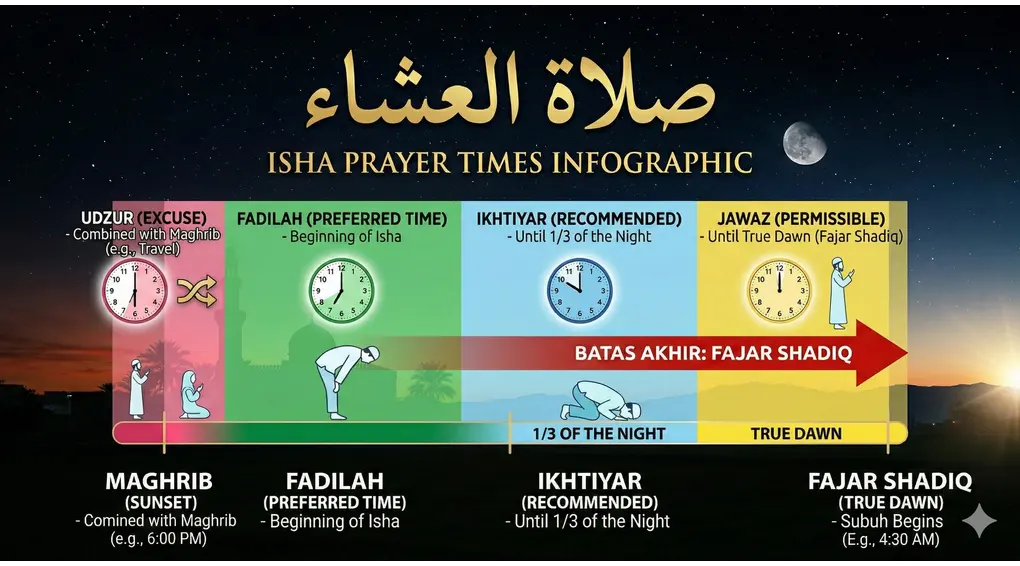
According to the Shafi’i school, the Isha prayer time limit is not a single point but a series of phases. Understanding these helps a believer prioritize the performance of prayer according to the Sunnah.
1. The Time of Excellence (Zaman al-Faḍīlah)
- This is the best time to pray.
- It begins immediately after the red twilight (al-shafaq al-aḥmar) disappears from the sky.
- A Muslim should aim to pray as soon as they respond to the adhan to gain the greatest reward.
2. The Chosen Time (Zaman al-Ikhtiyār)
- This phase extends until the end of the first third of the night.
- The text states: “(al-ikhtiyāru) ay waqtuhu yamtaddu (ila thuluthil lail).”
- To calculate this, determine the duration between sunset and dawn, then divide by three. If sunset is at 6:00 PM and dawn at 4:30 AM, this phase ends around 9:30 PM.
3. The Permissible Time (Zaman al-Jawāz)

- This phase extends from the third of the night until the break of the true dawn.
- The text explains: “(wal jawāzu)… yamtaddu (ila al-fajri ash-shādiq).”
- While it is legally valid to pray during this time, doing so after midnight without a valid excuse is considered makrūh (disliked) by scholars such as al-Ruyānī.
4. The Time of Excuse (Zaman al-ʿUdhur)
- This is a special provision for those combining prayers (jamʿ).
- It refers to performing Isha during the time of Maghrib due to travel or heavy rain.
Identifying the Natural Sign: The True Dawn
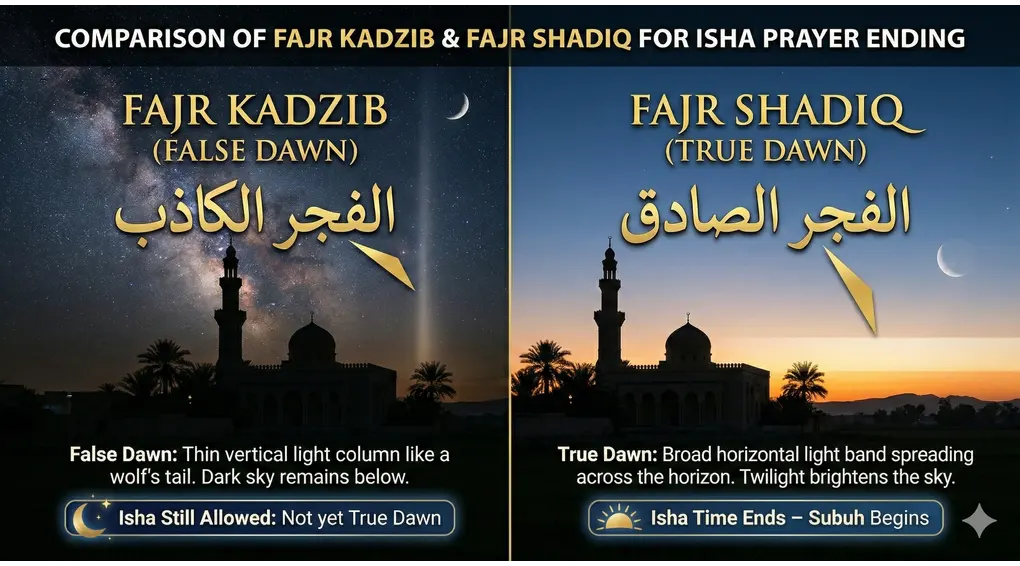
The absolute Isha prayer time limit is marked by the appearance of the “True Dawn” (Fajr al-Ṣādiq). It is vital to distinguish this from the “False Dawn” to avoid missing the prayer.
- False Dawn (Fajr al-Kādhib): This is a vertical light that appears high in the sky, often described as having the shape of a “wolf’s tail” (dhanab al-sirḥān). It is temporary and followed by darkness; if this light is present, the Isha time is still active.
- True Dawn (Fajr al-Ṣādiq): This is a horizontal light that spreads across the eastern horizon. Its appearance marks the definitive end of Isha and the start of the Subuh prayer limit.
Global Context: Extreme Latitudes and the Midnight Sun
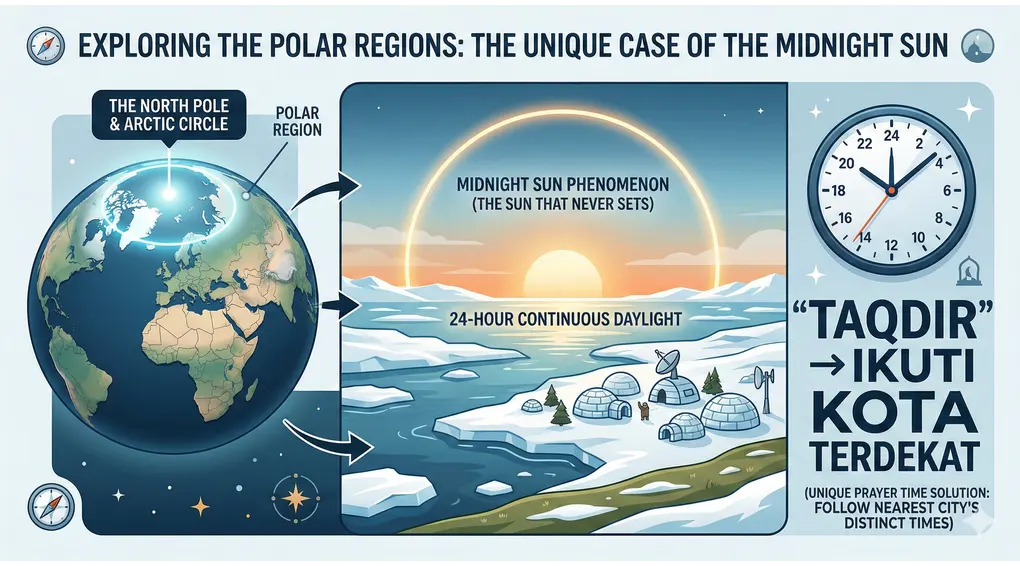
For Muslims living in Northern Europe or the polar regions, the sun may not set for months (the Midnight Sun), or the twilight may never disappear.
- The text of Asnā al-Maṭālib provides a practical solution for these unique regions.
- For those without a visible Isha entry sign, they must use taqdīr (estimation).
- They calculate their prayer times based on the nearest city that experiences a normal night cycle.
- This demonstrates the inherent flexibility of the Islamic Sharia in accommodating global diversity.
Summary of the Isha Prayer Timing
| Time Category | Estimated Range | Legal Status |
| Faḍīlah | Immediately after Maghrib ends | Highly Recommended |
| Ikhtiyār | Until 1/3 of the night | Highly Acceptable |
| Jawāz | From 1/3 night until Dawn | Valid, but potentially Makrūh |
| Ḥarām | After True Dawn (Fajr) | Sinful if delayed without excuse |
FAQ: Common Questions on the Isha Prayer Time Limit
Is it permissible to pray Isha at 3:00 AM?
Yes, it is legally valid and accepted as long as the True Dawn (Fajr al-Ṣādiq) has not yet broken. However, it falls within the Jawāz time, which should not be made a habit without reason.
How do I find the most accurate Isha time for my location today?
The most reliable way is to use verified digital schedules or apps that utilize regional calculation methods. Naturally, the time begins when the red twilight (shafaq) is completely gone from the western sky.
What should I do if I wake up exactly at the time of the Subuh adhan?
In cases where you have missed the time, you must immediately perform the qaḍā (make-up) for Isha before praying Subuh, provided there is enough time to do so without losing the Subuh period. This is part of the essential rules of prayer.
Conclusion
Understanding the Isha prayer time limit is not intended to encourage procrastination but to provide spiritual peace during emergencies or exhaustion. While the door of permissibility remains open until dawn, a believer should strive for the excellence of the early period, especially on nights of accepted supplication. Prioritizing our connection with Allah ensures our worship is performed with both legal accuracy and spiritual presence.
Reference
Zakariyā al-Anṣārī, Asnā al-Maṭālib fī Sharḥ Rawḍ al-Ṭālib, with the ḥāshiyah by Aḥmad al-Ramlī, edited by Muḥammad az-Zuhrī al-Ghamrāwī (Cairo: al-Maṭbaʿah al-Maymānīyah, 1313 AH; repr. Dār al-Kitāb al-Islāmī), vol. 1, p. 117.


