
Understanding the meaning of Islam in language and Sharia reveals that every human action holds the potential for worship when accompanied by the correct intention and etiquette. This includes the most private of acts, such as relieving oneself. Practicing the bathroom and Istinja prayers is not merely a verbal routine but a profound spiritual awareness to maintain physical and spiritual purity.
This academic article explores the comprehensive etiquette and supplications related to bathroom use based on classical fiqh studies of the Shafi’i school, complete with Arabic text, international standard transliterations, and deep semantic analysis.
The Importance of Bathroom Etiquette in Shafi’i Fiqh
Naturally, the bathroom is a place designated for impurities, making it susceptible to negative spiritual entities like jinn. In the framework of Ahlus Sunnah wal Jama’ah (Aswaja), a true manifestation of faith in Allah is demonstrated by constantly seeking His divine protection (isti‘ādhah) in all conditions.
Classical scholars emphasize that the purification process is inseparable from supplication. These prayers serve as a spiritual shield and an instrument to cleanse the heart from spiritual diseases, proving that Islamic law regulates life comprehensively by connecting physical reality with the divine dimension.
Prayer for Entering the Bathroom: Text and Meaning
Before stepping into the restroom with the left foot, a Muslim is recommended (sunnah) to recite a specific supplication. The primary purpose of this prayer is to build a protective barrier against the disturbances of evil spirits (khubuth and khabā’ith) residing in impure places.
اللَّهُمَّ إِنِّي أَعُوذُ بِكَ مِنَ الْخُبُثِ وَالْخَبَائِثِ
Allāhumma innī a‘ūdhu bika min al-khubuthi wa al-khabā’ith.
Meaning: “O Allah, I seek refuge in You from male and female evil spirits.”
Explaining the Meaning of the Entering Prayer
This supplication is an explicit request for protection. The word al-khubuth (الخبث) refers to male devils, while al-khabā’ith (الخبائث) refers to female devils. By reciting this, we declare our vulnerability and surrender our protection entirely to Allah SWT, ensuring that the whispers and disturbances of metaphysical entities cannot penetrate our spiritual defenses while we are inside.
Prayer for Exiting the Bathroom and Its Spiritual Significance
After fulfilling one’s need and stepping out with the right foot, there is a profound prayer that combines an admission of weakness with deep gratitude for the smooth functioning of the body’s biological systems.
غُفْرَانَكَ الْحَمْدُ لِلَّهِ الَّذِي أَذْهَبَ عَنِّي الْأَذَى وَعَافَانِي
Ghufrānaka. Al-ḥamdu lillāhi al-ladhī adhhaba ‘annī al-adhā wa ‘āfānī.
Meaning: “I seek Your forgiveness. All praise is due to Allah who has removed harm from me and granted me health.”
Understanding Gratitude in the Exiting Prayer
This prayer encompasses two essential theological dimensions:
- Dimension of Istighfār (غُفْرَانَكَ): We ask for forgiveness because, while in the toilet, our tongues are restrained from reciting dhikr (remembrance of Allah). This acts as an introspection that a believer always yearns to remember God.
- Dimension of Gratitude (الْحَمْدُ لِلَّهِ…): We express gratitude for our body’s excretory system. If this vital process were obstructed, it would cause severe pain. This prayer represents an acknowledgment of the blessing of health that humans often overlook.
Prayer After Istinja: Purifying Body and Soul
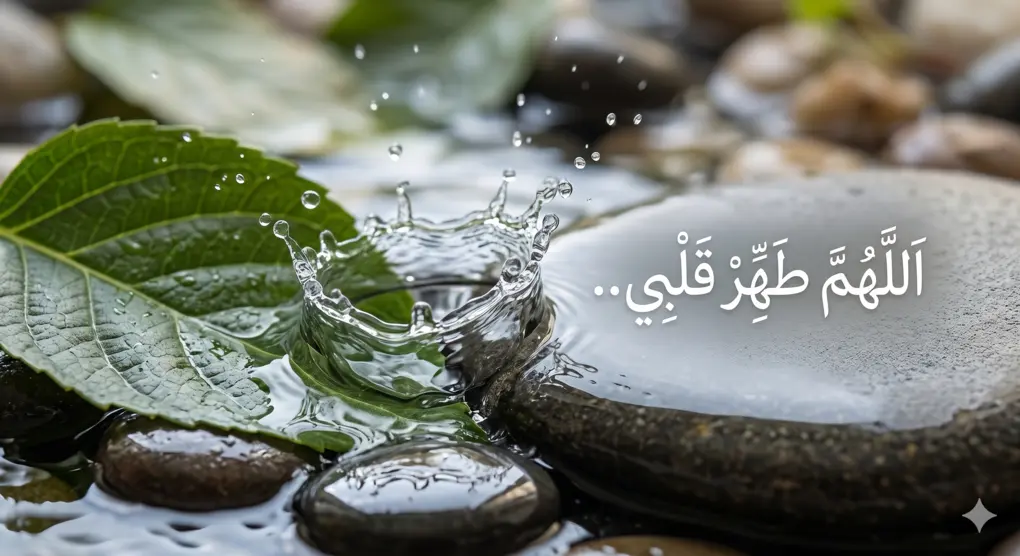
In the concept of thaharah (purification), after the elimination of waste, it is obligatory for a Muslim to perform Istinja using pure water or other valid thaharah media. Understanding the meaning of Istinja in Islamic law means removing the remnants of impurity completely. Following this, it is highly recommended to recite a specific prayer that bridges physical cleanliness with spiritual purity.
اللَّهُمَّ طَهِّرْ قَلْبِي مِنَ النِّفَاقِ وَحَصِّنْ فَرْجِي مِنَ الْفَوَاحِشِ
Allāhumma ṭahhir qalbī min an-nifāqi wa ḥaṣṣin farjī min al-fawāḥish.
Meaning: “O Allah, purify my heart from hypocrisy and protect my private parts from immoral acts.”
Cleansing the Heart from Hypocrisy (Nifāq)



After cleansing the body from physical waste, or understanding the meaning of najis linguistically and terminologically, this prayer guides us to cleanse the “impurity” of the heart, namely nifāq (hypocrisy). Nifāq is a spiritual pathology where one’s outward appearance contradicts their inner state. The connection between Istinja and the purification of the heart emphasizes that the evidence and ruling of Istinja are not merely hygiene rules, but a means to calibrate honesty and sincerity before the Creator.
Guarding Honor from Immoral Acts
The phrase wa ḥaṣṣin farjī min al-fawāḥish is a specific plea to protect one’s honor from major sins, particularly adultery (zinā). Given that Istinja directly involves the intimate organs, this moment is highly contextual for asking Allah’s protection so that human desires remain subjected to the control of Sharia.
The formulation of these etiquettes and prayers is clearly documented in authoritative Shafi’i literature. One such record is found in the book I‘ānat aṭ-Ṭālibīn, which is an extensive commentary (sharḥ) on the foundational text Fatḥ al-Mu‘īn.
Conclusion
The integration of bathroom and Istinja prayers establishes a holistic paradigm of cleanliness in Islam. These three prayers do not merely regulate physical routines; they project divine protection, foster gratitude for health, and protect the heart from hypocrisy and immorality. Making this guide a daily habit is a concrete step in preserving personal honor and maintaining inner and outer purity, in accordance with the guidance of Ahlus Sunnah wal Jama’ah scholars.
Frequently Asked Questions (FAQ)
Why are we recommended to enter the bathroom with the left foot?
In Shafi’i fiqh, the right side of the body is honored for good and pure activities (like entering a mosque). Conversely, for places designated for impurities, like the bathroom, the proper etiquette is to lead with the left side as a form of proportional etiquette placement.
Is it permissible to do dhikr in the heart while inside the toilet?
As a general rule, vocalizing the name of Allah or verses of the Quran inside the restroom is makrūh taḥrīm (prohibitively disliked). However, remembering Allah in the heart without moving the lips or tongue remains permissible and is not subject to this prohibition.
What if I forget to recite the entering prayer and am already inside?
If someone has entered the restroom area and forgot to recite the prayer, they should simply recite it in their heart (without vocalizing it) to seek Allah’s protection from the disturbances of devils. For further insights, you can explore the guidelines for istinja and categories of najis in related fiqh references.
Academic Reference
Abū Bakr (al-Mashhūr bi-al-Bakrī) ʿUthmān ibn Muḥammad Shaṭṭā ad-Dimyāṭī ash-Shāfiʿī, Iʿānat aṭ-Ṭālibīn ʿalā Ḥall Alfāẓ Fatḥ al-Muʿīn (Ḥāshiyah ʿalā Fatḥ al-Muʿīn bi-Sharḥ Qurrat al-ʿAyn bi-Muhimmat ad-Dīn), 1st ed. (Beirut: Dār al-Fikr, 1997), 1:132.


