
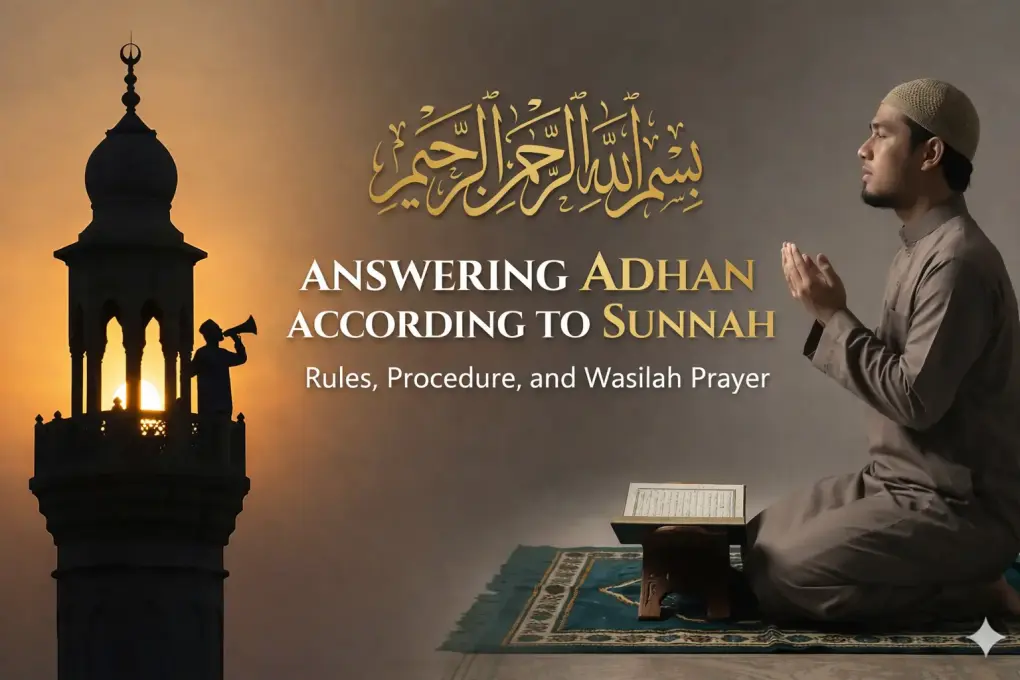
The call to prayer is a profoundly familiar sound, echoing five times a day from local mosques. However, we often listen to it passively without observing the proper etiquette. In Islam, answering the Adhan is highly recommended and holds immense spiritual blessings.
Many questions frequently arise regarding this practice: Can a menstruating woman reply to it? How do we answer the Fajr call of As-shalatu khairun minan naum? Furthermore, what are the complete supplications after the Adhan to attain the Prophet’s intercession?
This article provides a comprehensive academic guide to answering the Adhan according to the Sunnah, referencing the classical Shafi’i fiqh text, Asna al-Matalib Syarh Raudh at-Thalib, authored by Shaykh al-Islam Zakariyya al-Ansari.
The Islamic Ruling on Answering the Adhan
The first fundamental concept to understand is its legal status in Islamic jurisprudence. Some might wonder whether replying to the call is obligatory (wajib) or recommended (sunnah). To understand the broader context of the call itself, you can learn about the meaning of Adhan and Iqamah.
In the text Asna al-Matalib, the ruling is explicitly stated:
(ويستحب أن يجيب)
السامع (المؤذن) والمقيم (وإن كان جنبا) أو حائضا (بمثل قوله عقيبه)
Translation: “It is recommended for the listener to answer the muezzin and the one establishing the Iqamah, even if they are in a state of major ritual impurity (junub) or menstruation, with similar words immediately after him.”
Therefore, what is the ruling on answering the Adhan? The answer is Sunnah (highly recommended). Interestingly, this practice remains recommended even for those in a state of ritual impurity. You can read further regarding the prohibitions for a person in a state of junub to understand why certain acts are restricted while this is not. This exception exists because replying to the Adhan falls under the category of remembrance of Allah (dhikr), not Quranic recitation.
The basic principle is straightforward: we mirror the muezzin’s words. If he recites the Takbir, we recite the Takbir. However, there are specific jurisprudential exceptions.
Proper Methods for Answering the Adhan
To practice the proper etiquette, pay close attention to the specific phrases. Generally, we repeat the muezzin’s pronouncements. For instance, when hearing the testimony of faith (Ashhadu anna Muhammadan Rasulullah), we utter the exact same declaration.
However, take note of the following variations:
1. Replacing with the Hauqalah
When the muezzin calls the congregation to prayer (Hayya ‘ala as-Salah) and success (Hayya ‘ala al-Falah), we do not repeat these phrases. Instead, we recite the Hauqalah.
The reference text states:
( إلا في الحيعلتين فإنه يحولق )
بأن يقول عقبهما في الأذان لا حول ولا قوة إلا بالله أربعا
Translation: “Except for the two hay’alahs, he should recite the hauqalah… namely: La hawla wa la quwwata illa billah.”
The rationale is that the muezzin’s utterance is a summons to perform the prayer because the time has entered. We respond to this invitation by seeking strength from Allah—an acknowledgment of the virtues of the Hauqalah—to enable our physical steps toward the mosque.
2. Specifically Answering the Fajr Adhan
This is a frequently asked question: how do we respond to the Fajr call during the Tatswib? When the muezzin proclaims “As-shalatu khairun minan naum” (Prayer is better than sleep), we do not repeat it.
Asna al-Matalib dictates:
( وفي التثويب يقول صدقت وبررت )
مرتين بكسر الراء الأولى
Translation: “And during the At-Tatswib, he answers: Sadaqta wa barirta (You have spoken the truth and acted righteously) twice.”
Thus, the accurate response confirms the truth that prayer indeed supersedes sleep.
3. Answering the Maghrib and Isha Adhan




There is no special distinction when replying to the Maghrib or Isha calls compared to the daytime prayers. The principle remains identical: mirror the phrases, substitute the call to prayer with the Hauqalah, and conclude with the designated supplication.
Complete Supplication After the Adhan (The Wasilah Prayer)
This Sunnah practice is incomplete without the concluding supplication. According to Asna al-Matalib, the structured sequence is as follows:
- Send Salutations upon the Prophet (Salawat): It is recommended to send blessings upon Prophet Muhammad ﷺ immediately after the Adhan concludes.
- Recite the Wasilah Supplication: Following the Salawat, proceed with the prayer asking Allah to grant the Prophet the Wasilah (the highest station in Paradise).
Here is the universally recognized text of the Wasilah prayer, complete with Arabic, transliteration, and translation:
Arabic Text:
اللَّهُمَّ رَبَّ هَذِهِ الدَّعْوَةِ التَّامَّةِ وَالصَّلَاةِ الْقَائِمَةِ آتِ مُحَمَّدًا الْوَسِيلَةَ وَالْفَضِيلَةَ وَابْعَثْهُ مَقَامًا مَحْمُودًا الَّذِي وَعَدْتَهُ
Allāhumma rabba hādhihi al-da‘wati al-tāmmati wa al-ṣalāti al-qā’imah, āti Muḥammadan al-wasīlata wa al-faḍīlah, wab‘ath-hu maqāman maḥmūdan alladhī wa‘adtah.
Translation: “O Allah, Lord of this perfect call and the established prayer. Grant Prophet Muhammad the Wasilah (a station in Paradise) and virtue, and resurrect him in the praised station that You have promised him.”
The fiqh text cites a prominent Hadith confirming the virtue of this act: “Whoever asks for the Wasilah for me, my intercession becomes permissible (guaranteed) for him.”
Special Circumstances While Hearing the Adhan
We often hear the call to prayer while engaged in other activities. What is the jurisprudential ruling in such cases?
1. While Reciting the Quran
If you are reading the Quran or engaging in dhikr, the Sunnah is to pause momentarily.
ويقطع القراءة والذكر ندبا (للجواب)
“And he interrupts the Quranic recitation and dhikr—as a recommended act—to answer the Adhan.”
2. If You Missed the Immediate Response
If the Adhan has concluded and you forgot to reply, you are permitted to make it up (qada) as long as the time gap is relatively short.
3. Answering the Adhan During Prayer (Salah)
Exercise caution in this scenario. The fundamental ruling is that it is disliked (makruh) to answer the Adhan while actively performing Salah. However, the prayer remains valid if the response consists purely of dhikr (such as “Allahu Akbar”).
Nevertheless, your prayer will be INVALIDATED if:
- You answer the Fajr Adhan with “Sadaqta wa barirta”. This specific phrase is grammatically classified as human conversation (kalam adami).
- You answer with “Hayya ‘ala as-Salah”. Repeating this invalidates the prayer because it signifies a command, not a dhikr.
إلا إن أجاب (بصدقت وبررت) فتبطل لأنه كلام آدمي
“Except if he answers with ‘Sadaqta wa barirta‘, then his prayer is invalidated, because it is considered human speech.”
Conclusion
Reviving the practice of answering the Adhan is a profound yet simple method to draw closer to Allah. Based on the scholarly insights from Asna al-Matalib, we recognize the flexibility of this worship—it accommodates menstruating women and allows for immediate qada if momentarily missed, though it requires strict vigilance during actual prayer. Let us cultivate this spiritual habit. Beginning with the next call you hear, ensure you conclude with the Wasilah prayer outlined above. By consistently applying this Sunnah, we hope to be among those granted the intercession of Prophet Muhammad ﷺ.
Frequently Asked Questions (FAQ)
Is it obligatory to answer the Adhan?
No. According to the Shafi’i school of thought, answering the Adhan is a highly recommended Sunnah, not an obligation (wajib).
Can a menstruating woman reply to the Adhan?
Yes. Replying to the Adhan is considered a form of dhikr (remembrance of Allah), which is entirely permissible for individuals in a state of menstruation or major ritual impurity (junub).
How do you reply to As-shalatu khairun minan naum?
During the Fajr prayer, when the muezzin says As-shalatu khairun minan naum, you should not repeat it. Instead, reply with Sadaqta wa barirta (You have spoken the truth and acted righteously).
Reference
Zakariyā al-Anṣārī, Asnā al-Maṭālib fī Sharḥ Rawḍ al-Ṭālib, with a ḥāshiyah by Aḥmad al-Ramlī, edited by Muḥammad az-Zuhrī al-Ghamrāwī (Cairo: al-Maṭbaʿah al-Maymānīyah, 1313 H; repr. Dār al-Kitāb al-Islāmī), vol. 1, pp. 130-131.


