
Being in a state of junub but not yet having the opportunity to perform the ritual bath (ghusl) is a common scenario in our daily lives. Perhaps you wake up in the last third of the night for the pre-dawn meal (sahoor) only to realize you are in a state of major impurity. Alternatively, you might return home late from work, feel utterly exhausted after marital intimacy, and find your eyes too heavy to immediately perform the major bath. Questions regarding the rules for junub—what is strictly forbidden and what remains permissible during this state—are highly relevant discussions among Muslims.
Islamic Sharia is revealed with the essence of ease, yet it meticulously maintains strict boundaries of purity. Understanding the jurisprudential guidelines surrounding major ritual impurity (hadath akbar) is an absolute obligation for every mukallaf (a person legally accountable in Islamic law). This academic article provides a comprehensive exploration of fiqh guidelines based on classical literature, specifically the authoritative text Asna al-Matalib Syarh Rawdh ath-Thalib authored by Shaykh al-Islam Zakariyya al-Anshari.
What is Junub? The Linguistic and Legal Definition of Hadath Akbar
Before detailing the various prohibitions, we must establish the linguistic and terminological understanding of the word Junub or Janabah. Etymologically, the term janabah denotes al-bu’d, which translates to “distance” or “being far.” It is named as such because an individual in a state of major ritual impurity is temporarily “distanced” from performing specific acts of worship, such as prayer and residing in the mosque, until they purify themselves. This condition necessitates a Muslim to practice the complete guide on the Shafi’i method of major ablution to once again draw near to Allah in pure worship (mahdhah).
In Islamic legal terminology (syara’), junub is a legal status (major impurity) attributed to an individual as a result of sexual intercourse (even without ejaculation) or the emission of seminal fluid. For detailed specifics regarding this matter, you can explore the causes of mandatory bathing according to Shafi’i fiqh.
The primary scriptural evidence mandating purification from this state is explicitly stated in the words of Allah Almighty:
وَإِنْ كُنْتُمْ جُنُبًا فَاطَّهَّرُوا
“And if you are in a state of janabah, then purify yourselves.” (QS. Al-Maidah: 6)
Just as a servant purifies their soul from sin through understanding the essence of Islamic repentance, they are equally obligated to purify their physical body from major impurity.
To ensure clarity and avoid the extremes of negligence (taqshir) or obsessive excessiveness (was-was) in religious practice, we will divide the rules for junub into three major categories: activities that are forbidden, activities that remain permissible, and the recommended sunnah practices while in this state.
Forbidden Activities for Those in a State of Junub
The status of major ritual impurity establishes strict boundaries regarding ritual worship. Below is the detailed breakdown of prohibitions that must be avoided.
1. Ritual Prayer (Salah) — Absolutely Forbidden
A person in a state of junub shares this prohibition with those in a state of minor impurity. Physical purity is an absolute prerequisite for the validity of prayer. This prohibition encompasses all types of prayer: the five obligatory daily prayers, sunnah prayers, funeral prayers, as well as the prostrations of recitation (sujud tilawah) and gratitude (sujud shukr). Performing prayer while junub is legally invalid and strictly forbidden. Allah Almighty decrees:
يَا أَيُّهَا الَّذِينَ آمَنُوا لَا تَقْرَبُوا الصَّلَاةَ وَأَنْتُمْ سُكَارَىٰ حَتَّىٰ تَعْلَمُوا مَا تَقُولُونَ وَلَا جُنُبًا إِلَّا عَابِرِي سَبِيلٍ حَتَّىٰ تَغْتَسِلُوا “
O you who have believed, do not approach prayer while you are intoxicated until you know what you are saying or in a state of janabah, except those passing through [a place of prayer], until you have washed [your whole body].” (QS. An-Nisa: 43)
2. Reciting the Qur’an with Intent — Even a Single Verse
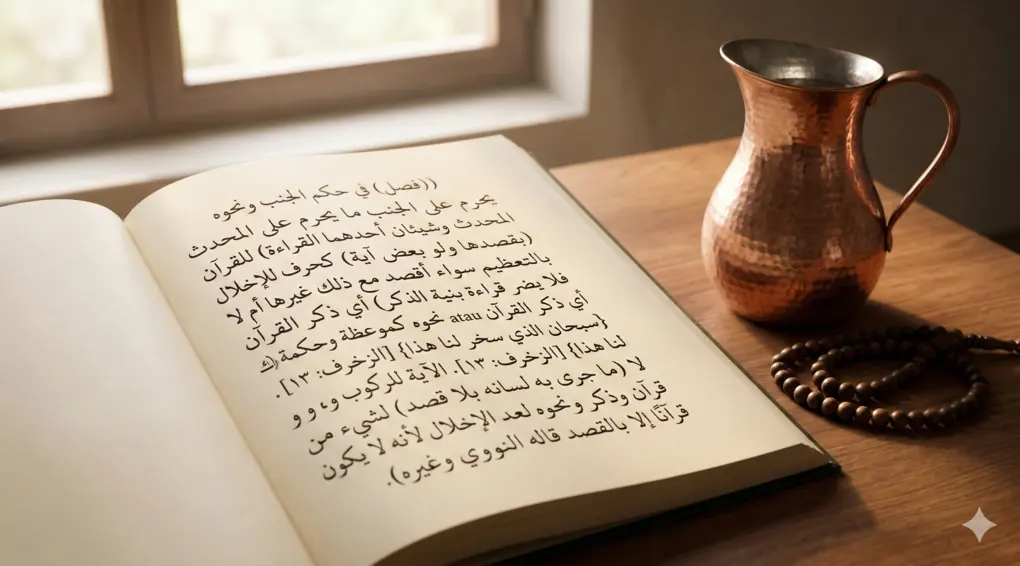
This is a specific prohibition that distinguishes a junub person from someone with minor impurity. Reciting the Qur’an while junub is prohibited in the Shafi’i school if it is done with the intention of recitation (tilawah). The text Asna al-Matalib strictly affirms this:
قوله: (يحرم على الجنب ما يحرم على المحدث وشيئان أحدهما القراءة) للقرآن (بقصدها ولو بعض آية) كحرف للإخلال بالتعظيم سواء أقصد مع ذلك غيرها أم لا
“It is forbidden for the junub person to do what is forbidden for the one in minor impurity, plus two additional matters. One of them is reciting the Qur’an with the intention of reading it (qishd al-qira’ah), even if it is only a part of a verse (such as a single letter), because it compromises the veneration due to the Qur’an, whether they intend something else along with it or not.”
This prohibition relies on the Hadith narrated by Imam Tirmidhi from Ibn Umar (may Allah be pleased with them), that the Prophet ﷺ said: “A junub person and a menstruating woman must not recite anything from the Qur’an.”
3. Touching the Mushaf of the Qur’an



In addition to reciting, touching the physical Qur’an (mushaf) is also prohibited. Direct skin contact with the pages of the mushaf, its attached cover, or its storage box (while the mushaf is inside) is forbidden for someone lacking ritual purity. Allah Almighty states:
لَا يَمَسُّهُ إِلَّا الْمُطَهَّرُونَ
“None touch it except the purified.” (QS. Al-Waqi’ah: 79)
Regarding a mushaf accompanied by translated text or exegesis (tafsir), you can study the detailed nuances in the ruling on touching a translated Qur’an during impurity in the Shafi’i school.
4. Staying (Mukth) in the Mosque
Staying, sitting idly, or pacing aimlessly inside a mosque are prohibited activities for a junub person. This relates deeply to the etiquette of honoring the House of Allah. Asna al-Matalib mentions:
قوله: (الثاني المكث والتردد في المسجد) لا عبوره لقوله تعالى {لا تقربوا الصلاة} [النساء: ٤٣] الآية قال ابن عباس وغيره أي لا تقربوا موضع الصلاة لأنه ليس فيها عبور سبيل بل في موضعها وهو المسجد
“The second [forbidden matter] is staying (Mukth) and lingering within the mosque, though not merely passing through. This is based on Allah’s words: ‘Do not approach prayer.’ The companion Ibn Abbas and other scholars interpreted this as: ‘Do not approach the place of prayer (the mosque).'”
If someone is forcibly trapped inside a mosque, they are excused. However, they are required to perform dry ablution (tayammum) inside the mosque to lighten their impurity while remaining there. This strict spatial boundary is also a crucial foundation when studying the fiqh of i’tikaf in the Shafi’i school.
5. Performing Tawaf at the Ka’bah
Circumambulating the Ka’bah (Tawaf) shares the exact purity prerequisites as prayer. The Prophet ﷺ stated:
الطَّوَافُ بِالْبَيْتِ صَلَاةٌ
“Tawaf around the House is [like] prayer…” (HR. Tirmidhi)
Consequently, a person in a state of major impurity is forbidden from performing tawaf. If they force themselves to do so, their tawaf is deemed invalid and must be repeated upon purification.
Permissible Activities While in a State of Junub

Islam does not view the physical body of a believer in a state of junub as fundamentally unclean (najis). Abu Hurairah once avoided the Prophet ﷺ because he felt ashamed of being junub. The Prophet subsequently said: “Subhanallah, indeed a believer does not become najis.” (HR. Bukhari and Muslim). Based on this principle, the following activities remain completely permissible.
1. Eating, Drinking, and Working
Engaging in worldly activities such as working, eating, and drinking remains permissible (mubah). There is no scriptural evidence forbidding a junub person from touching food, cooking, or executing professional duties. However, the taught etiquette is to partially purify oneself first (which will be discussed in the sunnah section).
2. Dhikr Using Qur’anic Phrases (Without Recitation Intent)
What if a junub person wishes to supplicate using a prayer that happens to be a Qur’anic verse? Shafi’i fiqh offers profound facilitation. One may recite a Qur’anic verse provided the intention in their heart is purely for remembrance (dhikr), supplication, or drawing a lesson, rather than intending it as Qur’anic recitation.
Shaykh al-Islam Zakariyya al-Anshari provides a precise example:
قوله: (فلا يضر قراءة بنية الذكر) أي ذكر القرآن أو نحوه كموعظة وحكمة (ك {سبحان الذي سخر لنا هذا} [الزخرف: ١٣] . الآية للركوب و) لا (ما جرى به لسانه بلا قصد)
“It does not harm to read with the intention of dhikr from the Qur’an or the like, such as for admonition and wisdom (like reading the verse ‘Subhanalladzi sakhkhara lana hadza…’ as a supplication for riding a vehicle). Nor does it harm if the words flow from the tongue unintentionally.”
Before eating, understanding the ruling on reciting basmalah ensures you remain within bounds; uttering “Bismillah” is perfectly lawful for a junub person as a daily dhikr. You can delve into the spiritual depths of this through the secrets of basmalah. Similarly, uttering “Alhamdulillah” after sneezing is permitted, which aligns with examining the meaning of hamdalah and gratitude in daily Islamic life.
3. Reciting the Qur’an in the Heart (Without Moving the Lips)
The prohibition of qira’ah focuses strictly on vocalized pronunciation. If a junub person merely flows the holy verses in their heart or looks at the mushaf without moving their lips, it is permissible.
قوله: (وله) أي الجنب (إجراؤه) أي القرآن (على قلبه ونظر في المصحف)
“And it is permissible for him (the junub) to flow it (the Qur’an) over his heart and to look into the Mushaf.”
4. Passing Through (Murur) the Mosque for a Need
There is a legal line between staying (muktsu) and merely passing through (‘ubur / murur). If a junub person enters the mosque from one door and walks straight out another because it is the shortest route to their destination, it is permitted, relying on the verse “except those passing through”. However, passing through the mosque without any clear necessity is classified as makruh (disliked) according to the relied-upon opinion in the Shafi’i school.
5. Sleeping and Resuming Intimacy
Sleeping while junub is mubah. A person is not obligated to rush to the bathroom immediately after midnight intimacy. They may rest or even resume relations with their spouse on the same night. However, there is a strongly emphasized etiquette before doing so.
عَنْ أَبِي سَعِيدٍ الْخُدْرِيِّ قَالَ قَالَ رَسُولُ اللَّهِ صَلَّى اللَّهُ عَلَيْهِ وَسَلَّمَ إِذَا أَتَى أَحَدُكُمْ أَهْلَهُ ثُمَّ أَرَادَ أَنْ يَعُودَ فَلْيَتَوَضَّأْ بَيْنَهُمَا وُضُوءًا
From Abu Sa’id al-Khudri, he reported that the Messenger of Allah ﷺ said: “If one of you approaches his wife, then wishes to repeat [the act], let him perform wudhu between the two.” (HR. Muslim)
Sunnah Practices for the Junub Before Bathing
Islamic law instills noble ethics, encouraging a Muslim to maintain physical cleanliness as much as possible, even before being completely free from major impurity. Practicing these recommendations requires us to understand the sunnah and etiquette of the mandatory junub bath in the Shafi’i school.
1. Washing the Private Parts (Ghusl al-Farj) Before Wudhu
The foremost etiquette before bathing is removing physical impurities. It is highly recommended to perform istinja to wash away bodily fluids before engaging in any other activity.
2. Wudhu Before Sleeping While Still Junub
Performing ablution (wudhu) before sleeping in a state of junub is a strongly emphasized recommendation (sunnah muakkad). This wudhu does not lift the junub status; rather, its function is to lighten the state of impurity (takhfif al-hadats).
كَانَ النَّبِيُّ صَلَّى اللَّهُ عَلَيْهِ وَسَلَّمَ إِذَا أَرَادَ أَنْ يَنَامَ وَهُوَ جُنُبٌ غَسَلَ فَرْجَهُ وَتَوَضَّأَ وُضُوءَهُ لِلصَّلَاةِ
“Whenever the Prophet ﷺ intended to sleep while he was in a state of junub, he would wash his private parts and perform wudhu just as he performed wudhu for prayer.” (HR. Bukhari and Muslim)
3. Wudhu Before Eating and Drinking
Similar to sleeping, it is sunnah to perform wudhu before eating or drinking. Shaykh al-Islam states:
قوله: (وسن) للجنب (غسل فرج ووضوء لجماع ولأكل وشرب ونوم كحائض بعد انقطاعه)
“And it is sunnah for the junub to wash the private parts and perform wudhu for [repeating] intercourse, eating, drinking, and sleeping. This also applies to a menstruating woman after her bleeding stops.”
4. Expediting the Mandatory Bath — Do Not Delay
While delaying the bath is not forbidden as long as the time for obligatory prayer has not arrived, expediting it holds great virtue. It prevents the negligence that often leads to missing the congregational Fajr prayer due to morning lethargy.
Scholarly Disagreements (Khilafiyah) and Academic Nuances
The rich academic dialectic in fiqh literature offers Muslims broad-mindedness when addressing liturgical diversity.
1. Reciting the Qur’an for the Junub — Madhhab vs. Madhhab
While the Shafi’i school strictly forbids Qur’anic recitation for the junub, the Maliki school provides specific concessions (primarily for menstruating women, not necessarily junub) to recite for memorization (muraja’ah) so their memory does not fade. However, for the junub, the vast majority of scholars (Jumhur) from the Hanafi, Maliki, Shafi’i, and Hanbali schools agree on its prohibition.
2. Qur’anic Phrases Not Found Outside the Qur’an
A subtle internal debate within the Shafi’i school involves dhikr utilizing verses that are structurally exclusive to the Qur’an, such as Surah Al-Ikhlas or Ayat al-Kursi. Can they be recited as prayers for protection before sleep? Asna al-Matalib captures this nuance:
وظاهره أن ذلك جار فيما يوجد نظمه في غير القرآن وما لا يوجد نظمه إلا فيه لكن أمثلتهم تشعر بأن محل ذلك فيما يوجد نظمه في غير القرآن كالآية المذكورة والبسملة والحمد له وإن ما لا يوجد نظمه إلا في القرآن كسورة الإخلاص وآية الكرسي يمنع منه وإن لم يقصد به القراءة وبذلك صرح الشيخ أبو علي والأستاذ أبو طاهر والإمام
“The apparent meaning is that this allowance applies to structures found outside the Qur’an and those found exclusively within it. However, their examples suggest the allowance primarily applies to phrases commonly found outside the Qur’an, like Basmalah and Hamdalah. Conversely, phrases entirely exclusive to the Qur’an, like Surah Al-Ikhlas and Ayat al-Kursi, are prevented even if not intended as recitation. This was explicitly stated by Shaykh Abu Ali, Ustadz Abu Thahir, and Al-Imam.” This represents a high level of scholarly precaution (ihtiyath) rarely discussed in popular studies.
3. Passing Through the Mosque — Makruh or Haram?
If a junub person must urgently retrieve a left-behind item with no other route, passing through is permissible (mubah). Conversely, if the passage is merely for a casual stroll without legitimate necessity (syar’i need), Imam al-Nawawi classifies it as makruh.
Contemporary Practical Questions Regarding Junub
Modern life presents new realities. Here are legal guidelines addressing specific contemporary situations.
Can a Junub Person Call the Adhan or Iqamah?
According to fiqh, the call to prayer (adhan) is a public proclamation (syiar), not a prayer itself. Thus, it is legally valid for a mu’adhin to call the adhan while junub. However, the act is deemed Makruh, as this profound dhikr should ideally be delivered in perfect purity. Mosque administrators must prioritize these specifics, which can be further studied in the valid requirements to become a mu’adhin.
Listening to Murottal of the Qur’an while Junub — Is it Permissible?
While vocal recitation is prohibited, listening is entirely permissible. If you play Qur’anic audio at home or in your vehicle while junub, it is lawful and you are still rewarded for listening to the Divine word.
Do All Prohibitions Apply Equally to Menstruation (Haid) and Postpartum Bleeding (Nifas)?
Both haid and nifas constitute major impurity, carrying identical legal consequences regarding worship prohibitions. Asna al-Matalib affirms:
قوله: (والحائض والنفساء) في تحريم القراءة (كالجنب)
“And the menstruating woman and the woman in postpartum bleeding, regarding the prohibition of recitation, are like the junub.” They are likewise forbidden from staying in the mosque and touching the mushaf.
Frequently Asked Questions (FAQ)
Can a person in a state of junub eat before bathing?
Yes, it is highly permissible. No ruling forbids a junub person from touching or consuming food. However, it is a recommended sunnah to wash the private parts and perform wudhu before eating.
Is it permissible to sleep while junub without bathing first?
Yes. There is no strict obligation to bathe immediately in the middle of the night. Nevertheless, sleeping in a junub state without performing wudhu beforehand is considered makruh.
Can I say ‘Bismillah’ while junub?
Yes, provided you say it with the intention of dhikr or initiating a task (like eating), not intending to recite a portion of the Qur’an. The phrase is standard in daily conversational etiquette.
How long can I delay the mandatory ghusl?
There is no rigid hourly limit. The Sharia only dictates that the bath must be completed before the time for the upcoming obligatory prayer expires. A person who becomes junub at night must bathe before sunrise to perform the Fajr prayer on time.
Can a junub person enter a bathroom located inside a mosque area?
The ruling depends on the land’s endowment (waqf) status. If the bathroom is structurally and legally outside the primary mosque area (not the prayer hall), it is allowed. If the bathroom’s access is within the absolute waqf boundaries of the mosque, a junub person is permitted to pass through the mosque to access it, as entry necessitates passing through.
Conclusion: The Fiqh Ruling Map for the Junub
To consolidate the academic explanations above, refer to this classification table summarizing the rules for junub.
| Activity | Ruling for the Junub | Shafi’i Fiqh Explanation | Scriptural Reference |
|---|---|---|---|
| Prayer & Tawaf | Strictly Haram | Invalidates the worship entirely. | QS. An-Nisa: 43 |
| Staying in Mosque | Haram | Permitted only in emergencies (requires tayammum). | QS. An-Nisa: 43 |
| Reciting Qur’an | Haram | Applies if intended as tilawah (recitation). | Hadith HR. Tirmidhi |
| Touching Mushaf | Haram | Direct skin contact with the mushaf is forbidden. | QS. Al-Waqi’ah: 79 |
| Passing Mosque | Makruh / Mubah | Makruh if without need. Mubah if necessary. | QS. An-Nisa: 43 |
| Sleep w/o Wudhu | Makruh | Highly recommended to perform wudhu (takhfif). | HR. Bukhari & Muslim |
| Eating & Drinking | Permissible (Mubah) | Sunnah to perform wudhu beforehand. | HR. Bukhari & Muslim |
| Dhikr w/ Qur’an | Permissible | Condition: Pure intention for dhikr/dua (e.g., Basmalah). | Asna al-Matalib |
| Resuming Intimacy | Permissible | Sunnah to wash and perform wudhu between acts. | HR. Muslim |
Maintaining physical purity is the gateway to the divine acceptance of our deeds. Conceptualized lightly, purity of the body acts as a vessel that prepares the heart for spiritual connection. May this jurisprudential understanding, rooted in the classical literature of the Salaf scholars, consistently guide our daily lives to remain steadfast upon the straight path of Sharia. Wallahu a’lam bish-shawab.
Reference
Zakariyā al-Anṣārī, Asnā al-Maṭālib fī Sharḥ Rawḍ al-Ṭālib, with ḥāsyiyah by Aḥmad al-Ramlī, edited by Muḥammad az-Zuhrī al-Ghamrāwī (Cairo: al-Maṭbaʿah al-Maymānīyah, 1313 H; repr. Dār al-Kitāb al-Islāmī), vol 1, p. 66.


