
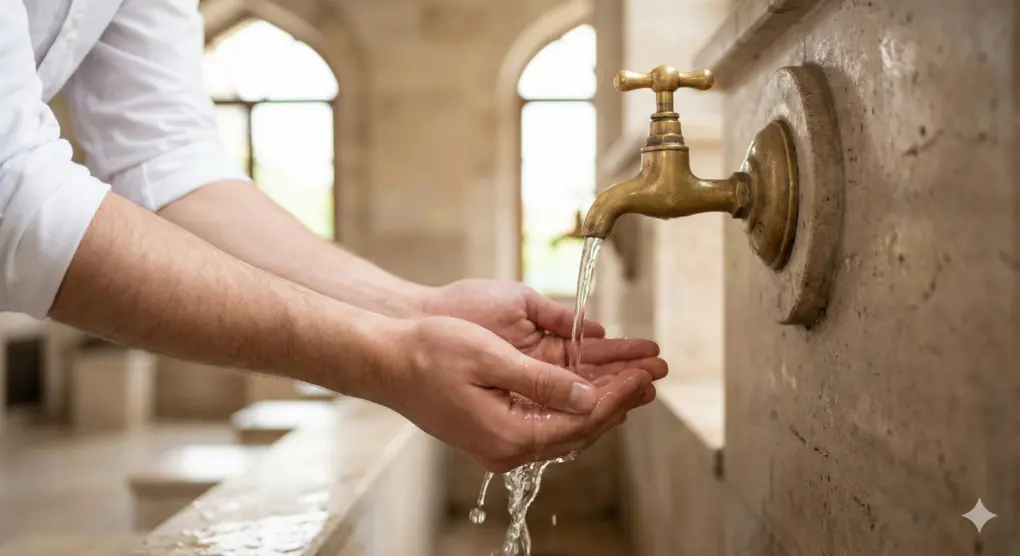
Wudu (ablution) is the Islamic method of purifying oneself before engaging in specific acts of devotion, such as the daily prayers (salah) and circumambulating the Kaaba (tawaf). Maintaining a valid state of purity is essential for these rituals to be accepted by Allah. However, certain human actions and conditions break this state. This article provides a comprehensive academic overview of the things that invalidate wudu, grounded in the authoritative Shafi’i jurisprudential text, Al-Fiqh al-Manhaji, to help Muslims accurately preserve their ritual purity.
Understanding Wudu and Its Purpose
Wudu is the act of purifying oneself by washing specific body parts—namely the face, hands, head, and feet—according to the procedures established by Islamic law (Sharia). Allah decrees in the Quran:
“O you who have believed, when you rise to [perform] prayer, wash your faces and your forearms to the elbows and wipe over your heads and wash your feet to the ankles.” (Surah Al-Ma’idah: 6)
The primary function of wudu is to lift minor ritual impurity (hadath asghar). This is a state that obligates an individual to perform ablution before engaging in acts of worship that require wudu, such as prayer or touching the physical copy of the Quran (mushaf). This differs significantly from major impurity (such as janabah or menstruation), which requires an individual to perform a complete ritual bath.
Grasping the meaning of wudu in Islamic terminology is crucial, as the Prophet Muhammad ﷺ explicitly stated: “No prayer is accepted without purification” (Sahih Muslim).
Summary: What Nullifies Wudu?
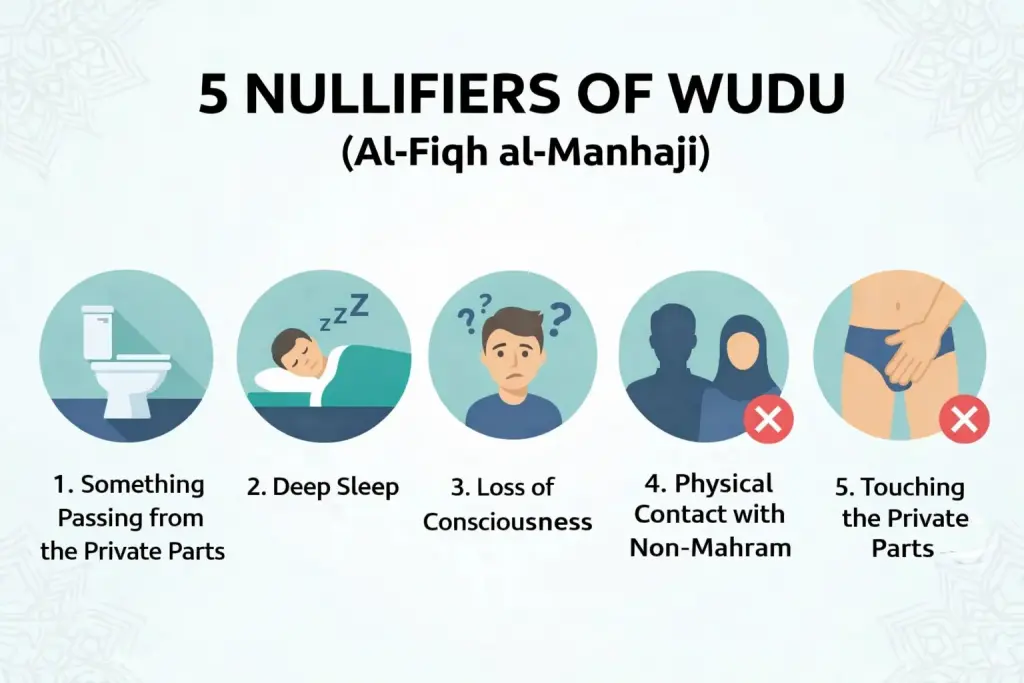
According to the classical teachings compiled in Al-Fiqh al-Manhaji, there are precisely five things that invalidate wudu:
- Any discharge from the front or back passages.
- Sleeping in an unstable position (where the buttocks are not firmly seated).
- Loss of intellect or consciousness (due to intoxication, fainting, or insanity).
- Direct skin contact with the opposite gender (non-mahram) without a barrier.
- Touching the private parts or the anus with the inner palm.
Detailed Explanations and Evidences
Below is a detailed breakdown of the five nullifiers based on Al-Fiqh al-Manhaji (Vol. 1, pp. 62–63), complete with their foundational evidence.
1. Discharges from the Front or Back Passages
The discharge of anything from the qubul (front passage) or dubur (rear passage) absolutely invalidates wudhu (ablution). This includes the emission of urine, feces, blood, and gas (flatulence).
In the jurisprudential principles of the Shafi’i school, invalidation due to the emission of gas applies not only to wind from the dubur, but also includes gas exiting from the qubul (front passage), including the female genitalia (for detailed rulings on this matter, you may read the explanation regarding whether queefing invalidates wudhu).
This also applies to any other objects that are discharged, whether they are impure (najis) or pure, such as worms or seeds exiting through either of these two passages.
Allah states: “Or one of you comes from the place of relieving himself” (Surah An-Nisa: 43). Furthermore, a hadith narrated by Abu Hurairah reports that the Prophet ﷺ said: “Allah does not accept the prayer of a person who has released hadath until he performs wudu.” When asked what hadath meant, Abu Hurairah replied, “Passing wind, with or without sound.” (Sahih Bukhari and Muslim).
Original text from Al-Fiqh al-Manhaji:
كل ما خرج من أحد السبيلين من بول أو غائط أو دم أو ريح: قال تعالى: (أو جاء أحد منكم من الغائط) [النساء: ٤٣]. أي مكان قضاء الحاجة، وقد قضى حاجته من تبرز أو تبول… وقيس على ما ذكر كل خارج من القبل أو الدبر، ولو كان طاهراً.
Translation: Everything that exits from either of the two passages, be it urine, feces, blood, or wind. The Almighty said: (or one of you comes from the place of relieving himself)… By analogy to what is mentioned, anything exiting the front or back passage [invalidates wudu], even if it is pure.
2. Sleeping in an Unstable Position
Sleep only invalidates wudu if the person is not firmly seated. If an individual sleeps while their buttocks are completely and firmly pressed against the ground, their wudu remains intact because they would physically feel if any wind was passed.
The Prophet ﷺ said: “Whoever sleeps, let him perform wudu” (Sunan Abi Dawud). However, Sahih Muslim records that the companions of the Prophet ﷺ would sometimes doze off while sitting in the mosque waiting for the prayer, and they would pray without renewing their wudu, as their seated position was firm.
Original text from Al-Fiqh al-Manhaji:
النوم غير المتمكن: والتمكن أن يكون جالساً ومقعدته ملتصقة بالأرض… وأما من نام على هيئة المتمكن فلا ينقض وضوؤه، لأنه يشعر بما يخرج منه.
Translation: Sleep that is not firmly established: Firmness means sitting with the buttocks adhering to the ground… As for one who sleeps in a firm position, his wudu is not invalidated, because he would perceive whatever exits from him.
3. Loss of Intellect or Consciousness




Losing consciousness due to intoxication, fainting, illness, or insanity breaks wudu. In such states, a person loses all physical awareness and cannot guarantee that nothing has exited their body. The scholars use an analogy (qiyas) comparing this to sleep, noting that a complete loss of consciousness is even more profound than normal sleep.
Original text from Al-Fiqh al-Manhaji:
زوال العقل بسكر أو إعماء أو مرض، أو جنون: لأن الإنسان إذا انتابه شيء من ذلك كان هذا مظنة أن يخرج منه شيء من غير ان يشعر، وقياساً على النوم، لأنه أبلغ منه في معناه.
Translation: Loss of intellect through intoxication, fainting, illness, or insanity: Because if a person is afflicted by any of these, it is presumed something might exit him without his realization. This is by analogy to sleep, as it is more profound in its effect.
4. Direct Skin Contact with a Non-Mahram
In the Shafi’i school, direct, skin-to-skin contact between a male and a female who are not mahram (meaning they are legally permissible to marry each other, which includes spouses) invalidates the wudu of both individuals, provided there is no barrier like clothing.
This is derived from the verse: “Or you have touched women” (Surah An-Nisa: 43). If there is a barrier, such as cloth or gloves, the ablution remains valid.
Original text from Al-Fiqh al-Manhaji:
لمس الرجل زوجته أو المرأة الأجنبية من غير حائل، فإنه ينتقض وضوؤه ووضوؤها. والأجنبية هي كل امرأة يحل له الزواج بها. قال تعالى في بيان موجبات الوضوء: (أو لامستم النساء) [النساء: ٤٣].
Translation: A man touching his wife or a non-mahram woman without a barrier invalidates his wudu and hers. A non-mahram woman is any woman he is permitted to marry…
5. Touching the Private Parts
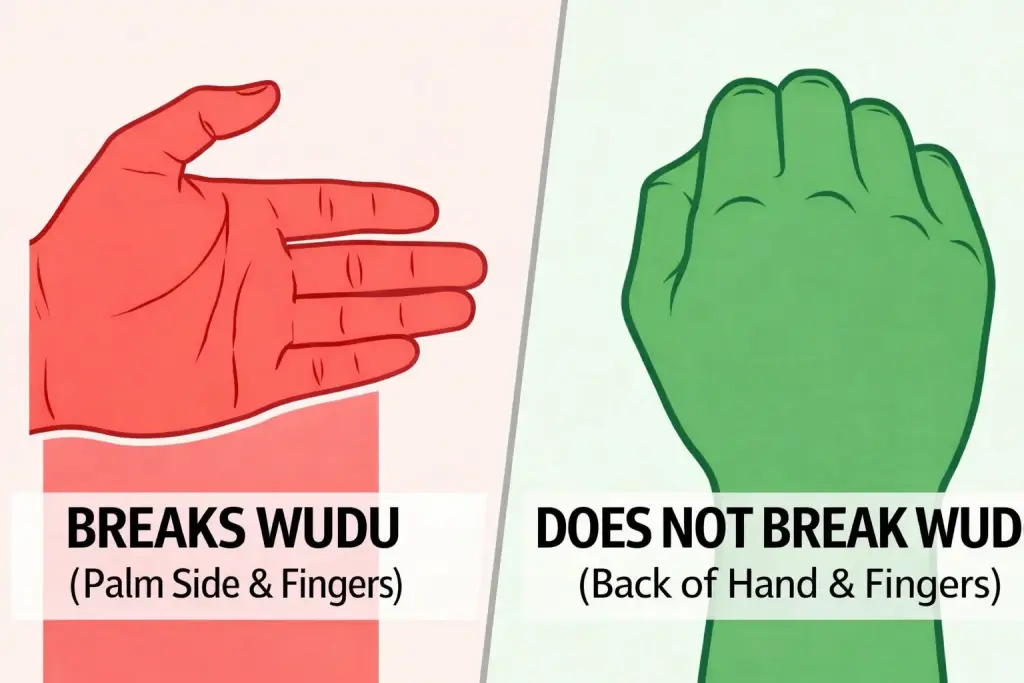
Touching the human private parts (front or back) directly invalidates ablution, but with a specific condition: it must be touched using the inner part of the palm or the inner surface of the fingers. Touching with the back of the hand or other body parts does not break the wudu. This applies whether one touches their own private parts or someone else’s, without a barrier.
Original text from Al-Fiqh al-Manhaji:
مس الفرج من نفسه أو من غيره، قبلاً أو دبراً، بباطن الكف والأصابع من غير حائل.
Translation: Touching the private part of oneself or another, front or back, with the inner palm and fingers without a barrier.
Frequently Asked Questions (FAQ)
Does passing wind (farting) invalidate wudu?
Yes. Passing wind from the posterior passage definitively breaks wudu, regardless of whether it is accompanied by a sound or smell. The ruling relies on absolute certainty, not mere doubt.
Does picking the nose invalidate wudu?
No, picking the nose does not break wudu as it does not involve the specified nullifying factors.
If my foot touches my private part, does my wudu break?
No. According to the Shafi’i madhhab, touching the private areas only nullifies wudu if it is done specifically with the inner palm or the inner side of the fingers directly without a barrier.
Does all sleep invalidate wudu?
No. Sleep only invalidates wudu if it is deep enough to lose consciousness and the person is not sitting firmly (with their buttocks pressed completely against the floor).
Does bleeding or pus invalidate wudu?
In the Shafi’i madhhab, the emission of blood or pus from anywhere other than the front or back passages does not invalidate wudu. However, blood is considered najis (impure) and must be washed off the body or clothes before praying.
Does touching one’s own breasts invalidate wudu?
No. In Islamic jurisprudence, breasts are not classified as private parts (farj) in the context of breaking ablution. Therefore, touching them—with or without desire, and with any part of the hand—does not invalidate wudu.
Does physical contact with a grandfather invalidate wudu?
No. A grandfather is considered a mahram (a permanently unmarriageable relative). The nullification of wudu by touch only applies to non-mahram individuals of the opposite sex.
Conclusion
Guarding one’s ritual purity is a hallmark of a believer’s dedication to their daily prayers. Based on the established Shafi’i jurisprudence in Al-Fiqh al-Manhaji, the five things that invalidate wudu revolve around bodily discharges, loss of awareness through sleep or unconsciousness, direct skin contact with a non-mahram, and touching the private parts with the inner palm.
By understanding these parameters, Muslims can worship with confidence and certainty. Once wudu is invalidated, it is obligatory to perform it again using permissible types of water to restore the state of spiritual readiness for prayer.
Conceptual References
Al-Khin, Mustafa, Mustafa al-Bugha, and Ali al-Sharbaji. Al-Fiqh al-Manhaji ‘ala Madhhab al-Imam al-Shafi’i. Vol. 1. (Damascus: Dar al-Qalam, 1992), pp. 62–63.


