The Meaning of Intention: The Soul of Every Action in Islam

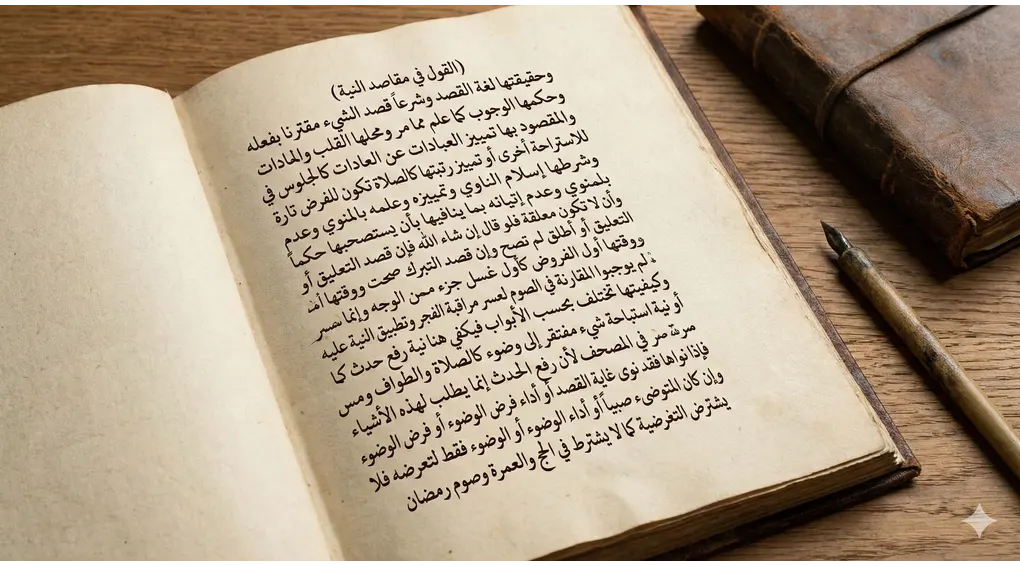
An open antique Islamic fiqh manuscript on a wooden table, displaying Arabic text explaining the linguistic and legal definitions of intention (niyyah).

In every step of life, whether visible to the world or hidden deep within the heart, there is one crucial element that determines its true weight and direction: intention (niyyah). The phrase “everything depends on intention” is not just a passing proverb; rather, it is a fundamental jurisprudential principle that underlines the essence of every … Read more

The Difference Between Mani, Madhi, and Wadi: A Guide to Islamic Purity in Shafi’i Fiqh

difference between mani madhi and wadi: A traditional copper jug pouring clear, fresh water into a white marble basin, accompanied by clean white towels, olive soap, and a miswak stick on a wooden surface, symbolizing preparation for Islamic ritual purification.

Maintaining physical and spiritual purity from ritual impurity (hadath) is a fundamental foundation for every Muslim before performing acts of worship. Often, individuals experience confusion when noticing the discharge of fluids from their private parts. The common question arises: does every discharged fluid necessitate a major ritual bath (ghusl)? To resolve this issue, we must … Read more

Complete Guide to Ghusl Janabah: Intention, Method, and Causes in Shafi’i Fiqh

A person's hands holding a ceramic bowl filled with clear water and floating white flower petals, under a gentle stream from a faucet and bright window light.

Spiritual and physical purity stands as a fundamental pillar in the performance of Islamic worship. Understanding the profound meaning of thaharah (purification) is the essential first step for every Muslim. One primary method of purifying oneself from major ritual impurity (hadats akbar) is through major ablution, widely known as Ghusl Janabah or mandi wajib. This … Read more

The Ruling and Number of Rak’ahs in Tarawih Prayer: A Shafi’i Fiqh Perspective

Ribuan jamaah pria berbaris rapi melaksanakan shalat Tarawih berjamaah di dalam interior masjid agung yang megah dengan cahaya keemasan pada malam Ramadhan.

The holy month of Ramadan consistently brings forth magnificent night worship. One of the most prominent acts is Qiyam al-Lail, which is widely recognized as the Tarawih prayer. In Islamic jurisprudence, particularly within the Shafi’i school of thought, the rules governing this worship are comprehensively detailed. The primary goal is to preserve the quality of … Read more

The Complete Guide to the Fiqh of I’tikaf (Shafi’i School)

A Muslim man is reverently reading the Quran while observing i'tikaf in the mosque at dawn.

The worship of I’tikaf is one of the great symbols of Islam; it is a profound manifestation of a servant isolating themselves to draw closer to Allah ﷻ. Within the Islamic scholarly tradition, specifically the rules and procedures of I’tikaf according to the Shafi’i school of thought, this act of worship possesses highly precise pillars … Read more

Understanding the Essence of Tasawuf: The Science of Heart Purification for Eternal Happiness

Illustration symbolizing the concept of tasawuf in Islam with a glowing heart representing spiritual purification.

Many people feel confused upon hearing the word Tasawuf (Sufism). Some mistakenly consider it a foreign doctrine, whereas, in reality, Tasawuf is the very heartbeat of the Islamic faith. Simply put, the essence of Tasawuf is the spiritual path of self-improvement designed to purify our hearts and cultivate a more profound, intimate relationship with Allah … Read more

Exploring the Meaning of Hamdalah and Shukr in the Book of I’anah at-Talibin

An open classic manuscript on a table with a warm cup of tea and prayer beads in the morning, symbolizing the study of gratitude.

We all frequently say “Alhamdulillah” (All praise is due to Allah). Whether after a satisfying meal, upon receiving joyful news, or when escaping a calamity, this phrase is deeply ingrained in the daily lives of Muslims. But have we ever paused to ask: what is the true, profound meaning of Hamdalah and Shukr? Is merely … Read more

The Jurisprudential Ruling on Masturbation While Fasting and Limits of Physical Contact

An open antique Arabic fiqh manuscript resting on a wooden rehal stand, positioned in front of a mashrabiya patterned window with natural daylight. Classic calligraphy fills the pages.

In the rigorous performance of the fast (al-Ṣawm), a believer is summoned not merely to endure hunger and thirst but to exert profound discipline over their base desires. The spiritual essence of fasting lies in al-Imsāk—a mechanism of comprehensive self-restraint from everything that invalidates the fast, extending from the precise moment of dawn until sunset. … Read more

5 Conditions for a Valid Prayer According to Fathul Qarib: A Complete Guide

Illustration showing the five conditions for valid prayer according to the classical fiqh book Fathul Qarib.

Have you ever felt doubtful after completing your worship, wondering, “Was my prayer valid?” or “Are my clothes truly pure?” These questions naturally arise because every Muslim profoundly desires their worship to be accepted by Allah SWT. Prayer (Salah) is not merely a sequence of standing, bowing, and prostrating. There is an essential “entry ticket” … Read more

Conditions of Taubat Nasuha: Imam Nawawi’s Guide to True Repentance

A silhouette of a Muslim praying with raised hands on a mountain at sunrise, symbolizing hope within the requirements of sincere repentance (taubatan nasuha).

In a servant’s (sālik) spiritual journey towards Allah SWT, human nature, prone to error, requires a path of return. This mechanism, in Islamic legal terminology, is known as repentance (taubat). Understanding the conditions for the validity of sincere repentance (taubat nasuha) is not merely theoretical knowledge, but an urgent need so that the process of … Read more