

Understanding niyyah and ikhlas in Islam is the gateway to authentic worship. Intention (niyyah) and sincerity (ikhlas) form the twin pillars upon which the acceptance of every believer’s deed rests. For this reason, Imam an-Nawawi raḥimahullāh opens his celebrated Riyāḍ al-Ṣāliḥīn with the chapter titled Bāb al-Ikhlāṣ wa Iḥḍār al-Niyyah fī Jamīʿ al-Aʿmāl wa al-Aqwāl wa al-Aḥwāl al-Bārizah wa al-Khafiyyah — “The Chapter on Sincerity and Bringing Intention into Every Act, Word, and State, Whether Manifest or Hidden.”
The discussion of intention truly touches every dimension of a Muslim’s life — from ablution, prayer, and fasting to charity, business transactions, and daily affairs. For that reason, leading scholars such as Sheikh Muḥammad ibn ʿAllān al-Ṣiddīqī al-Bakrī al-Makkī, in his commentary Dalīl al-Fāliḥīn li-Ṭuruq Riyāḍ al-Ṣāliḥīn, devote substantial pages to this chapter as the threshold for internalising the Prophet’s ﷺ entire teaching.
This guide presents a comprehensive exposition of niyyah and ikhlas — covering linguistic and technical definitions, Quranic foundations, principal hadith, classifications, and the spiritual diseases that nullify deeds — all drawn directly from primary classical sources.
The Meaning of Niyyah and Ikhlas: Linguistic and Technical Definitions
Definition of Niyyah in the Arabic Language
Etymologically, niyyah (النية) derives from an-nawā, meaning “purpose” or “intent” (al-qaṣd). Classical jurists define it as the inclination of the heart toward a particular act, accompanied by the resolve to perform it. Sheikh Muḥammad ibn ʿAllān al-Ṣiddīqī, in Dalīl al-Fāliḥīn, writes:
النية بالتشديد مصدر أو اسم مصدر لغة: القصد. وشرعاً … قصد الشيء مقترناً بفعله
“Niyyah, with the doubled letter, is a verbal noun. Linguistically it means al-qaṣd (purpose). In the legal sense, it is the purpose to do something paired with its performance.”
When the execution of an act is delayed beyond its intention, the more accurate term becomes al-ʿazm (resolve) rather than niyyah. This subtle distinction underpins much of the classical fiqh discussion of intention in worship.
Definition of Ikhlas According to al-Rāghib al-Iṣfahānī

Imam al-Rāghib, in his al-Mufradāt fī Gharīb al-Qurʾān, offers a concise yet profound formulation, as cited in Dalīl al-Fāliḥīn:
الإخلاص التعرّي عما دون الله تعالى
“Ikhlāṣ is the heart’s emptying itself of everything besides Allah Most High.”
This brief expression encapsulates a vast meaning: the heart of the sincere worshipper harbours no longing for human praise, no fear of human blame, and no expectation of worldly recompense for his deeds.
Definition of Ikhlas According to Imam al-Qushayrī




Imam Abū al-Qāsim al-Qushayrī raḥimahullāh, the eminent Sunni Sufi authority, defines ikhlāṣ as follows:
الإخلاص إفراد الحقّ سبحانه وتعالى في الطاعات بالقصد
“Ikhlāṣ is to single out al-Ḥaqq, glorified and exalted, in one’s acts of obedience by intention — meaning that the worshipper desires through his obedience nothing but nearness to Allah Most High.”
The “other intentions” rejected by al-Qushayrī include performing for the sake of creation, seeking human applause, or chasing validation and affection from peers. In another phrasing, he writes:
الإخلاص تصفية العمل عن ملاحظة المخلوقين
“Ikhlāṣ is purifying the deed from any regard for created beings.”
The Position of Niyyah in Islam: One-Third of Knowledge According to Imam al-Shāfiʿī
The Foundation of Every Legal Act
Niyyah occupies a magnificent station in the Sacred Law. Sheikh Ibn ʿAllān states:
والنية واجبة أول كل فعل شرعي لتوقف صحته عليها
“Intention is obligatory at the outset of every legal act, since the validity of the deed depends upon it.”
Sustaining the presence of intention until the act’s completion, meanwhile, is a strongly recommended sunnah. Consequently, almost all the principal acts of worship — including ritual prayer (ṣalāh), fasting (ṣawm), almsgiving (zakāh), and the pilgrimage (ḥajj) — are invalid without it.
The Hadith of Intention as One-Third of Knowledge

Early scholars held this hadith in extraordinary regard. Imam al-Shāfiʿī raḥimahullāh is widely reported to have said that the hadith innamā al-aʿmālu bi-l-niyyāt encompasses one-third of religious knowledge and enters into seventy chapters of fiqh. The reason lies in the breadth of its application, which covers not only ritual worship but also etiquette, commercial dealings, and the inward movements of the heart.
Imam al-Bukhārī placed this hadith at the very head of his Ṣaḥīḥ. Imam an-Nawawi likewise positioned it as the first hadith in both al-Arbaʿīn al-Nawawiyyah and Riyāḍ al-Ṣāliḥīn. This editorial convention is no coincidence — it signals the necessity of correcting one’s intention before pursuing any branch of sacred knowledge.
Four Quranic Foundations of Niyyah and Ikhlas
Imam an-Nawawi selected four cardinal verses to introduce the chapter. Together they form the scriptural bedrock for understanding intention and sincerity in the religion of Islam.
Sūrat al-Bayyinah, Verse 5
Allah Most High says:
وَمَا أُمِرُوا إِلَّا لِيَعْبُدُوا اللَّهَ مُخْلِصِينَ لَهُ الدِّينَ حُنَفَاءَ وَيُقِيمُوا الصَّلَاةَ وَيُؤْتُوا الزَّكَاةَ وَذَلِكَ دِينُ الْقَيِّمَةِ
“Yet they were commanded only to worship Allah, sincere to Him in religion, inclining to truth, and to establish prayer and give zakāh. That is the upright religion.” (Q. 98:5)
Al-Ḥāfiẓ al-Suyūṭī, in al-Iklīl — as quoted in Dalīl al-Fāliḥīn — observes that this verse establishes the obligation of intention in worship, since the reality of sincerity cannot manifest without it.
Sūrat Āl ʿImrān, Verse 92
لَنْ تَنَالُوا الْبِرَّ حَتَّى تُنْفِقُوا مِمَّا تُحِبُّونَ وَمَا تُنْفِقُوا مِنْ شَيْءٍ فَإِنَّ اللَّهَ بِهِ عَلِيمٌ
“You will never attain righteousness until you spend from that which you love. And whatever you spend, indeed Allah is Knowing of it.”
This verse teaches that genuine al-birr (righteousness) is realised only when the believer parts with what is dear to him for the sake of Allah — exemplified by the Companion Abū Ṭalḥah, who donated his beloved orchard, Bayruḥā.
Sūrat al-Ḥajj, Verse 37
لَنْ يَنَالَ اللَّهَ لُحُومُهَا وَلَا دِمَاؤُهَا وَلَكِنْ يَنَالُهُ التَّقْوَى مِنْكُمْ
“Their meat will not reach Allah, nor will their blood, but what reaches Him is piety from you.”
Imam al-Qurṭubī, citing Ibn ʿAbbās, explains that the verse was revealed when pre-Islamic Arabs would smear the Kaʿbah with sacrificial blood, and some Muslims wished to imitate them. The lesson is unambiguous: what Allah evaluates in sacrifice is not the volume of flesh but the sincerity of the heart.
Sūrat Āl ʿImrān, Verse 29
قُلْ إِنْ تُخْفُوا مَا فِي صُدُورِكُمْ أَوْ تُبْدُوهُ يَعْلَمْهُ اللَّهُ
“Say: ‘Whether you conceal what is in your breasts or reveal it, Allah knows it.'”
This verse is a stern reminder that Allah is fully aware of the heart’s contents. An impure intention cannot be hidden from His knowledge, however virtuous the outward form of the deed may appear to people.
Principal Hadith of the Chapter on Ikhlas
Imam an-Nawawi compiled twelve hadith in his Chapter on Sincerity. The following table summarises them based on Dalīl al-Fāliḥīn:
| No | Narrator | Core Content | Source |
|---|---|---|---|
| 1 | ʿUmar ibn al-Khaṭṭāb | “Deeds are by intentions” | Agreed upon |
| 2 | ʿĀʾishah | The army that attacks the Kaʿbah will be swallowed up and resurrected by their intentions | Agreed upon |
| 3 | ʿĀʾishah | “There is no migration after the Conquest, but jihad and intention” | Agreed upon |
| 4 | Jābir ibn ʿAbd Allāh | Companions held back in Madinah by valid excuse share the reward | Muslim |
| 5 | Anas ibn Mālik | Returning from Tabūk: “Excuse held them back” | al-Bukhārī |
| 6 | Maʿn ibn Yazīd | A dīnār of charity received by his own son | al-Bukhārī |
| 7 | Saʿd ibn Abī Waqqāṣ | Bequest of one-third of wealth | Agreed upon |
| 8 | Abū Hurayrah | “Allah looks at your hearts, not your bodies or forms” | Muslim |
| 9 | Abū Mūsā al-Ashʿarī | Whoever fights so that Allah’s word is supreme is on His path | Agreed upon |
| 10 | Abū Bakrah | Two Muslims meeting with swords: both slayer and slain in Hell | Agreed upon |
| 11 | Abū Hurayrah | Reward of congregational prayer multiplied by 25–27 degrees | Agreed upon |
| 12 | Ibn ʿAbbās | Divine recording of good and evil intentions | Agreed upon |
| 13 | Ibn ʿUmar | The three trapped in the cave who supplicated by their righteous deeds | Agreed upon |
The First Hadith: Innamā al-Aʿmālu bi-l-Niyyāt
The most monumental hadith of the chapter is the narration of the Commander of the Believers, ʿUmar ibn al-Khaṭṭāb raḍiya Allāhu ʿanhu:
إِنَّمَا الأَعْمَالُ بِالنِّيَّاتِ، وَإِنَّمَا لِكُلِّ امْرِئٍ مَا نَوَى. فَمَنْ كَانَتْ هِجْرَتُهُ إِلَى اللهِ وَرَسُولِهِ فَهِجْرَتُهُ إِلَى اللهِ وَرَسُولِهِ، وَمَنْ كَانَتْ هِجْرَتُهُ لِدُنْيَا يُصِيبُهَا أَوِ امْرَأَةٍ يَنْكِحُهَا فَهِجْرَتُهُ إِلَى مَا هَاجَرَ إِلَيْهِ
“Deeds are only by intentions, and every person shall have only what he intended. So whoever’s migration was to Allah and His Messenger, his migration is to Allah and His Messenger; and whoever’s migration was for some worldly gain or a woman to marry, his migration is to that for which he migrated.”
The sabab al-wurūd (occasion of utterance), as recounted in Dalīl al-Fāliḥīn, concerns a man who emigrated from Mecca to Madinah not for Allah’s sake but to marry a woman named Umm Qays. Ever after, he was known as Muhājir Umm Qays — “the Emigrant of Umm Qays.”
Classifications of Niyyah: Taqarrub, Tamyīz, and Ījādī
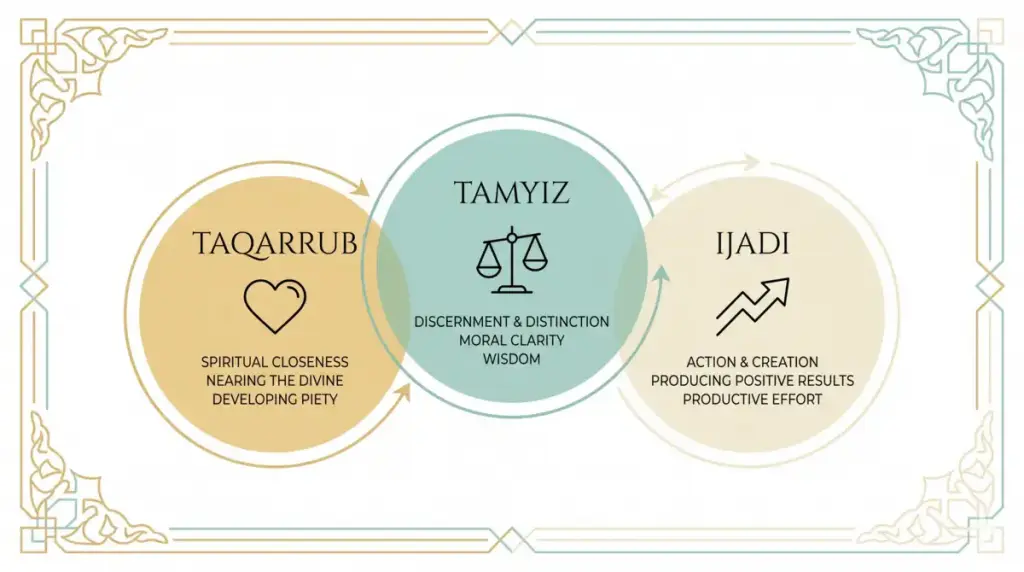
Jurists classify intention into three principal categories, a distinction implicit throughout the discussion in Dalīl al-Fāliḥīn.
Niyyah Taqarrub (Drawing Near to Allah)
This is the intention to seek closeness to Allah. It is the heart of sincerity — as al-Qushayrī affirms, the servant worships solely for taqarrub ila Allāh, with no worldly aim. This category alone qualifies a deed for divine reward.
Niyyah Tamyīz (Differentiation)
The intention of differentiation distinguishes one act of worship from another, or worship from habit. A person abstaining from food and drink between dawn and sunset, for instance, may be observing an obligatory fast, a voluntary fast, or merely dieting. Only the intention separates them. Likewise, intention distinguishes the obligatory Ẓuhr prayer from a voluntary rawātib prayer.
Niyyah Ījādī al-Fiʿl (Bringing the Act into Existence)
This refers to the intention that initiates the act itself. Whenever a legally responsible person resolves to perform a deed, an intention has already formed. For this reason, Imam an-Nawawi held that intention is sufficient when present in the heart, without verbal pronouncement. Articulating the intention aloud is merely a reinforcement to focus the heart and is regarded as a recommended practice within the Shāfiʿī school.
Spiritual Diseases That Corrupt Intention: Riyāʾ, Sumʿah, and ʿUjub

At the close of his exegesis on the fourth verse, Dalīl al-Fāliḥīn delivers a sober warning:
وفي الآيات تنبيه للموفق على الإخلاص وتحذير له من الرياء، ولا يغترّ بخفائه ظاهراً فإن الله تعالى عالم بخفيات الأمور
“These verses alert the one granted divine success to sincerity and warn him against ostentation. Let him not be deceived by its outward concealment, for Allah Most High knows the hidden of all matters.”
Three spiritual diseases must therefore be carefully guarded against by anyone seeking purity of worship.
Riyāʾ (Ostentation)
Riyāʾ is the performance of a deed in order to be seen by people, so that the doer may receive their praise. It constitutes shirk aṣghar (minor associationism) and can nullify the reward of an act of worship. Its forms range from prolonging prayer in the presence of others to displaying charity so as to be considered generous.
Sumʿah (Seeking to Be Heard Of)
Sumʿah is making one’s deeds known to others, typically by recounting one’s worship. Whereas riyāʾ concerns what is seen, sumʿah concerns what is heard. Both spoil the value of the deed, since the doer pursues the appreciation of fellow creatures.
ʿUjub (Self-Admiration)
ʿUjub is being impressed by one’s own deed, as though it sprang purely from one’s own strength without divine assistance. It differs from gratitude: the self-admirer attributes excellence to himself, whereas the grateful servant returns it to Allah’s enabling grace.
Comparing Riyāʾ, Sumʿah, and ʿUjub
| Aspect | Riyāʾ | Sumʿah | ʿUjub |
|---|---|---|---|
| Linguistic root | al-ruʾyah (seeing) | al-samāʿ (hearing) | al-ʿajab (wonder) |
| Target | Others’ sight | Others’ hearing | The self |
| Form | Displaying the deed | Speaking of the deed | Glorifying the deed |
| Consequence | Deed nullified | Deed nullified | Reward consumed |
| Status | Minor shirk | Akin to riyāʾ | Disease of the heart |
Applying Niyyah in Daily Worship
How does a Muslim translate intention into daily practice? The following is a concise practical guide grounded in the principles laid out in Dalīl al-Fāliḥīn.
Niyyah in Wudūʾ and Ghusl
In the Shāfiʿī school, intention is a condition for the validity of ritual purification. Verbal pronouncement is not required, but bringing the intention to mind at the moment of washing the first limb (the face) is obligatory.
Niyyah in Prayer
The intention for prayer must coincide with takbīrat al-iḥrām. It must include three elements: qaṣd al-fiʿl (the intent to act), taʿyīn (specifying the prayer — Ẓuhr, ʿAṣr, etc.), and, for obligatory prayers, taʿarruḍ li-l-farḍiyyah (acknowledging its obligatory status).
Niyyah in Fasting
For obligatory fasts such as Ramaḍān, the intention must be formed during the night before dawn — known as tabyīt al-niyyah. Imam an-Nawawi clarifies that intention is required every night, since each day of Ramaḍān constitutes an independent act of worship (ʿibādah mustaqillah).
Niyyah in Zakāt and Ṣadaqah
Intention is a condition for the validity of zakāt payment. The case of Maʿn ibn Yazīd raḍiya Allāhu ʿanhu, recorded in Dalīl al-Fāliḥīn, illustrates how reward is calibrated to intention. When his father, Yazīd ibn al-Akhnas, expressed concern to the Messenger of Allah ﷺ that his charitable dīnārs had been received by his own son, the Prophet ﷺ replied:
لَكَ مَا نَوَيْتَ يَا يَزِيدُ، وَلَكَ مَا أَخَذْتَ يَا مَعْنُ
“For you is what you intended, O Yazīd; and for you is what you received, O Maʿn.”
Niyyah in Permissible Activities
Permissible (mubāḥ) acts — eating, drinking, sleeping, even marital intimacy — can become acts of worship when accompanied by the intention to strengthen oneself for obedience. The hadith of Saʿd ibn Abī Waqqāṣ in this very chapter affirms the principle:
وَإِنَّكَ لَنْ تُنْفِقَ نَفَقَةً تَبْتَغِي بِهَا وَجْهَ اللهِ إِلَّا أُجِرْتَ عَلَيْهَا، حَتَّى مَا تَجْعَلُ فِي فِي امْرَأَتِكَ
“You will never spend anything seeking the face of Allah but that you will be rewarded for it — even the morsel you place in your wife’s mouth.”
Comparison of the Schools on the Intention of Ramaḍān Fasting
Because this issue arises so frequently, the following table compares the four Sunni schools:
| School | Time of Intention for Ramaḍān Fast | Single Intention for the Entire Month |
|---|---|---|
| Ḥanafī | Permitted until before mid-day | Insufficient |
| Mālikī | Sufficient on the first night of Ramaḍān | Sufficient for the whole month |
| Shāfiʿī | Required every night before dawn | Insufficient, except as a precautionary backup |
| Ḥanbalī | Required every night before dawn | Insufficient |
For prudence, many scholars in the Indonesian archipelago recommend combining the Shāfiʿī intention (each night) with an additional Mālikī-style intention (once for the whole month) at the beginning of Ramaḍān, so that any forgotten night is covered.
Frequently Asked Questions on Niyyah and Ikhlas
1. Must intention be pronounced verbally?
No. The Shāfiʿī school holds that the seat of intention is the heart. Verbalising the intention is a recommended practice that helps focus the heart on what is to be performed.
2. What if one forgets to make the intention for Ramaḍān fasting?
According to the Shāfiʿī school, that day’s fast is invalid and must be made up after Ramaḍān. To safeguard against this, some scholars recommend an additional month-long intention following the Mālikī position.
3. Does showing off (riyāʾ) during worship invalidate the entire deed?
Riyāʾ present from the very beginning of the intention nullifies the deed. Riyāʾ that arises mid-worship and is promptly resisted does not automatically corrupt the act, provided the worshipper continues for Allah’s sake.
4. Is sharing one’s worship on social media a form of riyāʾ?
The ruling depends on intention. If the aim is to encourage others toward good or to share knowledge, it is permissible. If the underlying motive is to seek praise, it falls under riyāʾ or sumʿah.
5. What distinguishes the hadith of intention from the verses on sincerity?
The hadith establishes that the validity and reward of every deed depend on intention. The Quranic verses, in turn, insist that the intention must be purely for Allah, not for any other.
6. Why do the Shāfiʿī and Mālikī schools differ on the intention for Ramaḍān?
The Shāfiʿī school treats each day of Ramaḍān as an independent act of worship, while the Mālikī school regards Ramaḍān as a single, unified obligation requiring only one intention at its outset.
7. What can one do to overcome recurring slips into riyāʾ?
Scholars advise cultivating private acts of worship (ʿibādah sirriyyah), engaging in daily muḥāsabah (self-examination), seeking Allah’s protection from minor shirk, and reflecting on the Quranic and prophetic warnings against ostentation.
Conclusion: Reflections from the Chapter on Sincerity
The Chapter on Sincerity assembled by Imam an-Nawawi and richly expounded in Dalīl al-Fāliḥīn conveys an enduring lesson: a deed as massive as a mountain may amount to nothing if its intention is corrupted, while a deed as small as a mustard seed may become priceless treasure in the Hereafter when grounded in pure sincerity.
Classical scholars modelled how to examine intention before, during, and after acting. This is the path every Muslim ought to walk, lest he find himself among those described in the verse:
وَقَدِمْنَا إِلَىٰ مَا عَمِلُوا مِنْ عَمَلٍ فَجَعَلْنَاهُ هَبَاءً مَنْثُورًا
“And We will turn to whatever deeds they did and make them as scattered dust.”
May every reader take continuous care to audit his intention before and within every act of worship, so that the provisions he carries home to Allah Most High may truly carry weight in His sight.
Conceptual References:
The discussion above draws on Ibn ʿAllān al-Ṣiddīqī’s Dalīl al-Fāliḥīn li-Ṭuruq Riyāḍ al-Ṣāliḥīn, al-Nawawī’s Riyāḍ al-Ṣāliḥīn, the Ṣaḥīḥ collections of al-Bukhārī and Muslim, al-Qurṭubī’s al-Jāmiʿ li-Aḥkām al-Qurʾān, al-Qushayrī’s al-Risālah al-Qushayriyyah, al-Rāghib al-Iṣfahānī’s al-Mufradāt fī Gharīb al-Qurʾān, and al-Suyūṭī’s al-Iklīl fī Istinbāṭ al-Tanzīl — all consulted from the chapter Bāb al-Ikhlāṣ wa Iḥḍār al-Niyyah, Dalīl al-Fāliḥīn, 1:49–90.


