
For every Muslim parent, witnessing a child grow up is a profound blessing. However, there is one highly critical phase that frequently induces confusion: the transitional period from childhood to adulthood, or Akil Baligh (reaching the age of legal responsibility). Exactly when do obligatory acts of worship, such as prayer and fasting, become fully binding upon them?
Many individuals erroneously assume that Islamic adulthood is merely a matter of reaching the numerical age of 17 or 18. In reality, the signs of baligh according to Islamic jurisprudence (fiqh) possess their own highly specific and intricate parameters. Comprehending this is absolutely crucial to ensure we do not delay in guiding our children to fulfill their religious obligations.
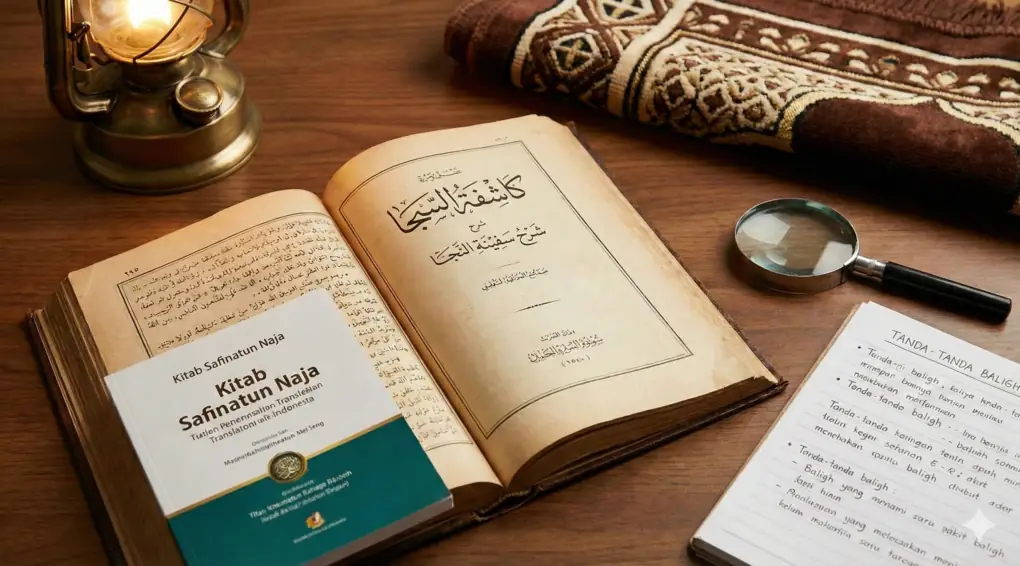
In this comprehensive article, we will thoroughly dissect the definitive signs of puberty (baligh) based on the highly popular classical reference text, Safinatun Naja, alongside its detailed exegesis in the book Kashifat al-Saja.
What is Baligh and Why is it Critically Important?
Linguistically, baligh translates to “reaching” or “arriving.” In the terminology of the Sharia, it designates the precise point when an individual becomes subject to legal religious obligations (taklif). Prior to reaching baligh, the divine pen recording sins and obligatory rewards is not yet fully active. However, the very moment those signs manifest, their status entirely transforms before Allah.
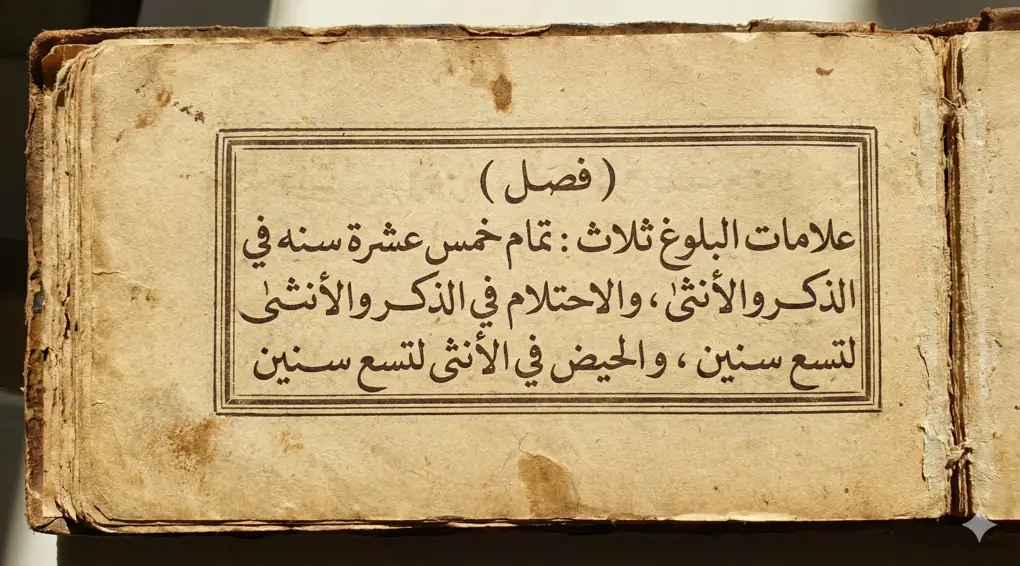
To understand this deeply, let us consult the primary source. Below is the original Arabic text from the book Kashifat al-Saja by the illustrious Shaykh Nawawi al-Bantani (pages 40-41), elucidating this specific chapter:
فصل: في بيان بلوغ المراهق والمعصر (علامات البلوغ ثلاث) في حق الأنثى واثنان في حق الذكر أحدها (تمام خمس عشرة سنة) قمرية تحديدية باتفاق (في الذكر والأنثى) وابتداؤها من انفصال جميع البدن. (و) ثانيها (الاحتلام) أي الإمناء وإن لم يخرج المني من الذكر كأن أحسب بخروجه فأمسكه وسواء خرج من طريقه المعتاد أو غيره مع الانسداد الأصلي وسواء كان في نوم أو يقظة بجماع أو غيره. (في الذكر والأنثى لتسع سنين) قمرية تحديدية عند البيجوري والشربيني.
والذي اعتمده ابن حجر وشيخ الإسلام أنها تقريبية, ونقل عبدالكريم عن الرملي أنها تقريبية في الأنثى وتحديدية في الذكر. (و) ثالثها (الحيض في الأنثى لتسع سنين) تقريبية بأن كان نقصها أقل من ستة عشر يوماً ولو بلحظة1…
If you inquire about the signs of puberty (baligh) articulated in the text above, the answer is definitively three. One sign is exclusive to females, while the other two are universally applicable. Let us systematically break down each one using easily digestible language.
Signs of Puberty for Males and Females
The jurisprudential scholars (fuqaha) categorized these markers of adulthood into three primary indicators. Here are the precise details:
1. Completing 15 Lunar Years (The Absolute Maximum Limit)
This is the indicator that is most frequently neglected. Many parents merely wait for a wet dream or menstruation to occur. However, the definitive sign of baligh for a female who has not yet experienced menstruation is simply when she completes exactly 15 years of age. The exact same ruling applies to a male who has not yet experienced a wet dream.
The classical text explicitly states: “Completing fifteen lunar years with absolute precision (tahdidiyah).” There are two highly critical points embedded here:
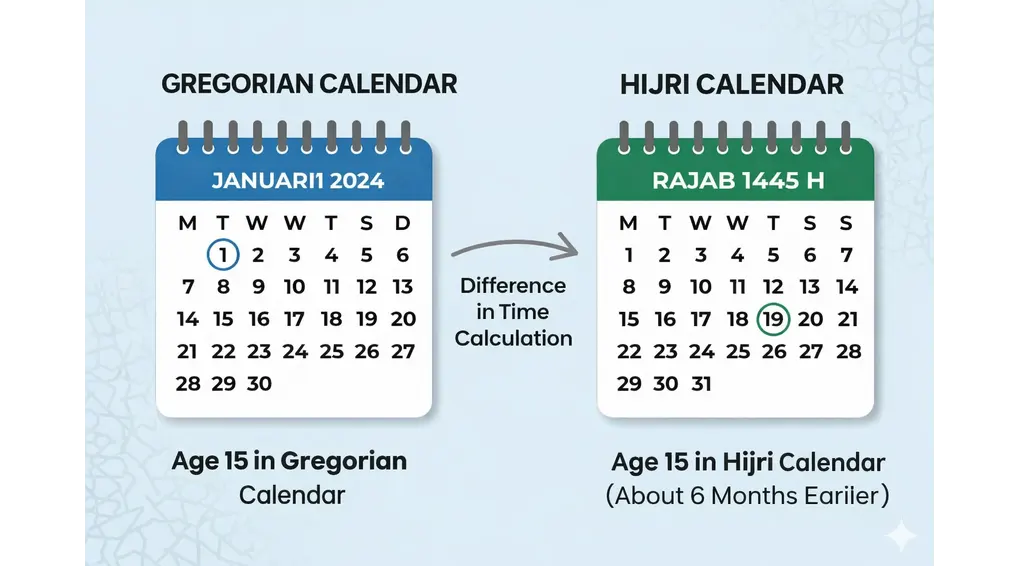
- The Hijri Calendar: The calculation of age in Islam strictly utilizes the lunar calendar (Qamariyah), absolutely not the Gregorian (Masehi) calendar. Remember, 15 Hijri years is approximately 6 months shorter than 15 Gregorian years. You can learn more about the history and calculation of the Hijri calendar to ensure your calculations are accurate.
- Absolute Precision (Tahdidiyah): The calculation must be mathematically precise. The 15 years are calculated from the exact second the infant is born (the complete separation of the entire body from the womb). If it is short by even a single day, the individual is not yet considered baligh through the avenue of age.
Therefore, the signs of baligh according to fiqh do not strictly necessitate waiting for physical, biological changes. If the absolute age limit has been reached, the child automatically becomes a mukallaf (legally obligated to execute the Sharia), and must immediately learn the conditions for the validity of prayer.
2. Ihtilam (The Emission of Semen / Wet Dream)
This second sign is strictly biological. The primary sign of baligh for a male is the emission of semen, commonly known in English as a wet dream.
Shaykh Nawawi profoundly elaborates on the concept of ihtilam. The jurisprudential definition of ihtilam is absolutely not restricted to a dream occurring during sleep. The emission of semen while fully awake—whether triggered by desire or otherwise—is also fully encompassed within this category.
It is imperative to understand that ihtilam serves as a definitive sign of baligh for both males and females, provided they have already reached the absolute minimum age of 9 Hijri years.
If a 7-year-old child experiences this, it is legally classified as an illness or a severe physical abnormality, not a valid sign of baligh. The scholars hold a slight divergence of opinion regarding the absolute precision of this 9-year mark:
- Imam al-Bajuri maintains that they must be exactly 9 years old.
- Ibn Hajar maintains that this age is an approximation (taqribiyah). This implies that if a child experiences ihtilam slightly before turning 9, they are still legally considered baligh.
If asked to list the specific signs of baligh for males, the occurrence of ihtilam and reaching 15 Hijri years are the two definitive answers.
3. Menstruation (Haid)




This third sign is the primary biological differentiator between males and females. The most universally recognized and easily identifiable sign of baligh for females is the onset of menstruation (haid).
The sign of baligh in a female child is the discharge of menstrual blood from the vagina while she is in a state of health, absolutely not caused by an illness or childbirth. Identical to the ruling on ihtilam, the absolute minimum age for valid menstruation is 9 Hijri years.
However, there is a specific jurisprudential allowance in its calculation. The sign of baligh for a female according to fiqh is menstruation at the age of 9 by approximation (taqribiyah). This signifies that if a girl discharges menstrual blood when her age is slightly less than 9 years, she is still legally judged as baligh.
What is the exact tolerance for this shortfall? The book Kashifat al-Saja dictates that the tolerance cannot exceed 16 days. This is mathematically based on the maximum possible duration of menstrual blood in a single month (15 days and nights).
- If her age is 9 years minus 14 days and she menstruates: She is validly Baligh.
- If her age is 9 years minus 20 days and she menstruates: That blood is legally classified as the blood of disease (fasad), and she is Not Yet Baligh.
Therefore, when asked to list the signs of baligh for females, the comprehensive answer is: completing 15 Hijri years, ihtilam (wet dream/emission), and menstruation. Because reaching baligh initiates the obligation of worship, one must also begin to understand the deeper spiritual aspects, such as the levels of intention in prayer.
Summary Table of the Signs of Baligh
To facilitate rapid comprehension, below is a concise summary table comparing the signs between males and females:
| The Sign of Baligh | Male | Female | Absolute Minimum Age |
| Completing 15 Years | Yes | Yes | 15 Years (Hijriyah) |
| Ihtilam (Wet Dream) | Yes | Yes | 9 Years (Hijriyah) |
| Menstruation (Haid) | No | Yes | 9 Years (Hijriyah) |
A Special Case: What if Pregnancy Occurs?
A question might arise in your mind: what is the jurisprudential ruling regarding pregnancy? Is it considered an independent sign of baligh?
Factually and biologically, pregnancy is not a primary sign; rather, it is secondary, incontrovertible evidence. A female cannot possibly conceive if her ovum has not matured (ovulation). Ovulation in females is jurisprudentially equated to the emission of semen in males.
Therefore, if a female child becomes pregnant, it serves as absolute proof that she had actually reached baligh previously through the internal process of ovulation/emission, even if she was entirely unaware of it occurring. To ensure these physical milestones translate into spiritual maturity, parents should guide their children on the most superior physical acts of worship.
FAQ: Frequently Asked Questions Regarding the Signs of Baligh

Here are some frequently asked questions regarding this topic:
Is a wet dream the absolute only sign of baligh for a male?
No. If you are asked to state the signs of baligh for a male, besides a wet dream, there is the definitive age marker of 15 Hijri years. Thus, if a male child never experiences a wet dream up to the age of 15, he automatically becomes baligh on his 15th Hijri birthday.
What exactly is meant by the term Ihtilam?
Ihtilam is a sign of baligh for both males and females characterized by the emission of sexual fluid (semen), whether occurring during sleep or while fully conscious. The common English term “wet dream” is merely one manifestation of this broader jurisprudential concept.
Is every discharge of blood from a female child automatically considered menstruation (haid)?
Absolutely not. The valid sign of baligh for a female is menstruation that occurs exclusively after the age of 9 Hijri years (or slightly less within the strict 16-day tolerance limit). If blood is discharged at the age of 7 or 8, it is jurisprudentially termed dam fasad (corrupt blood/blood of disease).
What is the sign of baligh for a female who has never experienced menstruation?
The definitive sign of baligh for a female who has not yet menstruated is when she experiences ihtilam (wet dream/emission) or when she exactly reaches the age of 15 Hijri years.
Conclusion
Comprehending the signs of baligh is not merely an exercise in memorizing theoretical jurisprudence. It is the fundamental, essential provision for us as parents to adequately prepare our children to cross the threshold into total religious responsibility. Do not let a catastrophic situation arise where our child is already legally obligated to perform the five daily prayers, yet they abandon them simply due to our own profound ignorance regarding the signs of adulthood according to fiqh.
We sincerely hope this detailed explanation derived from the classical text Kashifat al-Saja proves immensely beneficial for your family. Meticulously observe the growth and development of your beloved children, and guide them with immense love and strict adherence to the Sharia when those signs of adulthood begin to manifest.
Footnote
- Muhammad bin Umar Nawawi al-Jawi, Kāsyifat al-Sajā fī Syarḥ Safīnat al-Najā (maktabah al-Syāmilah al-Dzahabiyyah), hlm. 40–41. ↩︎


