
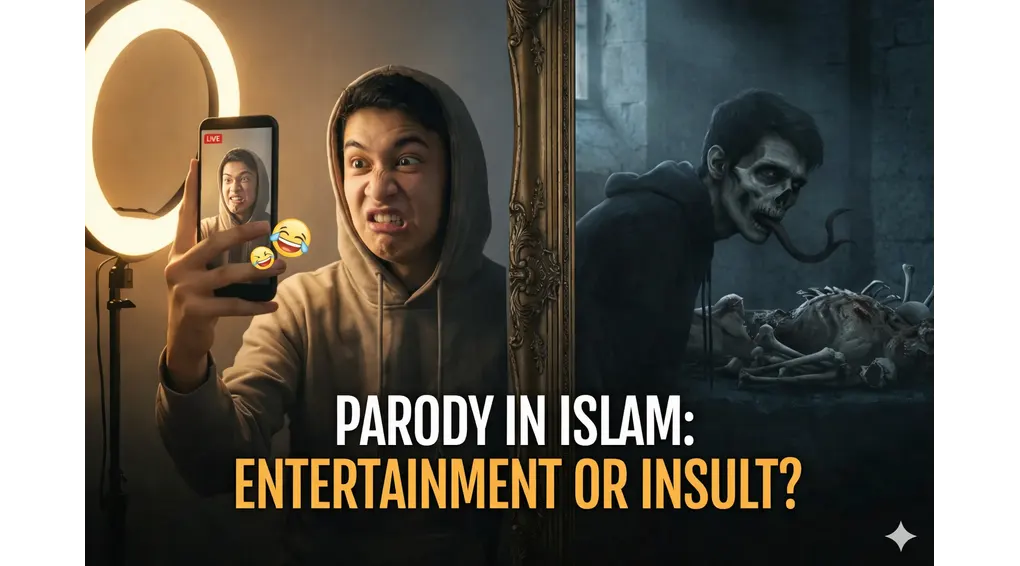
In today’s social media-driven era, parody and impersonation content are absolutely rampant. From mimicking the distinct speech patterns of politicians and parodying a friend’s unique walking style, to creating comedy sketches that blatantly highlight someone’s physical flaws—all are executed in the relentless pursuit of likes, laughter, and entertainment.
Admittedly, it is often hilarious, and we frequently burst into laughter marveling at the uncanny resemblance. However, as Muslims, has the thought ever crossed our minds: What exactly is the ruling on parody in Islam? Is mimicking another person’s mannerisms for the sake of comedy legally permissible, or does it actually fall into the terrifying category of major sins that we casually overlook?
This article will comprehensively dissect the perspectives of classical scholars, specifically focusing on the profound insights of Imam Al-Ghazali in his monumental work Ihya’ ‘Ulum al-Din, regarding the Islamic jurisprudence of creating and consuming parody content.
Understanding the Term “Al-Muhakah” (Parody in the Lens of Fiqh)

In modern terminology, we refer to it as parody or impersonation. However, centuries ago, Imam Al-Ghazali extensively analyzed this exact social phenomenon using the classical term Al-Muhakah (mimicry/imitation).
The ruling on parody in Islam is inextricably linked to the jurisprudential definition of Ghibah (backbiting). Many individuals erroneously believe that ghibah is exclusively restricted to “talking bad about people.” In reality, ghibah can be flawlessly executed through body language, subtle gestures, and physical impersonation. To fully grasp this, you must first understand what exactly constitutes ghibah in Islamic law.
Imam Al-Ghazali issues a severe warning in Ihya’ ‘Ulum al-Din:
وَمِنْ ذَلِكَ الْمُحَاكَاةُ يَمْشِي مُتَعَارِجًا أَوْ كَمَا يَمْشِي فَهُوَ غِيبَةٌ بَلْ هُوَ أَشَدُّ مِنَ الْغِيبَةِ
“And among (the forms of ghibah) is Al-Muhakah (mimicry). Someone walks with a limp (to imitate a limping person) or imitates their specific way of walking. That is ghibah; in fact, it is even more severe than verbal ghibah.”
Why is it deemed more severe? Because parody is inherently visual. Mimicking another person’s specific mannerisms through exaggerated body movements or facial expressions paints a significantly more vivid and profoundly insulting picture than merely describing them with words.
Scriptural Evidence Prohibiting Impersonation
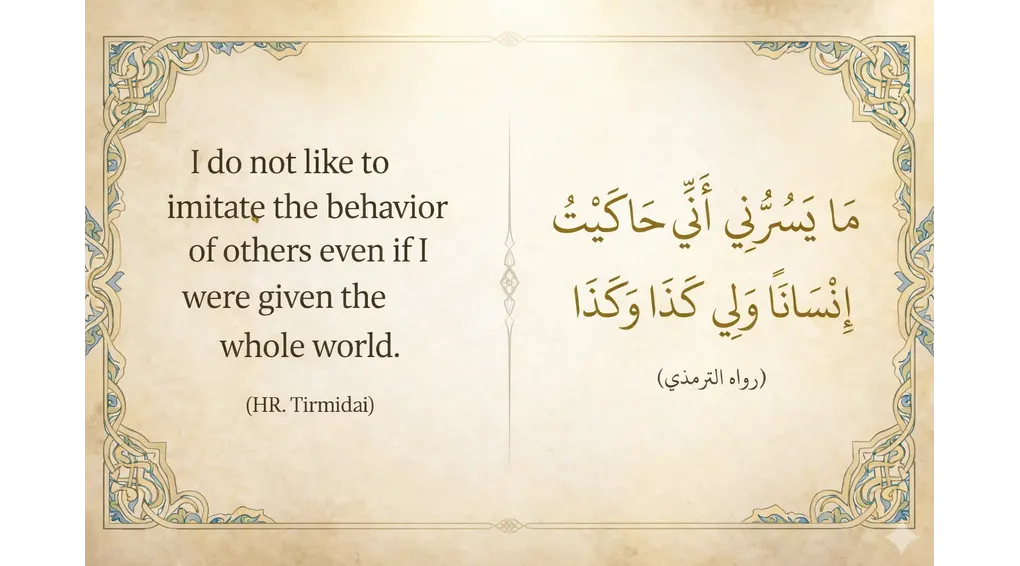
The primary foundation explaining why mocking parody is strictly forbidden originates directly from an authentic hadith of Prophet Muhammad ﷺ. On one occasion, Aisha (may Allah be pleased with her) imitated a person’s specific physical mannerisms in the presence of the Messenger of Allah.
Upon witnessing this, the Prophet ﷺ immediately and sternly reprimanded her:
مَا يَسُرُّنِي أَنِّي حَاكَيْتُ إِنْسَانًا وَلِي كَذَا وَكَذَا
“It would not please me to imitate any person (to belittle them), even if I were given such and such (wealth/the world).” (Narrated by Tirmidhi)
This hadith serves as the robust, foundational proof that the ruling on impersonation in Islam—specifically when it highlights a person’s flaws or physical shortcomings—is strictly Haram (forbidden). The Prophet ﷺ found absolutely no joy in it, even if heavily compensated, because it fundamentally violates the sacred honor of a fellow human being.
Why Can Parody Be Classified as a Major Sin?
Content creators might defensively argue, “Come on, it’s just a joke to entertain people.” However, through the deeply analytical lens of Imam Al-Ghazali, several devastating spiritual diseases of the heart are concealed beneath the surface of parody:
1. It Falls Under Sukhriyah (Mockery and Derision)
Parody inherently functions by deliberately exaggerating (hyperbolizing) the characteristics of the person being imitated. If the target speaks slightly slowly, the parody dramatically slows the speech down for comedic effect. If the target has slightly protruding teeth, the parody exaggerates it severely.
This directly violates the explicit prohibition of Allah in Surah Al-Hujurat, verse 11:
يٰٓاَيُّهَا الَّذِيْنَ اٰمَنُوْا لَا يَسْخَرْ قَوْمٌ مِّنْ قَوْمٍ عَسٰٓى اَنْ يَّكُوْنُوْا خَيْرًا مِّنْهُمْ وَلَا نِسَاۤءٌ مِّنْ نِّسَاۤءٍ عَسٰٓى اَنْ يَّكُنَّ خَيْرًا مِّنْهُنَّۚ وَلَا تَلْمِزُوْٓا اَنْفُسَكُمْ وَلَا تَنَابَزُوْا بِالْاَلْقَابِۗ بِئْسَ الِاسْمُ الْفُسُوْقُ بَعْدَ الْاِيْمَانِۚ وَمَنْ لَّمْ يَتُبْ فَاُولٰۤىِٕكَ هُمُ الظّٰلِمُوْنَ ١١
“O you who have believed, let not a people ridicule [another] people; perhaps they may be better than them; nor let women ridicule [other] women; perhaps they may be better than them…”
2. A Manifestation of Arrogance (Takabbur)
The individual performing the parody subconsciously feels “safer” or “superior” to the object of their parody. Al-Ghazali explicitly notes that one of the primary triggers of ghibah and mockery is the feeling of self-amazement (ujub) and looking down upon others. We laugh because we feel the target looks ridiculous, and the very feeling of “finding someone else ridiculous” is a subtle, dangerous manifestation of arrogance.
3. Inflicting Emotional Pain (Iza’)



The definitive parameter of ghibah is: “Saying that about your brother which he would dislike hearing.”
Imagine if that viral parody video reached the specific person being imitated. Would they be genuinely happy that their private flaws, speech impediment, or physical shortcomings were transformed into a laughingstock for millions of strangers? If it causes them emotional pain, then the sin is undeniably validated as the severe sin of ghibah.
When Is Parody Permissible?
Does Islam, therefore, totally prohibit the entire realm of acting, theater, or comedy? Certainly not; Islamic jurisprudence is not rigidly suffocating. There are highly specific boundaries where imitating characters is legally permissible, provided strict conditions are met:
- Not Imitating a Specific Individual (Anonymity): If the comedic sketch portrays “The typical types of neighbors when buying vegetables” without referencing Mrs. Siti or Mr. Budi specifically, this is permissible. This falls under the category of general social critique. As the Prophet ﷺ frequently utilized the phrase: “What is the matter with people who do such and such…” He sharply criticized the behavior, never the specific person.
- Devoid of Physical Insults: Imitating voice characteristics (e.g., a robot’s voice, animal sounds) for educational purposes or children’s storytelling is permissible, as it does not involve mocking human physical deformities.
- Possessing Explicit Permission and Non-Degrading: If someone impersonates a historical hero to honor their legacy (not to mock their flaws), this can be tolerated within an educational context. However, scholars continuously advise extreme caution because the psychological boundary between acting and mocking is razor-thin.
The Danger of Parody Content on Social Media: A Continuous Sin

During the era of Imam Al-Ghazali, Al-Muhakah occurred in closed, physical gatherings. Perhaps 5 to 10 people witnessed it. Today, however, a parody video uploaded to TikTok, Instagram, or YouTube is rapidly consumed by millions.
Imam Al-Ghazali warned:
“The pen is one of the two tongues.”
In the digital landscape, video recordings and typed statuses serve as the modern “pen.” If we produce parody content that physically insults someone, and that content is viewed by 1 million people, we are effectively distributing the “dead flesh of our brother” to 1 million individuals simultaneously.
A sin of ghibah that was initially personal instantly transforms into an endless stream of sin that continues to flow as long as the video remains online and people laugh at it—potentially even long after the creator has died. Na’udzubillah (We seek refuge in Allah). If you have consumed such content, you must urgently learn how to deal with backbiting to protect your faith.
Differentiating Social Critique and Insulting Parody
To be clearer, let’s differentiate between what is permissible and what is forbidden through the following table:
| Aspect | Social Critique (Permissible/Encouraged) | Forbidden Parody (Haram) |
| Object | General behavior / Social phenomena (Anonymous) | A highly specific person (Named or clearly identifiable) |
| Objective | Rectifying mistakes / Moral education | Laughing at / Degrading / Chasing Views |
| Focus | Moral issues / Societal problems | Physicality, Flaws, Private shortcomings, Speech style |
| Impact | People realize mistakes and desire to change | The imitated person feels deeply humiliated/hurt |
| Example | A drama highlighting the dangers of corruption (without mimicking specific politicians) | Imitating the stuttering speech of Politician X to make him look stupid |
Frequently Asked Questions (FAQ) Regarding the Ruling on Parody
What if the person being parodied also laughs along?
If the individual is genuinely pleased (ridha) and absolutely does not feel insulted in the slightest, then the sin of Haqqul Adami (the right of harming a human) is dropped. However, one must still be intensely vigilant regarding muru’ah (personal dignity and honor). Transforming a human being into a clownish spectacle can severely diminish the dignity of a Muslim, even with their explicit permission. If feelings were hurt, specific steps for repentance regarding Haqqul Adami must be undertaken immediately.
Does lip-syncing the audio of someone angrily yelling on TikTok constitute haram parody?
If the original audio highlights a person’s flaw (e.g., someone fiercely arguing, someone who is easily startled/latah, or someone with a severe speech impediment) and we imitate it using mocking facial expressions, it explicitly falls under the prohibited Al-Muhakah. We are actively laughing at the moral or physical misfortune of another human being.
Is it permissible to impersonate an Ustadh (Islamic teacher) for the sake of preaching (da’wah)?
If the pure intention is to honor them and convey Islamic knowledge utilizing their unique, iconic style without any exaggeration (caricature), some scholars cautiously permit it. However, if the primary objective is to make the audience burst into laughter at the uncanny physical resemblance, it is vastly superior to avoid it entirely. The profound fear is that it slips into the realm of Sukhriyah (mockery), especially since the object is a scholar of religion who fundamentally deserves immense respect as a carrier of the Sharia. Such matters are intricately tied to the primary sources of Islamic law, which command the veneration of sacred knowledge.
Conclusion
The ruling on parody in Islam is absolutely not a trivial matter. Imam Al-Ghazali has fiercely warned us that Al-Muhakah (mimicking people’s styles) can be significantly more cruel than verbal ghibah due to its highly visual nature that permanently imprints on the memory.
As wise, conscious Muslims, let us be exceptionally selective in choosing our entertainment. Do not allow our fleeting laughter in this world to be paid for with agonizing tears in the Hereafter because we casually “devoured the dead flesh” of our own brothers and sisters through parody content.
If you have ever created this type of content, delete it immediately before the sins continue to flow into your record. If you are merely a consumer of it, cease giving it likes and shares, because the silent spectator is a full partner to the creator in the commission of this sin..
Reference
Al-Ghazali, Abu Hamid. Ihya’ ‘Ulum ad-Din (The Revival of the Religious Sciences). Beirut: Dār al-Maʿrifah.


