
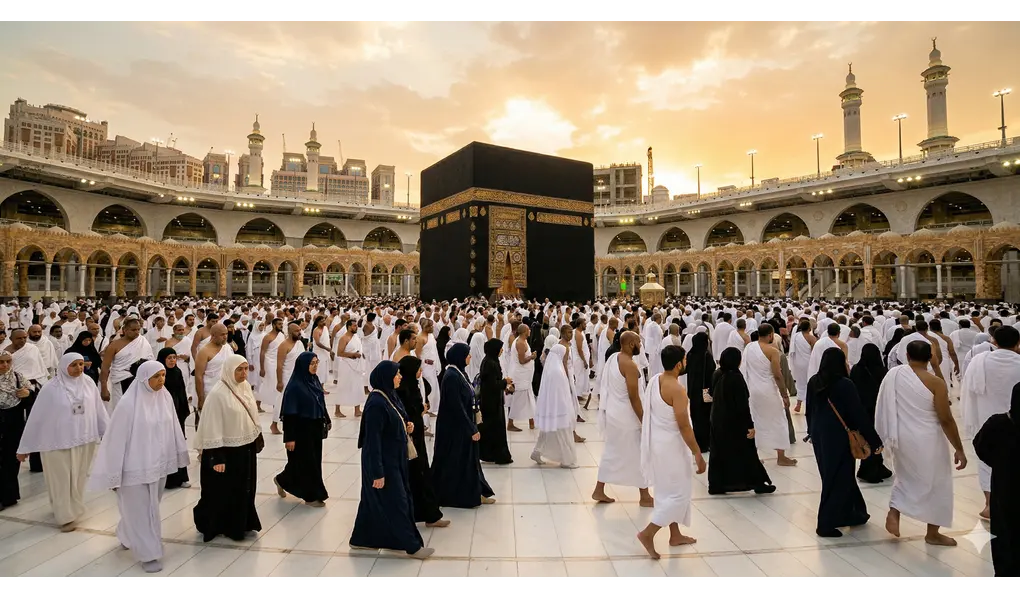
Hajj is one of the most fundamental pillars in the teachings of Islam. As the fifth pillar, it is a profoundly sacred act of worship encompassing deep spiritual, historical, and social dimensions for every Muslim who is capable of undertaking it.
For the majority of the Muslim Ummah, performing the Hajj pilgrimage is the highest aspiration in life. However, a fundamental question often arises: what is the actual meaning of Hajj? To fully comprehend this noble act of worship, we must explore its definition from both linguistic and Islamic jurisprudential (Fiqh) perspectives. This article will thoroughly examine the definition of Hajj, its legal foundations, and the essential pillars that form the core of its performance.
The Linguistic Meaning of Hajj (Etymology)
To deeply grasp the meaning of Hajj, we must begin at its root: the Arabic language. Etymologically, the word “Hajj” (الحج) originates from Arabic and literally translates to al-Qasd (الْقَصْدُ).
The term al-Qasd carries the definition of intention, purpose, resolving, or directing oneself toward a specific destination. Therefore, in a purely linguistic context, Hajj is the act of having an intention or purpose to journey to a particular place.
Furthermore, prominent Arabic linguists provide a more nuanced definition. As cited in authoritative Shafi’i jurisprudence texts, including al-Fiqh al-Manhaji, it is stated:
الحج لغة القصد: وقال الخليل: كثرة القصد إلى من يُعظم.
This excerpt from al-Fiqh al-Manhaji explains:
- الحج لغة القصد: Hajj linguistically means al-Qasd, which is intention or purpose.
- وقال الخليل: كثرة القصد إلى من يُعظم: And Al-Khalil (Al-Khalil bin Ahmad al-Farahidi, a prominent Arabic linguist) stated: The linguistic meaning of Hajj also implies a frequent (repeated) intention or journey toward an entity that is deeply venerated or glorified.
From this linguistic explanation, we can conclude that literally, the meaning of Hajj is the deliberate act of journeying toward something considered noble or magnified, often carrying the connotation of a repeated visit.
The Meaning of Hajj in Islamic Terminology (Shari’ah)
While the linguistic meaning provides a foundation, the definition of Hajj within the context of the Islamic faith is far more specific and legally binding. In Islamic terminology, Hajj is a dedicated act of worship governed by precise pillars and conditions.
In al-Fiqh al-Manhaji, after elucidating the linguistic root, the scholars provide the jurisprudential understanding of fiqh regarding Hajj:
وشرعاً: القصد إلى بيت الله الحرام لأداء عبادة مخصوصة بشروط مخصوصة.
This explanation breaks down the Shari’ah definition of Hajj as follows:
- وشرعاً: And in Islamic terminology (Shari’ah)…
- القصد إلى بيت الله الحرام: …it is the intention to visit the Sacred House of Allah (Baitullah al-Haram or the Kaaba) in Mecca…
- لأداء عبادة مخصوصة: …to perform specific acts of worship (whose procedures are divinely ordained)…
- بشروط مخصوصة: …under specific conditions (which are also established by Islamic law).
From this technical definition, we understand that Hajj is far more than an ordinary journey. It explicitly involves:
- A Definite Destination: Specifically, Baitullah al-Haram (the Kaaba) in Mecca.
- Specific Activities: Performing a series of rituals regulated by Islamic law, such as Ihram, Tawaf, Sa’i, Wukuf in Arafah, and casting pebbles at the Jamarat.
- Binding Conditions: It must be performed during a specific time (the months of Hajj, culminating in Dzulhijjah) and is restricted to those who meet the obligatory conditions of Hajj and Umrah, such as being a Muslim, of sound mind (aqil), having reached puberty (baligh), being free, and possessing the physical and financial capability (istitha’ah).
Thus, the meaning of Hajj is a deliberate spiritual journey to the Kaaba at a designated time, aimed at fulfilling specific rituals according to Islamic teachings, performed by those who meet its prerequisites.
The Position of Hajj in Islam
After understanding the meaning of Hajj both linguistically and terminologically, it is crucial to recognize its fundamental position in Islam. Hajj holds a supremely noble status as the fifth pillar among the pillars of Islam, following the Shahada, prayer (Salah), almsgiving (Zakat), and fasting during Ramadan. You can learn more about the broader framework by understanding the pillars of Islam.
The Legal Basis for the Obligation of Hajj
The obligation to perform Hajj stems directly from the words of Allah Subhanahu wa Ta’ala in the Holy Quran. One of the most frequently cited verses establishing the legal basis of Hajj and Umrah is Surah Ali ‘Imran (3), verse 97:
فِيهِ آيَاتٌ بَيِّنَاتٌ مَّقَامُ إِبْرَاهِيمَ ۖ وَمَن دَخَلَهُ كَانَ آمِنًا ۗ وَلِلَّهِ عَلَى النَّاسِ حِجُّ الْبَيْتِ مَنِ اسْتَطَاعَ إِلَيْهِ سَبِيلًا ۚ وَمَن كَفَرَ فَإِنَّ اللَّهَ غَنِيٌّ عَنِ الْعَالَمِينَ
Translation: “In it are clear signs [such as] the standing place of Abraham. And whoever enters it shall be safe. And [due] to Allah from the people is a pilgrimage to the House – for whoever is able to find thereto a way. But whoever disbelieves – then indeed, Allah is free from need of the worlds.” (QS. Ali ‘Imran: 97)
This verse explicitly states that performing Hajj to Baitullah is an obligation (lillahi ‘ala an-nas) for anyone who is capable (man istatha’a ilaihi sabila). This capability encompasses physical health, financial means, and a secure travel route. This solidifies Hajj as a compulsory duty to be fulfilled once in a lifetime for every eligible Muslim.
The Fundamental Pillars of Hajj (Arkan al-Hajj)
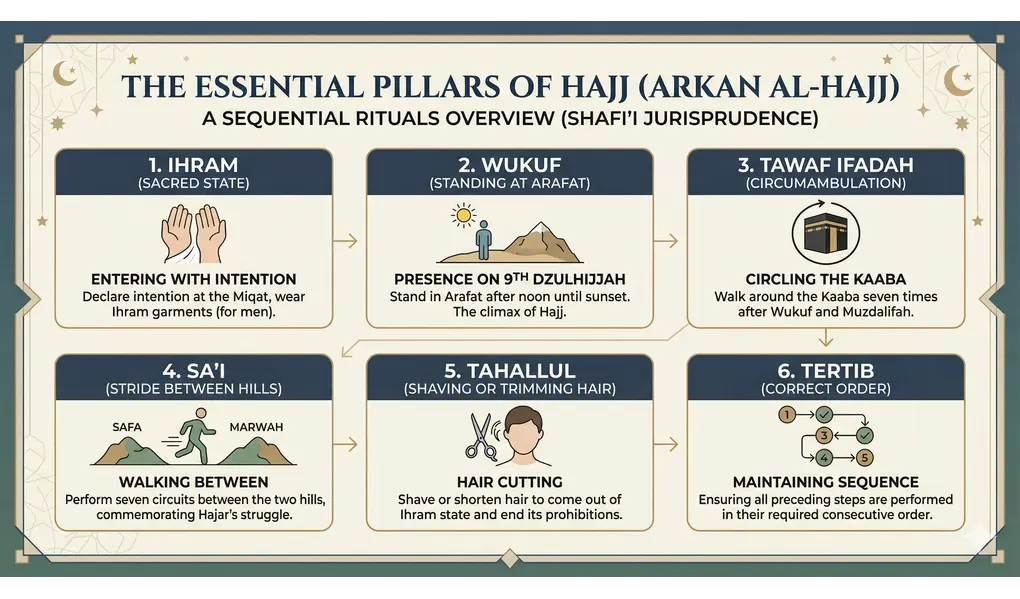
To fully comprehend the essence of this worship, one must know the pillars of Hajj and Umrah. In Shafi’i jurisprudence, a pillar (rukn) is a fundamental action; if omitted, the Hajj becomes invalid and must be repeated in a subsequent year. It cannot be compensated for with an expiation penalty (dam).
According to the Shafi’i school of thought, the essential pillars of Hajj are:
- Ihram: This is the sacred state entered into by forming the intention for Ihram, accompanied by donning the Ihram garments and strictly avoiding the 10 prohibitions of Ihram. The intention is the pivotal key that commences the pilgrimage, aligning with the core meaning of intention in Islamic jurisprudence.
- Wukuf in Arafah: Being present in the plains of Arafah on the 9th of Dzulhijjah, from the time the sun passes its zenith until the break of dawn on the 10th of Dzulhijjah. Wukuf is the absolute climax of Hajj. Prophet Muhammad (ﷺ) profoundly stated, “Hajj is Arafah” (Sunan al-Tirmidhi). Without Wukuf, there is no Hajj.
- Tawaf Ifadah: Circumambulating the Kaaba seven times after returning from Arafah and Muzdalifah on Eid al-Adha or during the days of Tashriq. This is a primary pillar marking the completion of the core Mecca-based rituals.
- Sa’i: Walking briskly or lightly jogging seven times between the hills of Safa and Marwah. Sa’i commemorates the remarkable struggle of Hajar (peace be upon her) as she searched for water. It is performed after Tawaf Ifadah (or Tawaf Qudum for those who begin with it).
- Tahallul (Shaving or Trimming the Hair): Completely shaving (halq) or trimming (taqsir) at least three hairs of the head. This marks the release from the state of Ihram, allowing the pilgrim to enter the first phase of tahallul awwal.
- Tertib (Order): Performing most of these pillars in their correct sequential order, specifically regarding Wukuf, Tawaf Ifadah, Sa’i, and Tahallul.
The Wisdom and Benefits of Hajj
Fulfilling the Hajj is not merely about discharging a legal duty; it is replete with profound wisdom behind Hajj, yielding immense personal and collective benefits.
Individually, Hajj is a journey of self-purification and elevated piety (Taqwa). It rigorously trains a believer in patience, physical and mental resilience, and sincerity. By shedding worldly adornments and wearing the same simple cloth as millions of others, a pilgrim truly internalizes human equality before Allah.
Socially, Hajj serves as the largest global congregation of the Muslim Ummah. Millions of Muslims across different ethnicities, nationalities, and backgrounds gather to worship identically, facing the same Qibla. It vividly demonstrates the unity, solidarity, and mutual care inherent in the Islamic faith.
The Core Differences Between Hajj and Umrah
At a glance, Hajj and Umrah share several overlapping rituals, such as Ihram, Tawaf, and Sa’i. However, their definitions and legal structures differ significantly:
- Time of Performance: Hajj can only be performed during specific months (Syawal, Dzulqa’dah, and Dzulhijjah), culminating on the 9th of Dzulhijjah. Conversely, Umrah can be performed at almost any time of the year.
- The Pillars: Hajj mandates the Wukuf in Arafah, which is its absolute core. Umrah does not include Wukuf, nor does it include staying in Mina or Muzdalifah, or stoning the Jamarat.
- The Ruling: While both are immense acts of devotion, the Shafi’i school maintains that both Hajj and Umrah are obligatory (fardh) to be performed once in a lifetime for those who are capable.
Conclusion
Understanding the meaning of Hajj extends far beyond memorizing definitions; it requires internalizing its profound spiritual essence. Linguistically meaning “intention or purpose,” it translates in Islamic law to a sacred, purposeful journey to Baitullah to fulfill divine commandments. By comprehending the virtues of Hajj, its legal foundations in the Quran, and its essential pillars, Muslims are ideally motivated to undertake this journey with pure sincerity (ikhlas). The ultimate goal is to achieve Hajj Mabrur—an accepted pilgrimage whose only reward, as promised by the Prophet (ﷺ), is Paradise.
Frequently Asked Questions (FAQ)
What is the fundamental meaning of Hajj in Islam?
In Islamic terminology, the meaning of Hajj is the deliberate intention and physical journey to the Sacred House of Allah (the Kaaba) in Mecca to perform specific acts of worship, such as Ihram, Tawaf, Sa’i, and Wukuf in Arafah, during a specific time and under specific conditions.
Why is Wukuf in Arafah considered the most critical pillar of Hajj?
According to the Hadith of Prophet Muhammad (ﷺ), “Hajj is Arafah.” It is the core spiritual apex of the pilgrimage. If a pilgrim misses the Wukuf in Arafah during the designated time, their Hajj is entirely invalid and cannot be compensated for with an expiation (dam).
What is the difference between Hajj and Umrah?
The main differences lie in the timing and the rituals. Hajj must be performed during specific Islamic months and includes the pillar of Wukuf in Arafah, staying in Muzdalifah and Mina, and stoning the Jamarat. Umrah can be performed year-round and consists only of Ihram, Tawaf, Sa’i, and Tahallul.
Reference
Mustafa al-Khin, Mustafa al-Bugha, and Ali al-Syarbaji, al-Fiqh al-Manhaji ‘alā Madhhab al-Imām al-Shāfi‘ī, vol. 2 (Damascus: Dār al-Qalam, 1992), p. 113.


