
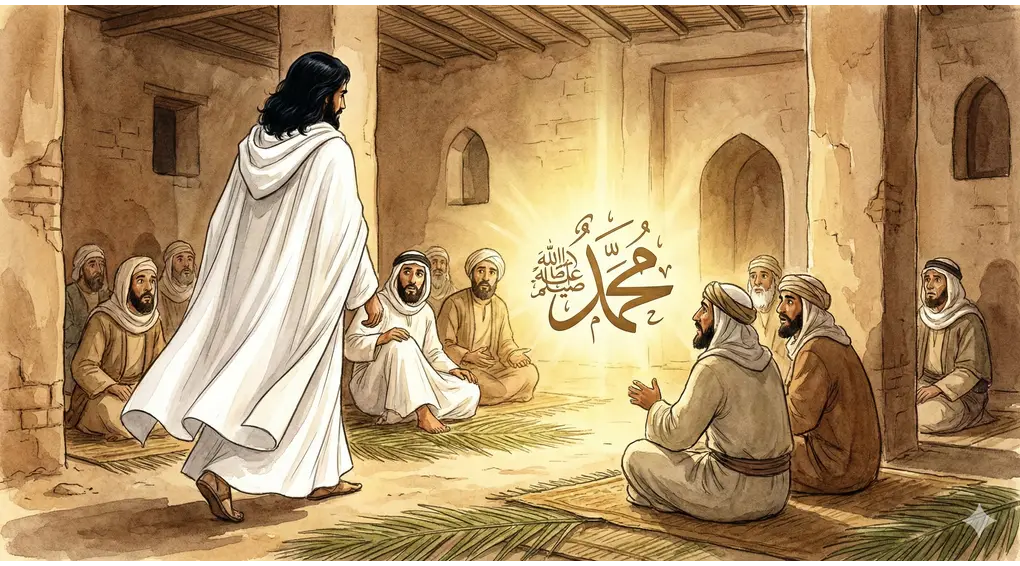
In the rich tradition of Hadith studies, there is a famous narration known as Umm al-Sunnah (The Mother of the Sunnah). This profound narration begins with the sudden arrival of a mysterious figure who astonished the Companions in the gathering of Prophet Muhammad ﷺ. This figure was not an ordinary guest but the definitive key to unlocking the understanding of the 3 levels of religion: Islam, Iman, and Ihsan.
Many seekers of knowledge ask: who exactly is this man in white clothes? Why did his pristine appearance contrast so sharply with the harsh, dusty geographical conditions of Arabia? This article will unravel his identity, physical characteristics, and theological significance by referencing the authoritative Shafi’i text, Al-Fath Al-Mubin bi Syarhi Al-Arba’in An-Nawawiyah (pages 139-143) by Syaikh al-Islam Ibn Hajar al-Haytami.
The Narrative of the Mysterious Guest’s Arrival
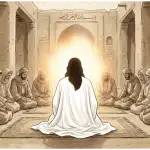
Umar ibn al-Khattab (may Allah be pleased with him) narrated this monumental event with razor-sharp visual detail. While the Companions were sitting quietly with the Prophet ﷺ, an unrecognized man suddenly appeared, bearing an exceptionally clean and striking presence.
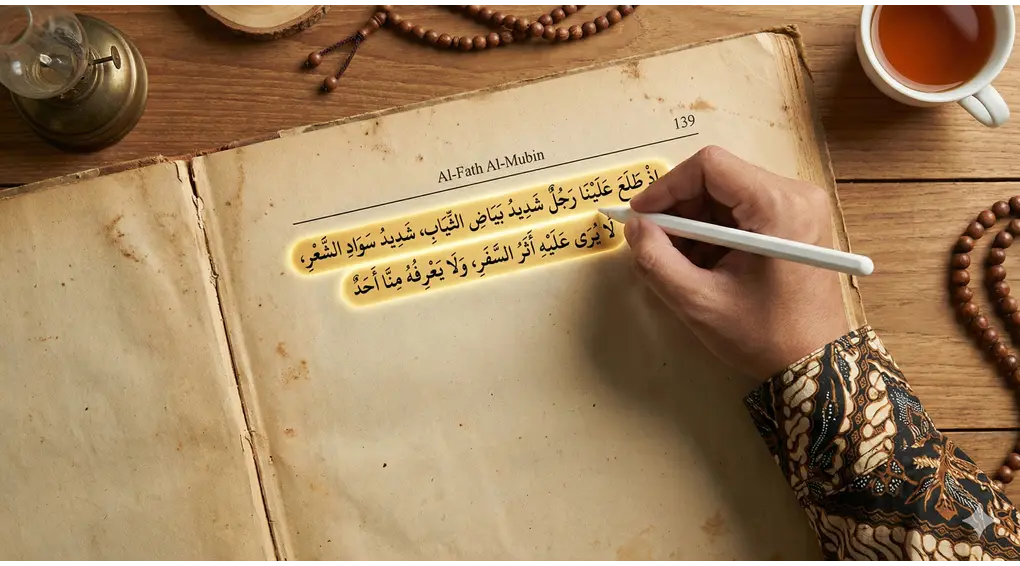
In the original manuscript of the book Al-Fath Al-Mubin, the wording of the ḥadīth is written as follows:
إذ طلع علينا رجل شديد بياض الثياب , شديد سواد الشعر , لا يري عليه أثر السفر , ولا يعرفه منا أحد
(Suddenly, a man appeared before us with extremely white garments, very black hair, showing no signs of travel, and none of us recognized him).
Syaikh Ibn Hajar al-Haytami provides a fascinating linguistic commentary (ta’liq) on this phrasing. The Arabic word (لا يُرَى – yu-raa) is read in the passive voice, which conveys a much stronger and objective meaning than the active voice (لا نَرَى – na-raa, “we did not see”). This emphasizes that objectively, there was not a single trace of travel upon him.
The Paradox of Identity
The presence of this man in white clothes created an immediate paradox in the minds of the Sahabah. Syaikh Ibn Hajar explains that this situation heightened the mystery (al-‘amāyah) for the onlookers:
- If he were a resident of Medina, the Companions would have certainly recognized him.
- If he were a traveler, the physical toll of the desert—such as dusty clothes or disheveled hair—should have been visible (atsar as-safar).
Yet, he appeared immaculately neat, as though he had just stepped out of a nearby bathhouse, despite nobody knowing his identity.
Analyzing the Physical Characteristics and Symbolic Meaning
The physical manifestation of Archangel Gabriel (Jibril) in human form contains profound legal reasons (‘ilal syar’iyyah) and high-level lessons in etiquette (adab).
1. Intensely White Clothes and Black Hair
The description of his “intensely white clothes” and “intensely black hair” is not a mere narrative detail. The commentary on page 141 states:
ففيه ندب تنظيف الثياب , وتحسين الهيئة بإزالة ما يؤخذ للفطرة , وتطييب الرائحة عند الدخول للمسجد
(Therefore, it is recommended to cleanse clothing, improve one’s appearance by removing natural impurities, and apply perfume when entering the mosque).
This teaches us that inner spiritual purity must align with outward physical cleanliness. This discipline of hygiene is a core aspect of faith, parallel to the daily practices we maintain through supplications for purification. The black hair signifies youth and physical vitality, while white is the preferred color for seekers of knowledge entering sacred spaces.
2. The Fragrant Aroma

Beyond the visual, Syaikh Ibn Hajar quotes a narration by Imam An-Nasa’i from Abu Hurairah and Abu Dharr, adding a vital olfactory detail:
أحسن الناس وجها , وأطيب الناس ريحا , كأن ثيابه لا يمسها دنس
(He was the most handsome of people in face, the most fragrant in scent, as if dirt had never touched his clothes).
This otherworldly fragrance was a subtle indicator that he was not an ordinary human made of earthly clay, but a pure being bringing divine tidings.
Etiquette of the Man in White Clothes Before the Prophet ﷺ
The identity of the guest is revealed not just by his appearance, but by his conduct (ahwal) before the Prophet ﷺ.
The Sitting Posture: Jalsah Al-Muta’allim
He did not sit casually. He assumed an intimately close and highly respectful posture:
فأسند ركبتيه إلى ركبتيه , ووضع كفيه على فخذيه
(He rested both his knees on the knees of the Prophet, and placed both his palms on the Prophet’s thighs).
Al-Fath Al-Mubin explains that this is the seating position of a dedicated student (jalsah al-muta’allim). He approached with absolute earnestness (mubalaghah), symbolizing deep focus (Muraqabah) in seeking knowledge.
Scholars debated regarding whose thighs the hands were placed upon. Syaikh Ibn Hajar supports the dominant view that Gabriel placed his hands on the Prophet’s thighs as a profound gesture of reverence (ta’zim) and spiritual intimacy during the transmission of revelation.
The Direct Address: “O Muhammad”
One peculiar detail is that the man addressed the Prophet by saying, “O Muhammad!”, rather than the respectful “O Messenger of Allah.” The Qur’an explicitly forbids calling the Prophet merely by his name (Surah An-Nur: 63).
Syaikh Ibn Hajar offers an insightful justification (tawjih) on page 143:
- Disguise (Ta’miyah): Gabriel deliberately mimicked the blunt, straightforward speaking style of the desert Bedouins (A’rab) to ensure the Companions would not suspect he was an angel.
- Chronology: It is highly probable that this event occurred before the specific Quranic verse forbidding the direct use of his name was revealed.
Theological Reality: The Angelic Transformation (Tasyakkul)
At the conclusion of the hadith, after the man departed, the Prophet ﷺ revealed the truth to Umar:
فإنه جبريل أتاكم يعلمكم دينكم
(Indeed, he is Gabriel, he comes to you to teach your religion).
How can an angel, a being created from pure light, transform into solid human matter?
Syaikh Ibn Hajar fiercely refutes the deviant concept of divine incarnation (hululiyah) and affirms the orthodox Ahlussunnah wal Jamaah belief on page 184:
لأن جبريل جسم نوراني في غاية اللطافة , فقبلت ذاته التشكل والانخلاع من طور إلى طور
(Because Jibril is a luminous essence [body of light] that is very subtle [lathif], his essence is able to take on different forms [tasyakkul] and transition from one phase to another).
The man was Gabriel undergoing tasyakkul. While he often appeared in the form of the famously handsome Companion Dihyah Al-Kalbi, here he appeared as a complete stranger to ensure the Sahabah focused entirely on the sacred knowledge rather than his personal identity.
Recognizing that this figure was Gabriel awakened the Companions to the presence of the unseen, serving as the ultimate masterclass in the meaning of belief in angels. Among the names of angels, Gabriel holds the highest rank as the transmitter of the divine law.
This single event meticulously outlined the pillars of faith, instructing Muslims on the absolute necessity of belief in the divine books, the understanding of belief in the Prophets, and internalizing the reality of belief in the Last Day.
Summary Table: Characteristics of the Man in White
| Description in Hadith | Meaning & Explanation (Al-Fath Al-Mubin) | |
|---|---|---|
| Clothing | Very White (Shadidul Bayadh) | Symbol of purity of the heart and the sunnah of wearing white in gatherings of knowledge. |
| Hair | Very Black (Shadidus Sawad) | Indicates youthfulness and physical vitality. |
| Condition | No trace of travel | An unusual occurrence (Kharqul ‘Adah) that aroused the curiosity of the companions. |
| Position | Knees touching knees | The etiquette of a student towards a teacher; a symbol of closeness (Qurb). |
| Address | “O Muhammad” | Disguise as an Arab Bedouin (A’rab) or occurred before the prohibition. |
FAQ: Questions About the Figure of Jibril in This Ḥadīth
Did the companions see Jibril with their physical eyes or the eyes of their hearts?
The companions saw with their own eyes (Ru’yah Bashariyah). This is affirmed by Umar’s statement: “A man appeared before us.” They saw a human form, but in reality, it was an angel.
Why did Gabriel place his hand on the Prophet’s thigh?
According to the rajih (strong) opinion in this commentary, the action demonstrates intimacy and a gesture of readiness to receive knowledge, as well as a form of teaching etiquette to the companions present regarding the etiquette of a student towards a sheikh or teacher.
Is it permissible for us to wear all white like Jibril?
Highly recommended (Mandub). Shaykh Ibn Hajar affirmed that this story serves as evidence for the Sunnah of cleaning one’s clothes and applying perfume when visiting a mosque or a scholar.
Conclusion
The profound theological analysis confirms that the man in white clothes was none other than the Archangel Gabriel, sent by Allah with a brilliant pedagogical strategy. His immaculate appearance teaches us that sacred knowledge must be approached with outward cleanliness, inner purity, impeccable etiquette, and absolute spiritual earnestness.
In the intellectual heritage of Islam, the arrival of this mysterious figure serves as the magnificent prologue to the most comprehensive Prophet’s teaching method, ensuring that the foundations of the religion remain crystal clear for all generations to come.
And Allah knows best.
Referensi
Ibn Ḥajar al-Haytamī, Aḥmad ibn Muḥammad. al-Fatḥ al-Mubīn bi-Sharḥ al-Arbaʿīn. Edited by Aḥmad Jāsim Muḥammad al-Muḥammad, Quṣayy Muḥammad Nūrūs al-Ḥallāq, and Abū Ḥamzah Anwar ibn Abī Bakr al-Shaykhī al-Dāghistānī. 1st ed. Jeddah: Dār al-Minhāj, 2008.


