

Every individual inevitably finds themselves standing at the crossroads of life. Whether it concerns selecting a career path, choosing a life partner (marriage), or simply making a monumental business decision, the heavy cloud of doubt frequently haunts us: “Is this truly the best choice for me?”
In Islam, we are never left to wander aimlessly in the dark. The Messenger of Allah ﷺ taught us a profoundly beautiful solution known as Salat al-Istikhara. This is not merely a dry ritual; it is our intimate method of “conversing” with Allah, earnestly requesting Him to select what is absolutely best for our worldly and spiritual affairs.
In this comprehensive guide, we will thoroughly dissect the chapter on Istikhara directly from its primary, authoritative source: the legendary book Al-Adhkar by the great Shafi’i scholar, Imam An-Nawawi (pages 119-120). Let us deeply study the authentic procedures of Salat al-Istikhara exactly as taught by the Prophet ﷺ.
What is Istikhara?
Etymologically, the Arabic dictionary Al-Ma’ani explains that Istikhara (اِستخارة) is the verbal noun (masdar) derived from the verb istakhara (اِستَخارَ). Its foundational meaning is thalabul khair fi ash-shay’, which translates to “seeking or demanding goodness in a matter.” Therefore, the person performing Istikhara (mustakhir) is actively striving to uncover the most beneficial aspect of the situation they are currently facing.
From a jurisprudential (fiqh) perspective, Salat al-Istikhara is defined as an act of worship consisting of two rakaat performed by a Muslim when confronted with a choice between two (or more) permissible matters. The core essence of this prayer is to supplicate to Allah Azza wa Jalla with a specific, dedicated invocation (du’a makhshush), begging for His divine guidance (tawfiq) to be steered toward the choice that harbors ultimate goodness.
Before engaging in this specific prayer, it is highly beneficial to understand the broader concept and purpose of prayer (Salah) in Islam. Furthermore, Istikhara is categorized as a voluntary prayer, so familiarizing yourself with the complete guide to voluntary prayers (Salat al-Tathawwu’) will deepen your understanding.
In the book Al-Adhkar, Imam An-Nawawi elaborates on an authentic (sahih) hadith narrated by Jabir bin Abdullah (may Allah be pleased with him). Fascinatingly, Jabir stated that the Prophet ﷺ used to teach them this Istikhara “just as he would teach us a Surah from the Qur’an.” This profoundly emphasizes the immense importance of this supplication in absolutely all affairs (fi al-umuri kulliha), not exclusively when one is desperate or confused about marriage.
The Translation and Original Text from Al-Adhkar
To meticulously preserve the authenticity of the sacred knowledge, below is the direct quotation of Hadith number 341 from the book Al-Adhkar, accompanied by its translation:
The Arabic Text (Hadith No. 341)
٣٤١ – روينا في ” صحيح البخاري ” عن جابر بن عبد الله رضي الله عنهما قال: ” كان رسول الله صلى الله عليه وسلم يعلمنا الاستخارة في الأمور كلها, كالسورة من القرآن, يقول: ” إذا هم أحدكم بالأمر فليركع ركعتين من غير الفريضة, ثم ليقل: اللهم إني أستخيرك بعلمك, وأستقدرك بقدرتك…
Translation and Scholarly Explanation
From Jabir bin Abdullah, the Messenger of Allah ﷺ said: “If any one of you intends to undertake a matter, let him pray two rakaat other than the obligatory prayer, then let him say…”
The critical jurisprudential points derived from Imam Nawawi’s explanation of this hadith are:
- Flexibility of Intention (Niyyah): These two rakaat do not strictly necessitate an exclusive intention for Salat al-Istikhara. According to the scholars cited by Imam Nawawi, the intention for Istikhara can be seamlessly combined with the regular Sunnah prayers (Rawatib), the prayer for greeting the mosque (Tahiyatul Masjid), or any other voluntary prayer. Understanding the levels of intention in prayer is crucial for this flexibility.
- The Recitation of Surahs: It is highly recommended (sunnah) to recite Surah Al-Kafirun in the first rakaat and Surah Al-Ikhlas in the second rakaat, immediately following Surah Al-Fatihah.
- The Timing of the Dua: The specific supplication is recited after the completion of the prayer (after the salam).
The Complete Dua of Istikhara (Arabic, Transliteration, and Meaning)
This is the absolute core of the practice. Many individuals constantly search for the precise reading of the Istikhara supplication. Below is the exact phrasing taught by the Messenger of Allah ﷺ, according to the narration of Bukhari recorded in the text:
The Arabic Text
اللَّهُمَّ إنِّي أَسْتَخِيرُكَ بِعِلْمِكَ , وَأَسْتَقْدِرُكَ بِقُدْرَتِكَ , وَأَسْأَلُكَ مِنْ فَضْلِكَ الْعَظِيمِ , فَإِنَّكَ تَقْدِرُ وَلا أَقْدِرُ , وَتَعْلَمُ وَلا أَعْلَمُ , وَأَنْتَ عَلامُ الْغُيُوبِ , اللَّهُمَّ إنْ كُنْتَ تَعْلَمُ أَنَّ هَذَا الأَمْرَ (.. تذكر حاجتك…) خَيْرٌ لِي فِي دِينِي وَمَعَاشِي وَعَاقِبَةِ أَمْرِي فَاقْدُرْهُ لِي وَيَسِّرْهُ لِي ثُمَّ بَارِكْ لِي فِيهِ , وَإِنْ كُنْتَ تَعْلَمُ أَنَّ هَذَا الأَمْرَ شَرٌّ لِي فِي دِينِي وَمَعَاشِي وَعَاقِبَةِ أَمْرِي فَاَصْرِفْهُ عَنِّي وَاصْرِفْنِي عَنْهُ وَاقْدُرْ لِي الْخَيْرَ حَيْثُ كَانَ ثُمَّ رَضِّنِي بِهِ
Allāhumma innī astakhīruka bi ‘ilmika, wa astaqdiruka bi qudratika, wa as’aluka min faḍlika al-‘aẓīm.
Fa-innaka taqdiru wa lā aqdir, wa ta‘lamu wa lā a‘lam, wa anta ‘allāmu al-ghuyūb.
Allāhumma in kunta ta‘lamu anna hādhā al-amra (…mention your need here…) khayrun lī fī dīnī wa ma‘āshī wa ‘āqibati amrī faqdurhu lī wa yassirhu lī thumma bārik lī fīh.
Wa in kunta ta‘lamu anna hādhā al-amra sharrun lī fī dīnī wa ma‘āshī wa ‘āqibati amrī faṣrifhu ‘annī waṣrifnī ‘anhu waqdur lī al-khayra ḥaythu kāna thumma raḍḍinī bih.
“O Allah, I seek Your guidance [in making a choice] by virtue of Your knowledge, and I seek ability by virtue of Your power, and I ask You of Your great bounty. You have power, I have none. And You know, I know not. You are the Knower of hidden things. O Allah, if in Your knowledge, this matter [mention the specific matter] is good for me in my religion, my livelihood, and the ultimate outcome of my affairs, then ordain it for me, make it easy for me, and bless it for me. But if in Your knowledge, this matter [mention the specific matter] is bad for me in my religion, my livelihood, and the ultimate outcome of my affairs, then turn it away from me, and turn me away from it, and ordain for me the good wherever it may be, and make me pleased with it.”
How to Perform Salat al-Istikhara: A Step-by-Step Guide
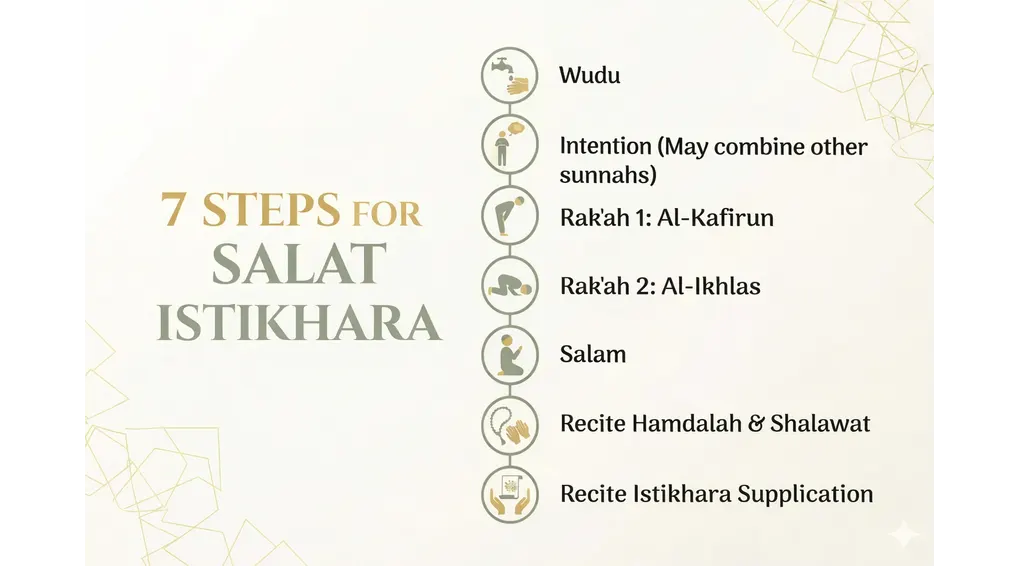
To ensure practical ease, follow this structured sequence:
- Wudu: Perform ablution perfectly. Understanding the linguistic and technical meaning of Wudhu enhances your spiritual readiness.
- Intention: Formulate the intention for a voluntary prayer (either specifically for Istikhara or combined with another Sunnah prayer).
- Takbiratul Ihram: Commence the prayer with the opening Takbir and recite Al-Fatihah. Knowing the profound meaning of Takbiratul Ihram is essential for valid prayer.
- First Rakaat: Recite Surah Al-Kafirun.
- Second Rakaat: Recite Surah Al-Ikhlas.
- Salam: Conclude the prayer. While there are specific supplications before the Salam, the primary Istikhara dua is recited after.
- The Dua: Begin by praising Allah (Hamdalah) and sending blessings upon the Prophet ﷺ (Shalawat). Then, recite the complete Istikhara dua provided above, and conclude once again with Shalawat. To maximize the acceptance of your prayer, ensure you observe the proper etiquette of making Dua.
Is it Permissible to Perform Istikhara Without the Prayer?




Imam An-Nawawi provides a crucial dispensation for those physically unable to pray (e.g., women experiencing menstruation or postnatal bleeding). He states: “If someone is prevented from praying, they may perform Istikhara utilizing the supplication alone.” Therefore, a temporary physical barrier is absolutely no excuse to abandon seeking Allah’s divine guidance. Simply recite the supplication with immense humility (khushu’).
Dispelling the Myth: Must the Answer Come Through a Dream?

A widespread misconception dictates that following Salat al-Istikhara, an individual will instantaneously experience a vivid dream revealing specific colors or future events. However, Imam An-Nawawi elucidates an entirely different, more grounded concept.
In his precise explanation, he writes: “After performing Istikhara, a person should proceed with that towards which their heart feels expansive (inclines towards and finds peace in).”
Therefore, the definitive answer to Salat al-Istikhara manifests as an internal firmness of the heart (insyirah as-sadr) and the external facilitation of the process. If the intended matter contains goodness, the heart will discover profound tranquility, and the path will be made remarkably smooth. Conversely, if it harbors evil, the heart will experience relentless agitation, or insurmountable obstacles will continuously divert you away from that specific matter.
Frequently Asked Questions (FAQ) Regarding Istikhara
Here are some frequently asked questions regarding this topic:
When is the absolute best time to perform Salat al-Istikhara?
The most optimal time is during the final third of the night, when the atmosphere is perfectly still and divine mercy descends. However, this prayer is entirely valid when performed at any time of the day or night, provided it is not during the strictly prohibited times for prayer (e.g., exactly at sunrise or sunset).
Is it a mandatory requirement to sleep immediately before or after performing Salat al-Istikhara?
There is absolutely no requirement to sleep. This is fundamentally different from the Tahajjud prayer. You may perform it immediately after the Isha prayer or whenever you possess free time and mental clarity.
What should be done if, after performing the prayer, the heart remains consumed by doubt?
Repeat the process. Based on scholarly recommendation, repeating the supplication significantly increases spiritual proximity and clarity of heart. Continue to perform it until you experience a powerful, undeniable inclination toward one of the choices.
Conclusion
We sincerely hope this rigorous explanation derived from Kitab Al-Adhkar provides profound clarity for those currently engulfed in confusion. Always remember, when we wholly surrender our intricate affairs to the Essence Who is All-Knowing, we will never, ever face disappointment. May you successfully practice this beautiful supplication, and may Allah decree the absolute best choice for your life!
Reference
Al-Nawawī, Yaḥyā ibn Sharaf. Al-Adhkār. Edited by ʿAbd al-Qādir al-Arnaʾūṭ. New revised edition. Beirut: Dār al-Fikr, 1994.


