
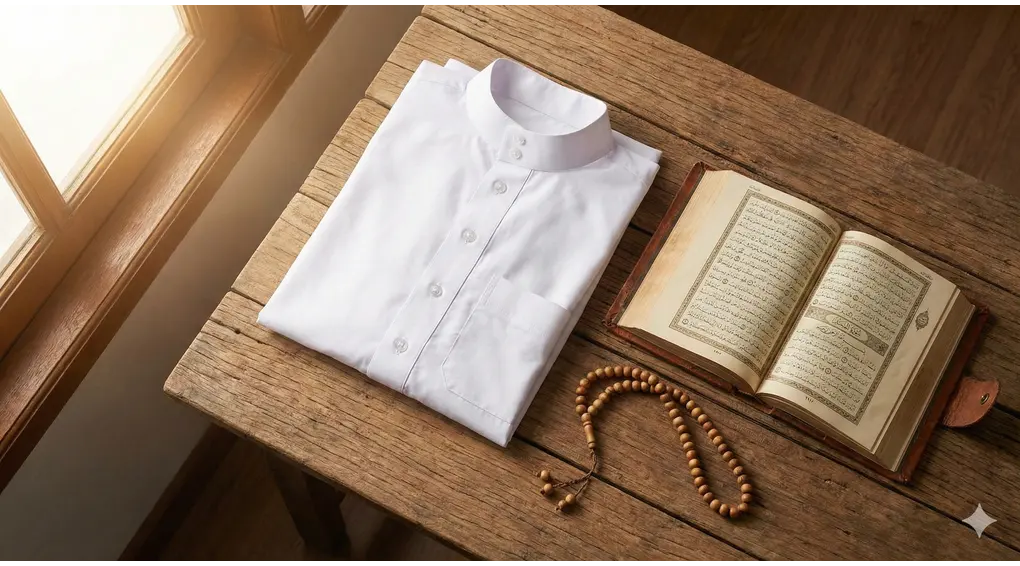
We all engage in this activity every single day: waking up, taking a shower, and selecting clothes to wear. Whether it is a work uniform, casual attire, or a modest garment for prayer, this routine is so deeply embedded in our lives that it often passes by without much thought. However, Islam is a remarkably detailed religion. Even seemingly trivial actions, such as how to insert your arm into a sleeve, are governed by specific guidelines.
Mastering the Islamic etiquette of dressing transforms a mundane daily habit into an act of worship. Imam Al-Nawawi, a prominent classical scholar whose works serve as a primary reference for Muslims globally, dedicated a specific chapter to this topic in his monumental book, Al-Adhkar. He goes beyond discussing clothing styles, focusing primarily on how we treat our bodies and garments as a profound manifestation of faith.
This article will comprehensively explore the Islamic etiquette of dressing, elucidate why the right side holds such distinction, and demonstrate how short supplications taught by the Prophet Muhammad ﷺ can turn daily routines into abundant sources of divine reward.
The Concept of At-Tayamun: Why Right and Left Matter
Before delving into the practical steps of dressing, we must first understand the underlying philosophy. Why must we start with the right? Why is it not simply left to personal preference?
In Islamic jurisprudence, there is a fundamental concept known as At-Tayamun. This refers to the active inclination to prioritize the right side in matters that are dignified, noble, and clean. Imam Al-Nawawi, in Al-Adhkar (p. 21), provides a golden principle that is highly beneficial to adhere to:
يستحب أن يبتدأ في لبس الثوب والنعل والسراويل وشبهها باليمين من كميه ورجلي السراويل ويخلع الأيسر , ثم الأيمن
“It is recommended (sunnah) to begin wearing a shirt, sandals, trousers, and the like with the right side, starting from the right sleeve and the right leg of the trousers. And [when] taking them off, one should start with the left, then the right.”
Division of Bodily Functions
Imam Al-Nawawi details a specific list of activities that should ideally utilize the right hand or commence from the right side. This is not an arbitrary set of rules; rather, it is a divine management of the body’s limbs to maintain balance and align with human nature (fitrah).
Use the Right Side For:
- Putting on clothes (shirts, trousers, socks).
- Putting on footwear (tana’ul).
- Purifying oneself (performing wudu or the major bath).
- Combing hair (tarajjul).
- Clipping nails and trimming the mustache.
- Eating and drinking.
- Entering the mosque.
- Shaking hands.
Use the Left Side For:
- Removing clothes and footwear.
- Exiting the mosque.
- Entering the bathroom/toilet.
- Cleaning oneself after relieving nature (istinja).
The foundation for this division is an authentic hadith narrated by Aisha (may Allah be pleased with her):
كان رسول الله صلى الله عليه وسلم يعجبه التيمن في شأنه كله : في طهوره وترجله وتنعله
“The Messenger of Allah ﷺ loved to start with the right side in all his affairs: in his purification, in his combing, and in his putting on of footwear.” (Narrated by Al-Bukhari and Muslim).
Furthermore, another wife of the Prophet, Hafsah (may Allah be pleased with her), emphasized in a narration by Abu Daud that the Prophet ﷺ reserved his right hand for eating, drinking, and dressing, while reserving his left hand for other things (such as handling impurities).
Step-by-Step Guide to the Islamic Etiquette of Dressing
Let us apply this sequence to ensure our daily dressing routine aligns with the prophetic sunnah. For a broader perspective on all related prayers, you can refer to our complete sunnah guide to dressing supplications.
1. Begin with Intention and Basmalah
The very first step is the “installation” of intention. Do not merely dress out of shyness regarding public appearance; rather, intend to cover your ‘awrah (intimate parts) because Allah has commanded it. Imam Al-Nawawi opens the chapter on clothing with brief yet profound advice:
يستحب أن يقول : بسم الله , وكذلك تستحب التسمية في جميع الأعمال .
“It is recommended to say: Bismillah (In the name of Allah). Likewise, it is recommended to recite the Basmalah in all actions.”
Reciting the Basmalah acts as a spiritual seal. By understanding the profound secrets of the Basmalah, clothes worn in the name of Allah are expected to bring goodness and protection to the wearer throughout the day.
2. Prioritize the Right Side of the Body
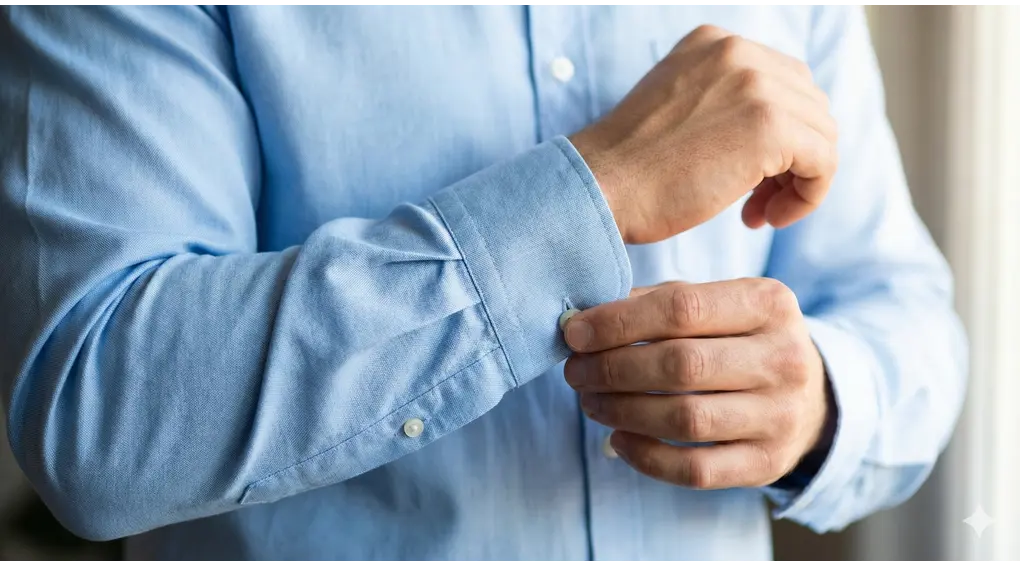
At-Tayamun (prioritizing the right) is a noble prophetic sunnah for initiating all positive activities, including wearing clothes.
When you hold a shirt, insert your right arm first. When putting on trousers, insert your right leg first. Do not reverse this order. This is a strong recommendation from the Prophet ﷺ. As narrated by Abu Hurairah (may Allah be pleased with him):
إذا لبستم , وإذا توضأتم فابدؤوا بأيامنكم
“If you put on clothes, and if you perform ablution, then begin with your right side.” (A Hasan Hadith, narrated by Abu Daud and Tirmidhi).
Habituating this practice may take time for those unaccustomed to it, but it will eventually become a beautiful, rewarding reflex.
3. Accompany the Act with Supplication (Dua)
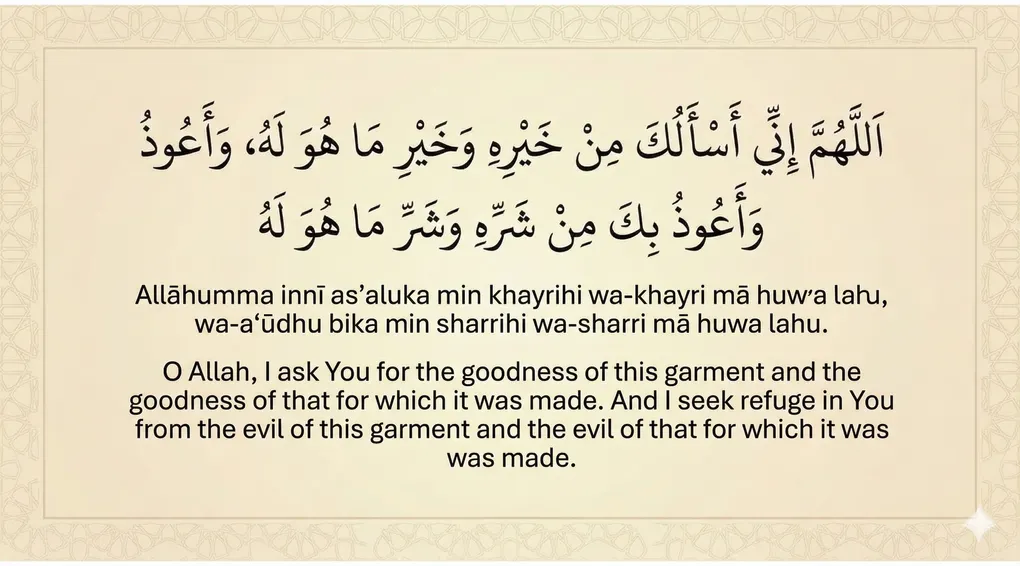
Do not let the act of dressing pass without mindfulness. Accompany it with supplication to invite blessings and divine protection. Depending on whether your garment is old or new, there are different prayers taught by the Prophet ﷺ. You can study the differences between the supplications for old and new clothes to understand the nuances perfectly.
General Supplication (Naming the Garment)
Narrated from Abu Sa’id Al-Khudri, the Prophet ﷺ used to explicitly name his garment (e.g., “this shirt” or “this turban”) and then supplicate:
اللَّهُمَّ إِنِّي أَسْأَلُكَ مِنْ خَيْرِهِ وَخَيْرِ مَا هُوَ لَهُ , وَأَعُوذُ بِكَ مِنْ شَرِّهِ وَشَرِّ مَا هُوَ لَهُ
Allāhumma innī as’aluka min khayrihi wa khayri mā huwa lahu, wa a‘ūdhu bika min sharrihi wa sharri mā huwa lahu.
“O Allah, I ask You for its goodness and the goodness of what it was made for, and I seek refuge in You from its evil and the evil of what it was made for.”
Specific Supplication for New Clothes (Forgiveness of Sins)
If the clothing you are wearing is brand new, there is an immense bonus reward of forgiveness if you recite the prayer narrated by Mu’adz bin Anas:
الْحَمْدُ لِلَّهِ الَّذِي كَسَانِي هَذَا وَرَزَقَنِيهِ مِنْ غَيْرِ حَوْلٍ مِنِّي وَلَا قُوَّةٍ
Al-ḥamdu lillāhi alladhī kasānī hādhā wa razaqanīhi min ghayri ḥawlin minnī wa lā quwwah.
“All praise is due to Allah who has clothed me with this and provided it for me without any strength or power on my part.”
Whoever recites this will have “their past sins forgiven.” This supplication carries extraordinary virtue. For an in-depth explanation of its meaning, read our article regarding the virtues of the Alhamdulillahilladhi Kasani Hadha prayer.
The Etiquette of Removing Clothes: The Reverse Rule
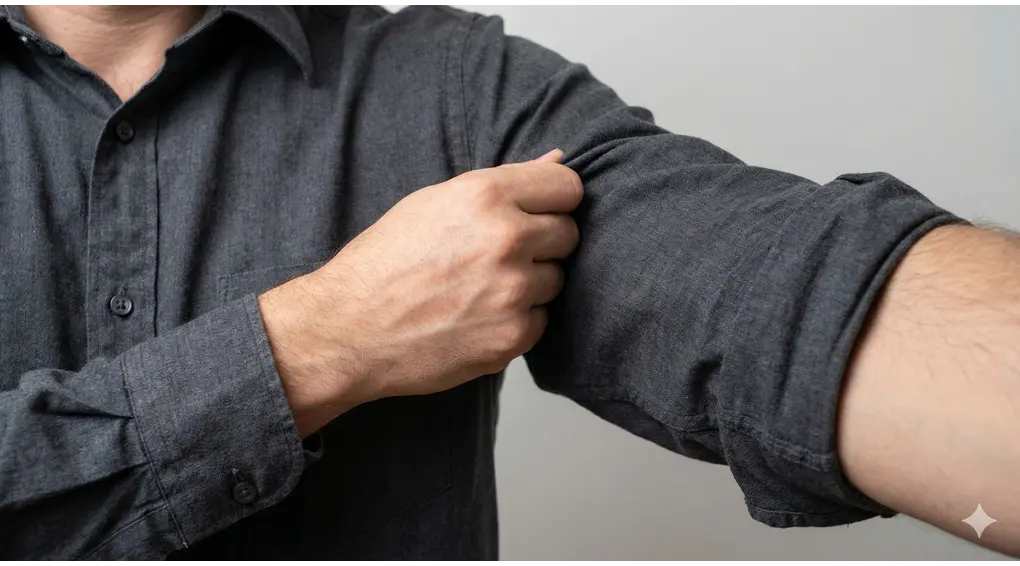
As a form of honoring the right side, the sunnah instructs us to begin removing our clothes from the left side of the body.
If wearing begins with the right, then removing must begin with the left. Why? Scholars explain that this is a tangible display of respect for the right side. The right side is “honored” by being clothed first and unclothed last, ensuring that the presence of the clothing (which is a divine blessing) remains longer on the right limbs.
The correct sequence is:
- Remove the left arm or left leg first.
- Followed by the right arm or right leg.
Supplication for Removing Clothes: An Unseen Shield
Have you ever felt anxious or paranoid when changing clothes alone? Islam teaches that we coexist with unseen entities (Jinn). They can see us, but we cannot see them. However, the Prophet ﷺ provided advanced spiritual “technology” to block their vision.
In a hadith narrated by Anas bin Malik (may Allah be pleased with him), the Messenger of Allah ﷺ said:
ستر ما بين أعين الجن وعورات بني آدم أن يقول الرجل المسلم إذا أراد أن يطرح ثيابه : بسم الله الذي لا إله إلا هو
“The screen between the eyes of the jinn and the intimate parts (‘awrah) of the children of Adam is that when a Muslim man wants to take off his clothes, he says: Bismillahilladhi laa ilaha illa huwa (In the name of Allah, other than Whom there is no deity).”
This phrase acts as an impenetrable, unseen curtain, ensuring complete privacy from the unseen realm.
Social Etiquette: When Seeing Others in New Clothes
The Islamic etiquette of dressing extends beyond personal practice. As social beings, we frequently see friends or family members wearing new outfits. How should we respond? With envy, or with empty flattery? The sunnah teaches us to actively pray for them, forging strong bonds of affection.
1. Supplication for a Long Life (The Story of Ummu Khalid)
In an authentic hadith from Al-Bukhari, the Prophet ﷺ was once given a garment with black patterns. He called for a young girl named Ummu Khalid, dressed her in it, and said:
أبلي، وأخلقي
“Abli, wa Akhliqi” (Wear it out, and tear it).
He repeated this twice. The phrase “wear it out” is a beautiful metaphorical prayer asking Allah to grant the wearer a long life, allowing them enough time to naturally wear out their new garment.
2. Supplication for a Praiseworthy Life and Martyrdom
When the Prophet ﷺ saw Umar bin Al-Khattab wearing a garment, he asked: “Is this new or washed?” Umar replied: “Washed.” Despite it not being new, the Prophet ﷺ still prayed for him:
البس جديدا , وعش حميدا , ومت شهيدا
“Ilbas jadīdan, wa ‘ish ḥamīdan, wa mut shahīdan.“ (Wear new clothes, live praiseworthily, and die as a martyr).
This is an exceptionally comprehensive prayer: asking for worldly prosperity (new clothes), noble character (a praiseworthy life), and the finest possible end (martyrdom).
Do Not Forget to Give Clothes in Charity
Our wardrobes are often overflowing, yet we continuously purchase new clothing. Imam Al-Nawawi cites a narration from Umar bin Al-Khattab that provides a perfect spiritual solution for this consumerism.
If you buy a new piece of clothing, and then take an older, slightly worn (akhlaq) garment of yours and give it in charity, you will receive a guarantee of divine protection:
كان في حفظ الله وفي كنف الله عز وجل , وفي سبيل الله حيا وميتا
“He will be in the safekeeping of Allah, under the protection of Allah Almighty, and in the path of Allah, both while living and when dead.”
Therefore, establish a personal rule: One In, One Out. Buy one new item, donate one old item.
Summary Table of the Etiquette of Dressing
To make it easier to remember, here is a quick-reference summary table:
| Activity | Body Part | Prayer Recitation / Dhikr | Description |
| Intention | Heart | – | Intention to cover the aurah for the sake of Allah Ta’ala. |
| Starting to Wear | Right Side | Bismillah | For all types of clothing/accessories. |
| Finished Wearing | – | Allahumma inni as’aluka min khairihi… | Prayer asking for the goodness of the clothing. |
| Wearing New Clothes | Right Side | Alhamdulillahilladhi kasani hadha… | Virtue: Past sins are forgiven. |
| Removing | Left Side | Bismillahilladhi laa ilaha illa huwa | So that the aurah is not seen by Jinn. |
| Seeing a Friend | Tongue | Ilbas jadidan, wa ‘ish hamidan… | Praying for goodness for others. |
FAQ (Frequently Asked Questions)
Is starting with the right side obligatory (wajib) or highly recommended (sunnah)?
The vast majority of scholars hold that starting with the right side when dressing is a sunnah (highly recommended practice), not an absolute obligation. This means if you forget and start with the left, you have not committed a sin, but you miss out on the reward of the sunnah. However, Imam Al-Nawawi emphasized that the Prophet ﷺ “loved” (yu’jibuhu) doing this, highlighting its profound importance.
What about left-handed people?
This sunnah rule applies universally, including to left-handed individuals. The right hand possesses a legislated nobility (sharaf) in Islam that is independent of a person’s dominant hand. Therefore, left-handed people are still strongly encouraged to eat and dress starting with their right side.
Does the prayer for removing clothes need to be said out loud?
No, it does not. It is sufficient to utter it softly so that only you can hear it. The primary objective is dhikr (remembrance of Allah) and seeking spiritual protection.
Does this rule apply to socks and shoes?
Yes, absolutely. In the principles detailed by Imam Al-Nawawi, he specifically mentions “an-na’l” (sandals/shoes) and “asy-syabah” (similar items). Therefore, putting on socks, shoes, gloves, and even watches should ideally begin with the right side.
Is it permissible to say these prayers in English or my native language?
Supplicating in Arabic, exactly as transmitted in the hadith text, is the most superior (afdhal). However, if you have not memorized them or find pronunciation difficult, praying in your native language with the same meaning is entirely permissible, especially for general supplications. Yet, for specific dhikr phrases (like Bismillah), it is highly recommended to maintain the original Arabic.
Conclusion
Let us begin today by implementing small, meaningful changes. Pay attention to which hand moves first when reaching for your shirt. Utter the prayer of protection when taking off your work clothes. These minor adjustments, when practiced consistently, will elevate your ordinary daily activities into acts of worship highly valued in the sight of Allah. Master the Islamic etiquette of dressing, and wrap yourself not just in fabric, but in divine blessings.
Reference
Al-Nawawī, Yaḥyā ibn Sharaf. Al-Adhkār. Edited by ʿAbd al-Qādir al-Arnaʾūṭ. New revised edition. Beirut: Dār al-Fikr, 1994.


