
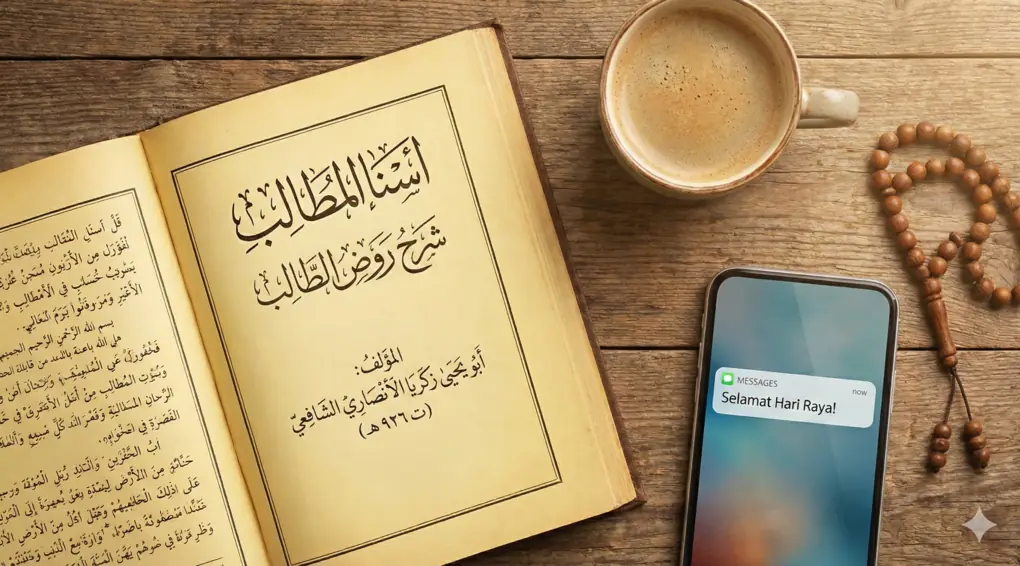
Whenever the Islamic New Year arrives or Eid approaches, family WhatsApp groups and social media platforms are immediately filled with festive messages. While many enthusiastically send their greetings, others hesitate or fear falling into religious innovation (bidʿah). The classic question arises: “Is there a prophetic guidance for this practice?”
This hesitation is a natural manifestation of caution in religious practice. However, the Islamic intellectual tradition is vast and deeply nuanced. Before hastily judging a widespread custom, it is essential to consult the classical works of the Shafi’i school to examine the fundamental concepts of Islamic jurisprudence (Fiqh) regarding the act of giving congratulations, known academically as Tahni’ah.
This article will comprehensively explore the legal status of Tahni’ah in Islam, the textual evidences utilized by Hadith scholars, and the proper etiquette of offering congratulations, drawing primarily from the esteemed texts Asnā al-Maṭālib and Al-Kawkab al-Wahhāj.
What is Tahni’ah? Understanding the Linguistic Roots
Before delving into the legal rulings, it is crucial to establish the definition of Tahni’ah. The classical commentary Al-Kawkab al-Wahhāj Sharḥ Ṣaḥīḥ Muslim provides a profound linguistic explanation.
Tahni’ah is the conceptual opposite of Taʿziyah (offering condolences). If taʿziyah aims to console a grieving person to strengthen them during a calamity, tahni’ah is the act of supplicating for a joyous person so that their happiness becomes blessed.
The term is derived from the root word Hanaʾa, which signifies ease or something pleasant devoid of hardship.
هنؤ الشيء… هناءة… تيسر من غير مشقة ولا عناء فهو هنيء1
“Hanuʾa al-shayʾu… hanāʾah… (meaning) a thing became easy without difficulty or exhaustion, thus it is haniʾ (pleasant/enjoyable).”
Therefore, when you say “Happy Eid” or “Congratulations on your achievement” to a fellow Muslim, you are essentially praying: “May this blessing bring you ease, not hardship.” This is an inherently beautiful supplication.
Scholars’ Perspectives: Is Tahni’ah in Islam Mubah or Mashru’?
Did the practice of giving specific seasonal congratulations exist during the time of the Prophet ﷺ? In Asnā al-Maṭālib (Vol. 1, p. 283), Shaykh Zakariyya al-Ansari cites a fascinating scholarly discourse.
Initially, Shaykh al-Qamuli noted that he did not find explicit texts from the early Shafi’i authorities (Ashāb) regarding annual or monthly congratulations. Due to this absence of explicit early texts, later scholars utilized legal deduction (istinbāṭ) to determine its ruling, resulting in two primary perspectives:
1. The View of al-Hafiz al-Maqdisi: It is Mubāḥ (Permissible)
The first perspective comes from al-Hafiz al-Maqdisi. Observing the reality that human customs frequently vary regarding greetings, he categorized the act as Mubāḥ.
الذي أراه أنه مباح لا سنة فيه ولا بدعة
“My view is that it is mubāḥ (permissible); there is no specific sunnah in it, nor is it a bidʿah (innovation).”
In this view, it is regarded simply as a permissible human custom (ʿādah). Performing it incurs no sin, and omitting it causes no harm.
2. The View of Ibn Hajar al-Asqalani: It is Mashrūʿ (Prescribed/Recommended)
The second—and stronger—view originates from the “Commander of the Faithful in Hadith,” Ibn Hajar al-Asqalani. He elevated the ruling beyond mere custom, stating that offering congratulations is Mashrūʿ (prescribed or legislated in the religion).
وأجاب عنه شيخنا حافظ عصره الشهاب ابن حجر بعد اطلاعه على ذلك بأنها مشروعة
“And our teacher, the Hafiz of his era, Shihab al-Din Ibn Hajar, answered the matter after reviewing it, stating that it (congratulating) is mashrūʿ.”
Ibn Hajar’s assertion that it holds religious merit is backed by solid legal reasoning and scriptural evidence.
The Evidences Supporting Islamic Greetings
Ibn Hajar employed both analogical deduction (qiyās) and Hadith narrations to substantiate his ruling.
1. The Narrations of Imam al-Bayhaqi




Imam al-Bayhaqi dedicated a specific chapter to the greetings exchanged by people during Eid: “Taqabbalallāhu minnā wa minkum” (May Allah accept from us and from you). While individual chains of transmission for these reports might be weak (ḍaʿīf), their sheer multitude reinforces one another, rendering them suitable as evidence (ḥujjah) for virtuous deeds (faḍāʾil al-aʿmāl). This effectively refutes the claim that the practice lacks any foundation.
2. Analogy (Qiyās) with Sujud al-Shukr and Taʿziyah
Ibn Hajar constructed a brilliant legal framework based on analogy:
ويحتج لعموم التهنئة لما يحدث من نعمة أو يندفع من نقمة بمشروعية سجود الشكر والتعزية
“And the general practice of congratulating for a newly acquired blessing or a repelled calamity is evidenced by the legislation of the Prostration of Gratitude (Sujud al-Shukr) and Condolences (Taʿziyah).”
The logical sequence is as follows:
- When we receive a blessing or avoid a disaster, it is Sunnah to perform Sujud al-Shukr.
- When a fellow Muslim faces a calamity, it is Sunnah to offer Taʿziyah (consolation).
- Consequently, when a fellow Muslim receives a blessing (such as Eid or a new year), it is highly appropriate to congratulate them as a form of moral support, just as we console them in sorrow.
3. The Story of Kaʿb ibn Malik and Talhah (The Strongest Evidence)

The ultimate evidence is found in the Ṣaḥīḥayn (Bukhari and Muslim), recounting the repentance of the companion Kaʿb ibn Malik, who was temporarily boycotted for missing the Expedition of Tabuk. When the divine revelation confirming his repentance arrived, Kaʿb entered the Prophet’s Mosque with a radiant face.
قام إليه طلحة بن عبيد الله فهنأه2
“Talhah ibn Ubaydillah stood up, went to him, and congratulated him (upon the acceptance of his repentance).”
The critical juristic point here is that the Prophet ﷺ was present, witnessed the event, and remained silent. The Prophet’s tacit approval (taqrīr) serves as definitive proof that congratulating someone for a religious success or worldly blessing is a commendable act.
The Etiquette and Wisdom of Giving Congratulations

Beyond the legal rulings, Al-Kawkab al-Wahhāj highlights the profound ethical and social wisdom behind the tahni’ah. Why does the Shari’ah encourage this?
Purifying the Heart (Taṣfiyat al-Qalb): This is a profound psychological insight. Witnessing another’s success can sometimes trigger envy. By forcing the tongue to articulate “Congratulations,” a Muslim actively cleanses their heart from the disease of envy (ḥasad), replacing it with a sincere supplication.
Manifesting Joy (Iẓhār al-Surūr): Congratulating someone is the ultimate expression of happiness for the blessings bestowed upon our brethren. It actively trains the soul against selfishness.
فإنه إظهار السرور بما يسر به أخوه المسلم وإظهار المحبة وتصفية القلب بالمودة3
“For indeed, it is the manifestation of joy for what makes his Muslim brother happy, the display of love, and the purification of the heart through affection.”
Sunnah in Religious Matters: The scholars specify that if the congratulations pertain to a religious matter (such as accepted repentance, Eid, or completing the Quran), the ruling elevates to Mandūb (Sunnah/Recommended). Conversely, for purely worldly matters, it remains Jāʾiz (Permissible).
Summary Table of Tahni’ah Rulings
To easily grasp the varying scholarly opinions discussed above, please refer to the following summary table:
| Scholar’s View | Legal Status | Primary Reasoning |
| Al-Hafiz al-Maqdisi | Mubāḥ (Permissible) | Considered a human custom that naturally varies. There is no specific prohibition nor an explicit command. |
| Ibn Hajar al-Asqalani | Mashrūʿ (Prescribed) | Analogized with the Sunnah of Sujud al-Shukr and Taʿziyah. Evidenced by the Hadith of Kaʿb ibn Malik. |
| M. al-Amin al-Harari | Mandūb (Recommended) | Specifically for religious matters, as it contains elements of Iẓhār al-Surūr (manifesting joy) and strengthens brotherhood. |
FAQ: Frequently Asked Questions About Greetings
Here are some frequently asked questions regarding this topic:
Is it permissible to say “Happy Islamic New Year”?
Based on the juristic deduction of Ibn Hajar in Asnā al-Maṭālib, this is considered mashrūʿ (prescribed). The changing of the year is a blessing of time (“a newly acquired blessing”) that deserves gratitude, analogized with the circumstances requiring Sujud al-Shukr.
What is the most authentic phrase to use for Islamic congratulations?
There is no rigid, mandatory wording. However, the Companions exemplified the supplication: “Taqabbalallāhu minnā wa minkum” (May Allah accept [good deeds] from us and from you). You may also use your native language, such as saying, “May this year bring immense blessings.”
Is the act of giving congratulations considered an evil bidʿah (innovation)?
Referring to the classical explanations above, the majority of Shafi’i authorities, including Ibn Hajar, firmly reject the notion that it is a blameworthy bidʿah. On the contrary, it possesses a strong foundation in the actions of the Companions (āthār) and the tacit approval (taqrīr) of the Prophet ﷺ.
Closing
From the comprehensive academic discourse above, it is evident that the tradition of exchanging congratulations is deeply rooted in Islamic jurisprudence. It is far from mere pleasantries; rather, it is a profound social act of worship designed to unify hearts and spread sincere supplications.
Just as Talhah ibn Ubaydillah hastened to congratulate Kaʿb ibn Malik, we are taught to be highly responsive to the happiness of others. Therefore, do not hesitate to spread prayers and congratulations to your family, friends, and fellow Muslims.
Wallāhu aʿlam bi al-ṣawāb (And Allah knows best).
Reference
- Muhammad al-Amīn al-Uramī al-Hararī, Syarḥ Ṣaḥīḥ Muslim (al-Kaukab al-Wahhāj wa al-Raudh al-Bahhāj), jil. 25 (Riyadh–Beirut: Dar al-Minhāj–Dar Thauq an-Najāh, 1430 H), hlm. 281. ↩︎
- Zakariyā al-Anṣārī, Asnā al-Maṭālib fī Sharḥ Rawḍ al-Ṭālib, dengan ḥāsyiyah oleh Aḥmad al-Ramlī, disunting oleh Muḥammad az-Zuhrī al-Ghamrāwī (Kairo: al-Maṭbaʿah al-Maymānīyah, 1313 H; repr. Dār al-Kitāb al-Islāmī), juz 1, hlm. 283. ↩︎
- Muhammad al-Amīn al-Uramī al-Hararī, Syarḥ Ṣaḥīḥ Muslim (al-Kaukab al-Wahhāj wa al-Raudh al-Bahhāj), jil. 25 (Riyadh–Beirut: Dar al-Minhāj–Dar Thauq an-Najāh, 1430 H), hlm. 281. ↩︎


