

For a Muslim, prayer is the most intimate moment to communicate with the Creator. One of the sunnahs that we often practice at the beginning of prayer is reciting the iftitah. However, did you know that there are many variations of the iftitah recitation taught by the Prophet? In fact, under certain conditions, we are allowed to combine several prayers at once.
Read also: Understanding the Meaning of Prayer: Lexical Meaning and Terms in Islam
This article will comprehensively review the do’a iftitah prayer, starting from its definition, fiqh law, the Arabic text of the do’a iftitah, to a guide for those who want to read the long version when praying alone.
Understanding the Iftitah: A Supplication or a Declaration?
In terminology, the understanding of the do’a iftitah is a sunnah reading recited as an opening to the prayer. Its position is very specific, as the do’a iftitah is read after the Takbiratul Iḥrām and before reciting Surah Al-Fatihah.
There is an interesting discussion in the book I’anah ath-Thalibin regarding this term. Linguistically, “supplication” (doa) means a request (thalab). However, the popular opening supplications (iftitah) such as Wajjahtu wajhiya contain more declarations and praise, rather than requests.
Imam Al-Ajhuri explained that the mention of “supplication” here is metaphorical (majaz). Although the content is a pledge, Allah still gives reward as Allah rewards those who supplicate. Meanwhile, Imam Al-Hafnawi argued that it is called “supplication” because of looking at another narration containing a request for forgiveness, such as Allahumma ba’id baini….
The Fiqh Rulings of Reciting the Iftitah Prayer
Referring to the book Asna al-Matalib by Sheikh Zakariyya al-Ansari1, the ruling on reciting the iftitah supplication is sunnah (recommended). Both in obligatory (fardhu) prayers and voluntary (nafilah) prayers, reciting it will perfect the reward of our prayers.
However, the ruling of this Sunnah can be invalidated or is not recommended under the following conditions:
- Limited Time: If the time for prayer is running short, it is obligatory to prioritize Al-Fatihah (a pillar) over iftitah (a sunnah).
- Masbuq (Latecomer): If you fear missing Al-Fatihah because the Imam is about to bow, then the requirements for the opening supplication (dua iftitah) are not met. Immediately recite Al-Fatihah.
- Imam Sitting: If the imam is sitting when the prayer begins, immediately say takbir and join him in sitting.
- Funeral Prayer: There is no recommendation for an opening supplication (iftitah) because this prayer requires brevity (takhfif).
Three Authentic Variations of the Iftitah Prayer
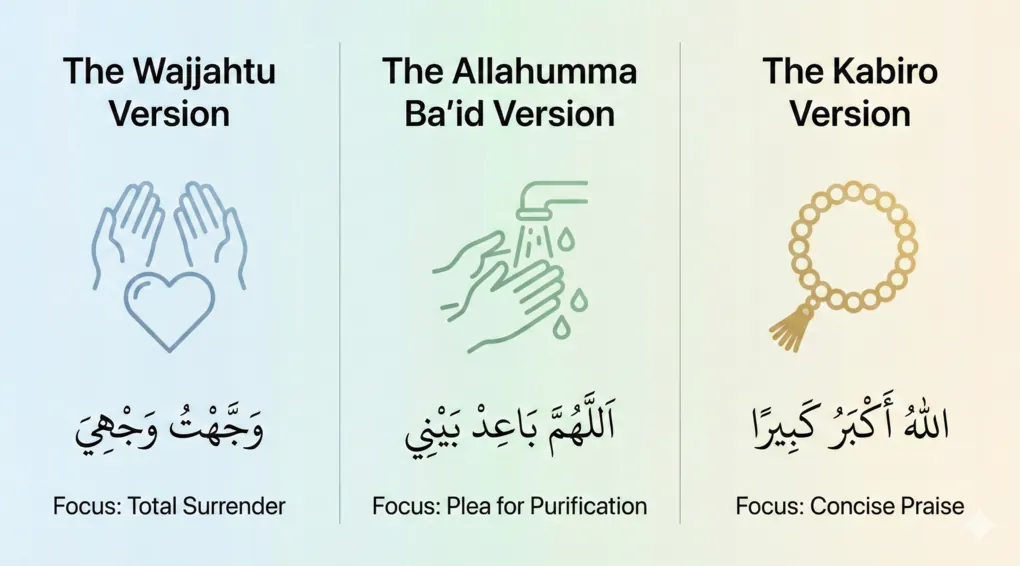
The Messenger of Allah ﷺ taught various recitations. You are free to choose one, but understanding the differences will broaden our knowledge. Here are the options for the iftitah prayer along with their meanings:
1. The Wajjahtu Version: The Declaration of Total Surrender
This authentic variation is predominantly followed by the Shafi’i school of jurisprudence, and is therefore widely practiced by Nahdlatul Ulama (NU) congregations. The supplication itself is a breathtaking declaration of a servant’s total surrender to Allah.
Arabic Text:
وَجَّهْتُ وَجْهِيَ لِلَّذِي فَطَرَ السَّمَاوَاتِ وَالْأَرْضَ حَنِيفًا مُسْلِمًا وَمَا أَنَا مِنَ الْمُشْرِكِينَ. إِنَّ صَلَاتِي وَنُسُكِي وَمَحْيَايَ وَمَمَاتِي لِلَّهِ رَبِّ الْعَالَمِينَ. لَا شَرِيكَ لَهُ وَبِذَلِكَ أُمِرْتُ وَأَنَا مِنَ الْمُسْلِمِينَ
Transliteration and Meaning:
Wajjahtu wajhiya li-lladhī faṭara al-samāwāti wa al-arḍa ḥanīfan musliman wa mā anā mina al-mushrikīn.
Inna ṣalātī wa nusukī wa maḥyāya wa mamātī li-llāhi rabbi al-‘ālamīn.
Lā sharīka lah, wa bidhālika umirtu wa anā mina al-muslimīn.
“I direct my face toward the One who created the heavens and the earth, in a state of straightness and submission (Muslim), and I am not among the polytheists.
Indeed, my prayer, my worship, my life, and my death are for Allah, Lord of the worlds.
He has no partner, thus I am commanded, and I am among the Muslims.”
Note: In Asna al-Matalib, it is recommended to recite Wa ana minal muslimin (not awwalul muslimin), because the phrase “the first to surrender/become Muslim” is specific to the Prophet Muhammad ﷺ.
2. The Allahumma Ba’id Version: A Plea for Purification
This authentic variation, narrated in Sahih Bukhari and Muslim, is the primary choice for followers of the Muhammadiyah movement in Indonesia. The wording of this supplication focuses heavily on seeking profound forgiveness and total purification from sins.
Original Arabic Text:
اللَّهُمَّ بَاعِدْ بَيْنِي وَبَيْنَ خَطَايَايَ كَمَا بَاعَدْتَ بَيْنَ الْمَشْرِقِ وَالْمَغْرِبِ , اللَّهُمَّ نَقِّنِي مِنْ خَطَايَايَ كَمَا يُنَقَّى الثَّوْبُ الْأَبْيَضُ مِنَ الدَّنَسِ , اللَّهُمَّ اغْسِلْنِي مِنْ خَطَايَايَ بِالْمَاءِ وَالثَّلْجِ وَالْبَرَدِ
Transliteration and Meaning:
Allāhumma bā‘id baynī wa bayna khaṭāyāya kamā bā‘adta bayna al-mashriqi wa al-maghrib.
Allāhumma naqqinī min khaṭāyāya kamā yunaqqā al-thawbu al-abyaḍu mina al-danas.
Allāhumma ighsilnī min khaṭāyāya bi al-mā’i wa al-thalji wa al-barad.
“O Allah, distance me from my sins as You have distanced the east from the west.
O Allah, cleanse me of my sins as a white garment is cleansed of dirt.
O Allah, cleanse me of my sins with water, snow, and dew.
3. The Allahu Akbar Kabira Version: A Concise Declaration of Praise



This concise variation is highly practical for beginners or when congregating behind an Imam who adopts a swifter pace. Despite its brevity, the wording of this Iftitah is profoundly majestic.
Arabic Opening Prayer:
اللهُ أَكْبَرُ كَبِيرًا , وَالْحَمْدُ لِلَّهِ كَثِيرًا , وَسُبْحَانَ اللهِ بُكْرَةً وَأَصِيلًا
Transliteration and Meaning:
Allāhu akbaru kabīrā, wa al-ḥamdu li-llāhi kathīrā, wa subḥāna llāhi bukratan wa aṣīlā.
“Allah is the Greatest with all His greatness, all praise is due to Allah with abundant praise, and Glorified is Allah throughout the morning and evening.”
The Permissibility of Combining Multiple Iftitah Variations
A common question arises: is it permissible to recite Allahu Akbar Kabira, seamlessly transition into Wajjahtu, and conclude with Allahumma Ba’id within a single prayer?
The answer is unequivocally yes—it is both permissible and highly recommended under specific conditions.
According to the authoritative text Asna al-Matalib, prolonging the opening supplication by combining these narrations is deeply encouraged for a Munfarid (an individual praying alone) or an Imam who is absolutely certain that his congregation consents to a lengthier prayer.
Sheikh Zakariyya al-Ansari elucidated this principle:
“And for someone praying alone, or an Imam who knows the contentment of their followers, it is permissible to add (other recitations)…”
How to Combine the Supplications

When praying alone (such as during the late-night Tahajjud or other voluntary prayers), you can maximize your divine reward by structuring your Iftitah as follows:
- Begin with the concise praise of the Kabira variation (Allāhu akbar kabīrā…).
- Transition seamlessly into the declaration of surrender using the Wajjahtu variation.
- Conclude by adding supplications from other authentic narrations, such as the plea for forgiveness (Allāhumma bā’id…) or the extended prayer “Allāhumma Antal Malik lā ilāha illā Anta..”
اللَّهُمَّ أَنْتَ الْمَلِكُ لَا إِلَهَ إِلَّا أَنْتَ، أَنْتَ رَبِّي وَأَنَا عَبْدُكَ، ظَلَمْتُ نَفْسِي وَاعْتَرَفْتُ بِذَنْبِي فَاغْفِرْ لِي ذُنُوبِي جَمِيعًا، إِنَّهُ لَا يَغْفِرُ الذُّنُوبَ إِلَّا أَنْتَ، وَاهْدِنِي لِأَحْسَنِ الْأَخْلَاقِ لَا يَهْدِي لِأَحْسَنِهَا إِلَّا أَنْتَ، وَاصْرِفْ عَنِّي سَيِّئَهَا لَا يَصْرِفُ عَنِّي سَيِّئَهَا إِلَّا أَنْتَ، لَبَّيْكَ وَسَعْدَيْكَ وَالْخَيْرُ كُلُّهُ فِي يَدَيْكَ وَالشَّرُّ لَيْسَ إِلَيْكَ، أَنَا بِكَ وَإِلَيْكَ تَبَارَكْتَ وَتَعَالَيْتَ أَسْتَغْفِرُكَ وَأَتُوبُ إِلَيْكَ
Transliteration & Meaning:
Allāhumma anta al-malik, lā ilāha illā anta. Anta rabbī wa anā ‘abduka. Ẓalamtu nafsī wa‘taraftu bi-dhanbī faghfir lī dhunūbī jamī‘an. Innahu lā yaghfiru al-dhunūba illā anta. Wahdinī li-aḥsani al-akhlāq, lā yahdī li-aḥsani-hā illā anta. Waṣrif ‘annī sayyi’ahā, lā yaṣrifu ‘annī sayyi’ahā illā anta. Labbayka wa sa‘dayk, wa al-khayru kulluhu fī yadayk, wa al-sharru laysa ilayk. Anā bika wa ilayk. Tabārakta wa ta‘ālayta. Astaghfiruka wa atūbu ilayk.
Meaning: “O Allah, You are the Sovereign; there is no deity worthy of worship but You. You are my Lord and I am Your servant. I have wronged myself and I confess my sins, so forgive all my sins; indeed, none forgives sins except You. Guide me to the best of manners, for none guides to the best of them except You. And turn away from me the evil ones, for none turns away the evil ones except You. I am here responding to Your call and ready to obey You. All good is in Your hands, and evil is not attributed to You. I exist by You and to You I shall return. Blessed and Exalted are You. I seek Your forgiveness and repent to You.”
Combining these recitations is an extraordinary form of dhikr and an opportunity to prolong supplication to Allah, as long as it does not violate the rights of others (such as causing the congregation to become bored during communal prayer).
References to Classical Texts
As a form of scientific accountability, here is a verbatim quote from the reference book:
Text from the Asna al-Matalib Book (Regarding Adding Recitation for a Solitary Reciter):
ويزيد المنفرد ومن أي وإمام ( علم رضا مقتديه به اللهم أنت الملك إلى آخره كما في الأصل )2…
Text from the I’anah ath-Thalibin Book (Regarding the Naming of Supplication):
قوله : أي دعاؤهأفاد به أن في الكلام حذف مضاف تقديره ما ذكر … وقال الأجهوري في تسميته : دعاء تجوز , لأن الدعاء طلب وهذا لا طلب فيه , وإنما هو إخبار 3.
Conclusion
Exploring the various authentic texts of the Doa Iftitah enriches our spiritual connection during prayer. Whether you recite the Wajjahtu version, the Allahumma Ba’id narration, or the brief Kabira praise, each offers a unique pathway to glorify Allah. For those praying individually, merging these supplications serves as a powerful means to achieve profound humility and immense reward. May this article assist us in perfecting our Salah.
References & Footnotes
- Zakariyyā al-Anṣārī, Asnā al-Maṭālib fī Sharḥ Rawḍ al-Ṭālib, with a ḥāshiyah by Aḥmad al-Ramlī, ed. Muḥammad az-Zuhrī al-Ghamrāwī (Cairo: al-Maṭbaʿah al-Maymānīyah, 1313 AH; repr., Dār al-Kitāb al-Islāmī), vol. 1, p. 148. ↩︎
- Zakariyyā al-Anṣārī, Asnā al-Maṭālib fī Sharḥ Rawḍ al-Ṭālib, with a ḥāshiyah by Aḥmad al-Ramlī, ed. Muḥammad az-Zuhrī al-Ghamrāwī (Cairo: al-Maṭbaʿah al-Maymānīyah, 1313 AH; repr., Dār al-Kitāb al-Islāmī), vol. 1, p. 149. ↩︎
- ʿUthmān bin Muḥammad Shattā ad-Dimyāṭī (al-Bakrī), Iʿānat aṭ-Ṭālibīn ʿalā Ḥall Alfāẓ Fatḥ al-Muʿīn (Beirut: Dār al-Fikr, 1997), vol. 1, p. 170. ↩︎


