
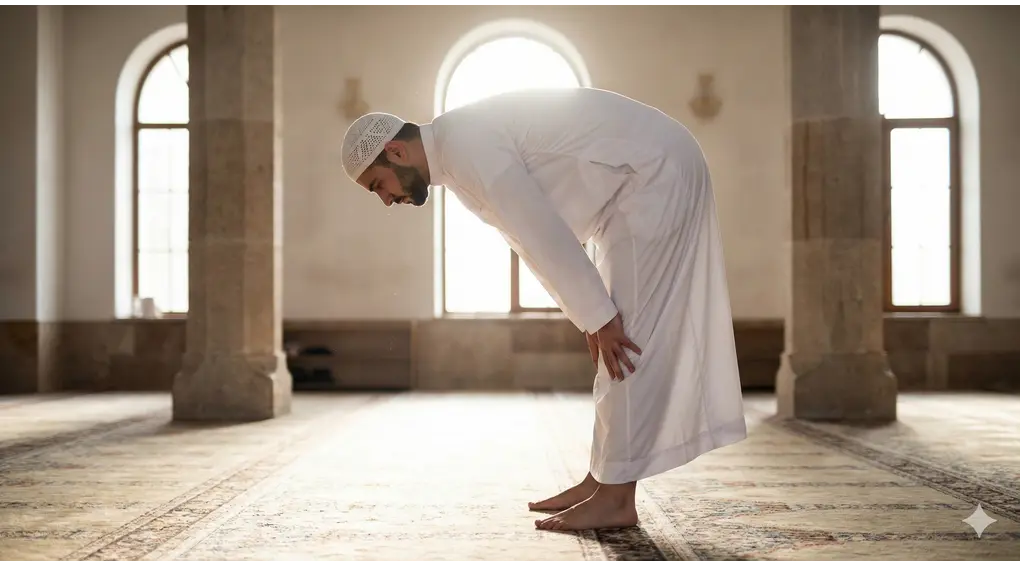
Understanding the meaning of prayer (Salah) is fundamental, as it is the pillar of the Islamic religion. Every movement within it possesses strict rules to ensure it is accepted by Allah ﷻ. One essential pillar that we perform repeatedly, yet sometimes overlook the technical details of, is bowing (rukūʿ).
Many Muslims ask: what is the correct way to perform rukūʿ? Is simply bending the back enough?
This comprehensive guide will discuss everything you need to know about bowing in prayer. We will explore its definition, the conditions (syurūṭ) required for the rukūʿ to be considered valid, and the recommended supplications taught by Prophet Muhammad ﷺ. All explanations are referenced from highly reliable classical texts within the Shafi’i school of Islamic jurisprudence (Fiqh), namely Ḥāshiyatā Qalyūbī wa ‘Umayrah, Al-‘Azīz Syarḥ al-Wajīz, and Nail al-Rajā’.
What is Rukūʿ? (Definition and Essence)
Before delving into the technicalities, we must first define rukūʿ. Linguistically, the word means “to bow” (al-inḥinā’). However, in the terminology of Fiqh, not just any bending motion qualifies as rukūʿ.
In the book Nail al-Rajā’ Syarḥ Safīnat an-Najā, it is detailed:
الْخَامِسُ : الرَّكُوعُ … وهو لغةٌ : الانحناء , وشرعاً : أَن ينحني بلا آنخناس ; بحيث تنالُ يقيناً راحتاه ركبتيه
Meaning: “The fifth Pillar (of prayer) is bowing (rukūʿ). Linguistically, it means to bend. According to Islamic law (shar’an), it means to bow without inkhinās (excessively bending the knees or protruding the chest), to the extent that both palms of the hands can confidently reach both knees.”
Therefore, the rukūʿ in prayer is not merely lowering the head; it requires a specific alignment of the spine and a precise positioning of the hands.
Conditions for a Valid Rukūʿ in Prayer
To ensure our prayers are not in vain, we are obligated to fulfill the strict requirements for a valid rukūʿ. Based on the authoritative text Ḥāshiyatā Qalyūbī wa ‘Umayrah, there are several crucial conditions:
1. Bowing Until the Palms Touch the Knees
For an individual praying while standing with a normal physical constitution (arms that are not disproportionately long or short), the absolute minimum limit of rukūʿ is bending the back until the inner palms can touch the knees.
The book Qalyūbī explains this minimum boundary:
قوله: (وأقله ) أن ينحني قدر بلوغ راحتيه ركبتيه إذا أراد وضعهما عليهما وهو معتدل الخلقة سالم اليدين والركبتين…
Meaning: “(And its minimum) is to bow to the extent that his palms reach his knees when he intends to place them there, assuming he is of average build with healthy hands and knees…”
If we bow, but our hands merely rest on our thighs and cannot reach our knees due to an insufficient bend of the back, then the rukūʿ is invalid. (Note: Exceptions apply to individuals with physical disabilities, similar to the specialized rulings on Wudu for amputees).
2. Abstaining from Inkhinās
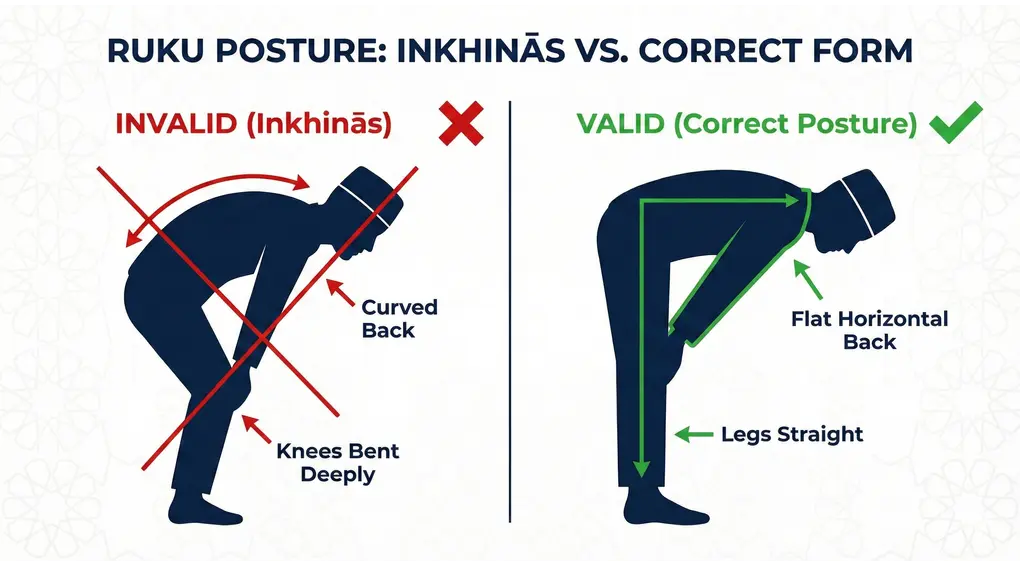
As quoted from Nail al-Rajā’ above, a core condition of rukūʿ is executing it without inkhinās. This means you must not cheat the posture by dropping into a squatting position (bending the knees deeply) or puffing out the chest just to make the hands reach the knees. The descent of the torso must be achieved by hinging at the waist/hips, keeping the legs generally straight.
3. Tuma’ninah (A Moment of Tranquility)

This is a critical pillar that is frequently neglected. A valid rukūʿ requires tumaʾninah. This means that all body parts must come to a complete, still, and calm pause in the rukūʿ position before the worshipper begins to rise for iʿtidāl (standing straight).
قوله: (بطمأنينة بحيث ينفصل رفعه عن هويه ) بأن تستقر أعضاؤه قبل رفعه
Meaning: “(With tuma’ninah, such that his rising is distinctly separate from his descending) by ensuring his limbs are completely settled before he rises.”
If a person performs rukūʿ and immediately bounces back up like a spring without pausing for at least the duration it takes to say “Subhanallah”, their prayer is invalidated.
4. Pure Intention (No Alternative Motives)
The physical movement of descending must be purely intended for performing the rukūʿ of the prayer. For example: If a person is standing in prayer, drops a coin, bends over to pick it up, and while down there thinks, “I will just count this movement as my rukūʿ,” the rukūʿ is invalid. They must return to a full standing position and initiate the bowing motion again with the pure intention (niyyah) of worship.
قوله: (ولا يقصد به غيره ) أي بالهوي غير الركوع … بل عليه أن يعود إلى القيام ثم يركع
Meaning: “(And he must not intend anything else by it) meaning by the descent, anything other than rukūʿ… rather, he must return to standing and then bow.”
The Perfect Procedure for Performing Rukūʿ
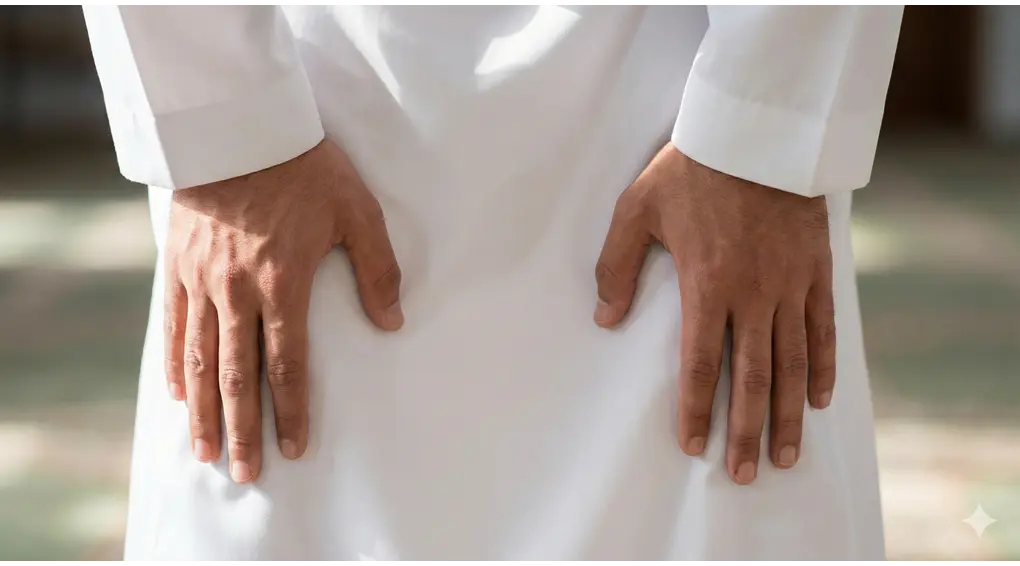
Once the basic conditions of validity are met, a devout Muslim should strive for the perfection (Kamāl) of the posture to maximize their reward. Here is the Prophetic standard for a perfect rukūʿ:
- Back Flat Like a Board: Do not lift your head to look forward, nor tuck your chin entirely to your chest. The back, neck, and head should form a straight, level line.
- Straight Legs: The calves must be straight, and the knees should be pushed back, not bent.
- Clasping the Knees: The hands should not just lightly touch the knees; they should firmly grasp them.
- Spread Fingers: The fingers should be spread apart (not closed tight) and pointing downwards towards the Qibla.
Reference from Qalyūbī:
قوله: (وأكمله تسوية ظهره وعنقه ) كالصفيحة … ( ونصب ساقيه ) … ( وأخذ ركبتيه بيديه وتفرقة أصابعه ) للاتباع
Meaning: “(And its most perfect form is leveling his back and neck) like a flat board… (keeping his lower legs straight)… (and taking hold of his knees with his hands, spreading his fingers) to follow the Sunnah.”
Special Guide: Bowing for Those Praying While Sitting
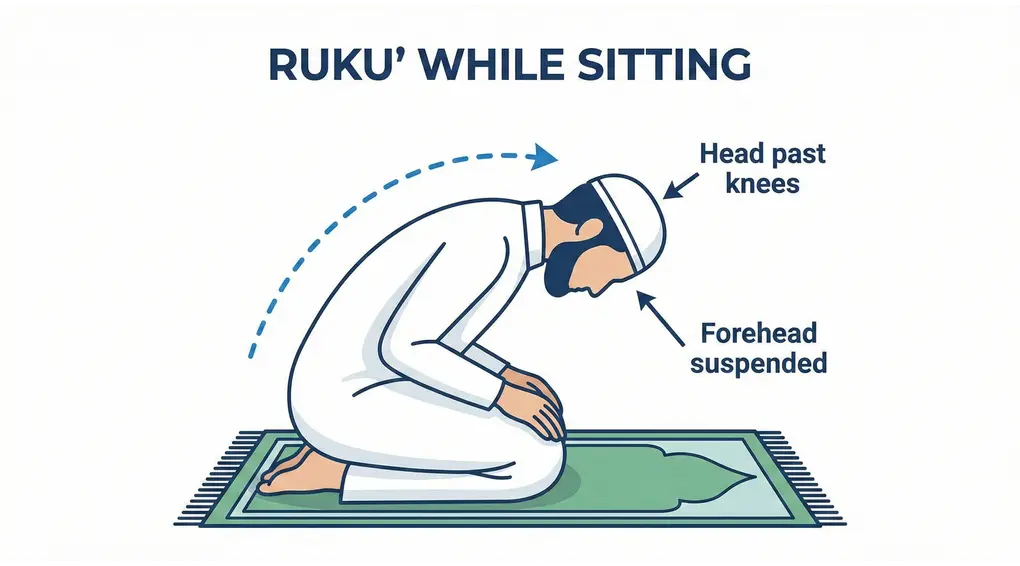
What about a sick or elderly person who must pray while sitting? The physical requirements are naturally adapted.
Imam al-Rāfiʿī in Al-‘Azīz Syarḥ al-Wajīz explains that the minimum limit of rukūʿ for someone sitting is for their forehead to lean forward past their knees. As for the perfect position, it is for their forehead to be parallel (aligned) with the place of prostration, but without actually touching the floor. If the forehead touches the floor, the movement transitions into a prostration (sujūd).
The Authentic Rukūʿ Recitations (Arabic, Transliteration, & Meaning)
A vital part of understanding the Pillars of Islam is knowing the correct supplications. It is Sunnah to recite Tasbīḥ and Duʿā while bowing.
1. The Standard Tasbīḥ
This is the standard recitation universally practiced. It is highly recommended to recite it three times.
سُبْحَانَ رَبِّيَ الْعَظِيمِ
Transliteration: Subḥāna Rabbiyal-‘Aẓīm.
Meaning: “Glory be to my Lord, the Most Great.”
An Imam leading a congregation should generally not recite this more than three times to avoid burdening the followers, unless the congregation has explicitly consented to a lengthened prayer.
2. The Comprehensive Supplication (For Solitary Prayer)
If you are praying alone (munfarid) or leading a congregation that enjoys longer prayers, it is highly recommended to add the following profound supplication. It represents a total physical and mental submission, rooted in true faith in Allah ﷻ.
The wording is taken from a Ṣaḥīḥ Hadith quoted in Qalyūbī:
اللَّهُمَّ لَكَ رَكَعْتُ، وَبِكَ آمَنْتُ، وَلَكَ أَسْلَمْتُ، خَشَعَ لَكَ سَمْعِي، وَبَصَرِي، وَمُخِّي، وَعَظْمِي، وَعَصَبِي، وَمَا اسْتَقَلَّتْ بِهِ قَدَمِي لِلَّهِ رَبِّ الْعَالَمِينَ
Transliteration: Allāhumma laka raka’tu, wa bika āmantu, wa laka aslamtu, khasha’a laka sam’ī, wa baṣarī, wa mukhkhī, wa ‘aẓmī, wa ‘aṣabī, wa mastaqallat bihi qadamī lillāhi Rabbil-‘Ālamīn.
Meaning: “O Allah, to You I bow, in You I believe, and to You I submit. My hearing, my sight, my brain, my bones, my nerves, and whatever my feet carry are all humbled before You, O Lord of the worlds.”
This prayer holds a breathtakingly profound meaning. We acknowledge that not only our external bodies submit, but our very nervous systems, brains, and senses join in rukūʿ to the Creator.
Conclusion
Improving the quality of our prayer is the greatest investment for the Hereafter. By understanding that rukūʿ is not just a physical stretch but a profound posture of devotion, and by practicing it accurately according to the Sharia, we ensure our prayers are focused (khushū’) and accepted. Always ensure the baseline conditions—such as hand placement and tumaʾninah (tranquility)—are met, and beautify the posture with the authentic recitations.
May this guide assist you in perfecting your prayer movements. Never hesitate to consult classical Fiqh literature or local scholars if you harbor any doubts, as the ocean of Islamic jurisprudence is vast and brimming with wisdom.
References
‘Abd al-Karīm bin Muḥammad al-Rāfi‘ī al-Qazwīnī, Al-‘Azīz Syarḥ al-Wajīz, verified by ‘Alī Muḥammad ‘Awaḍ and ‘Ādil Aḥmad ‘Abd al-Maujūd (Beirut: Dār al-Kutub al-‘Ilmiyyah, 1st ed., 1417 AH / 1997 CE), vol. 1, p. 483.
Aḥmad Salāmah al-Qalyūbī and Aḥmad al-Barlasī ‘Umayrah, Ḥāshiyatā Qalyūbī wa ‘Umayrah ‘alā Syarḥ al-Maḥallī ‘alā Minhāj al-Ṭālibīn (Beirut: Dār al-Fikr, 1415 AH / 1995 CE), vol. 1, pp. 175–177.
Aḥmad bin ‘Umar al-Syāṭirī, Nayl al-Rajā fī Syarḥ Safīnat an-Najā (Jeddah: Dār al-Minhāj, n.d.), p. 157.


