
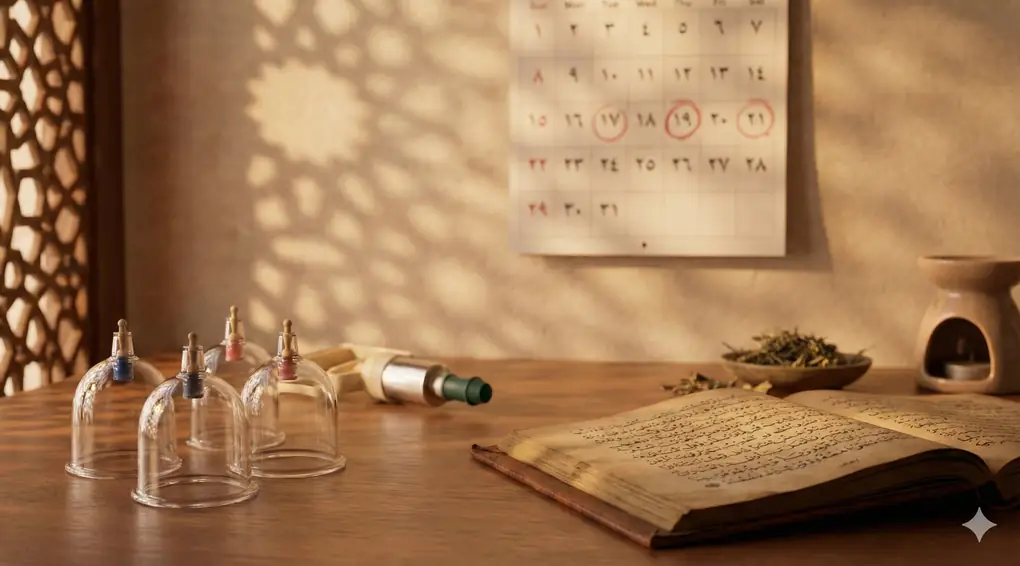
Have you ever felt hesitant when scheduling a cupping therapy (Hijama) session? Perhaps you have heard rumors that performing Hijama on specific days might bring misfortune or exacerbate existing illnesses. Alternatively, you might be searching for the absolute best time for Hijama to maximize its therapeutic and spiritual benefits.
Hijama is not merely a traditional medical treatment; it is a highly recommended prophetic practice (Sunnah) of the Prophet Muhammad ﷺ. However, the discourse surrounding the selection of the correct timing often leads to confusion. Some claim that Tuesday is dangerous, while others state that Wednesday causes skin diseases. Which of these statements holds academic weight?
In this article, we will thoroughly analyze this topic based on authentic Hadith collections and authoritative classical texts such as Nayl al-Awtar and Tuhfat al-Ahwadhi. We will differentiate between mere myths, historically grounded precautions, and classical medical perspectives, relying on a sound understanding of Islamic jurisprudence (Fiqh).
The Mystery of Tuesday: Is it Truly the “Day of Blood”?
One of the most frequently debated topics among practitioners of prophetic medicine (Thibbun Nabawi) is the prohibition of cupping on Tuesdays. Why is this specific day viewed negatively in the context of bloodletting?
Within the text Nayl al-Awtar, a narration explains the reasoning behind this apprehension. It mentions that Tuesday bears a rather intimidating title: Yaum ad-Dam, or the “Day of Blood.”
Let us examine the original Arabic text:
وَعَنْ أبي بَكْرَةَ: أنَّهُ كانَ يَنْهَى أهْلَهُ عَنِ الحجامَةِ يَوْمَ الثُّلاثاءِ وَيَزْعُمُ عَنْ رَسُولِ الله صلى الله عليه وسلم أن يَوْمَ الثُّلاثَاءِ يَوْمُ الدَّمِ، وَفِيه ساعَةٌ لا يَرْقأ
Translation: “From Abu Bakrah: He used to forbid his family from performing cupping on Tuesdays, and he claimed from the Messenger of Allah ﷺ that Tuesday is the ‘Day of Blood,’ and within it is an hour where blood does not stop.” (Narrated by Abu Dawud).
Academic Interpretation
Scholars in the commentary At-Taysir Syarh Al-Jami’ As-Saghir explain that the phrase “blood does not stop” (la yarqa’) mirrors a medical condition where blood struggles to coagulate. There is an undisclosed moment on Tuesday where, if the body is wounded (such as through the incisions made during Hijama), severe hemorrhaging could occur.
For this reason, a majority of scholars opt for the path of caution (ihtiyath). Even though some Hadith experts grade this specific narration as weak (da’if), the warning is still academically respected as a preventive health measure.
Exercising Caution on Wednesdays and Saturdays
In addition to Tuesdays, Wednesdays and Saturdays frequently appear on the “red light” list for Hijama practitioners. The warning associated with these days sounds even more severe, as it is linked to chronic skin conditions like leprosy or vitiligo (wadhah).
Consider the following narration from Az-Zuhri:
وَرَوَى الزُّهْرِيُّ أن النَّبيَّ صلى الله عليه وسلم قالَ: “مَنِ احْتَجَمَ يَوْمَ السَّبْتِ أوْ يَوْمَ الأرْبِعاءِ فأصَابَهُ وَضَحٌ فَلا يَلُومَنَّ إلَّا نَفْسَهُ”
Translation: “Whoever performs cupping on Saturday or Wednesday and is then afflicted with Wadhah (leprosy/vitiligo), let him blame no one but himself.”
Imam Ahmad bin Hanbal, the founding figure of the Hanbali school, strictly adhered to this precaution and disliked cupping on Wednesdays. Historical accounts even mention individuals who disregarded this warning, performed cupping on a Wednesday, and subsequently contracted a skin disease. Maintaining physical purity and guarding against skin ailments is highly emphasized in Islam, similar to the preventive health measures taught in the etiquette of entering public baths.
Although this Hadith is categorized as Mursal (a broken chain of transmission because Az-Zuhri attributed it directly to the Prophet without naming the Companion), many senior scholars utilize it as a basis for caution. Therefore, unless there is a pressing medical need, avoiding Wednesdays and Saturdays remains a wise, precautionary step.
The Golden Dates: When is the Best Time for Hijama?

If certain days are to be avoided, when exactly is the optimal time? Classical scholars and historical physicians unanimously agree that the best time for Hijama is during the middle of the lunar month, specifically after the full moon begins to wane, based on the Hijri calendar.
The highly recommended “golden dates” are the 17th, 19th, and 21st of the Hijri month. The text Tuhfat al-Ahwadhi cites the following Hadith:
مَنِ احْتَجَمَ لِسَبْعَ عَشْرَةَ وَتِسْعَ عَشْرَةَ وَإِحْدَى وَعِشْرِينَ كَانَ شِفَاءً مِنْ كُلِّ دَاءٍ
Translation: “Whoever performs cupping on the 17th, 19th, and 21st, it will be a cure for every disease.” (Narrated by Abu Dawud).
Classical Medical Analysis
Why are these specific dates emphasized? Al-Muwaffaq Al-Baghdadi provides a fascinating medical rationale. He posits that at the beginning of the lunar month, the bodily fluids (humors/akhlat) are highly volatile and active. Conversely, by the end of the month, these fluids become too stagnant and settled.
The middle of the month (shortly after the 15th) offers the perfect physiological equilibrium. The blood is “mature” and ready to be safely extracted. This is why cupping on the 17th, 19th, or 21st is considered the most effective time for systemic detoxification.
What if Tuesday Falls on the 17th?



This presents a brilliant analytical question. We possess a warning against Tuesdays, but an active recommendation for the 17th. Which ruling takes precedence?
Prominent scholars like Ishaq bin Rahawayh provided an elegant juristic solution. He generally disliked cupping on Tuesdays, except when a Tuesday coincided with the 17th, 19th, or 21st. When this intersection occurs, the Sunnah recommendation of the date overrides the general precaution of the day.
Medical Emergencies: Can the Rules be Broken?
It is crucial to understand that all the aforementioned rules regarding specific days and dates apply to optional conditions (ikhtiyari). This means if you are generally healthy and simply seeking preventative maintenance, you should target the 17th, 19th, or 21st, preferably falling on a Monday or Thursday.
However, what if you experience a sudden severe migraine, a dangerous spike in blood pressure, or toxic poisoning on a Wednesday night? Must you wait for the following week?
Absolutely not. Imam Bukhari and Imam Ahmad offer a scientifically sound and reassuring perspective. The commentaries note:
كَانَ أَحْمَدُ يَحْتَجِمُ أَيَّ وَقْتٍ هَاجَ بِهِ الدَّمُ وَأَيَّ سَاعَةٍ كَانَتْ
Translation: “Imam Ahmad used to perform cupping whenever his blood pressure surged, regardless of what hour it was.”
When an urgent medical need (hajah) arises, all temporal restrictions are lifted. You may perform Hijama in the morning, afternoon, evening, on a Wednesday, or a Saturday. The preservation of life and health is the highest priority in Islamic law, just as there are specific medical exceptions discussed regarding the ruling of cupping while fasting during Ramadan.
Practical Tips Before Cupping
To ensure you receive the maximum benefit and avoid adverse side effects, consider these practical tips extracted from Tuhfat al-Ahwadzi:
- Choose the Morning: The most virtuous time is the second or third hour after sunrise (approximately 8:00 AM to 10:00 AM).
- Monitor Stomach Conditions: Do not perform cupping on an overly full stomach (immediately after a heavy meal) or while extremely hungry. A light meal 2-3 hours prior is ideal.
- Avoid Strenuous Activity: Do not undergo Hijama immediately after a hot shower, marital relations, or heavy exercise. The body requires a stabilized state.
- Track the Hijri Calendar: Consistently mark the 17th, 19th, and 21st of every lunar month.
Conclusion
Determining the best time for Hijama requires a degree of meticulousness, but the ultimate goal is profoundly beneficial: achieving maximum physical healing and spiritual blessings by following the Sunnah.
To summarize the operational guidelines:
- Top Priority: The 17th, 19th, and 21st of the Hijri month.
- Preferred Days: Mondays and Thursdays.
- Days to Avoid (For Precaution): Wednesdays and Saturdays (due to skin disease risks), and Tuesdays (due to bleeding risks).
- The Emergency Exception: If acute illness strikes, disregard the calendar and perform cupping immediately.
May this academic clarification bring you confidence and tranquility as you schedule your cupping therapy. Health is an invaluable asset, and preserving it through properly applied Prophetic knowledge is a tremendous blessing.
FAQ (Questions Regarding the Best Time for Hijama)
When is the absolute best time for Hijama?
The optimal time for Hijama is during the middle of the Islamic lunar month, specifically on the 17th, 19th, and 21st days. It is highly recommended if these dates coincide with a Monday, Tuesday, or Thursday. Medically, this is when the body’s fluids are optimally balanced for detoxification.
Why is cupping sometimes prohibited on Tuesdays?
In classical texts like Nayl al-Awtar, Tuesday is referred to as the ‘Day of Blood’ (Yaum ad-Dam). Prophetic narrations suggest there is a specific hour on Tuesday where blood struggles to coagulate. Consequently, many scholars advise avoiding Hijama on this day as a precautionary health measure (ihtiyath).
Is it permissible to perform cupping on a Wednesday?
While scholars like Imam Ahmad disliked performing optional cupping on Wednesdays due to precautionary warnings linking it to skin diseases (like vitiligo), it is entirely permissible to perform Hijama on a Wednesday if there is an urgent medical necessity.
References
Muḥammad ʿAbd al-Raḥmān al-Mubārakfūrī, Tuḥfat al-Aḥwadhī bi-Sharḥ Jāmiʿ al-Tirmidhī (Beirut: Dār al-Kutub al-ʿIlmiyyah, n.d.), 6:175.
ʿAbd al-Raʾūf al-Munāwī, Al-Taysīr bi-Sharḥ al-Jāmiʿ al-Ṣaghīr, 3rd ed. (Riyadh: Maktabat al-Imām al-Shāfiʿī, 1988), 1:354.
Muhammad bin ‘Ali al-Syaukani, Nail al-Awṭār min Asrār Muntaqā al-Akhbār, tahqiq Muhammad Ṣubḥī bin Ḥasan Ḥallāq (Riyadh: Dar Ibn al-Jauzi, 1427 AH), vol. 15, p. 276.


