Does Slight Penetration or Sexual Intercourse Require Ghusl? Shafi’i Fiqh Boundaries

An aesthetic close-up photograph of classical yellowed Fiqh books on a wooden desk, with one open book displaying Arabic text on Mandi Wajib and penetration, pointed with a quill pen.

Married life demands precise religious understanding, particularly concerning Thaharah (purification) from major ritual impurity (hadath al-akbar). A servant’s prayers and recitation of the Qur’an are legally invalid if they have not performed the major obligatory bath (Ghusl) when required. Therefore, attaining a deep understanding of purification is crucial for every Muslim. One private matter that … Read more

The Meaning of Thaharah: Significance, Rulings, and Its Importance in Islam

A modestly dressed Muslim woman in a proper hijab sitting reverently, holding a Quran in a bright mosque.

Thaharah is a fundamental concept in Islamic teachings that is inextricably linked to cleanliness and purity. For Muslims, understanding the meaning of thaharah goes far beyond merely maintaining physical cleanliness; it comprehensively encompasses the purity of the heart and soul. Before delving deeper, it is essential to realize that this teaching is an inseparable part … Read more

The Ruling on Ghusl After Using a Condom According to Shafi’i Fiqh

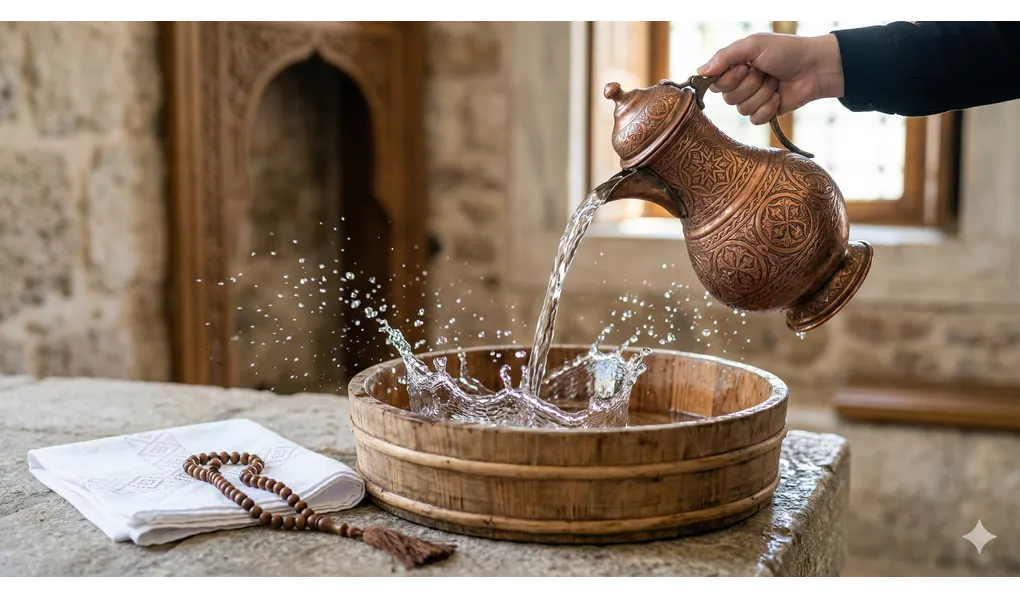
An aesthetic still-life photograph showing an open classical Arabic fiqh manuscript beside a beautiful copper bowl filled with crystal clear water and a neatly folded clean white towel, symbolizing Islamic jurisprudence leading to physical purification (Thaharah).

Islamic law governs all dimensions of human life with a highly organized system, ranging from social transactions (mu’amalah) to the most private matters within a household. Maintaining physical and spiritual purity through the act of Thaharah is a fundamental obligation so that a servant is worthy of conversing with Allah the Almighty. If you are … Read more

How to Purify Najis and Musta’mal Water: A Study of the Book Asna al-Mathalib

A traditional wide-mouthed clay pitcher (kendi) being gently submerged into a pristine, crystal-clear stone pool of water, with the water level inside the pitcher matching the pool outside. Natural sunlight refracts through the clear water.

Have you ever experienced the frustrating moment when an impure substance (najis) falls into your water bucket or bathtub? This is especially troubling when we desperately need that water. In the jurisprudence (fiqh) of the Shafi’i School, a small volume of water (less than two qullahs) is indeed highly sensitive. The moment it comes into … Read more

The Procedures of TasbΔ«αΈ₯ and AwwābΔ«n Prayers: Evidence, Scholarly Views, and Practice in ShāfiΚΏΔ« Fiqh

An elegant still-life of an open classical Arabic fiqh manuscript on a prayer mat with coiled wooden beads, next to a mosque window at twilight, representing Shalat Tasbih and Awwabin.

The diverse array of supererogatory (nāfilah) acts of worship in Islamic law serves as the primary gateway for a spiritual seeker (sālik) to ascend to the station (maqām) of proximity to Allah the Exalted. These acts of worship possess a dual function: as a patch for the deficiencies in obligatory acts of worship and as … Read more

Sunnah Iftar Supplications: A Complete Guide Based on Kanz al-NajāαΈ₯ wa-al-SurΕ«r

Still life of Ajwa dates, a clear glass of water, and an open Arabic manuscript with a wooden tasbih on a rustic table during the sunset golden hour.

The moment of breaking the fast (ifṭār) is not merely a physical activity intended to alleviate hunger and quench thirst. Within the Islamic scholarly tradition, the time of sunset constitutes a highly auspicious spiritual station (maqām) for presenting our petitions to Allah ο·». After previously discussing the immense spiritual rewards for those who provide food … Read more

The Ruling on Cupping While Fasting According to Asna al-Matalib

A flat lay photograph on a wooden table featuring an open antique Arabic Fiqh manuscript discussing the ruling of cupping (hijamah) while fasting, next to modern plastic cupping cups, a manual suction pump, and a wooden tasbih.

The month of Ramadan is a golden moment for a believer to practice self-control (al-imsāk) and elevate spiritual quality. Fasting is not merely withholding from thirst and hunger; it is a profound medium for purifying the soul. However, in practice, Muslims often face medical issues or physical therapies during the day. One such treatment is … Read more

Shafi’i Fiqh Analysis: The Rule of Substances (Al-‘Ain) Entering Body Cavities While Fasting

A scholarly flat lay photograph featuring an open classical Arabic Fiqh book relating to fasting rules, alongside modern medical items like eye drops and an inhaler, a glass of water, seeds, and a magnifying glass on a wooden table.

The act of fasting (al-αΉ£awm) is a tangible manifestation of al-imsāk, which constitutes total restraint from all things that invalidate the fast from the break of dawn until sunset. This noble act of worship must, of course, be preceded by a sincere and correct intention for Ramadan fasting. In the scholarly tradition of the Shafi’i … Read more

Faith in Allah: Understanding the Meaning and Importance as the First Pillar of Iman

Silhouette of a person praying with hands raised toward a golden sunrise on a coastal hill, next to a balanced stone cairn symbolizing a strong spiritual foundation.

Faith in Allah (Iman billah) constitutes the paramount pillar within Islamic doctrine, forming the very bedrock of a Muslim’s existence. As the first pillar of Iman (Rukun Iman), faith in Allah not only dictates the direction of worship but also profoundly shapes one’s entire worldview and approach to daily life. With unwavering faith, a Muslim … Read more

Environmental Protection in Islam: Why Planting Trees is an Act of Worship

Close-up photo of soiled hands planting a small green date palm shoot into dark soil during a golden sunrise, symbolizing Islamic environmental stewardship and hope.

The earth is our shared homeβ€”the sacred ground where we reside, develop, and perform our acts of worship. However, we often forget that environmental protection in Islam is not merely a modern “green” lifestyle trend; it is a profound trust (amanah) bestowed by the Creator. Islam does not solely regulate the vertical relationship between humanity … Read more