
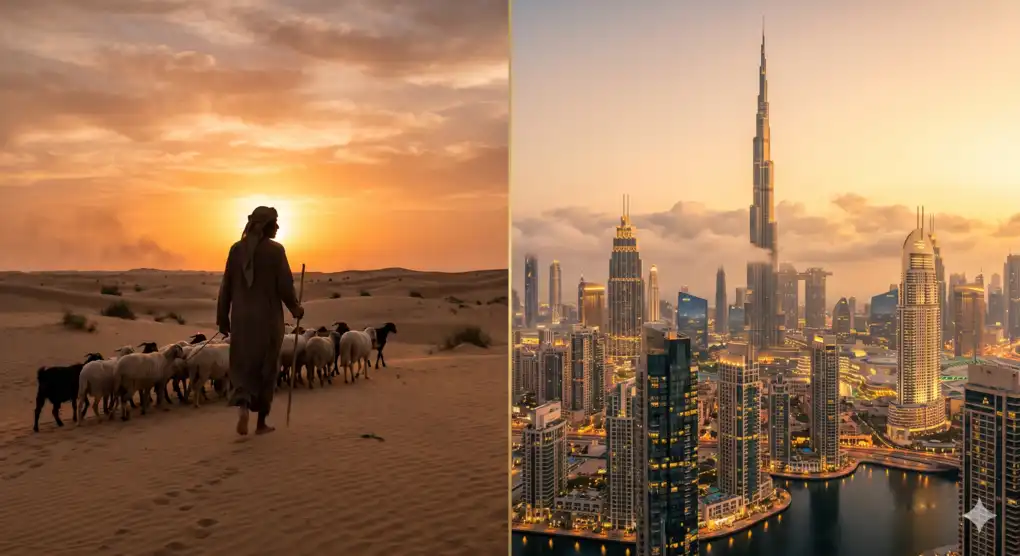
Imagine for a moment the year 610 CE. In the midst of the barren and arid Arabian desert, a barefoot man herds a flock of sheep under the scorching sun. There are no towering structures. There are no paved roads. As far as the eye can see, there is only dust, stone, and an endless, empty horizon.
Now, leap forward to the year 2010. On that exact same expanse of land—just a few hundred kilometers from that ancient landscape—a concrete and steel structure rises 829 meters into the sky. Piercing the clouds, it eclipses every architectural creation before it. This is the Burj Khalifa, the tallest building ever constructed by humanity. It is a masterpiece built by a nation whose ancestors once walked without shoes.
This extreme historical shift is not a mere coincidence. It is the undeniable physical manifestation of a prophetic foretelling delivered by the Messenger of Allah ﷺ fourteen centuries ago. He ﷺ revealed a highly specific phenomenon regarding the Signs of the End Times in the Hadith of Jibril, a narration familiar to every student of knowledge.
Through his profound words, “that you see barefoot, naked, destitute shepherds competing in constructing tall buildings,” the Prophet ﷺ unveiled the future with a precision that astounds the intellect. By referencing the esteemed Shafi’i text Al-Fath al-Mubin bi Syarhi Al-Arba’in An-Nawawiyah by the master of Fiqh and Hadith, Shaykh Ibn Hajar al-Haytami (pp. 180–184), we will conduct a deep academic analysis. Has this prophecy truly reached its culmination today? And what is the underlying theological message behind this skyline of skyscrapers?
The Complete Hadith Text and Its Status
To comprehend the essence of any Islamic evidence, a Muslim must refer to the original text and its transmission record.
The Arabic Text & Translation
At the conclusion of the majestic dialogue between the Prophet ﷺ and the Angel Jibril, Jibril inquired about the signs of the Hour. The Messenger of Allah ﷺ replied:
وَأَنْ تَرَى الْحُفَاةَ الْعُرَاةَ الْعَالَةَ رِعَاءَ الشَّاءِ يَتَطَاوَلُونَ فِي الْبُنْيَانِ
“And [a sign of the Hour is] that you see barefoot, naked, destitute shepherds competing in constructing tall buildings.” (Sahih Muslim, narrated by Umar bin Khattab رضي الله عنه).
Status and Transmission
This hadith is universally classified as Sahih (authentic). It holds a primary position as it is narrated by Imam Muslim from the senior companion, Umar bin Khattab. Furthermore, supporting narrations reinforce its core meaning:
- Imam al-Bukhari’s Narration: Through Abu Hurairah, featuring the variant phrasing “ru’ā al-ibil al-buhm” (shepherds of black camels).
- Imam Ahmad’s Narration: Through Ibn Abbas, providing a definitive identification of who these “shepherds” specifically are.
In the science of Hadith, this narration reaches the level of Mutawatir Maknawi (recurrent in meaning). Consequently, no scholar within Ahlus Sunnah wal Jamaah disputes its validity.
The Position of This Sign in the Hadith of Jibril



This is one of only two signs of the Hour mentioned by the Prophet ﷺ to Jibril (the first being a slave girl giving birth to her master). If this hadith serves as the foundational matrix of the religion—as detailed in the study of understanding the three levels of religion—why did the Prophet ﷺ isolate these two signs among dozens of others?
Shaykh Ibn Hajar al-Haytami provides a brilliant insight. He states that the specification of these two signs serves as “tahdhīran lil-hādirīn” (a specific warning for those present in the gathering). This implies that the seeds of these social transformations were, consciously or unconsciously, beginning to take root during that era or would soon afflict the succeeding generations.
Linguistic Analysis: Who Are the “Shepherds”?
Many popular readings misinterpret this hadith due to a reluctance to dissect its classical Arabic morphology. Let us analyze the four critical vocabulary choices employed by the Messenger of Allah ﷺ.
Four Key Terms in One Sentence
| Arabic Term | Literal Meaning | Sociological Implication |
|---|---|---|
| الحفاة (Al-Hufāt) | Barefoot | A symbol of poverty and materially underdeveloped living conditions. |
| العراة (Al-‘Urāt) | Naked / Scantily clad | Indicates extreme economic limitation; the inability to afford proper garments. |
| العالة (Al-‘Ālah) | Destitute / Dependent | Living in severe poverty, heavily reliant on nature for survival. |
| رعاء الشاء (Ru’ā al-Syā’) | Shepherds of sheep/goats | The lowest occupational caste in classical Arab society; lower in status than camel herders. |
Why Sheep Herders, Not Camel Herders?
Why did the Prophet ﷺ specifically select the word “sheep/goats” in Umar’s narration? Shaykh Ibn Hajar al-Haytami presents a compelling argument:
خص مطلق الرعاء لأنهم أضعف الناس، ورعاء الشاء لأنهم أضعف الرعاء
“He specifically mentioned herders in an absolute sense because they are the weakest of people, and specifically sheep herders because they are the weakest among the herders.”
In the classical Arab social stratification, camel owners were often Bedouin aristocrats holding significant assets. Conversely, goat herders sat at the very bottom of the social pyramid, living a nomadic life of extreme hardship.
Who Are They? A Definitive Answer from Ibn Abbas
Does this prophecy apply to all shepherds globally? Imam Ahmad recorded a clarifying narration from Ibn Abbas. The companions once asked, “O Messenger of Allah, who are these barefoot, hungry, and destitute shepherds?” The Prophet ﷺ answered firmly: “Al-‘Arab” (The Bedouin Arabs).
This explanation is not a racial generalization; rather, it is a factual, historical description of the socio-economic conditions of the Arabs during the pre-Islamic and early prophetic eras, a demographic destined to experience a drastic economic explosion.
Five Scholarly Interpretations of “Competing in Tall Buildings”
The phrase yatatāwalūna fil bunyān demands analytical study. Here are five interpretative frameworks formulated by the experts of Hadith and Fiqh.
- Boasting in Architecture (The Strongest View): This refers to the ambition of individuals or nations to build structures taller than their neighbors. Al-Hafidh Ibn Hajar al-Asqalani defines this phrase as: “Every person desires their house to be higher than the house of others.” It is a metaphor for spiritual disease: material arrogance and the pursuit of social status through real estate.
- The Lower Class Suddenly Becoming Rulers: Shaykh al-Haytami interprets this as a political metaphor: “A metonymy for the lower classes becoming kings or acting like kings.” The sign here is the inversion of social order. The historically marginalized now hold economic dominance, channeling their newfound wealth into massive construction projects to showcase power.
- The Victory of Islam and Expansion of Muslim Territories: Some classical scholars viewed this positively in its early stages, representing the expansion of the Islamic conquests (Futuhat). Impoverished Bedouins, empowered by Islam, conquered the Persian and Roman superpowers. The spoils of war (ghanimah) allowed them to construct grand residences.
- The Ignorant Becoming Leaders: This ties the Hadith of Jibril to another narration where the Prophet ﷺ described these herders as “deaf and dumb.” This is a metaphor for ignorance, religious illiteracy, and devoid of beneficial speech. When people with this mentality control public affairs and massive wealth, the Hour draws near.
- Competing in Decorating and Beautifying Buildings: The meaning of yatatāwalūna is not limited to vertical height; it encompasses an arms race in interior design and architectural luxury. This resonates deeply with modern reality, from hyper-luxury villas to multi-billion-dollar resorts.
Al-Haytami’s Caveat: Shaykh al-Haytami remains academically objective. He does not automatically rule all tall buildings as makruh (disliked), stating: “Restricting the ruling of ‘disliked’ only applies to that which is not driven by genuine need.”
Has It Happened? Empirical Evidence in the Modern Era
We arrive at the central question. Has the era of shepherds building skyscrapers truly materialized? Let us harmonize the religious texts with historical data.
The Transformation of the Arabian Peninsula in One Century
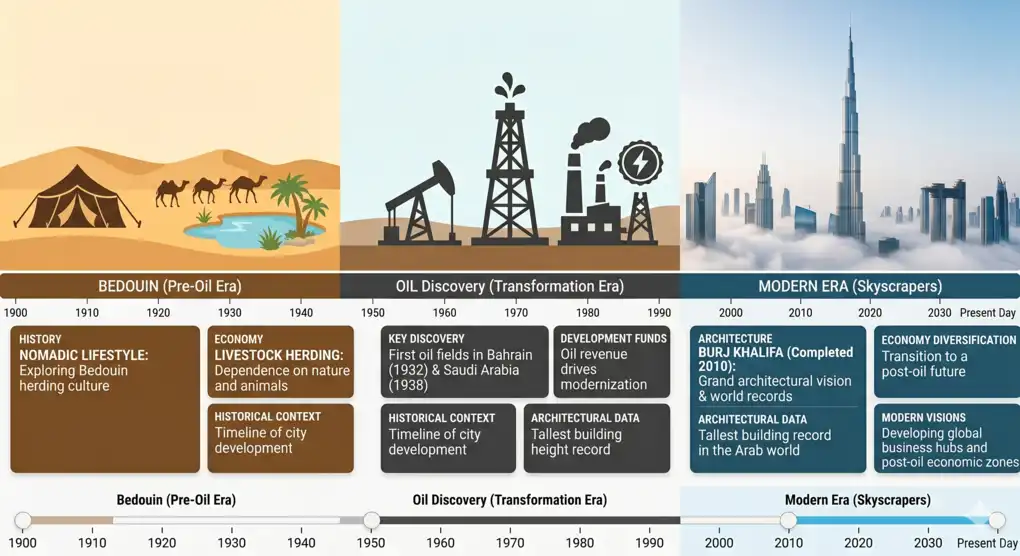
Before the commercial discovery of crude oil (“black gold”), the Arabian Peninsula was largely impoverished. The majority of populations in Saudi Arabia, the UAE, and Qatar lived nomadically as herders or traditional pearl divers. After the oil boom of the 1930s, the transformation was radically swift. They transitioned from Bedouin tents to glass skyscrapers in a single generation. Grandfathers literally herded goats on hot sand; their grandsons now sit in boardrooms financing megaprojects.
A Startling Historical Comparison
| Nation | Historical Fact (Early/Mid 20th Century) | Reality Today (21st Century) |
|---|---|---|
| UAE (Dubai) | 1960s: Coastal fishing and herding communities. | Home to the Burj Khalifa (829 m)—the tallest man-made structure on Earth. |
| Saudi Arabia | 1930s: Deep-desert Bedouin majority living simply. | Developing the Jeddah Tower, planned to reach ~1,000 meters. |
| Qatar | 1950s: One of the poorest regions on the Gulf coast. | Achieved the highest GDP per capita, building hyper-luxury infrastructure. |
| Kuwait | Local desert populations (Bedouin). | Boasts one of the most modern skylines in the Middle East. |
The Prophet’s Direct Testimony
The absolute truth of this message is proven by the Prophet’s ﷺ own attitude. In a narration from Sunan Abu Dawud, the Prophet ﷺ was walking in Madinah and noticed a new dome owned by an Ansari companion that towered over the surrounding structures. The Prophet ﷺ intentionally turned his face away and refused to return the companion’s greeting. Only after the companion realized his error and dismantled the dome did the Prophet ﷺ resume greeting him. This demonstrates how seriously he viewed the trend of unnecessary vertical construction.
Is This Sign Exclusive to Arabs or Universal?
While Imam Ahmad’s narration points to the Arabs as “patient zero,” the strongest conclusion is that while the Arabs initiated the fulfillment of the prophecy, this materialistic lifestyle has become a global pandemic. From China to the United States to Southeast Asia, nations fiercely battle for the title of the tallest skyline.
Is This a Good, Bad, or Neutral Sign?
Understanding the jurisprudence surrounding the End Times is as crucial as understanding the definition of Islam and its pillars. To ensure theological precision, we must rely on the established science of Fiqh.
The Classification of Signs
Not all signs of the Hour are inherently sinful. Scholars categorize them into three:
- Good Signs: The spread of knowledge, the expansion of Islam. (Positive — to be grateful for).
- Bad Signs: Widespread bloodshed (al-harj), open fornication. (Negative — must be avoided and eradicated).
- Neutral Signs: Competing in tall buildings, tunneling through mountains. (Neutral — depends on the intention).
The Specific Nuance of the “Tall Buildings” Sign
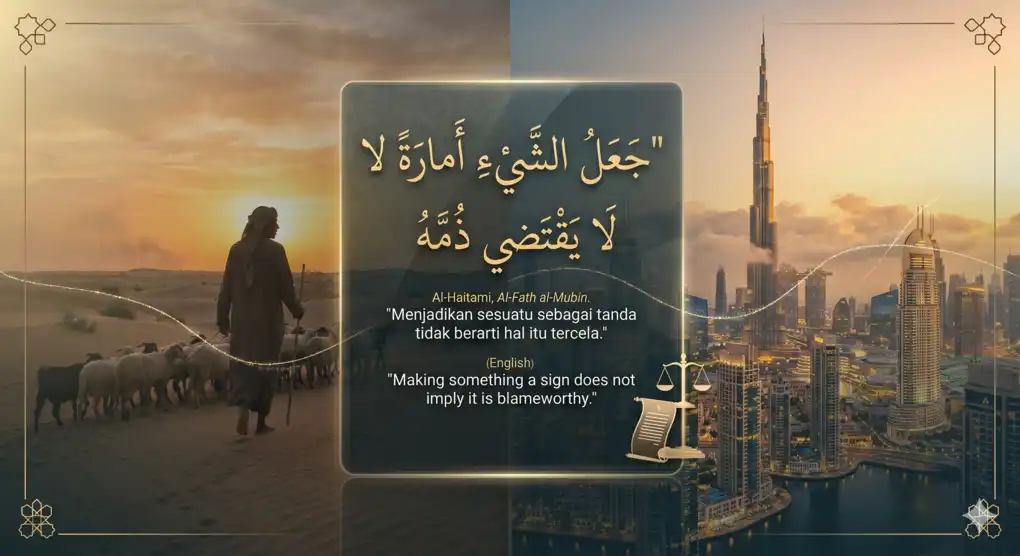
Shaykh al-Haytami rectifies a common paradigm: “The fact that something is designated as a sign does not necessitate that it is blameworthy.” However, understanding human nature, he adds a balancing note: “Yet, predominately, it does imply censure.” The core issue is not the concrete and steel, but the intention (qasd) and the socio-economic context driving the construction.
The Fiqh Ruling on Building Tall Structures
As Muslims striving to implement religion comprehensively—as emphasized in understanding the pillars of Islam—we must approach construction laws fairly. Building a skyscraper is Mubah (permissible) if there is a genuine public need (like housing shortages or integrated commercial centers).
Final Fiqh Classification
| Condition & Motive of Construction | Fiqh Ruling |
|---|---|
| Building extremely high due to severe land crises for real housing/business. | Mubah (Permissible); potentially rewarding if intentions are pure. |
| Building beyond reasonable needs, without the intent of arrogance. | Makruh (Disliked); best avoided due to the risk of showing off. |
| Constructing purely for arrogance, rivalry, and displaying social status. | Haram (Forbidden); falls under Tabdhir (squandering) and pride. |
| Large-scale public welfare facilities (multi-story hospitals, universities). | Mandub (Recommended); brings widespread public benefit. |
Shaykh al-Haytami concludes this Fiqh analysis beautifully by quoting a narration: “The son of Adam is rewarded for everything except what he places into this soil [building without benefit].” Investing capital into lifeless concrete without a genuine need yields emptiness in the Hereafter, unless it is endowed (Waqf) for the Ummah.
Contemporary Phenomena: The Perfecting of the Sign
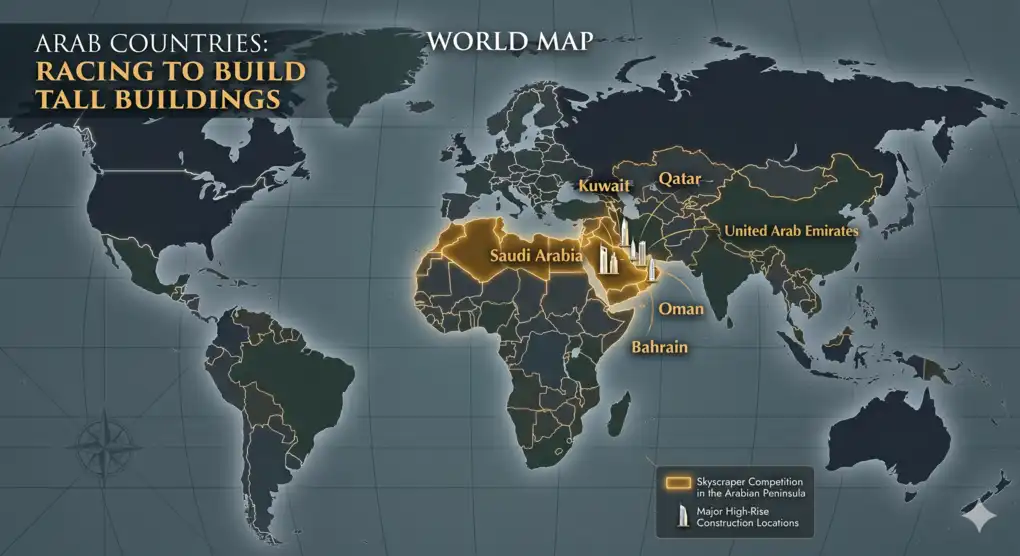
When we look at the modern world, the race to the heavens is unstoppable.
The Race for the Tallest Building (Real Data)
- Burj Khalifa (Dubai, UAE): 829 m (Completed 2010)
- Merdeka 118 (Kuala Lumpur, Malaysia): 678 m (Completed 2023)
- Makkah Royal Clock Tower (Makkah, Saudi Arabia): 601 m (Completed 2012)
- Jeddah Tower (Jeddah, Saudi Arabia): ~1,000 m (Under construction)
The startling sociological fact is that the vast majority of these towering monoliths are built on the soil of Muslim-majority nations, specifically within the Arabian Peninsula. When Sheikh Mohammed bin Rashid Al Maktoum (Ruler of Dubai) reflects on his grandfather’s simple desert life compared to his generation’s ownership of the Burj Khalifa, we witness the literal fulfillment of the Prophet’s ﷺ words echoing across fourteen centuries.
This sign is also manifesting locally. The proliferation of hyper-luxury cluster housing and the intense competition to renovate homes simply to outshine neighbors on social media is the micro-manifestation of yatatāwalūna fil bunyān.
Profound Lessons from These Signs of the End Times
Recognizing these phenomena must directly correlate with spiritual growth. We must reflect on the essence of faith in the Last Day to navigate this modern landscape.
- Empirical Proof of Muhammad’s ﷺ Prophethood: This is an intellectual miracle. An unlettered man (ummi) from the Arabian desert could not have accurately predicted the precise socio-economic inversion of Bedouin wealth without divine revelation.
- A Warning Against Delusion (Ghurur al-Dunya): When humanity exhausts its time, energy, and intellect stacking bricks into the sky, they neglect their primary duty: building their palace in the Hereafter.
- Do Not Misread the Sign: We must not act extremely. Engineering marvels are products of human advancement. Islam is not anti-progress; it condemns the arrogance and degradation of human dignity hidden behind the luxurious facades.
- A Momentum for Introspection: Financial prosperity is a blessing, but being deceived by it is a catastrophe. Are we building our homes for shelter, or for the validation of others?
Conclusion
The wheel of history has turned exactly as foretold. From a dusty, barefoot herder walking on scorching sand to a skyline of glass and steel piercing the clouds, this dramatic transformation solidifies one absolute certainty: the words of the Prophet ﷺ were not empty metaphors. They were history written before it happened.
Today, the signs of the End Times are no longer ink on ancient parchment; they are our daily reality, our social media feeds, and the glorified investments of the masses. Therefore, the most critical question is not “Has the sign occurred?” but rather, “Are we unconsciously becoming the active participants of these very signs?” Let us anchor our creed, purify our intentions, and guard our hearts against being crushed under the weight of fleeting luxury. Wallahu a’lam bish-shawab.
Frequently Asked Questions (FAQ)
Is the phenomenon in Dubai absolute proof of the End Times sign from the Hadith of Jibril?
Yes. The majority of contemporary Islamic scholars and thinkers consider the rapid transformation of Dubai and the Gulf States as the concrete manifestation of the Prophet’s statement regarding destitute herders competing to build skyscrapers.
Historically, who were the “shepherds” referred to by the Prophet ﷺ?
Referring to Imam Ahmad’s narration from Ibn Abbas, the Prophet ﷺ specifically identified them as “Al-‘Arab”—the Bedouin Arab tribes who historically lived a harsh, nomadic lifestyle far from urban civilization.
Does this hadith make the profession of architecture and constructing high-rises Haram?
Absolutely not. Shaykh Ibn Hajar al-Haytami clarifies that building tall structures is generally Mubah (permissible). It only becomes Makruh (disliked) or Haram (forbidden) if it is motivated by arrogance, squandering wealth (tabdhir), or lacks any genuine utility. Building for public welfare is actively encouraged.
Is this “tall buildings” sign of the End Times still ongoing?
Scholars believe this phenomenon has manifested and is continuously unfolding. As long as nations continue battling to break records for the world’s tallest building, this sign is progressively perfecting its form.
Why is the sign of real estate competition paired with the sign of a slave girl giving birth to her master?
Shaykh al-Haytami explains that both signs share a core commonality: the inversion of the natural order (inqilab al-mafahim). The lower classes suddenly skyrocket to the top, seizing dominance and disrupting the proper hierarchy of values. The End Times are characterized by this structural chaos.
There is a difference in wording: Muslim’s narration mentions “sheep/goats,” while Bukhari’s mentions “black camels.” Which is correct?
Both are correct and complementary. Ibn Hajar al-Haytami explains that the Prophet ﷺ likely mentioned both within a single comprehensive statement during the gathering. Umar bin Khattab preserved the memory of the “sheep,” while Abu Hurairah retained the memory of the “camels.”
Reference
Aḥmad ibn Muḥammad Ibn Ḥajar al-Haytamī, al-Fatḥ al-Mubīn bi-Sharḥ al-Arbaʿīn, ed. Aḥmad Jāsim Muḥammad al-Muḥammad, Quṣayy Muḥammad Nūrūs al-Ḥallāq, and Anwar al-Shaykhī al-Dāghistānī, 1st ed. (Jeddah: Dār al-Minhāj, 2008), 181-184.


