
Have you ever felt as though every single door of opportunity has been slammed shut? Crushing financial burdens, deeply complicated family disputes, or a massive, desperately needed goal that remains entirely out of reach despite your absolute maximum effort. The sensation is undeniably exhausting and suffocating. As fragile human beings, it is entirely natural if we feel utterly incapable of bearing that colossal weight alone.
However, absolutely never allow despair to conquer your heart. Within the profoundly rich heritage of Islam, the pious predecessors (salaf) have bequeathed to us numerous spiritual “keys” to unlock the doors of Allah’s divine assistance. One of the most magnificent golden keys, meticulously documented in the legendary masterpiece Ihya’ Ulumuddin by the great Imam Al-Ghazali, is the specific procedure for performing Salat al-Hajat consisting of 12 rakaat.
In stark contrast to the standard Salat al-Hajat, which is generally recognized as a mere 2 rakaat prayer, this specific practice involves a significantly higher number of rakaat, accompanied by highly specific Quranic recitations and a profoundly powerful supplication (dua) made during the final prostration. Numerous scholars and spiritual practitioners (tariqah) utilize this as their “ultimate weapon” when confronted with insurmountable, catastrophic difficulties. Let us meticulously study the authentic procedure according to the precise methodologies of classical scholars. Before proceeding, it is crucial to ensure you have a firm grasp on the fundamental definition and purpose of prayer (Salat) in Islam.
Understanding the Salat al-Hajat Version from Ihya’ Ulumuddin
In the first volume of Ihya’ Ulumuddin (pages 206-207), Imam Al-Ghazali narrates a profound transmission from Wuhaib bin al-Ward. He was an incredibly ascetic (zuhd) and scrupulously pious (wara’) worshipper. Wuhaib explicitly stated that the supplication following this specific prayer is one that is absolutely never rejected (la yuraddu).
This specific prayer is designated for absolutely anyone experiencing severe restriction or distress (dhaqa alaihil amru) concerning either their religious affairs or worldly matters. Consequently, this prayer can be utilized for a vast array of urgent necessities—ranging from miraculously clearing crippling debt and seeking divine guidance for a life partner, to desperately begging for salvation from brutal oppression.
The Procedure for Performing Salat al-Hajat 12 Rakaat
The execution of this specific prayer totals exactly 12 rakaat. To prevent physical exhaustion and to perfectly align with the standard practice of voluntary night prayers, it is executed with 6 separate concluding salutations (salam). This signifies that you perform the prayer in units of 2 rakaat, then say the salam. You then stand up again for the next 2 rakaat, and continuously repeat this sequence until you have completed exactly 12 rakaat.
A critically important element requiring intense attention is the specific Quranic recitation. As is customary in classical texts (turath) regarding recitations in voluntary prayers (similar to the specific guidance for the Dhuha prayer), the technical recitation is as follows:
1. Intention (Niyyah) and Preparation
Perform ablution (wudu) flawlessly, ensuring you understand the various types of water permitted for purification. Wear clean, ritually pure garments. The absolute optimal time for execution is during the deep, tranquil hours of the night. Formulate the firm intention within your heart: “I intend to perform the voluntary prayer of Hajat, two rakaat, for the sake of Allah Ta’ala.”
2. The Recitation of Surahs
This is the most crucial segment. Imam Al-Ghazali explicitly dictates a highly specific recitation in every single rakaat immediately following Surah Al-Fatihah:
- Ayat al-Kursi (The Verse of the Throne): This recitation is the ultimate symbol of Allah’s absolute, unrivaled cosmic dominion.
- Surah Al-Ikhlas (Qul Huwallahu Ahad): The absolute symbol of the purest, unadulterated monotheism (Tawhid).
You must relentlessly execute this exact pattern in every single two-rakaat unit until you have successfully completed the grand total of 12 rakaat.
3. Why is this Specific Pattern So Crucial?




This precise pattern miraculously balances the desperate plea for divine protection and the profound acknowledgment of Allah’s supreme power (via Ayat al-Kursi in the initial rakaat) with the purest, most sincere affirmation of His absolute Oneness (via Al-Ikhlas in the second rakaat). This creates an exceptionally potent spiritual combination designed to forcefully knock upon the doors of the heavens.
4. The Special Prostration (Sujud) After the Final Salam
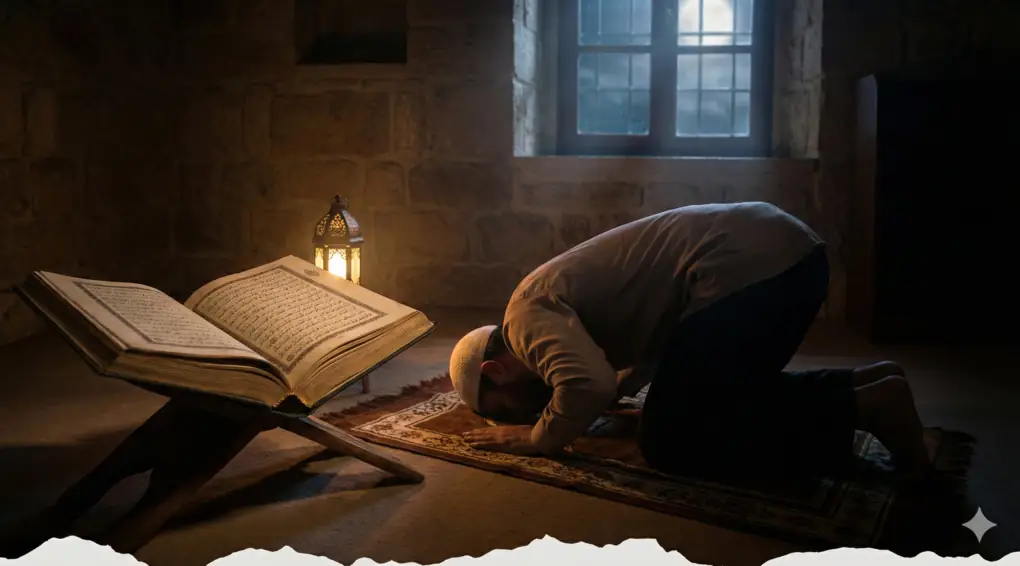
After you have successfully completed the 12th rakaat and uttered the final closing salam, do not rush to get up. Immediately perform a single prostration (a sujud completely outside of the formal prayer ritual) with crushing, absolute humility. To ensure your posture is valid, review the correct procedure for prostration (sujud). It is precisely within this specific prostration that we recite the highly guarded, secret supplication taught in the text.
The Supplication During the Prostration of Salat al-Hajat (Arabic, Transliteration, and Meaning)
While your forehead is firmly pressed against the prayer mat, recite the following profound praises and the supplication of intercession (tawassul). You may recite it slowly. It is incredibly highly recommended to deeply comprehend its meaning so that your heart actively “speaks” alongside your tongue. Understanding the proper etiquette of making Dua will amplify its effectiveness.
Part 1: The Praises (Tasbih)
This section contains a heart-trembling acknowledgment of Allah’s supreme majesty:
Arabic:
سُبْحَانَ الَّذِي لَبِسَ الْعِزَّ وَقَالَ بِهِ , سُبْحَانَ الَّذِي تَعَطَّفَ بِالْمَجْدِ وَتَكَرَّمَ بِهِ , سُبْحَانَ الَّذِي أَحْصَى كُلَّ شَيْءٍ بِعِلْمِهِ , سُبْحَانَ الَّذِي لَا يَنْبَغِي التَّسْبِيحُ إِلَّا لَهُ , سُبْحَانَ ذِي الْمَنِّ وَالْفَضْلِ , سُبْحَانَ ذِي الْعِزِّ وَالْكَرَمِ , سُبْحَانَ ذِي الطَّوْلِ
Transliteration:
Subḥāna alladhī labisa al-‘izza wa qāla bih, subḥāna alladhī ta‘aṭṭafa bil-majdi wa takarrama bih, subḥāna alladhī aḥṣā kulla shay’in bi‘ilmih, subḥāna alladhī lā yanbaghī at-tasbīḥu illā lah, subḥāna dhī al-manni wa al-faḍl, subḥāna dhī al-‘izzi wa al-karam, subḥāna dhī aṭ-ṭawl.
Meaning:
“Glory be to Him Who wears absolute majesty and speaks by it. Glory be to Him Who is cloaked in glory and acts generously by it. Glory be to Him Who flawlessly enumerates all things with His supreme knowledge. Glory be to Him to Whom alone all glorification is rightfully due. Glory be to the Possessor of absolute grace and bounty. Glory be to the Possessor of absolute majesty and generosity. Glory be to the Possessor of infinite power.”
Part 2: The Core Supplication (Tawassul)
Immediately after praising Him, proceed with the desperate plea, utilizing the mediation (tawassul) of Allah’s most majestic names and attributes:
Arabic:
أَسْأَلُكَ بِمَعَاقِدِ الْعِزِّ مِنْ عَرْشِكَ , وَمُنْتَهَى الرَّحْمَةِ مِنْ كِتَابِكَ , وَبِاسْمِكَ الْأَعْظَمِ , وَجَدِّكَ الْأَعْلَى , وَكَلِمَاتِكَ التَّامَّاتِ الْعَامَّاتِ الَّتِي لَا يُجَاوِزُهُنَّ بَرٌّ وَلَا فَاجِرٌ , أَنْ تُصَلِّيَ عَلَى مُحَمَّدٍ وَعَلَى آلِ مُحَمَّدٍ
Transliteration:
As’aluka bi-ma‘āqidi al-‘izzi min ‘arshika, wa muntahā ar-raḥmati min kitābika, wa bi-smika al-a‘ẓami, wa jaddika al-a‘lā, wa kalimātika at-tāmmāti al-‘āmmāti allatī lā yujāwizuhunna barrun wa lā fājirun, an tuṣalliya ‘alā Muḥammadin wa ‘alā āli Muḥammad.
Meaning:
“I desperately ask You by the joints of ultimate glory from Your Throne, and by the absolute pinnacle of mercy from Your Book, and by Your Greatest Name, and Your most exalted majesty, and Your perfect, universally encompassing words, which neither the righteous nor the wicked can ever bypass; that You bestow abundant blessings upon Muhammad and upon the family of Muhammad.”
Part 3: Stating the Need (Hajat)
Immediately after reciting the shalawat at the very end of the supplication above, intensely state your specific need within your heart with absolute, unshakeable conviction and towering hope (roja’). Desperately beg for the ultimate solution to the catastrophic problem currently crushing you.
Summary Table of the Practical Procedure
To significantly facilitate practical execution, below is a highly concise summary table:
| The Stage | Detailed Execution | Recitation of Surah / Dua |
| Total Rakaat | 12 Rakaat (Executed in units of 2 rakaat then salam, 2 rakaat then salam, etc.) | Intention for Salat al-Hajat |
| First & Second Rakaat | In absolutely every single rakaat (after Al-Fatihah) | Ayat al-Kursi & Al-Ikhlas |
| The Final Sujud | Executed immediately after the salam concluding the 12th rakaat | Recite the Tasbih & Tawassul Dua (Text provided above) |
| The Conclusion | While still remaining firmly in the prostration position | State your specific desire/need with intense clarity |
The Original Textual Reference from Ihya’ Ulumuddin
As an absolute testament to the validity of this profound practice, below is the original Arabic text documented within the book:
الثامنة صلاة الحاجة ( ٧ ) فمن ضاق عليه الأمر ومسته حاجة في صلاح دينه ودنياه إلى أمر تعذر عليه فليصل هذه الصلاة فقد روي عن وهيب بن الورد أنه قال إن من الدعاء الذي لا يرد أن يصلي العبد ثنتي عشرة ركعة يقرأ في كل ركعة بأم الكتاب وآية الكرسي وقل هو الله أحد فإذا فرغ خر ساجدا ثم قال سبحان الذي لبس العز وقال به سبحان الذي تعطف بالمجد وتكرم به سبحان الذي أحصى كل شيء بعلمه سبحان الذي لا ينبغي التسبيح إلا له سبحان ذي المن والفضل سبحان ذي العز والكرم سبحان ذي الطول أسألك بمعاقد العز من عرشك ومنتهى الرحمة من كتابك وباسمك الأعظم وجدك الأعلى وكلماتك التامات العامات التي لا يجاوزهن بر ولا فاجر أن تصلي على محمد وعلى آل محمد ثم يسال حاجته التي لا معصية فيها فيجاب إن شاء الله عز وجل 1
A Severe Warning: Absolutely Do Not Use This for Evil
There is a shockingly severe warning delivered by Wuhaib bin al-Ward at the very conclusion of that narration. He stated: “Do not teach this supplication to the foolish (sufaha’), because they will undoubtedly assist one another in committing sins against Allah.”
This specific supplication is considered instantaneously answered (mustajab). Consequently, the classical scholars were hyper-vigilant to ensure this highly potent dua did not fall into the hands of individuals harboring malicious intent—for example, utilizing it to pray for the unjust destruction of another person or to aggressively demand something inherently forbidden (haram). Ensure your intention is impeccably pure and exclusively directed toward goodness.
Must this prayer be exclusively performed in the middle of the night?
Absolute voluntary prayers or Salat al-Hajat can be performed at any time, provided it is absolutely not during the strictly prohibited times (e.g., immediately after Fajr until sunrise, or immediately after Asr). However, because it consists of a grueling 12 rakaat and demands immense, unbreakable concentration (khushu’), the deep night is undeniably the most highly recommended time.
I have not yet memorized the lengthy dua for the prostration; what is the solution?
Because this highly specific dua is recited during a prostration occurring after the formal salam (entirely outside the strict boundaries of the ritual prayer), you are fully permitted to place a note or a book directly in front of your prayer mat and read directly from it.
Is it permissible to combine this intention with the Tahajjud prayer?
You may certainly intend it during the time of Tahajjud. The Tahajjud prayer can be jurisprudentially combined with obligatory prayers or other voluntary prayers such as Witr, provided it is executed after waking up from sleep. Even if it is not specifically intended as Tahajjud, it is still legally ruled as both a valid Salat al-Hajat and Tahajjud, exactly identical to how the prayer for greeting the mosque (Tahiyatul Masjid) is automatically encompassed when an individual immediately performs an obligatory or rawatib prayer upon entering the mosque.
How long does it typically take for the hajat (need) to be granted?
Allah possesses absolute, infinite knowledge of the perfect timing. Some requests are granted instantaneously, some are deliberately delayed because Allah deeply desires to witness the intense perseverance of His servant, or it may be miraculously substituted with something infinitely better. The absolute master key is unshakeable conviction (yaqin) and never, ever plunging into despair.
Conclusion
This 12-rakaat Salat al-Hajat championed by Imam Al-Ghazali is a breathtakingly beautiful spiritual mechanism to intensely draw closer to Allah precisely when we feel utterly weak and entirely powerless. By meticulously following the authentic procedure—reciting Ayat al-Kursi and Al-Ikhlas—we are actively practicing the profound etiquette of supplication taught by the extraordinarily pious predecessors.
We fervently pray that through the mediation (wasilah) of this magnificent prayer, Allah immediately lifts your crushing difficulties, forcefully tears open the doors of sustenance, and grants you the profound tranquility of heart you are desperately seeking. May you be immensely blessed in your practice.
Reference
- Abū Ḥāmid Muḥammad ibn Muḥammad al-Ghazālī, Iḥyāʾ ʿUlūm al-Dīn (Beirut: Dār al-Maʿrifah, n.d.), vol. 1, pp. 206–207. ↩︎


