
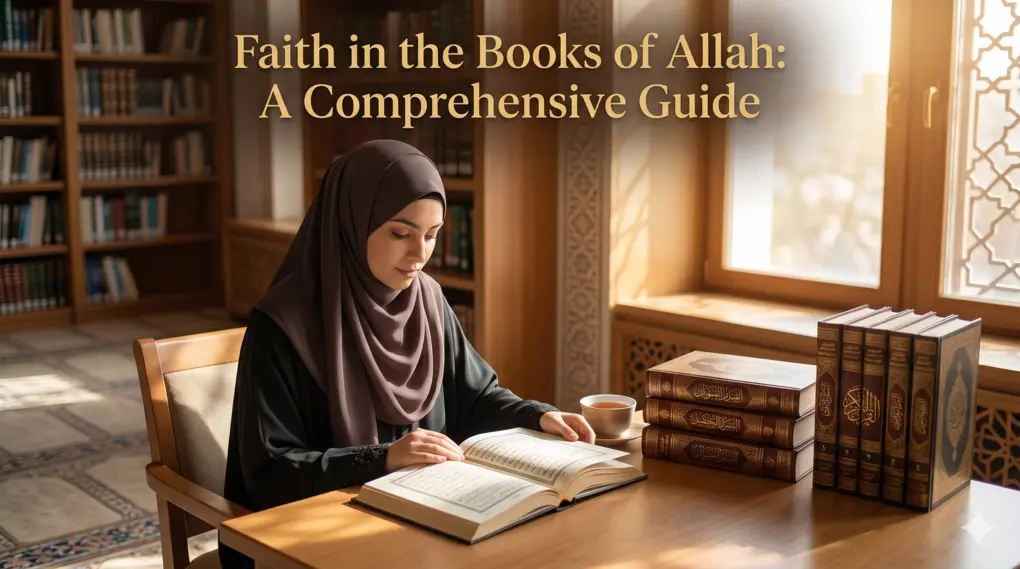
Faith in the books of Allah is one of the foundational pillars of Islamic theology. This conviction goes beyond mere verbal affirmation; it requires heartfelt validation and practical application in daily life. Believing in divine scriptures means having absolute certainty that Allah SWT revealed His words to His prophets and messengers as a universal guide for humanity. This fundamental belief is an inseparable component of the six pillars of faith.
What Does Faith in the Books of Allah Mean?
Having faith in the books of Allah means believing with utmost certainty that Allah SWT sent down His revelations in the form of holy scriptures to His chosen prophets and messengers. These revelations contain the Speech of Allah (Kalamullah), divine laws (Sharia), and comprehensive guidelines designed to lead humanity toward goodness in both this life and the hereafter.
As the third pillar of faith, this belief is closely intertwined with faith in Allah, demonstrating the paramount importance of divine scripture in constructing a Muslim’s worldview.
In Ahlus Sunnah wal Jama’ah (Aswaja) theology, the exact nature of these scriptures is thoroughly explained. As stated by Ibn Hajar al-Haytami in Al-Fathul Mubin Syarah Arba’in (p. 160):
وكتبه: أي: بأنها كلام الله تعالى الأزلي القديم، القائم بذاته، المنزه عن الحرف والصوت، وبأنه تعالى أنزلها على بعض رسله بألفاظ حادثة في ألواح، أو على لسان الملك، وبأن كل ما تضمنته حق وصدق، وبأن بعض أحكامها نسخ وبعضها لم ينسخ
“And His books: Meaning, they are the pre-eternal (Azali) and beginningless (Qadim) Speech of Allah Almighty, subsisting in His Essence, transcendent beyond letters and sounds. Furthermore, He Almighty revealed them to some of His messengers through created expressions inscribed on tablets or via the tongue of an angel. Everything they contain is absolute truth, and some of their rulings are abrogated (nasakh) while others remain unabrogated.”
Theological Foundations in the Qur’an
The scriptural basis for this pillar of faith is explicitly detailed in the Qur’an. Allah SWT commands believers in QS. An-Nisa: 136:
“O believers! Always believe in Allah, His Messenger, the Book He has revealed to His Messenger, and the Scriptures He revealed before. Whoever disbelieves in Allah, His angels, His Books, His messengers, and the Last Day has certainly strayed far away.”
This verse constitutes a direct mandate to embrace all the books of Allah—both the Qur’an revealed to Prophet Muhammad ﷺ and the scriptures that preceded it.
Furthermore, in QS. Al-Maidah: 16, Allah states:
“By which Allah guides those who pursue His pleasure to the ways of peace and brings them out from darknesses into the light, by His permission, and guides them to a straight path.”
QS. Ali Imran: 2-4 reinforces this concept by explicitly mentioning the previous scriptures and their core function as a divine compass:
“Allah—there is no deity except Him, the Ever-Living, the Sustainer of existence. He has sent down upon you, [O Muhammad], the Book in truth, confirming what was before it. And He revealed the Torah and the Gospel. Before, as guidance for the people. And He revealed the Qur’an (the criterion).”
Classifications of Belief in Divine Revelations
Islamic theology categorizes the belief in divine scriptures into two distinct approaches: detailed (Tafsili) and general (Ijmali). To better grasp how this fits into the broader Islamic creed, you may also explore the meaning and number of the pillars of faith.
Detailed Belief (Tafsili)
Every legally responsible Muslim (Mukallaf) is obligated to believe in four primary books in detail, which entails knowing their names and the specific prophets who received them:
- Torah (Taurat): Revealed to Prophet Musa (Moses) ‘alaihissalam, serving as a legal and spiritual guide for the Children of Israel.
- Psalms (Zabur): Revealed to Prophet Dawud (David) ‘alaihissalam, containing primarily hymns, praises, and supplications to Allah.
- Gospel (Injil): Revealed to Prophet Isa (Jesus) ‘alaihissalam, complementing the Torah and providing spiritual light for his followers.
- Qur’an: Revealed to Prophet Muhammad ﷺ. As the final scripture, it confirms, perfects, and supersedes all previous books.
This detailed obligation is beautifully encapsulated in the poem Aqidatul ‘Awwam, as cited in Nuur Azh-Zholam (p. 89):
أربعةٌ من كُتُبٍ تفصيلُها…توراةُ موسى بالهدى تنزيلُها زبورُ داودَ وإنجيلٌ على…عيسى وفرقانٌ على خيرِ المَلَا
“Four are the books whose details [must be known]… The Torah of Musa was revealed with guidance. The Zabur of Dawud, and the Injil upon… Isa, and the Furqan (Qur’an) upon the best of creation (Prophet Muhammad).”
The commentary (syarah) of the text further asserts:
أي يجب على كل مكلف أن يعتقد أربعة من الكتب تفصيلاً بأسمائها، وهي التوراة لسيدنا موسى، والزبور لسيدنا داود، والإنجيل لسيدنا عيسى، والفرقان لسيد الخلق سيدنا محمد صلوات الله وسلامه عليهم أجمعين
“Meaning, every Mukallaf is obligated to believe in these four books in detail by their names: the Torah for our master Musa, the Zabur for our master Dawud, the Injil for our master Isa, and the Furqan for the master of creation, our master Muhammad, peace and blessings of Allah be upon them all.”
General Belief (Ijmali)
Beyond the four major texts, Muslims must also possess a general belief in the numerous other scriptures or scrolls (Suhuf) bestowed upon various prophets, such as those given to Prophet Adam, Syits (Seth), Idris, and Ibrahim (Abraham). Speaking of Prophet Ibrahim, his profound submission to Allah established many lasting legacies, including the history of the Hajj pilgrimage.
Regarding the exact number of these divine texts, Al-Fathul Mubin (p. 160) notes:
قال الزمخشري وغيره: (وهي مئة كتاب وأربعة كتب، أنزل منها خمسون على شيث، وثلاثون على إدريس، وعشرة على آدم، وعشرة على إبراهيم، والتوراة، والزبور، والإنجيل، والفرقان)
“Az-Zamakhshari and others stated: They are one hundred and four books; fifty were revealed to Syits, thirty to Idris, ten to Adam, and ten to Ibrahim, alongside the Torah, the Zabur, the Injil, and the Furqan.”
Meanwhile, Nuur Azh-Zholam (p. 89) adds a critical academic nuance:
وأما بقية الكتب فيجب اعتقادها إجمالاً بأن يعتقد أن الله تعالى أنزل كتباً من السماء على الإجمال، وقد اشتهر أن جميع الكتب مائة وأربعة، وقيل إنها مائة وأربعة عشر، قال السحيمي: والأصح عدم حصر الكتب في عدد معين .. فلا يقال إنها مائة وأربعة فقط؛ لأنك إذا فتشت الروايات تجدها تبلغ أربعة وثمانين ومائة. انتهى
“As for the remaining books, it is obligatory to believe in them generally, believing that Allah Almighty sent down books from the heavens in a general sense. It is famous that all the books number 104, while others say 114. As-Suhaimi said: The most authentic view is not to restrict the books to a specific number… for if you examine the narrations, you will find they reach 184.”
The core academic consensus is simply to affirm that Allah sent down abundant revelations to guide His creation, without fixating on an exact numerical restriction.
Wisdom and Functions of the Divine Books
Cultivating faith in the books of Allah provides numerous spiritual and practical benefits:
- Knowing Allah and Life’s Purpose: The scriptures introduce humanity to Allah’s attributes and the divine intent behind human creation.
- Comprehensive Life Guide: They serve as an ethical, legal, and social compass, ensuring success in this realm and cultivating an understanding of the reality of faith in the Last Day.
- Criterion for Truth: The Qur’an acts as Al-Furqan, the ultimate standard to distinguish between absolute truth (Haqq) and falsehood (Batil).
- Protection from Deviance: Following divine revelation safeguards individuals and societies from moral corruption.
- Clear Jurisprudence (Sharia): The books provide explicit frameworks and boundaries to maintain justice and harmony in human affairs.
Practical Ways to Actualize Faith in Allah’s Books
True belief requires practical implementation. A Muslim demonstrates this faith through several actionable steps:
- Recitation and Study: Dedicating time to read, memorize, and deeply study the Qur’an.
- Implementation: Applying Qur’anic principles and rulings in daily transactions, family life, and personal conduct.
- Reverence: Treating the physical copies of the Qur’an (Mushaf) with the utmost respect and purity.
- Ultimate Reference: Accepting the Qur’an as the supreme source of legislation and conflict resolution.
- Acknowledging Previous Truths: Believing that the Torah, Zabur, and Injil were originally pure words of Allah, while recognizing that only the Qur’an is divinely protected from alteration until the Day of Judgment.
Conclusion
Faith in the books of Allah is the third fundamental pillar that bridges the gap between the Creator and the created. By recognizing these texts as the authentic, unadulterated Speech of Allah, Muslims are equipped with an infallible guide. Embracing this belief not only clarifies our purpose but guarantees a balanced, spiritually enriched life in this world and eternal salvation in the hereafter.
Frequently Asked Questions (FAQ)
If Muslims follow the Qur’an, why must we believe in the previous books?
Believing in the original Torah, Psalms, and Gospel is an obligatory pillar of faith because they were authentic revelations from Allah in their respective eras. Acknowledging them demonstrates a belief in the continuity and unity of Allah’s divine message throughout human history.
Are the laws of the previous scriptures still applicable today?
In Islamic jurisprudence, the Qur’an is the final testament that abrogates (nasakh) the legal frameworks of previous scriptures. While the core theological message (monotheism) remains identical across all books, the specific legal rulings (Sharia) Muslims follow today are derived exclusively from the Qur’an and the Sunnah.
How does faith in the books relate to faith in angels?
The two pillars are deeply interconnected. Muslims must believe that Allah’s scriptures did not descend on their own; they were transmitted to the prophets through the trusted angelic messenger, Jibril (Gabriel). Therefore, trusting the message inherently necessitates faith in the angels who faithfully delivered it.
References:
- Aḥmad ibn Muḥammad Ibn Ḥajar al-Haytamī, al-Fatḥ al-Mubīn bi-Sharḥ al-Arbaʿīn, 1st ed. (Jeddah: Dār al-Minhāj, 2008).
- Muḥammad ibn ʿUmar Nawawī al-Bantanī, Nūr al-Ẓalām Sharḥ Manẓūmat ʿAqīdat al-ʿAwām, 1st ed. (Beirut: Dār al-Ḥāwī, 1996).


