
The Hajj and Umrah pilgrimages hold a special place in the heart of every Muslim. Both represent a profound spiritual journey to the Sacred House (Baitullah) in Makkah Al-Mukarramah, deeply laden with values of obedience and ultimate submission to Allah (SWT). Understanding the legal basis of Hajj and Umrah is a crucial foundation for Muslims before planning and executing these noble acts of worship. This article details their legal statuses, meticulously grounded in authoritative sources within understanding fiqh (Islamic jurisprudence).
Introduction: The Status of Hajj and Umrah in Islamic Law
Before delving further into the legal basis of Hajj and Umrah, it is essential to recognize their theological position. Hajj is one of the five main pillars of Islam, known universally as the fifth pillar, which is vital for understanding the pillars of Islam.
This categorisation demonstrates how fundamental the meaning of Hajj is to a Muslim’s faith and perfection of religion. Meanwhile, Umrah, frequently referred to as the “minor Hajj,” also possesses its own distinct virtues and elevated status within Islamic law. Millions of Muslims yearn to perform both pilgrimages to seek divine pleasure and spiritual purification.
The Ruling of Hajj: An Obligation for the Capable
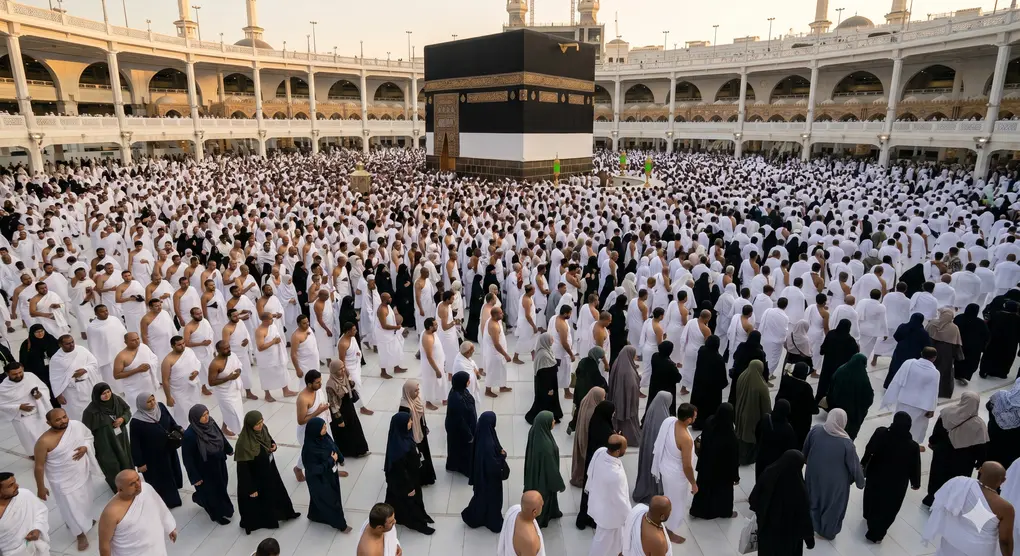
The execution of the Hajj pilgrimage has clear, unyielding legal stipulations agreed upon by the vast majority of classical scholars. Grasping this status is crucial for every believer.
The Legal Status of Hajj in Islam
In Islamic law, the ruling on Hajj is Fard ‘Ayn, an individual obligation for every Muslim who meets specific mandatory conditions of Hajj and Umrah. This assertion is documented across various prominent jurisprudential texts, such as the authoritative Shafi’i manual Fiqh al-Manhaji (Vol. 2, p. 115):
١ـ حكم الحج ودليله: الحج فرض باتفاق المسلمين، وركن من أركان الإسلام، لم يخالف في ذلك، أحد من المسلمين، ودليله: الكتاب، السنة، الإجماع.
Translation:
“1. The Ruling of Hajj and its Evidence: Hajj is an obligation (fard) by the consensus of Muslims, and it is a pillar among the pillars of Islam. No Muslim scholar has disagreed on this. Its evidences are the Quran, the Sunnah, and Consensus (Ijma).”
This excerpt highlights that the obligation of Hajj is a definitive consensus (Ijma) among Islamic scholars. There is absolutely no theological dispute regarding this mandate. The primary condition lies in the concept of capability (Istitha’ah). Therefore, Hajj for the capable is an undeniable Sharia necessity.
Evidences for the Obligation of Hajj
The obligation does not exist without a divine foundation. There are absolute evidences establishing the legal basis of Hajj from the 4 sources of Islamic law.
- Evidence from the Quran: The primary source of legislation in Islam is the Holy Quran. Regarding the obligation of Hajj, Allah (SWT) states:
إِنَّ أَوَّلَ بَيْتٍ وُضِعَ لِلنَّاسِ لَلَّذِي بِبَكَّةَ مُبَارَكاً وَهُدًى لِّلْعَالَمِينَ فِيهِ آيَاتٌ بَيِّنَاتٌ مَّقَامُ إِبْرَاهِيمَ وَمَن دَخَلَهُ كَانَ آمِناً وَلِلّهِ عَلَى النَّاسِ حِجُّ الْبَيْتِ مَنِ اسْتَطَاعَ إِلَيْهِ سَبِيلاً وَمَن كَفَرَ فَإِنَّ الله غَنِيٌّ عَنِ الْعَالَمِينَ
Translation: “Indeed, the first House [of worship] established for mankind was that at Makkah – blessed and a guidance for the worlds. In it are clear signs [such as] the standing place of Abraham. And whoever enters it shall be safe. And [due] to Allah from the people is a pilgrimage to the House – for whoever is able to find thereto a way. But whoever disbelieves – then indeed, Allah is free from need of the worlds.” (QS. Ali ‘Imran: 96-97). This verse explicitly states the phrase “And [due] to Allah from the people is a pilgrimage to the House – for whoever is able to find thereto a way.” This serves as the most fundamental legal basis of Hajj. - Evidence from the Sunnah: Besides the Quran, the Sunnah (Prophetic traditions) serves as primary evidence. One of the most universally recognized hadiths outlines the pillars of Islam:
“بني الإسلام على خمسٍ: شهادة أن لا إله إلا الله، وأن محمداً رسول الله، وإقام الصلاة، وإيتاء الزكاة، وصوم رمضان، وحج البيت لمن استطاع إليه سبيلاً”
Translation: “Islam is built upon five [pillars]: testifying that there is no deity but Allah and that Muhammad is the Messenger of Allah, establishing prayer, understanding what Zakat means and paying it, fasting Ramadan, and performing Hajj to the House for whoever is able to find thereto a way.” (Narrated by Bukhari and Muslim). This authentic hadith reaffirms Hajj as a core pillar of the religion, inextricably linking it to financial and physical capability. - Evidence from Scholarly Consensus (Ijma’): The consensus of scholars further solidifies this obligation. As stated in Fiqh al-Manhaji:
وأما الإجماع: فقد اتفقت علماء المسلمين على فرضيته من غير أن يشذ منهم أحد، ولذلك حكموا بكفر جاحده لأنه إنكار لما ثبت بالقرآن، والسنة، والإجماع
Translation: “As for Consensus: The Muslim scholars have agreed upon its obligation without a single deviation. Therefore, they ruled the one who denies it as a disbeliever, because it is a denial of what is established by the Quran, the Sunnah, and Consensus.”
The Ruling of Umrah: A Fiqh Perspective and Its Evidences
Beyond Hajj, the Umrah pilgrimage also garners significant attention among the Ummah. What is the precise legal status of Umrah? Is it identical to Hajj?
The Legal Status of Umrah According to Scholars




There is a nuanced difference of opinion among classical scholars regarding the ruling of Umrah. However, according to the strongest and most apparent view (al-azhhar) in the Shafi’i school of jurisprudence, performing Umrah is an individual obligation (Fard) once in a lifetime for those who are capable, exactly like Hajj. The text Fiqh al-Manhaji (Vol. 2, p. 116) explicitly states:
٢ـ حكم العمرة ودليلها: العمرة فرض كالحج على الأظهر من قول الإمام الشافعي رحمه الله تعالى. واستدل على ذلك بالكتاب والسنة:
Translation:
“2. The Ruling of Umrah and its Evidence: Umrah is obligatory like Hajj according to the most apparent (al-azhhar) opinion of Imam al-Shafi’i (may Allah have mercy upon him). He derived evidence for this from the Quran and the Sunnah.”
Based on this authoritative Shafi’i view, the obligation of Umrah rigorously applies to those possessing the means. While scholars from other schools (such as the Maliki and Hanafi Madhhabs) generally consider it a highly recommended Sunnah (Sunnah Mu’akkadah), the Shafi’i perspective is supported by robust scriptural arguments.
The Legal Basis of Umrah in the Shafi’i School
The opinion declaring Umrah as an obligation relies heavily on specific texts from the Quran and Sunnah.
- Quranic Evidence: The primary evidence for Umrah from the Quran is the divine command:
{وَأَتِمُّواْ الْحَجَّ وَالْعُمْرَةَ لِلّهِ}
Translation: “{And complete the Hajj and Umrah for Allah}.” (QS. Al-Baqarah: 196). According to the linguistic and jurisprudential interpretation of Imam al-Shafi’i and his adherents, the imperative verb “Atimmu” (complete/perfect) in this verse dictates a command to execute both rituals flawlessly, which inherently encompasses the command to initiate them. The juxtaposition of Hajj and Umrah in a single divine command serves as a formidable argument for the obligation of Umrah. - Evidence from the Sunnah: There are also prophetic traditions serving as evidence. One notable narration is from the Mother of the Believers, Sayyidah Aisha (RA):
فيما رواه ابن ماجه والبيهقي وغيرهما بأسانيد صحيحة عن عائشة رضي الله عنهما قالت: قلت يا رسول الله: هل على النساء جهاد؟ قال: “نعم جهاد لا قتال فيه: الحج والعمرة
Translation: “Narrated by Ibn Majah, Al-Bayhaqi, and others with authentic chains from Aisha (may Allah be pleased with her), she said: I asked, ‘O Messenger of Allah, is there Jihad for women?’ He replied, ‘Yes, a Jihad in which there is no fighting: Hajj and Umrah.'” Here, the Prophet (PBUH) equated Hajj and Umrah as a form of Jihad for women. Since Jihad carries an obligatory ruling in specific contexts, pairing Umrah with Hajj in this definitive answer leads Shafi’i scholars to deduce that Umrah shares a similar obligatory status.
Fundamental Differences and Similarities Between Hajj and Umrah
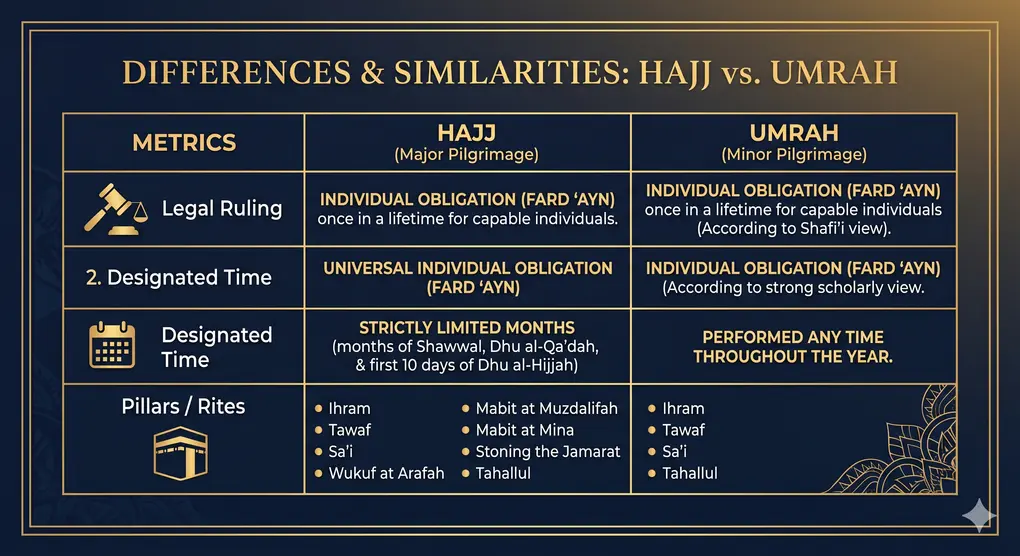
Although both are vital acts of devotion performed in the Holy Land, there are fundamental differences. Hajj has a strictly specified timeframe (the months of Hajj, culminating in Dhu al-Hijjah) and encompasses a broader array of rites. These include the standing (Wukuf) at Arafah, staying overnight in Muzdalifah and Mina, and stoning the Jamarat, all deeply rooted in the history of the Hajj pilgrimage.
Conversely, Umrah can be performed year-round. The rites of Umrah are considerably fewer: entering the state of Ihram, performing Tawaf around the Kaaba, performing Sa’i between Safa and Marwah, and concluding with Tahallul (cutting or shaving the hair).
Regarding their similarities, both require firmly understanding the intention (Niyyah) and specifically formulating the intention for Ihram from the designated boundary (Miqat). Both are legislated for those who are physically and financially capable, ensuring a safe journey.
The Profound Wisdom Behind the Obligation
Establishing the legal basis of Hajj and Umrah as obligations carries profound divine wisdom. Recognizing the wisdom behind the Hajj pilgrimage includes:
- Strengthening Monotheism (Tawhid): The entire sequence of Hajj-related rituals revolves around affirming the absolute Oneness of Allah.
- Fostering Islamic Unity: Millions of Muslims globally gather with a unified purpose, wearing identical, unstitched Ihram garments, eliminating all social, racial, or national distinctions.
- Expiation of Sins: Authentic texts confirm that an accepted (Mabrur) Hajj guarantees Paradise and the complete expiation of past sins.
- Cultivating Patience and Discipline: Performing these rites demands tremendous patience, physical endurance, and strict discipline.
Conclusion
Understanding that the legal basis of Hajj is Fard ‘Ayn for the capable, and recognizing the strong Shafi’i view that Umrah is equally obligatory, constitutes essential foundational knowledge for every Muslim. By comprehending the evidences from the Quran and Sunnah, believers cultivate a stronger consciousness to fulfill these noble acts of worship. May Allah (SWT) grant us all the profound opportunity to become His guests at the Baitullah and perform Hajj and Umrah perfectly.
Frequently Asked Questions (FAQ)
What is the primary legal basis of Hajj in Islam?
The primary legal basis of Hajj is found in the Quran (Surah Ali ‘Imran: 97), authentic Hadith outlining the five pillars of Islam, and the absolute consensus (Ijma) of Muslim scholars that it is an individual obligation (Fard ‘Ayn) for the capable.
Is Umrah obligatory according to the Shafi’i school of thought?
Yes. According to the strongest opinion (al-azhhar) in the Shafi’i Madhhab, performing Umrah is an obligation (Fard) once in a lifetime for those who possess the physical and financial capability, bearing the same mandatory status as Hajj.
What is the main difference between Hajj and Umrah?
The fundamental difference lies in their designated timing and required rituals. Hajj must be performed during specific Islamic months and includes additional rites like standing at Arafah and staying in Mina, whereas Umrah can be performed at any time of the year and involves fewer steps.
Academic References:
Mustafa al-Khin, Mustafa al-Bugha, and Ali al-Syarbaji. Al-Fiqh al-Manhaji ‘ala Madhhab al-Imam al-Shafi‘i. Vol. 2. Damascus: Dar al-Qalam, 1992, p. 115.


