
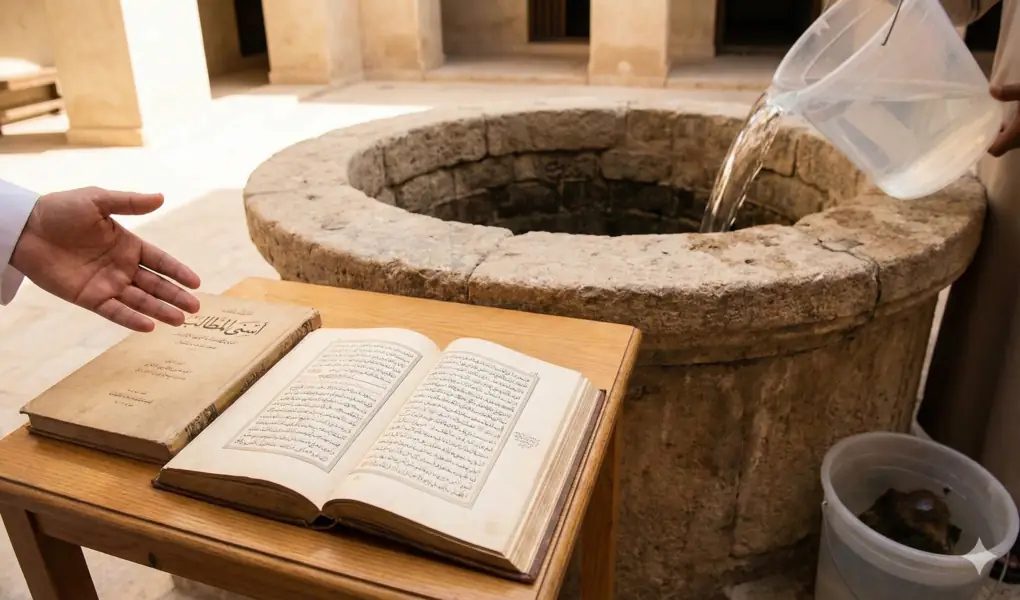
Have you ever experienced an unpleasant situation while preparing for ritual purification (thaharah)? For instance, while drawing water from a well, you suddenly find a dead lizard, a mouse, or other impurities (najis) inside. Doubt immediately creeps in. Is this water still valid for wudu (ablution)? Must the well be completely drained until it is dry?
Many people assume that the only solution for purifying well water is to drain it completely (nazh). However, in the study of Islamic jurisprudence (Fiqh), specifically within the Shafi’i Madhhab, this step is not always correct. In certain conditions, draining a well can actually complicate the purification process.
Let us examine this issue by referring directly to the classical text Asna al-Matalib Sharh Rawd al-Talib by Shaykh al-Islam Zakariyya al-Ansari, specifically Volume 1, page 16. We will discuss the legal status of such water and the practical solutions to purify it.
Original Text and Translation from Asna al-Matalib
Before diving into the detailed explanation, let us look at the original Arabic text from the reference to ensure a strong jurisprudential foundation.
فرع: إذا قل ماء البئر، وتنجس لم يطهر بالنزح بل بالتكثير كأن يترك أو يصب عليه ماء ليكثر قال في الأصل لا ينبغي أن تنزح لينبع الماء الطهور، بعده لأنه، وإن نزح فقعر البئر يبقى نجسا، وقد تنجس جدران البئر أيضا بالنزح. (وإن كثر) الماء (وتمعط فيه فأرة) مثلا عبارة الأصل، وتفتت فيه شيء نجس كفأرة تمعط شعرها (ولم يتغير فهو طاهر) بمعنى طهور (تعذر) ، وفي نسخة لكن يتعذر (استعماله) باغتراف شيء منه بدلو أو نحوها (إذ لا يخلو دلو) ، وفي نسخة كل دلو (منه) أي مما تمعط (فلينزح ما غلب على ظنه خروجه فيه) […]
English Translation:
(Branch Issue: If the well water is little in volume and becomes contaminated, it is not purified by being drawn out/drained, but rather through at-taktsir / increasing its volume) such as leaving it (so the spring adds to the water volume) or pouring other water over it so it becomes abundant.
The author of al-Ashl (Imam al-Nawawi) said: “The well should not be drained so that pure spring water gushes forth afterward. Because even if it is drained, the bottom of the well remains najis, and the walls of the well also become najis due to the draining process.”
(And if) the water (is abundant, and a mouse sheds its hair in it)—for example, the phrase in al-Ashl says: “And an impure thing decomposes in it, like a mouse whose hair falls out”—(and the water does not change in its attributes, then it is pure) meaning purifying.
(However, it is difficult)—and in one manuscript “but it is difficult”—(to use it) by scooping a portion of it with a bucket or the like (because no bucket is free)—and in one manuscript “every bucket”—(from it) meaning from the hair that fell out.
(So let him drain the water to the extent that he strongly believes / ghalib al-zhan that the najis has come out with it).
Purifying Well Water: Two Primary Scenarios
To correctly apply these rulings, we must categorize the water based on its volume, which determines how to purify impure water.
1. The Case of a Small Amount of Well Water (Less Than 2 Qullahs)
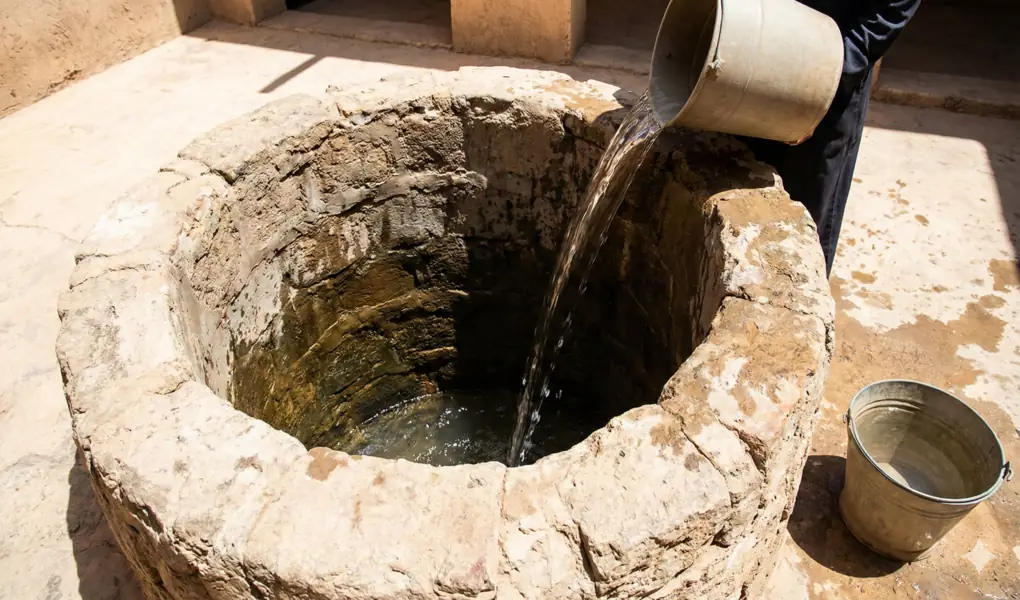
In Shafi’i Fiqh, a small amount of water (less than 2 qullahs, approximately 216 liters) that comes into contact with najis automatically becomes impure (mutanajjis), even if its color, smell, or taste does not change.
Why is Draining Prohibited?
Many people mistakenly drain the well until it is dry. Shaykh al-Islam Zakariyya al-Ansari logically explains why this is an error:
If you draw out the impure water, it will run down the walls of the well. Consequently, the walls and the base of the well become najis because they are wet with contaminated water. When the new spring water emerges (even though it is originally pure), it will come into contact with the contaminated walls and base. The result? The new water instantly becomes najis again.
The Solution: The Technique of At-Taktsir
The correct method for purifying well water in this scenario is At-Taktsir. You have two options:
- Leave the well alone: Allow the natural spring to fill the well until the volume increases and reaches the threshold of “abundant water” (2 qullahs).
- Add water manually: Pour pure water from an external source into the well until the volume overflows and reaches 2 qullahs.
Once the volume reaches 2 qullahs and the attributes of the water (smell, taste, color) remain normal, the entire body of water inside the well becomes pure and purifying. This principle is vital when learning about the types of water in Islam and their usage.
2. The Case of a Large Amount of Well Water (More Than 2 Qullahs)
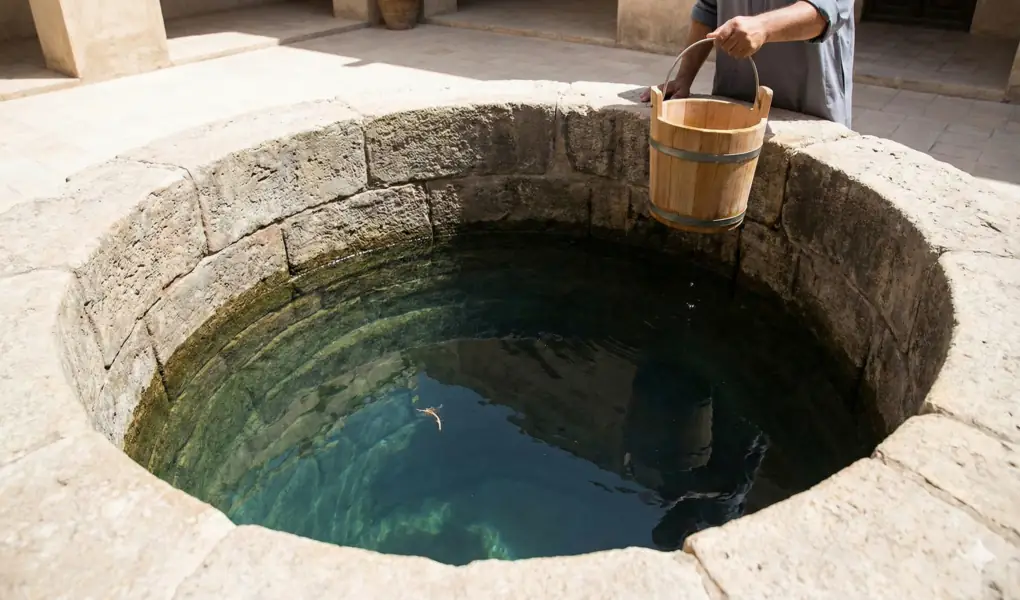
What if the well is deep and contains abundant water, but a dead mouse decomposes or sheds its hair inside it? This often raises questions similar to those regarding the ruling of cat hair in Islam, where small detached hairs can be problematic.
As long as the water does not change (no foul odor, no discoloration from the carcass), the water remains pure. The mere dropping of najis does not immediately render a large body of water impure.
Usage Challenges and Practical Solutions
Although the well water is pure, a problem arises when you try to draw it. Because the carcass has decomposed or its hair has scattered, there is a valid concern that every time you drop the bucket, some impure hair might be scooped up. If a piece of the carcass or hair enters the bucket, the water inside the bucket becomes mutanajjis (because the volume in the bucket is less than 2 qullahs).
The text provides clear guidance for this:
- Drain a Portion: Draw and discard water only to the extent of a strong presumption (ghalib al-zhan) that the impurities/hairs have been completely removed. You do not need to drain it dry.
- The Ruling of the Water in the Bucket: If you draw water, inspect the bucket, and see no visible hair or impurities, the water in that bucket is pure.
- Ignore Baseless Doubts: Do not succumb to excessive anxiety (was-was). Even if you internally suspect, “What if there is a microscopic hair I cannot see?”, mere doubt (zhan) cannot overpower the original certainty (al-ashl) that the water is pure.
Summary Table of Rulings on Well Water
To simplify your understanding, here is a comparison table for handling contaminated well water:
| Water Condition | Nature of Contamination | Initial Status | Incorrect Action | Correct Purification Method |
| Small Volume (< 216 Liters) | Najis falls in (even with no change in attributes) | Impure (Mutanajjis) | Draining completely (Nazh) | Adding water (Taktsir) until it reaches 2 qullahs |
| Large Volume (> 216 Liters) | Najis falls & decomposes (no change in attributes) | Pure & Purifying | Discarding all water unnecessarily | Draining a portion until confident the solid najis is gone |
Frequently Asked Questions (FAQ)
What is the exact measurement of 2 qullahs?
Modern scholars have various conversions, but the safe estimate ranges from 216 to 270 liters. If your well or water tank is a square measuring 60cm x 60cm x 60cm and is completely full, it has reached the 2 qullahs threshold.
What if I unintentionally used the contaminated water for a major ritual bath (ghusl)?
If the water was abundant (more than 2 qullahs) and its attributes did not change, your ghusl is valid. However, if the water volume was small, or if it was abundant but its smell or color changed due to the carcass, then your ghusl is invalid and must be repeated after finding pure water.
Can chlorine be used for purifying well water from najis?
Medically, chlorine functions to clarify water and kill germs. However, in Islamic jurisprudence, what transforms najis water back to a pure state is the addition of water volume (taktsir), not chemical clarification. Nevertheless, if chlorine is mixed into the pure water that is being poured into the well to increase its volume, it can aid the physical cleaning process alongside the taktsir.
What does the principle of “Prioritizing Al-Ashl” mean?
This is a fundamental Fiqh maxim. For example: You draw water from an abundant well where a dead mouse was found. When you look inside your bucket, the water is perfectly clear. The original ruling (al-ashl) is that the water is pure. The presence of unseen mouse hair is merely a doubt. Therefore, we hold onto the original ruling (pure) and ignore the doubt.
Conclusion
Understanding the jurisprudence of water (thaharah) greatly assists us in performing our daily worship without falling into excessive anxiety. Islam provides highly logical rules: Do not overcomplicate things by draining a shallow contaminated well; simply add more water. If the water is abundant, do not fear using it unless there is a clear change in its smell, taste, or color.
This knowledge prevents us from falling into extreme doubt or mistakenly treating pure water as makruh water or najis. Hopefully, this explanation from the classic text Asna al-Matalib resolves your confusion regarding purifying well water at home.
Reference
Zakariyā al-Anṣārī, Asnā al-Maṭālib fī Sharḥ Rawḍ al-Ṭālib, with marginalia by Aḥmad al-Ramlī, edited by Muḥammad az-Zuhrī al-Ghamrāwī (Cairo: al-Maṭbaʿah al-Maymānīyah, 1313 AH; repr. Dār al-Kitāb al-Islāmī), vol. 1, p. 16.


