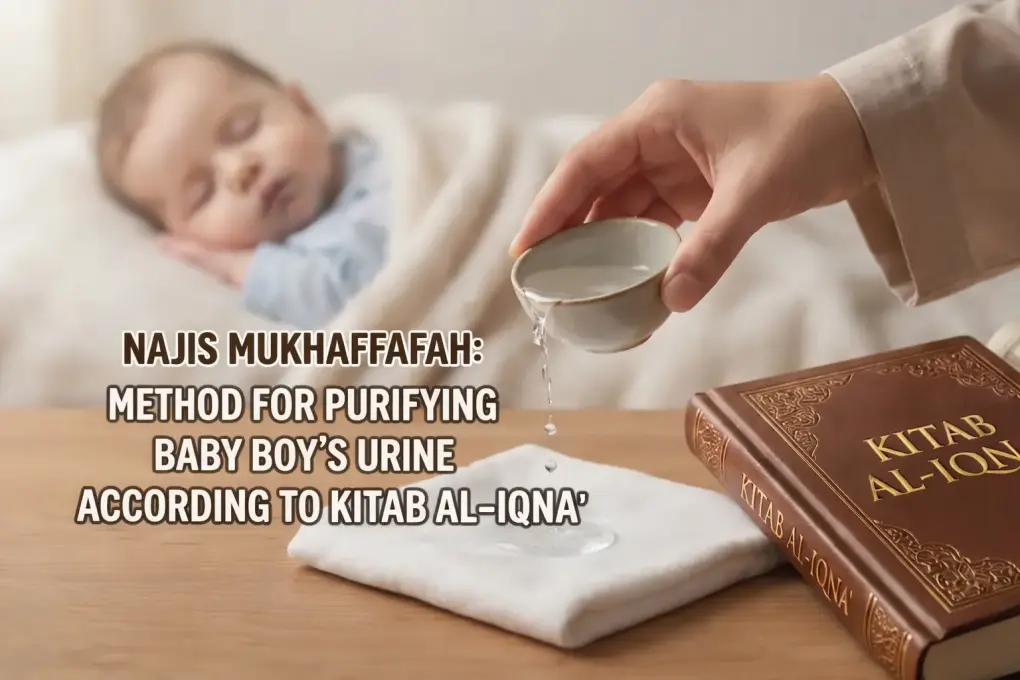
For new parents, managing diapers and infant urine is a daily reality. Amidst the busyness of caring for a little one, Islam provides profound ease and practicality in various aspects of worship, particularly concerning thaharah (ritual purity). One of the most frequently asked questions regarding these dispensations involves the urine of a baby boy.
Many have heard that a baby boy’s urine is “lighter” to clean. However, what are the precise academic parameters? Is a wet wipe sufficient, or is water strictly required? In this article, we will examine the classic Shafi’i jurisprudential text, Al-Iqna’ fi Hall Alfaz Abi Shuja’, to comprehensively understand what najis mukhaffafah is and how to manage it correctly to ensure the validity of our worship.
What is Najis Mukhaffafah?
Within the Shafi’i school of thought (madhhab), impurities are categorized into three distinct levels, as explained in the general definition of najis: severe (mughallazah), medium (mutawassithah), and light (najis mukhaffafah).
Najis mukhaffafah is a specific jurisprudential term designating the urine of a baby boy who has not consumed any food other than breast milk (ASI) and has not yet reached the age of two lunar years. The ruling strictly hinges on three variables: gender, dietary intake, and age.
Understanding this classification is crucial because its purification method is significantly simpler than that of standard impurities. This ruling reflects the inherent compassion of Islamic law (syariat) toward parents who may be overwhelmed by the demands of infant care.
Textual Analysis of Al-Iqna’ on Light Impurity
To ensure academic and theological accuracy, let us directly examine the authoritative text. The following is an excerpt from the book Al-Iqna’ (Volume 1, Page 90), accompanied by its jurisprudential explanation.
Original Arabic Text
القَوْل فِي النَّجَاسَة المخففة وإزالتها ثمَّ شرع فِي حكم النَّجَاسَة المخففة فَقَالَ (إِلَّا بَوْل الصَّبِي الَّذِي يَأْكُل الطَّعَام) أَي للتغذي قبل مُضِيّ حَوْلَيْنِ (فَإِنَّهُ يطهر برش المَاء عَلَيْهِ) بِأَن يرش عَلَيْهِ مَا يعمه ويغمره بِلَا سيلان بِخِلَاف الصبية وَالْخُنْثَى لَا بُد فِي بولهما من الْغسْل على الأَصْل ويتحقق بالسيلان
Translation and Jurisprudential Meaning
The author elucidates that this specific ruling applies exclusively as follows: “Except the urine of a baby boy who has not consumed food (for the purpose of nutrition) before the passing of two years.”
The purification method is explicitly stated: “Then indeed, it becomes pure by sprinkling water upon it. Namely, by sprinkling water such that it comprehensively covers and inundates it without flowing.”
This is the fundamental distinction. Unlike washing ordinary soiled clothes where water must physically flow (sialan) and the fabric must be wrung out, in this specific case, water only needs to be sprinkled until the affected area is thoroughly moistened. The water does not need to drip onto the floor.
Conversely, the text emphatically highlights the different protocol for female infants: “In contrast to the baby girl and the khuntha (intersex), it is obligatory regarding the urine of both to perform washing (al-ghusl) based on the original ruling, and that is achieved by the flowing of water.”
Primary Conditions for the Sprinkling Method
It is important to note that not all infant male urine automatically qualifies as a light impurity. Several strict parameters must be met based on the aforementioned text.
1. Must be a Male Infant

The absolute first prerequisite is the male gender. If the infant is female or khuntha (possessing ambiguous genitalia), the urine is classified as a medium impurity (najis mutawassithah). The purification method requires pouring water until it flows and completely removes the odor, color, and taste.
2. No Consumption of Supplementary Food
The infant must exclusively consume breast milk. The phrase “consumed food” in the Arabic text refers to eating for the purpose of nutrition or satiation (li at-taghazzi). Therefore, if a baby has begun consuming complementary foods (MPASI) such as porridge, biscuits, or bananas, the status of the urine reverts to a standard impurity.
What about formula milk? The majority of contemporary Shafi’i scholars argue that formula milk constitutes “food” because it serves as a satiating nutritional substitute. Consequently, the urine of a baby consuming formula must be washed with flowing water, not merely sprinkled.
3. Under Two Lunar Years of Age
The maximum time limit is two Hijri (lunar) years. If the child surpasses the age of two, even if he still exclusively drinks breast milk and refuses solid food, his urine is legally deemed a standard impurity that requires full washing.
Exceptions: Tahnik and Medication Are Not Considered Food
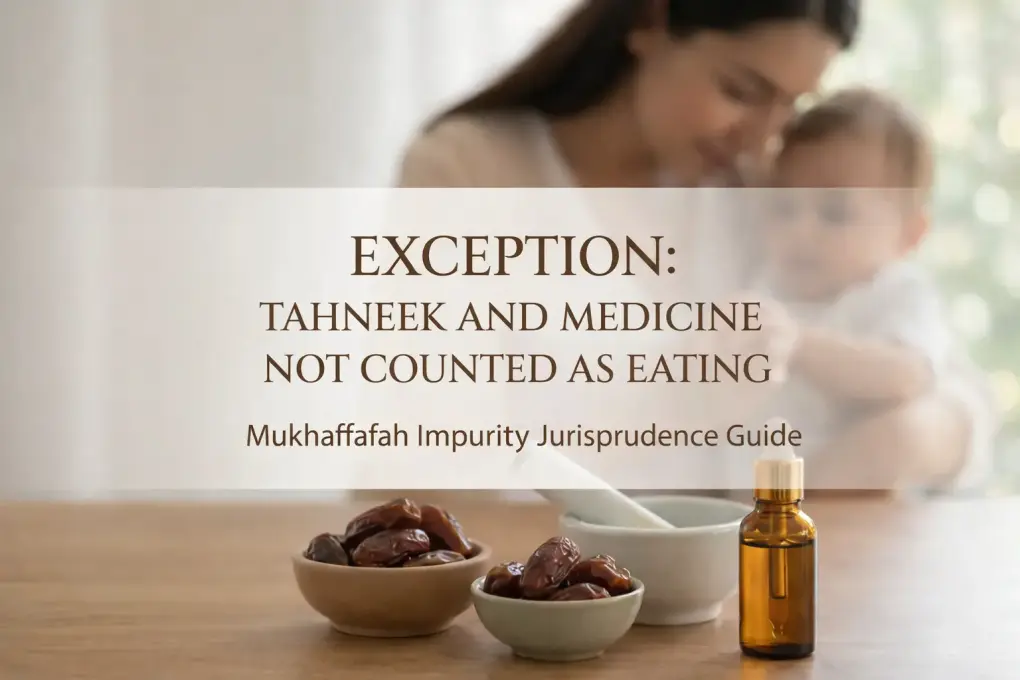
Fortunately, Al-Iqna’ provides clear exceptions. The text clarifies that items entering the infant’s mouth for purposes other than satiation do not alter the impurity’s status.
- Tahnik: The prophetic practice of chewing a date and rubbing it on the newborn’s palate for blessings.
- Medication: Fever-reducing syrups, vitamin drops, or prescribed powders designed for bodily recovery.
These things do not prevent the permissibility of simply sprinkling water when cleaning up urine.
Because these substances are administered for health or spiritual blessings rather than primary nutrition, they do not hinder the permissibility of simply sprinkling water to clean the infant’s urine.
Why Differentiate Between Male and Female Infants?
A common question arises: why is there a distinction when both are merely infants? Al-Iqna’ cites the underlying wisdom (hikmah) based on the authentic Hadith of the Prophet Muhammad ﷺ, which is one of the primary sources of Islamic law.
From Ummu Qais, that she came with her young son who had not yet eaten food, and the Messenger of Allah ﷺ sat him on his lap. Then the baby urinated on him. So he called for water and sprinkled it, and he did not wash it. (Narrated by Bukhari & Muslim)
Scholars mention two logical factors behind this differentiation:
- Frequency of Carrying: Historically, male infants were more frequently carried and passed around by various people. Requiring a full wash every time the child urinated would cause significant hardship (masyaqqah).
- Characteristics of the Urine: Classical texts note that the urine of a breastfed male infant is physically thinner (araqqu) than that of a female infant. Because it is less viscous, it does not bind as tenaciously to fabric fibers, making it easier to neutralize with a mere sprinkle of water.
Step-by-Step Guide to Purifying Najis Mukhaffafah
To eliminate any practical doubts, here is the procedural method for purifying najis mukhaffafah on carpets, mattresses, or clothing:
- Remove the Physical Substance: If the urine is pooled (e.g., on a ceramic floor), wipe it first with a dry cloth or tissue until the surface is dry.
- Obtain Pure Water: Prepare a container of pure water (mutlaq water).
- Sprinkle or Splash Lightly: Sprinkle the water onto the affected area. Ensure the volume of water applied is greater than, or at least equal to, the volume of the urine.
- Ensure Comprehensive Coverage: The sprinkled water must cover the entire soiled area (ya’ummuhu and yaghmaruhu).
- No Need to Flow: You do not need to pour water until it floods or wring out the fabric. Allow the water to soak in and overpower the impurity, then let it dry naturally.
Important Notes on Odor and Color
Must the smell of urine completely disappear? Al-Iqna’ states: “And it is obligatory during the sprinkling process to remove the attributes of the impurity (such as odor, color, and taste) just like other impurities.”
Even though the method is light, the ultimate objective remains complete cleanliness to ensure the validity of your sholat (prayer). Generally, the urine of a baby exclusively consuming breast milk does not have a pungent odor and dissipates easily with water. While some scholars, like Imam Az-Zarkashi, state that a lingering, hard-to-remove odor is excused (ma’fu), the stronger opinion advises ensuring all traits of the najis are thoroughly eliminated for total spiritual peace of mind.
Conclusion
Understanding the classifications of impurities, specifically najis mukhaffafah, significantly assists Muslim parents in maintaining household hygiene and the purity of their prayer garments. Islamic jurisprudence does not seek to burden its adherents. By knowing that the urine of a breastfed baby boy only requires sprinkling, the daily laundry workload is alleviated without compromising the validity of our worship.
Therefore, if your newborn son urinates on your clothes moments before prayer, there is no need to panic. Simply take pure water, sprinkle it comprehensively over the area, and you are ready to stand before Allah.
Frequently Asked Questions (FAQ)
1. Does giving my baby boy water or medicine change his urine from najis mukhaffafah to a standard impurity?
No. According to Shafi’i scholars, giving a baby water for hydration, medicine for illness, or dates for tahnik does not change the status of the urine. The ruling only changes if the baby consumes food or milk meant for satiation and primary nutrition (like porridge or formula).
2. How do I clean najis mukhaffafah if it gets on a thick mattress or carpet?
First, absorb the excess urine using dry paper towels or a cloth until the area feels dry. Next, take pure water and sprinkle it generously over the exact spot until the water volume exceeds and completely covers the trace of the urine. You do not need to pour water until it flows through the mattress. Allow it to air dry.
3. If my baby boy is over two years old but still exclusively breastfed, is his urine still considered najis mukhaffafah?
No. Once the male infant reaches two lunar years of age, his urine automatically becomes a medium impurity (najis mutawassithah), regardless of his diet. It must then be washed with flowing water until the color, taste, and smell are removed.
Reference
Muḥammad ibn Aḥmad al-Khaṭīb ash-Shirbīnī, al-Iqnāʿ fī Ḥall Alfāẓ Abī Shujāʿ, ed. Maktab al-Buḥūth wa ad-Dirāsāt (Beirut: Dār al-Fikr, n.d.), 1:90.


