

Have you ever felt doubtful after completing your worship, wondering, “Was my prayer valid?” or “Are my clothes truly pure?” These questions naturally arise because every Muslim profoundly desires their worship to be accepted by Allah SWT.
Prayer (Salah) is not merely a sequence of standing, bowing, and prostrating. There is an essential “entry ticket” we must secure before commencing. This ticket refers to the conditions for a valid prayer. If this foundation is flawed, we cannot legally enter the state of worship, meaning the prayer is not recognized by Islamic law.
In the study of Islamic jurisprudence (Fiqh), specifically within the Shafi’i school of thought (Ahlus Sunnah wal Jama’ah), one of the primary references is the classical text Fathul Qarib Al-Mujib. This foundational book explains legal rulings concisely yet comprehensively. Let us explore these conditions together to bring tranquility and certainty to our daily worship. However, if you are unfamiliar with the linguistic and technical meanings of the prayer itself, it is highly recommended to first read about the definition of prayer.
What is the Difference Between Conditions and Pillars of Prayer?
Before delving into the core discussion, we must align our conceptual understanding. Many individuals confuse the conditions (syarat) with the pillars (rukun).
Simply put, the conditions for a valid prayer are the prerequisites that must be fulfilled before the prayer begins and must be maintained until the prayer concludes. Conversely, the pillars are the inherent components of the prayer itself, such as reciting Surah Al-Fatihah or prostrating. You can learn more about how many pillars of prayer exist to differentiate them clearly.
The author of Fathul Qarib, Shaykh Ibn Qasim Al-Ghazi, provides an academic distinction:
“Linguistically, a condition is a sign. In Islamic law (Shari’ah), a condition is a determinant for the validity of the prayer, yet it is not a part of the prayer itself.”
Therefore, Shaykh Ibn Qasim Al-Ghazi outlines 5 (five) primary conditions. If even a single point is missing, both obligatory (fardh) and voluntary (sunnah) prayers become invalid.
5 Conditions for a Valid Prayer According to Fathul Qarib
Here is a detailed breakdown of the five prerequisites found in this legendary classical text, accompanied by practical explanations for daily life.
1. Purity of the Body from Hadath
The first and most fundamental requirement is personal ritual purity. Our bodies must be completely cleansed from two types of hadath (states of impurity):
- Minor Hadath: A condition requiring wudu (ablution), such as after urinating, defecating, or passing gas.
- Major Hadath: A condition requiring ghusl (ritual bath/janabah), such as after marital relations, menstruation, or postpartum bleeding.
Under normal circumstances, this rule is absolute. We must perform ablution or a ritual bath using the proper types of water in Islam. However, Islam is a religion built on facilitation, not hardship. If a person cannot find valid media for purification like water, they are permitted to perform tayammum using pure dust.
What if someone lacks both water and dust (a state known as faqid at-tuhurain)? According to Shafi’i jurisprudence, the individual must still pray out of respect for the prescribed time, but they are obligated to repeat the prayer later once a purifying agent is found.
2. Purity of Clothing, Body, and Place from Najis

Physical cleanliness is a strict prerequisite. We must ensure that no najis (physical impurity) is attached to our body, worn clothing, or the area of prostration. There are three specific areas that require meticulous attention:
- Body: Ensure no traces of urine or other impurities remain on the skin.
- Clothing: Shirts, trousers, sarongs, or prayer garments (mukena) must be pure. Be cautious of impure water splashes in the bathroom that might touch the hem of your trousers.
- Place of Prayer: The prayer mat or floor where we stand, bow, and prostrate must be clean.
It is important to note that the Shafi’i standard for the “place of prayer” means avoiding direct physical contact with the impurity. If there is a light najis or other impurity on the floor, and you place a thick, pure prayer mat over it so your body does not touch the impurity, your prayer remains valid. The prayer is only nullified if the impurity physically touches your body or clothing during the prayer. For deeper academic insight, you can read about the comprehensive definition of najis.
3. Covering the ‘Awrah




The third requirement is covering the ‘awrah (intimate parts). This applies to anyone capable of doing so, even when praying alone in a completely dark room. Covering the ‘awrah during prayer is an act of profound reverence towards Allah SWT, not merely about modesty before human eyes.
The obligatory boundaries are:
- Men: The area between the navel and the knees. Ensure that during prostration, the back of the shirt does not ride up, exposing the lower back.
- Women: The entire body except for the face and the hands (both the palms and the back of the hands).
The fabric used must be thick enough to obscure the skin color beneath it. Wearing transparent clothing renders the prayer invalid. Although the strict requirement is simply to cover the ‘awrah with pure cloth, Fiqh scholars highly recommend wearing white garments and applying fragrance as a recommended practice (sunnah), aligning with the prophetic ideal of clothing for seekers of knowledge.
4. Knowing the Prayer Time has Entered
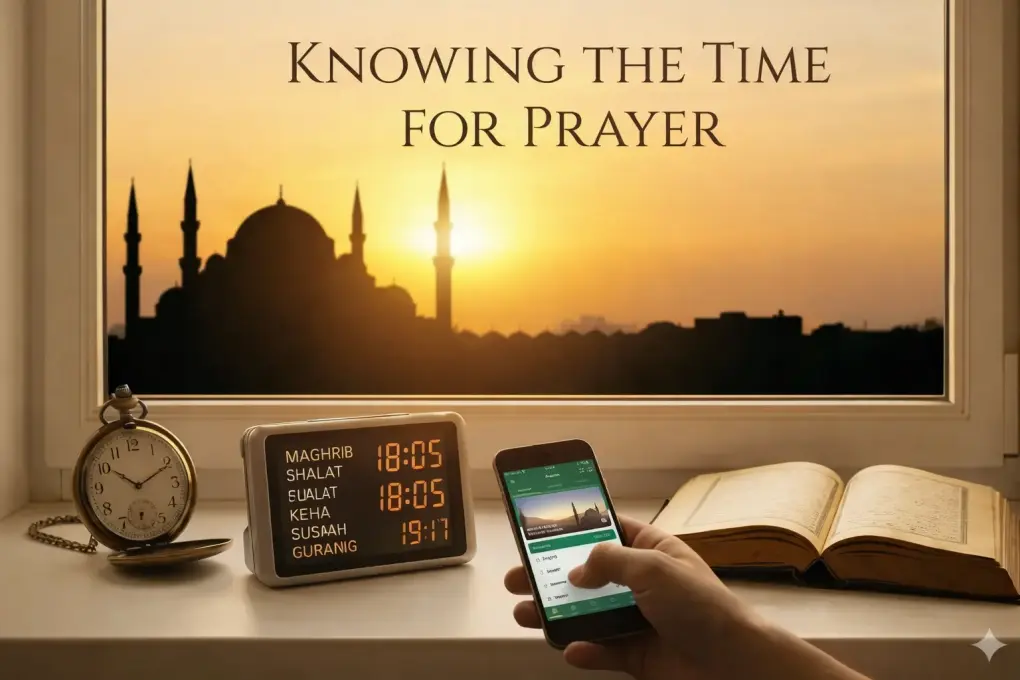
You cannot perform the Dhuhr prayer at 10:00 AM, regardless of your sincerity. You must wait until the Dhuhr prayer time legitimately begins. This certainty can be attained through:
- Certainty (Yaqin): Observing the sun setting (for Maghrib) or hearing the adhan and iqamah from a reliable local mosque.
- Strong Assumption (Ijtihad): Individuals in remote areas without clocks must strive to estimate the time, such as by observing the sun’s shadow.
If someone prays with hesitation about the time and proceeds without verifying, their prayer is invalid—even if their guess coincidentally turned out to be correct. Always verify the prayer schedule in your local area first.
5. Facing the Qibla (The Kaaba)
The final condition is facing the Kaaba. For Muslims residing outside of Mecca, the obligation is to direct oneself toward the general direction of the Kaaba.
This alignment must be maintained with the chest (bish-shadri), not merely turning the face. While standing and bowing, the chest must squarely face the Qibla. Exceptions exist for emergencies, such as during intense battle (salat al-khawf) or when performing voluntary prayers while traveling on a conveyance. However, in normal circumstances, facing the Qibla is an absolute requirement.
Original Reference Text from Fathul Qarib
To preserve the academic authenticity of this Islamic jurisprudence, we include the original Arabic text from Fathul Qarib Al-Mujib discussing this chapter:
{ فصل }
قوله: (وشرائط الصلاة قبل الدخول فيها خمسة أشياء)… الشرط الأول (طهارة الأعضاء من الحدث) الأصغر والأكبر عند القدرة… (و) طهارة (النجس) الذي لا يعفى عنه في ثوب وبدن ومكان… (و) الثاني (ستر) لون (العورة) عند القدرة… (و) الثالث (الوقوف على مكان طاهر)… (و) الرابع (العلم بدخول الوقت) أو ظن دخوله بالاجتهاد… (و) الخامس (استقبال القبلة) أي الكعبة1…
Summary Table of Prayer Conditions
For easier memorization, here is a quick reference table of the points discussed above:
| No | Condition for Valid Prayer | Brief Explanation |
| 1 | Purity from Hadath | Perform Wudu for minor hadath; Ghusl (ritual bath) for major hadath. |
| 2 | Purity from Najis | Ensure the Body, Clothing, and Place of prayer are entirely free from physical impurities. |
| 3 | Covering the ‘Awrah | Use opaque fabric. Men: Navel to knees. Women: Entire body except face and hands. |
| 4 | Entering the Prayer Time | Must have certainty the prayer time has arrived (guessing with doubt is invalid). |
| 5 | Facing the Qibla | Aligning the chest directly toward the Kaaba in Mecca. |
Frequently Asked Questions (FAQ)
Here are some frequently asked questions regarding this topic:
Is the prayer valid if the ‘awrah is slightly exposed during movement?
If the ‘awrah is exposed due to the wind or an unintentional movement and is covered immediately in that exact moment, the prayer remains valid. However, if it is left exposed or if the exposure is due to negligence (e.g., wearing clothing that is too tight or too short), the prayer is nullified.
What if I forget that my clothes are tainted with najis, and I only remember after the prayer is finished?
The prayer is invalid and must be repeated. Purity from najis is an absolute condition for a valid prayer that must be fulfilled, regardless of forgetfulness.
Are the conditions for a valid prayer the same across all schools of thought (Madhahib)?
Fundamentally, yes, but there are detailed academic differences. For example, the exact boundaries of a woman’s ‘awrah (whether the back of the hands is included) or specific methods of purification may vary slightly. This article strictly focuses on the Shafi’i perspective, which is the majority view practiced in Southeast Asia.
Is the intention (Niyyah) considered a condition for a valid prayer?
In Fathul Qarib and generally within the Shafi’i school, the intention is classified as a Pillar of Prayer (Rukun), not a pre-condition (Sharat). This is because the intention must be made simultaneously with the commencement of the prayer (Takbiratul Ihram), rather than beforehand.
Conclusion
Understanding the conditions for a valid prayer according to Fathul Qarib profoundly assists us in performing our worship with greater tranquility. By knowing these legal parameters, we can eliminate unnecessary doubts (was-was).
In essence: perfect your ablution, ensure your clothing is pure and properly covers your ‘awrah, pray within the designated times, and direct both your physical body and your heart toward the Qibla. May Allah SWT accept every single one of our prostrations.
Reference
- Muḥammad ibn Qāsim al-Ghazzī, Fatḥ al-Qarīb al-Mujīb fī Sharḥ Alfāẓ al-Taqrīb, ed. Bassām ʿAbd al-Wahhāb al-Jābī, 1st ed. (Beirut: Al-Jaffān wa-al-Jābī; Dār Ibn Ḥazm, 2005), 73–74. ↩︎


