
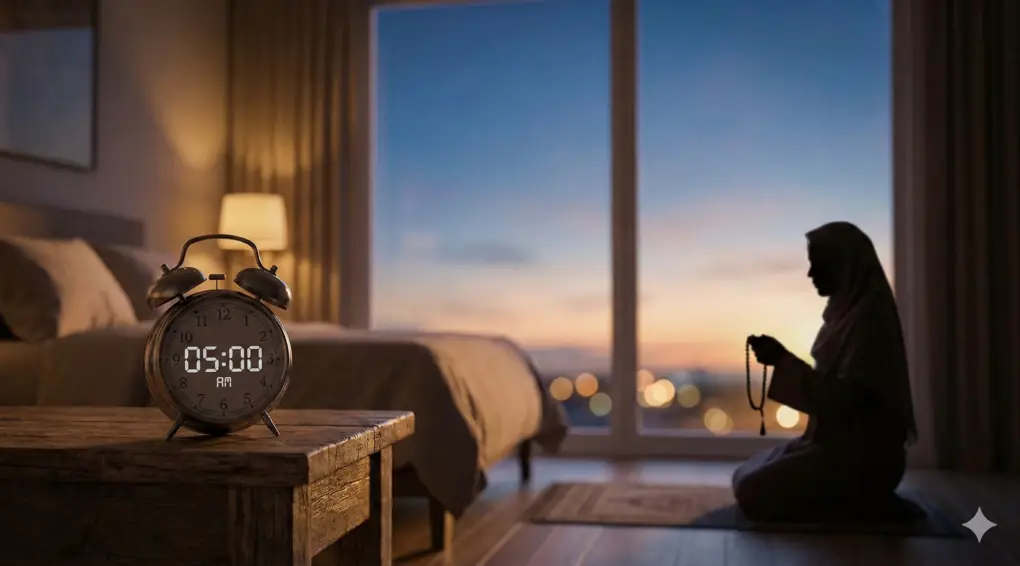
Have you ever woken to a brightening sky and panicked: “Is there still time for Fajr?” or “When does Fajr time actually end?”
This question is perfectly natural.. In the midst of busyness or fatigue, sometimes we wake up a little late. However, knowing the precise time limits is crucial so that our prayer is not rendered qadhāʾ (performed after its prescribed time) or invalid.
In this article, we will dissect the rules regarding the time of the Fajr prayer based on reliable references, namely the book Asna al-Matalib Syarh Raudhat at-Thalib by Sheikh Zakariyya al-Ansari (Volume 1, page 117). We will see how scholars divide the time of Fajr into several phases, from the best time to the disliked time (makruh).
When is the Beginning and End Time of the Fajr Prayer?
Simply put, the time for the Fajr prayer begins with the appearance of the true dawn (sadiq) and ends at sunrise (syuruq).
In the book Asna al-Matalib, Sheikh Zakariyya al-Ansari explains:
قوله: (وهو) أي الفجر الصادق (أول) وقت (الصبح) ويمتد إلى طلوع الشمس لخبر مسلم «وقت صلاة الصبح من طلوع الفجر ما لم تطلع الشمس»
“The true dawn (ṣādiq) marks the beginning of Fajr time; it continues until sunrise (shurūq), based on a hadith narrated by Muslim: ‘The time for Subuh prayer is from the appearance of dawn until the sun rises.'”
Therefore, the reference is astronomical: the position of the sun (not the clock) determines Fajr time. However, for today’s dawn prayer time, we usually rely on the imsakiyah schedule which has been converted into hours by the ministry of religious affairs or local astronomical institutions.
If your timetable lists sunrise at 05:45, then 05:45 is the final cutoff for Fajr; a prayer performed after that is qadhāʾ. Even one minute past that time, your prayer will be considered qadha (made up).
Four phases of Fajr time (Shafiʿī view)
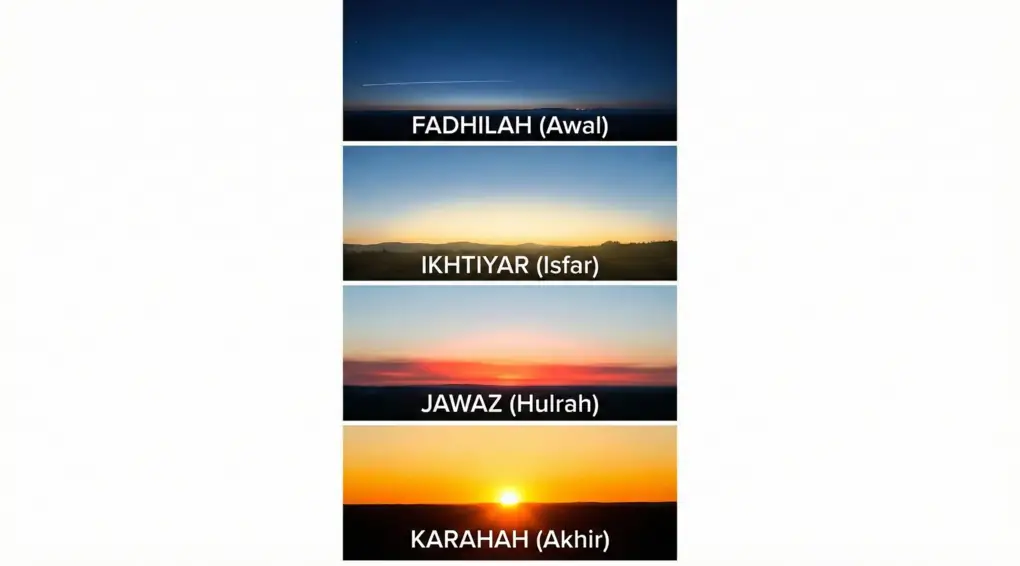
Many people think that the time of Subuh (dawn prayer) is “flat” or has the same value from beginning to end. In reality, the Shafi’i scholars divide it into four levels. This determines how much reward we gain or, conversely, the risk we take.
1. Fadhilah Time (Prime Time)
This is the best time. The prime time begins at true dawn (ṣādiq)—immediately after dawn breaks and the adhan is called. Prayer performed now is fadīlah (most meritorious). Performing the prayer at this time has the highest value of reward.
2. Preferred Time (Elective Time)
If you don’t have time to pray right at the beginning of the time, there is still time for ikhtiyar. Until when?
Shaykh Zakariyya explained:
قوله: (والاختيار) أي وقته يمتد (إلى الإسفار)
“(And the time of Ikhtiyar) means the preferred time extends (until al-isfar/the sky begins to lighten).”
The limit is al-isfār: when the sky lightens so that a person’s face is visible without artificial light, though the sun has not yet risen, but the sun has not yet risen.
3. Permissible Time (Allowed Without Dislike)


The third phase is the time of jawaz. You are allowed to pray during this time and will not be sinful, although you will miss the virtue of the initial time. It extends until the first reddish glow (al-ḥumrah) appears on the eastern horizon.
قوله: (ثم الجواز) بلا كراهة إلى الحمرة التي قبل طلوع الشمس
“(Then the Time of Jawaz) without any dislikedness, namely until the appearance of reddish hues before sunrise.”
4. Time of Karahah (Disliked Time)
This is the time to avoid: karāhah. It refers to praying when the sun is about to rise and the sky is very bright—close to the moment of sunrise. The sky is already very bright and red, approaching the moments of sunrise.
Why is it disliked (makrūh)? Because delaying until this time resembles the behavior attributed to hypocrites in the hadith literature. In the text of the book, the following hadith of the Prophet SAW is mentioned:
“That is the prayer of the hypocrite; he sits observing the sun until, when the sun is between the two horns of Satan (almost setting/rising), he stands and pecks (prays quickly) four rak’ahs…” (Reported by Muslim)
Summary Table of Fajr Prayer Times
To make it easier to understand, here is a table of the time distribution:
| Time Name | Natural Condition | Legal Status |
| Fadhilah | Just after True Dawn (Darkness) | Highly Recommended (Primary Reward) |
| Ikhtiyar | Sky begins to yellow/brighten (Isfar) | Preferred/Good |
| Jawaz | Sky turns reddish | Permissible (Not Disliked) |
| Karahah | Sun is almost rising | Disliked (Reprehensible but valid) |
| Haram/Qadha | Sun has risen | Forbidden (If intentional), Obligatory to Make Up (Qadha) |
Isfirar vs Ihmirar: A Few Linguistic Notes
There is an interesting point from the explanation of Sheikh Zakariyya al-Ansari. He corrected the use of the term Isfirar (yellowing) for the time of Subuh (dawn).
In natural fact, Notably, isfār (yellowing) is more typical of late afternoon skies; dawn typically shows reddening (iḥmirār). Zakariyya al-Ansari explains that some texts use “yellow” for dawn by terminological convention. The use of the word “yellow” for Subuh in some fiqh texts is merely a form of equating terms (taghlib). Therefore, the sign that the time of Subuh is ending is not yellow, but red on the eastern horizon.
Is Fajr a daytime or nighttime prayer?
Many are confused, is Fajr the end of the night or the beginning of the day? Based on our references:
(وصلاة الصبح نهارية)
“(And the Fajr prayer is a prayer of the daytime people / of the day)”
The Fajr prayer is considered as a prayer of the day. The basis for this is a verse from the Quran about fasting (Al-Baqarah: 187) which makes dawn the boundary for the beginning of “day” (the time for fasting).
FAQ: Questions About the Fajr Prayer Time
If I wake up at 5:30 AM and the sun rises at 5:45 AM, can I still pray Fajr?
Yes — if sunrise is at 05:45 and you begin at 05:30, you must perform the prayer immediately. It will be valid (adaʾ) but may fall into a less preferred phase if it is very close to sunrise.
What if during the first rak’ah the sun has not yet risen, but in the second rak’ah the sun appears?
The prayer remains valid and should be continued until completion. In fiqh, if you manage to perform one rak’ah before the time expires, the entire prayer is considered to be performed on time (ada’), even though it is still sinful if the delay was intentional without a valid reason.
What is the time for the Fajr prayer today in my city?
The schedule changes daily following the movement of the sun. Make sure you have a trusted prayer time application or a calendar from the Ministry of Religious Affairs. Always pay attention to the “Rise” or “Syuruq” column as an alarm indicating the deadline. You can check here for global prayer times.
Hopefully, this explanation helps you understand until what time is the dawn prayer time in more depth. Let’s strive to always wake up early and catch the time of Fadhilah, so that our worship is not just valid, but also has maximum value in the sight of Allah SWT.
Check today’s prayer timetable and set an alarm before dawn to help you catch the fadīlah time.
Reference
al-Anṣārī, Zakariyā. Asnā al-Maṭālib fī Sharḥ Rawḍ al-Ṭālib. With a ḥāshiyah by Aḥmad al-Ramlī. Edited by Muḥammad az-Zuhrī al-Ghamrāwī. Cairo: al-Maṭbaʿah al-Maymānīyah, 1313 H. Reprinted by Dār al-Kitāb al-Islāmī.


