
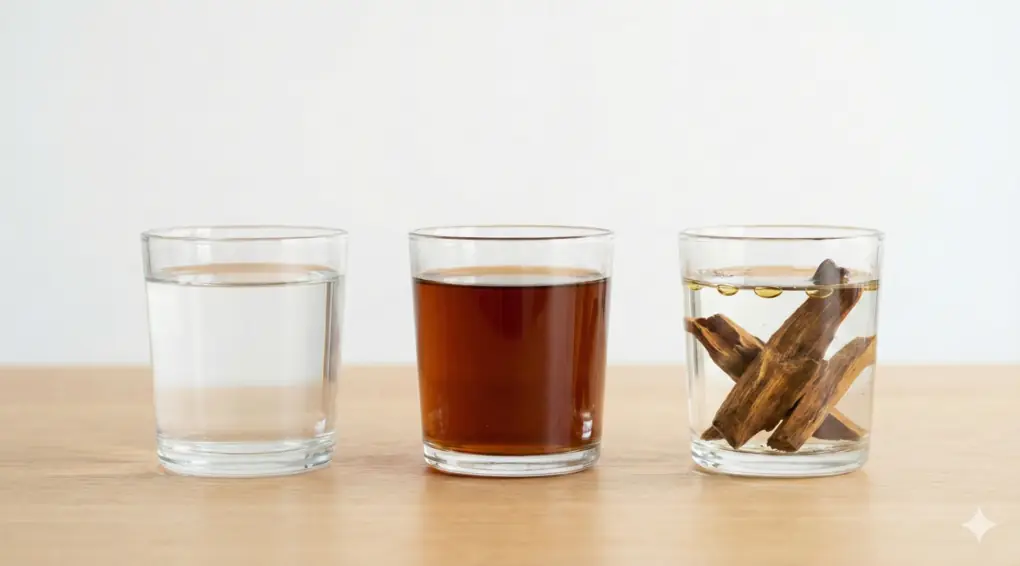
Have you ever noticed the water in your bathtub smelling slightly of soap? Or perhaps you have seen a pond turn green due to algae? In such situations, a common question often arises in our minds: “Is this water still valid for performing Wudu?”
Within Shafi’i jurisprudence, an essential chapter regarding the types of water in Islam addresses this exact scenario. Water that has undergone a change in its characteristics is jurisprudentially known as Mutaghayyir water (altered water). However, not every alteration strips water of its purifying capability. The Shari’ah establishes precise parameters. As believers, we must carefully distinguish whether the modifying substance acts as a Mukhalith (a soluble mixture) or merely a Mujawir (an adjacent or insoluble element).
Let us explore this fascinating topic of Islamic purification (Thaharah) with academic depth and clarity, referencing the classical Shafi’i text, Asnā al-Maṭālib Sharḥ Rawḍ al-Ṭālib.
What is Mutaghayyir Water?
In simple terms, Mutaghayyir water is absolute water (māʾ muṭlaq) that has experienced a change in one of its foundational properties—taste, color, or odor—due to mixing with a pure substance. It is crucial to note that we are discussing pure substances. If the water mixes with an impurity, it enters the distinct legal discussion of different types of najis.
Shaykh Zakariyya al-Ansari provides the foundational definition in Asnā al-Maṭālib (Vol. 1, p. 7):
(الماء المتغير طعما أو لونا أو ريحا بمخالطة طاهر يستغنى الماء عنه … تغيرا يمنعه الإطلاق … غير طهور)
“Water that changes in taste, color, or odor due to mixing with a pure substance that the water could have avoided… a change that prevents the application of the absolute name (of water)… is not purifying.”
The operational phrase here is “prevents the application of the absolute name.” This means if an observer looks at the liquid and no longer identifies it simply as “water,” but rather as “tea,” “milk,” or “ginger water,” its fundamental identity has shifted. Consequently, it loses its ability to purify.
Understanding “Mukhalith”: The Soluble Modifier
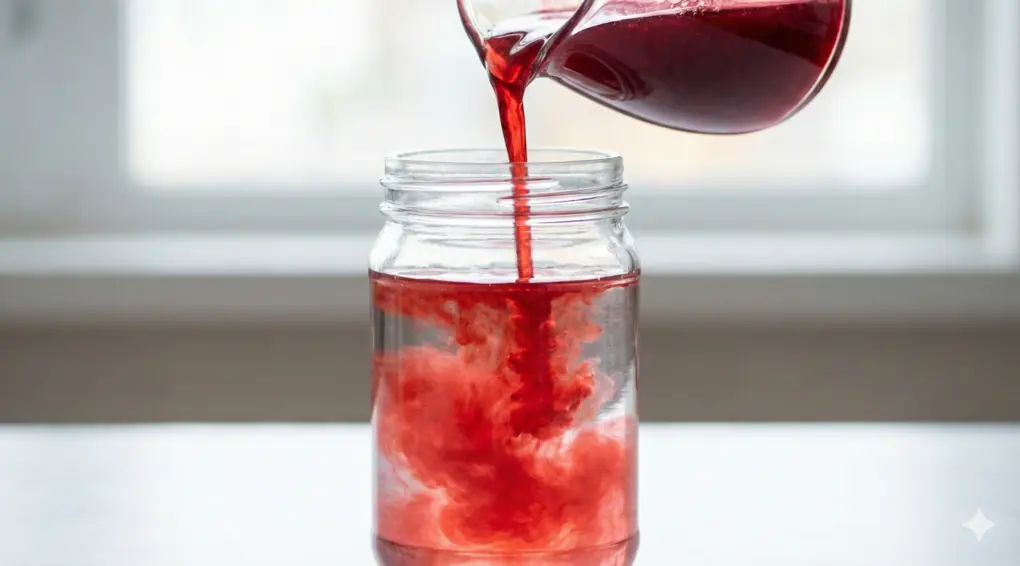
The first category involves changes caused by a Mukhalith. This type of alteration renders the water invalid for ritual purification.
A substance is classified as Mukhalith if it dissolves and integrates so completely with the water that the two cannot be physically separated or distinguished. The classical text provides specific examples:
(كالمني, والزعفران)
“…like semen, and saffron.”
If such soluble substances enter the water and alter its properties drastically (fāḥish), the water’s legal status becomes identical to Musta’mal water. It remains pure in its essence but loses its purifying nature (Ṭāhir Ghayr Muṭahhir). While it is permissible to drink it (provided the ingredients are safe), it is strictly invalid for Wudu or the obligatory bath (Ghusl).
Invisible Changes and the Concept of Taqdir (Estimation)
Occasionally, we encounter unique cases. For instance, what if absolute water mixes with “scentless rose water”? Physically, the water remains entirely clear, odorless, and tasteless. Yet, in reality, its purity has been compromised by a soluble modifier.
In such scenarios, Shafi’i jurists employ the method of Taqdir (Estimation). We must hypothetically assume the intervening substance possesses strong, noticeable properties. The text explains the standard of measurement:
(فرضناه مخالفا … وسطا في الصفات كلون العصير, وطعم الرمان, وريح الأذن)
“We assume it differs (in properties from water)… with moderate attributes: like the color of grape juice, the taste of pomegranate, and the scent of ladan (a type of fragrant resin).”
Therefore, imagine if the invisible substance had the dark color of juice; would the total volume of water change color? If the answer is “Yes,” the water is legally deemed compromised (non-purifying), even if our physical eyes see it as clear.
Understanding “Mujawir”: The Adjacent Modifier
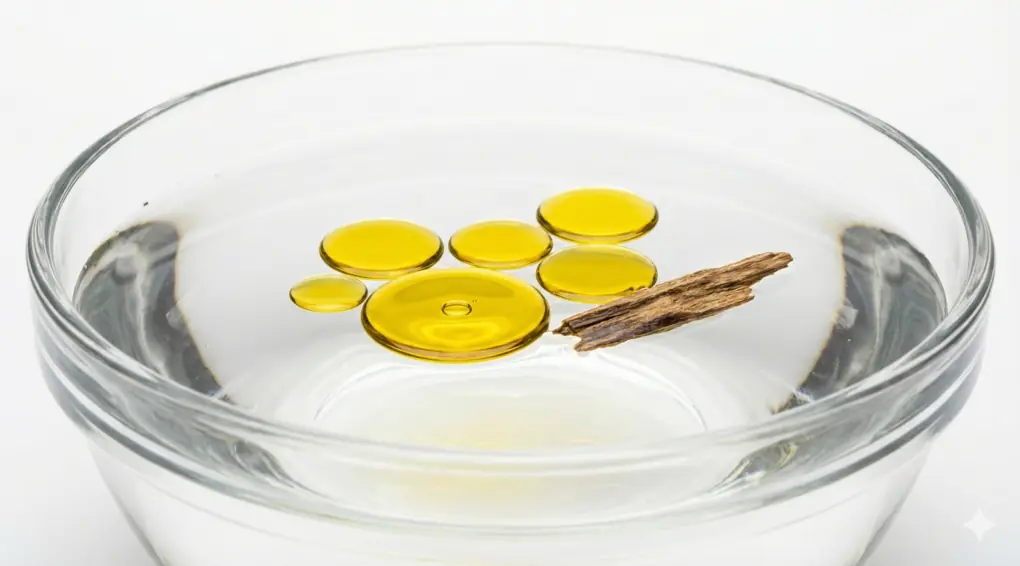
The second category is the Mujawir. This is excellent news for our daily practices because water altered by a Mujawir remains entirely valid for ritual purification.
Mujawir translates to adjacent or neighboring. This refers to a substance that exists within the water—perhaps slightly altering its scent or color—but does not dissolve or integrate. It can be physically separated from the water.
Asnā al-Maṭālib (p. 8) details this allowance:
(ولا كثير بمجاوره … كعود, ودهن, وكافور صلب)
“And an extensive change caused by an adjacent substance (mujawir) is not detrimental… such as agarwood, oil, and solid camphor.”
Why does oil not ruin the water’s purifying status? Because oil and water do not bond; the oil floats. The same principle applies to a solid chunk of agarwood or hard camphor. As long as the substance can be physically distinguished (“This is water; that is oil”), the liquid retains its primary name as “Absolute Water.” Thus, if a few drops of pure fragrance oil fall into your ablution basin and float on the surface, your Wudu remains perfectly valid.
Excused Alterations (Ma’fu) in Nature
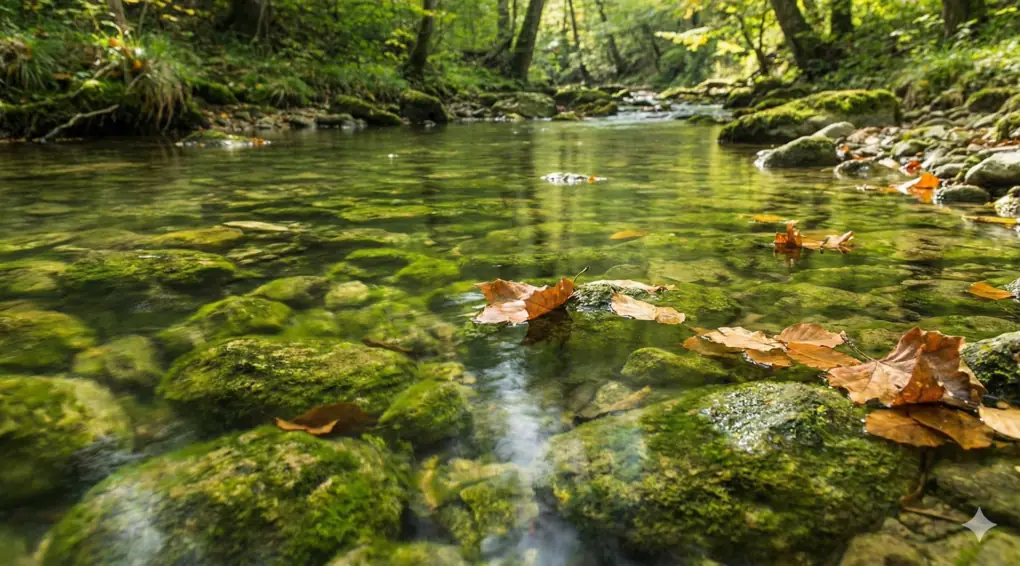
Islam is a religion of practicality and ease. There are natural conditions where water inevitably changes, and avoiding these changes causes undue hardship (mashaqqah). In such circumstances, the alteration is legally excused (ma’fu), and the water remains valid for purification.
The reference text outlines these exceptions:
1. Prolonged Stagnation (Mukth):
Water in an old well or pond often develops a musty odor due to remaining still for a long time.
(ولا بمكث)
“It is not harmed by prolonged stagnation.”
2. Algae and Soil (Mamar wa Maqar):
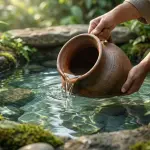
River or lake water frequently turns green from algae (ṭuḥlub) or becomes murky from the soil it flows over.
(ولا بما لا يستغنى الماء عنه في ممره, ومقره كطحلب)
“It is not harmed by what the water cannot avoid in its path or resting place, such as algae.”
This also applies to water passing through sulfur-rich mountains.
3. Naturally Fallen Leaves:
If a tree stands by a river and its leaves naturally fall (tanātharat) into the water, altering its color, the water remains valid.
(وأوراق شجر تناثرت)
However, intent matters! If you deliberately gather leaves, crush them, and throw them into the water, it becomes Mukhalith and ruins the water’s absolute status.
(وتفتتت … لا إن طرحت)
Meaning: “(Forgiven are) crushed leaves… but not if the leaves are intentionally thrown.”
4. Aquatic Salt (Milh Ma’i):
There is a jurisprudential distinction between aquatic salt (derived from evaporated seawater) and mountain/rock salt. If aquatic salt dissolves into the water in large amounts, the text affirms the water remains purifying.
- Sea Salt (Milh Ma’i): Salt derived from the freezing process of seawater. If it melts in water, the water remains pure.
- Rock Salt: If intentionally added, it spoils the water (according to some opinions referenced in this text, rock salt is considered like a solid mujawir if in chunks, but if dissolved it can be mukhalith). However, the text affirms tolerance for milh ma’i.
قوله: (وكذا إن تغير كثيرا بملح مائي, وتراب مطروح) فإنه طهور
Quick Reference Table: Is My Wudu Valid?
To avoid confusion, use this practical guide when encountering altered water:
| Cause of Water Alteration | Type of Change | Legal Status | Valid for Wudu? |
| Tea / Coffee / Milk | Mukhalith (Soluble) | Pure, Not Purifying | ❌ No |
| Liquid Soap (Large amount) | Mukhalith (Soluble) | Pure, Not Purifying | ❌ No |
| Fragrance Oil / Wood | Mujawir (Insoluble/Floating) | Absolute Water | ✅ Yes |
| Solid Camphor | Mujawir (Solid Object) | Absolute Water | ✅ Yes |
| Algae / Seaweed | Natural (Ma’fu) | Absolute Water | ✅ Yes |
| Naturally Fallen Leaves | Natural (Ma’fu) | Absolute Water | ✅ Yes |
| Intentionally Crushed Leaves | Mukhalith (Artificial) | Pure, Not Purifying | ❌ No |
FAQ: Everyday Questions about Mutaghayyir Water
1. The water in my bathroom basin smells like soil; can I use it for Wudu?
Yes, it is permissible. Soil constitutes the natural resting place (maqar) of water. A change caused by natural soil does not strip the water of its absolute status, provided someone has not intentionally dumped soil into it until it becomes thick mud.
2. What is the legal difference between a “slight” and an “extensive” change in water?
The classical text states: (لا يضر تغير يسير) – “A slight change does not harm.” The parameter for a “slight” (yasir) change is when an observer is genuinely doubtful whether the water has changed or not. Conversely, if anyone looking at it immediately agrees, “This is soapy water” or “This is syrup,” it is an “extensive” (katsir) change, rendering it invalid for Wudu.
3. Can I perform the obligatory bath (Ghusl) using water that has a tiny amount of soap mixed in?
If a small amount of soap accidentally falls in and the change is very slight (the water does not become heavily sudsy or slippery, but merely has a faint pleasant scent), it remains valid. Since soap is a Mukhalith, the ultimate criterion is the name of the liquid. If society still refers to it simply as “water,” it is valid. If the alteration is strong enough that people call it “soapy water,” it is invalid.
Conclusion
By studying this exposition derived from Asnā al-Maṭālib, we realize that the Shari’ah provides incredibly precise yet highly practical guidelines. Understanding the distinction between a soluble Mukhalith and an insoluble Mujawir when dealing with Mutaghayyir water protects us from unnecessary doubts (waswasah) while ensuring we do not trivialize the conditions of our worship. Knowing these boundaries brings profound peace of mind to our daily Thaharah.
Reference
Zakariyā al-Anṣārī, Asnā al-Maṭālib fī Sharḥ Rawḍ al-Ṭālib, with a ḥāshiyah by Aḥmad al-Ramlī, edited by Muḥammad az-Zuhrī al-Ghamrāwī (Cairo: al-Maṭbaʿah al-Maymānīyah, 1313 H; repr. Dār al-Kitāb al-Islāmī), vol. 1, pp. 7-8.


