

Have you ever visited a hot spring, sauna, or shower room in a fitness center (gym)? In classical Islamic literature, places like these are known as Hammam. Although their function is to cleanse oneself, these places have their own set of rules that often escape our attention.
Early scholars were very meticulous in discussing ethics in public spaces, including private areas such as public bathhouses. One reference that thoroughly examines this issue is the book Asna al-Matalib by Sheikhul Islam Zakariya al-Ansari. Let’s dissect how the fiqh (Islamic jurisprudence) views this activity so that our cleaning activities remain valuable in terms of reward and safe from sin.
What is a Ḥammām in the Context of Islamic Jurisprudence?
Before discussing the law, we need to align our understanding. Hammam in classical texts is not simply a bathroom in the house. It refers to a public bathhouse that usually provides hot water or steam facilities, a place where many people gather to cleanse themselves. In modern times, this concept is very similar to onsen, sauna, spa, or public bathrooms in dormitories and sports facilities.
Also learn: The meaning of Thaharah.
The book Asna al-Matalib (Volume 1, page 72) opens this discussion with a clear definition:
فصل (الحمام) أي دخوله للغسل فيه
(Section) (Regarding the Ḥammām), it means entering it to bathe within it.
The Ruling on Entering Public Bathhouses (Sauna/Spa)
The original ruling regarding entering this place differs between men and women due to factors of privacy and the potential for fitnah.
1. Ruling for Men
For men, the basic ruling is mubah or permissible. However, this permissibility is bound by an absolute condition: it is obligatory to guard one’s private parts. A man may not arbitrarily be naked in front of another man.
2. Ruling for Women
Shaykh Zakariya al-Ansari provided a detailed note for women. He wrote:
مباح و لكن (يكره للنساء بلا عذر)
The ruling is (Permissible/Allowed). However, (It is disliked for women without a legitimate Shar’i reason/excuse).
Why is it disliked? The author includes a ḥadīth narrated by Tirmidhī as a basis:
ما من امرأة تخلع ثيابها في غير بيتها إلا هتكت ما بينها وبين الله تعالى
“No woman removes her clothing except in her home, without having torn the veil (of modesty) between her and Allah Ta’ala.”
Furthermore, there is a fundamental logical reason behind this: matters pertaining to women are built upon the principle of maximal covering (satir). The gathering of women in public bathhouses has the potential to open the door to temptation or inappropriate conversation regarding physical appearance. Unless there is a valid excuse, such as an illness requiring steam therapy or a woman experiencing Istiḥāḍah who needs special care, then this disliked (makruh) ruling may be lifted.
Preparation and Etiquette Before Entering
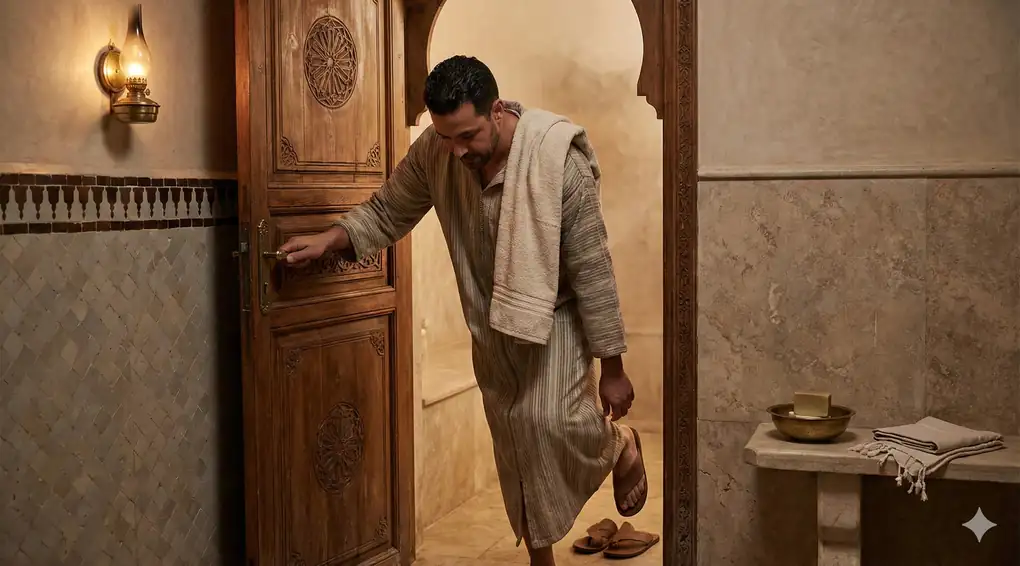
Islam regulates everything meticulously, even before our feet step into the bathing area. Here are the manners you need to observe:
Straighten Your Intention




Do not enter spas or saunas merely for show or luxury (taraffuh). Intend it for cleanliness and health so that the body is strong for worship.
وآدابه أي داخل الحمام ( قصد التنظيف ) والتطهير … ( لا الترفه )
(And its Etiquette) refers to the etiquette within the Hammam, which is (to intend to purify oneself)… (Not to indulge in luxury).
Complete Transactions at the Beginning
This is an interesting point about business ethics in Islam. We are encouraged to pay entrance fees or rental costs in advance.
وتسليم الأجرة أولا أي قبل دخوله
(Paying wages in advance) namely before entering.
Paying upfront avoids disputes after using the service, thus providing peace of mind while enjoying the facilities.
Supplication for Protection
Damp and dirty places are often favored by unseen beings. Therefore, fortify yourself with remembrance of God (dhikr). Enter with your left foot, say Bismillah, then recite a prayer for protection:
بسم الله الرحمن الرحيم أعوذ بالله من الرجس النجس الخبيث المخبث الشيطان الرجيم
Bismi Allāhi ar-Raḥmāni ar-Raḥīm. A‘ūdhu billāhi mina ar-rijsi an-najisi al-khabīthi al-mukhbithi ash-shayṭāni ar-rajīm.
(I seek refuge in Allah from impurity, that which is evil and corrupts, from the accursed Satan. impurity).
While Inside: Guarding the Gaze and Health
Once inside, the rules become stricter. This is not just about cleansing the body, but also purifying the heart.
Reflection on the Hereafter
The heat in a sauna or steam room should remind us of something more intense.
ويذكر بحره (النار والجنة)
(And remembering) because of the heat of water/the room (of Hell and Paradise).
Imam Nawawi in Al-Majmu’ suggests that when feeling the heat of the water, we should inwardly say, “Even this heat is burdensome, how much more the heat of Hellfire?” This is a clever way to transform a physical activity into remembrance of death.
Nudity-Free Zone
This is the most crucial rule. If you see someone exposing their Awrah in the bathhouse, you are forbidden to enter.
ورجوعه أي آدابه ما ذكر ورجوعه (عن عريان) فيه
(And he must return/exit) … (if there is a naked person) within it.
The eyes should not gaze upon the awrah of others. Even among the same gender, looking at the awrah remains a sin. If the situation is not conducive, it is better to turn back and go home. Guarding one’s gaze is more important than simply taking a hot bath.
Classic Health Tips
This book also highlights the medical aspects (Thib). There is a prohibition against pouring cold water on the head or drinking ice water immediately after leaving a hot room.
وكره من جهة الطب (صب الماء البارد على الرأس وشربه عند الخروج)
(And) it is disliked from a health/medical perspective (to pour cold water over the head and drink it upon exiting).
From a modern medical perspective, it makes sense to avoid thermal shock or drastic temperature changes that could burden the heart and blood vessels.
Etiquette for Leaving and Concluding Activities
After the body is clean and refreshed, do not immediately become heedless. Sheikh Zakariya suggests performing istighfar and a sunnah prayer of two rak’ahs.
Why should we seek forgiveness (Istighfar)? Because places like hammams (bathhouses) or gyms are prone to making us heedless, or unintentionally causing our eyes to fall upon what is inappropriate. The pious people of the past even referred to a day at the hammam as a “day of sin” due to the great potential for sinning with the eyes there. Therefore, conclude the act of bathing with a request for forgiveness and gratitude for the blessing of cleanliness that Allah has bestowed upon us.
In addition, social interaction should remain warm. It is permissible to ask someone to scratch your back (as long as it is not a vital private area and does not arouse desire). Do not forget to pray for each other with the words: “Ghafarallahu laka” or “Aafakallah” (May Allah grant you well-being).
ولا بأس بقوله لغيره : عافاك الله ولا بالمصافحة
It is not wrong to say to others, ‘May Allah heal you/grant you well-being,’ and it is not wrong to shake hands.
Read also: The Fiqh of Tahniah (Islamic Rulings on Congratulations).
Bringing Blessings in Purity
Bathing in public places such as gyms or hot springs is not merely a physical activity. There is a devotional value that we can attain if we pay attention to its etiquette. Starting with a sincere intention, guarding our gaze from the awrah of fellow visitors, to concluding it with prayer and gratitude.
The book Asna al-Matalib teaches us that Islam is present in every aspect of life, even in hot steam rooms. Let us practice this etiquette during our next visit to a bathhouse or swimming pool, so that our physical cleanliness is in line with the cleanliness of our hearts.
Reference
Zakariyā al-Anṣārī, Asnā al-Maṭālib fī Sharḥ Rawḍ al-Ṭālib, with a ḥāshiyah by Aḥmad al-Ramlī, edited by Muḥammad az-Zuhrī al-Ghamrāwī (Cairo: al-Maṭbaʿah al-Maymānīyah, 1313 H; repr. Dār al-Kitāb al-Islāmī), volume 1, page 72.


