
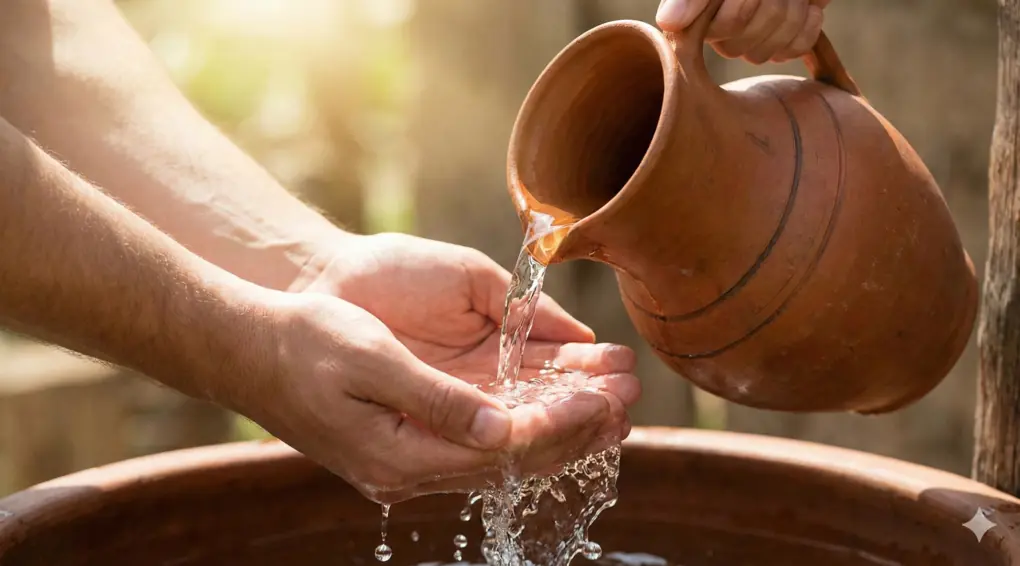
In Islamic jurisprudence (fiqh), purification (understanding thaharah) is the gateway to all acts of worship. We frequently hear the term “Mutlaq Water” (absolute or pure water) as the primary condition for the validity of wudu (ablution) and the obligatory bath (ghusl). However, has it ever crossed your mind why it must specifically be water? Why can’t we use other liquids that might be medically cleaner, such as alcohol, vinegar, or coconut water?
Understanding the essence of Mutlaq Water is not merely about memorizing a definition. We must trace the foundations of Islamic law to comprehend the true nature of this liquid. Based on the authoritative reference Asna al-Matalib Sharh Rawd al-Talib, let us deeply dissect what Mutlaq Water is, its boundaries, and the profound reasons why the Sharia designates it as the sole medium for purification.
Definition of Mutlaq Water According to Asna al-Matalib
Shaykh Zakariyya al-Ansari, in Asna al-Matalib (Vol. 1, p. 5), defines the valid instrument of purification with a definitive statement:
قوله: (الماء المطلق) أي لا غيره من تراب تيمم, وحجر استنجاء, وأدوية دباغ, وشمس, وريح, ونار
“Meaning: (Mutlaq Water), meaning not anything else, such as the dust of tayammum, stones for istinja, tanning agents, the sun, wind, and fire.”
From the text above, we understand that other substances—even if they can clean physically—do not fall under the category of an absolute “purifier.” These substances only serve as substitutes in emergency conditions (like the dust for tayammum) or as specific cleaners (like stones for istinja’). For an in-depth understanding of dry purification, read our article on the conditions of istinja with stones.
Mutlaq Water is pure, unadulterated water with which a person can lift ritual impurity (hadas) and remove physical filth (najis). Hadas is an abstract (i’tibari) matter existing on the limbs that prevents the validity of prayer. Meanwhile, najis (khabath) is a disgusting physical impurity that also prevents the validity of prayer.
Why Must it be Water? Fiqh Reasoning and Scriptural Evidence
Scholars hold different views regarding the reasoning behind selecting water as the sole primary instrument of purification. Why can’t other liquids replace it?
1. The Dogmatic Nature (Ta’abbudi)
Imam al-Haramayn argues that the specification of water is a dogmatic or ta’abbudi matter. This means it is a pure command from Allah that must be obeyed without necessarily seeking a logical reason. As stated in the reference:
لأن اختصاص الطهر به عند الإمام تعبد
“Because the specification of purification with it (water), according to the Imam, is ta’abbud (worship).”
2. The Nature of Subtlety (Riqqah wa Lathafah)
However, scholars other than Imam al-Haramayn provide a rational explanation. Water was chosen because it possesses the qualities of riqqah (thinness/fluidity) and lathafah (subtlety or gentleness) that are not found in other liquids. These characteristics allow water to penetrate and cleanse in a manner that oil or milk cannot.
Evidence from the Quran and Hadith

The legal foundation mandating the use of water is exceptionally strong. Allah says in Surah An-Nisa, verse 43:
{فلم تجدوا ماء فتيمموا}
“And if you do not find water, then seek clean earth (for tayammum).”
This verse affirms that transitioning to tayammum (dust) is only permissible if water is entirely unavailable. This indicates that as long as water exists, other substances are invalid for ritual purification.
Furthermore, in a hadith narrated by Bukhari and Muslim, when a Bedouin urinated inside the mosque, the Messenger of Allah ﷺ commanded:
«صبوا عليه ذنوبا من ماء»
“Pour over it (the urine) one bucket of water.”
The Prophet’s command to pour water is obligatory (al-amru lil wujub). If another liquid were permissible, the Prophet would not have restricted his command solely to water.
Nomenclature Boundaries: When is Water Called “Mutlaq”?
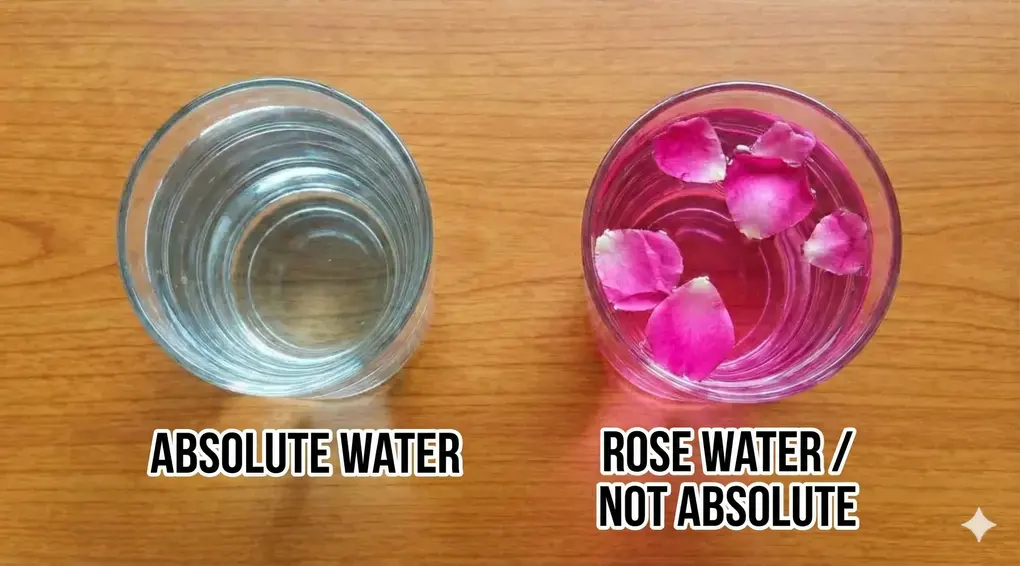
For water to be considered pure and purifying, it must be completely free from an idhafah lazimah (an inseparable, binding descriptive name).
In Asna al-Matalib, it is explained:
(وهو العاري عن إضافة لازمة)
“Meaning: It is that which is stripped of an inseparable addition (to its name).”
This means the water cannot possess an additional name that is so tightly bound to it that it alters its fundamental essence. For example:
- Rose Water (Ma’ul Ward): This is not Mutlaq Water because the word “rose” is an inseparable descriptor. If you remove the word “rose,” people will not refer to the remaining liquid as normal water.
- Semen (Mani): While the Hadith refers to it as “fluid/water,” its meaning is highly specific, rendering it invalid for wudu.
This differs from a non-binding descriptor or one that merely indicates a location or origin, such as:
- Well Water
- Rainwater
- Seawater
These types remain legally ruled as Mutlaq Water because the words “well” or “rain” can be dropped, and the substance is still universally recognized simply as “water.”
Fiqh Polemics: The Status of Steam and Ice
An intriguing discussion arises in this text regarding the status of substances derived from water but altered in physical form.
1. Water Vapor/Steam (Bukhar)
What is the ruling on condensed water or the steam from boiling water? Asna al-Matalib quotes the view of Imam al-Nawawi:
(أو بخاره) أي رشح بخار الماء المغلي لأنه ماء حقيقة
“…(or its steam), meaning the condensation of the steam of boiling water, because it is water in reality.”
Imam al-Nawawi in Ar-Raudhah (implicitly) and other books (explicitly) states that steam or the condensation from boiling water is pure and purifying. The reasoning is that, in its true essence, it remains water.
However, this opinion faced rebuttal from many other Shafi’i scholars (Al-Ashab). The majority argue that such vapor is merely called “steam” (bukhar) or “sweat” (rashy), not Mutlaq Water, making it invalid for purification. Nevertheless, Imam al-Nawawi’s opinion retains significant academic weight.
2. Salt Created from Water (Milh Ma’i)
If water freezes naturally or is processed into salt (milh ma’i), and then melts back into a liquid state, its ruling is pure and purifying. This is fundamentally different from mountain salt or mined rock salt, whose original state was never liquid water.
قوله: (ولو) كان العاري عما ذكر (ماء ينعقد بجوهره) … (ملحا) لأن اسم الماء يتناوله في الحال
“Meaning: (Even if) what is stripped of the aforementioned is (water that solidifies by its essence)… (into salt), because the name ‘water’ still applies to it in that state.”
Altered Water (Mutaghayyir) and How to Measure It
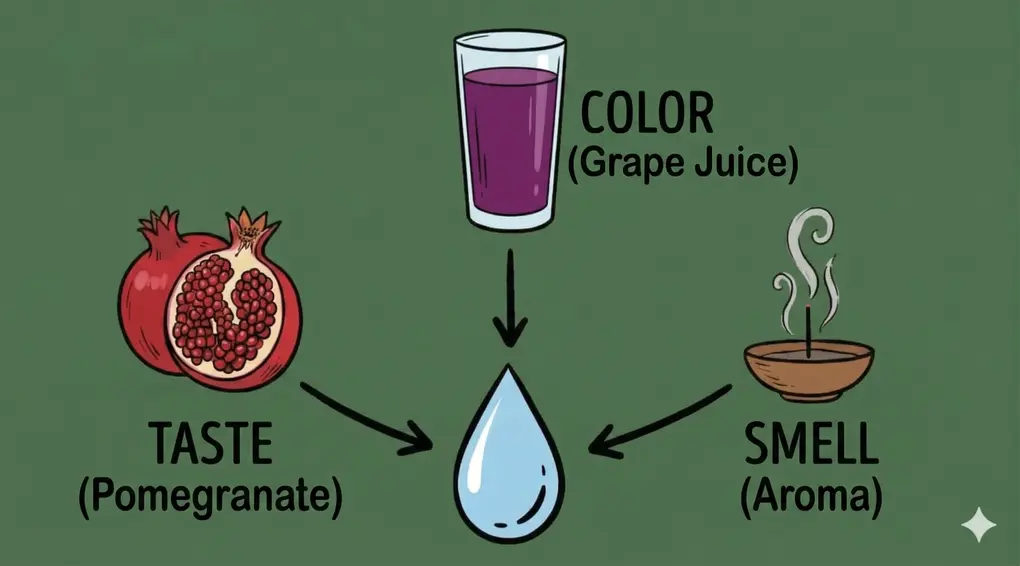
One of the strict conditions for a valid wudu is that the Mutlaq Water must not have its characteristics (taste, color, smell) altered due to mixing with another substance. Fiqh provides highly meticulous details here.
If water mixes with a pure, soluble substance that shares the exact same characteristics as pure water (such as scentless rose water or musta’mal water), and we are in doubt whether the water has altered or not, scholars employ the Taqdir (Estimation/Assumption) method.
Asna al-Matalib (p. 7) provides the standard of measurement. We must hypothetically assume the substance mixing with the water possesses “moderate” (wasathan) characteristics:
- For Taste: Assume the taste of a pomegranate (Rumman).
- For Color: Assume the color of grape juice (‘Ashir).
- For Smell: Assume the scent of Ladzan (a type of Arabian incense).
قوله: (فرضناه مخالفا) له فيها … (وسطا) في الصفات كلون العصير, وطعم الرمان, وريح الأذن
“Meaning: (We assume it to be contrary) to it in those… (moderate) in characteristics like the color of juice, the taste of pomegranate, and the smell of ladzan.”
If, based on this assumption, the water is deemed to have changed, it loses its purifying nature. However, if it hypothetically remains unchanged, the water remains pure and purifying.
Differentiating Mutlaq, Musta’mal, and Mutaghayyir Water
To easily grasp the classification of water based on the texts, observe the following table:
| Type of Water | Brief Definition | Ruling for Purification | Additional Notes |
| Mutlaq Water | Pure water without an inseparable added name. | Valid | Includes rainwater, well water, seawater, and snow. |
| Musta’mal Water | A small amount of used water (< 2 qullahs) from an obligatory purification. | Pure, but Invalid for purification. | Includes the used wudu water of a discerning (mumayyiz) child for prayer. |
| Mutaghayyir Water | Water altered in taste/color/smell by a pure substance. | Pure, but Invalid for purification. | If the alteration is slight or caused by an insoluble adjacent substance (mujawir), it remains valid. |
FAQ: Questions About Mutlaq Water
Is coconut water considered Mutlaq Water?
No. Coconut water possesses an inseparable added name (idhafah lazimah). People do not refer to it simply as “water,” but strictly as “coconut water.” Therefore, it is pure to drink but completely invalid for wudu.
Is it permissible to perform wudu with water heated by the sun?
The ruling is disliked (Makruh Tanzih) if used in an extremely hot climate and the container is made of hammered metal (like iron or copper), due to medical fears of it causing leprosy (barash). However, Imam al-Nawawi holds the view that it is not absolutely disliked, considering the medical evidence at the time to be insufficiently strong.
What if leaves naturally fall into the water?
If the water changes because leaves fall into it naturally (tanatharat) or algae grows in it (tuhlub), the water remains pure and purifying. This is because it is exceedingly difficult to prevent (mashaqqah).
Can the condensation water from an Air Conditioner (AC) be used for wudu?
Following Imam al-Nawawi’s opinion regarding condensed steam (bukhar), the condensation water is considered Mutlaq Water as long as it does not mix with any filthy substance (najis) or anything that alters its characteristics. However, other scholars hold the view that it is not absolute water.
Conclusion
Understanding the true essence of Mutlaq Water shields us from paralyzing doubts in our worship. Islam provides profound ease by establishing water as the most accessible medium for purification, naturally possessing unmatchable cleansing properties.
To understand the fundamental differences among the three types of water in more detail, you can read our pillar article on the types of water in Islamic fiqh. Ensure that our wudu and correct obligatory bath utilize water that strictly meets the Sharia criteria, so that our worship is accepted by Allah Subhanahu wa Ta’ala.
Reference
al-Anṣārī, Zakariyā. Asnā al-Maṭālib fī Sharḥ Rawḍ al-Ṭālib. With a ḥāshiyah by Aḥmad al-Ramlī. Edited by Muḥammad az-Zuhrī al-Ghamrāwī. Cairo: al-Maṭbaʿah al-Maymānīyah, 1313 H. Reprinted by Dār al-Kitāb al-Islāmī.


