
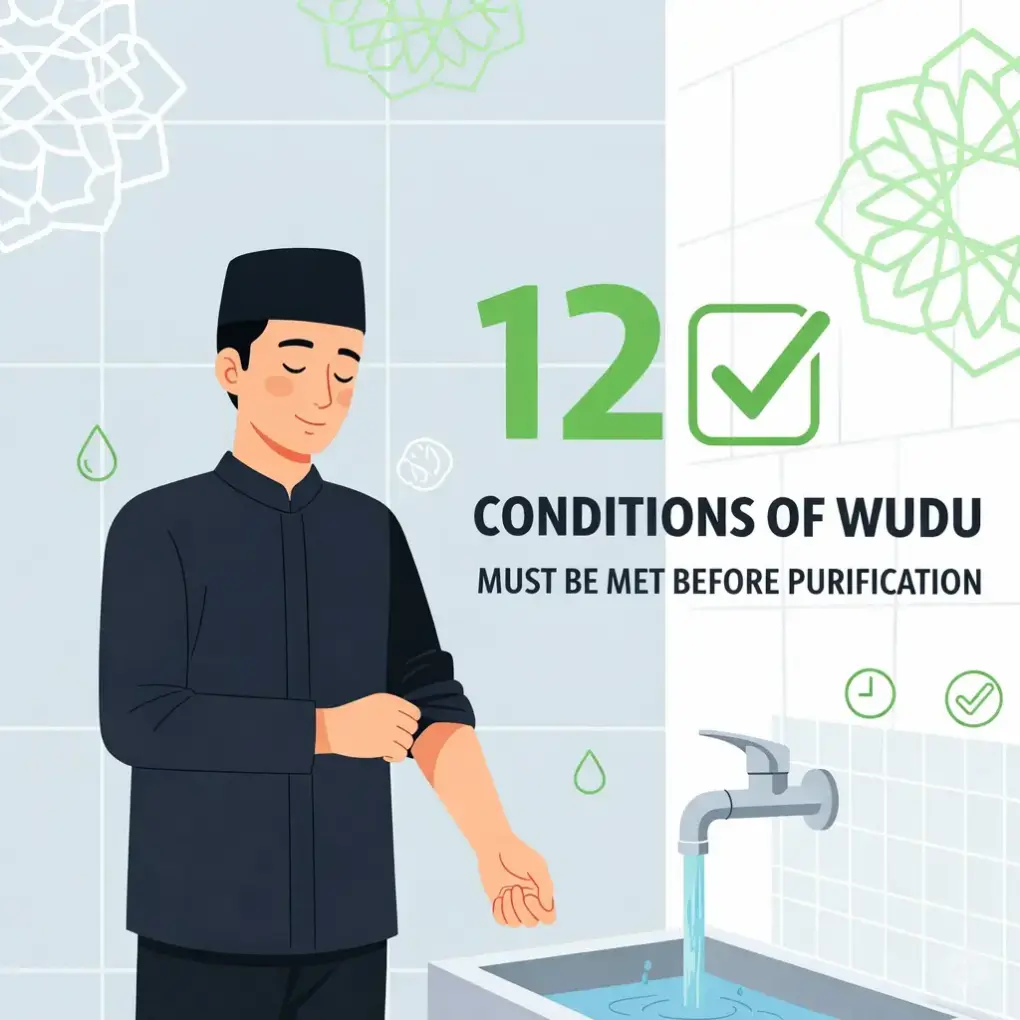
Every day, before standing before Allah in prayer, Muslims perform ablution. However, understanding the meaning of wudu goes beyond merely washing the face, hands, head, and feet. Have you ever paused to ask, “Is my ablution truly acceptable?”
According to Islamic jurisprudence, perfection in this act of worship requires adherence to strict parameters. There are specific conditions for valid wudu that must be fulfilled before and during the purification process. If a single requirement is missing, the ablution becomes invalid, consequently rendering the subsequent prayer unaccepted.
This article comprehensively outlines the 13 conditions for valid wudu, drawing from the authoritative Arabic texts (dalil) found in the classical Shafi’i manual, Al-Minhaj al-Qawim by Imam Ibn Hajar al-Haytami.
The Classical Evidence (Dalil) from Al-Minhaj al-Qawim
The primary reference for this academic exposition is the definitive text by Imam Ibn Hajar al-Haytami. The complete foundational dalil reads as follows:
فصل: في شروط الوضوء وبعضها شروط النية … “شروط الوضوء والغسل الإسلام” … “والتمييز” … “والنقاء من الحيض والنفاس” … “و” النقاء “عما بمنع وصول الماء إلى البشرة” … “والعلم بفرضيته” … “وأن لا يعتقد فرضًا معينًا من فروضه سنة” … “والماء الطهور” … “وإزالة النجاسة العينية وأن لا يكون على العضو ما يغير الماء وأن لا يعلق نيته” … “وأن يجري الماء على العضو ودخول الوقت لدائم الحدث” … “والموالاة”
Transliteration: Faṣl: fī shurūṭ al-wuḍū’ wa ba‘ḍuhā shurūṭ al-niyyah… “shurūṭ al-wuḍū’ wa al-ghusl al-Islām”… “wa al-tamyīz”… “wa al-naqā’ min al-ḥayḍ wa al-nifās”… “wa al-naqā’ ‘ammā yamna‘u wuṣūl al-mā’ ilā al-basharah”… “wa al-‘ilm bi farḍiyyatih”… “wa an lā ya‘taqida farḍan mu‘ayyanan min furūḍihī sunnah”… “wa al-mā’ al-ṭahūr”… “wa izālat al-najāsah al-‘ayniyyah wa an lā yakūna ‘alā al-‘uḍw mā yughayyir al-mā’ wa an lā yu‘alliqa niyyatah”… “wa an yujriya al-mā’ ‘alā al-‘uḍw wa dukhūl al-waqt li dā’im al-ḥadath”… “wa al-muwālāh”.
Below, we systematically elaborate on each phrase of this text to provide a practical understanding.
Fundamental Conditions for All Worship
1. Professing Islam
Ablution is inherently an act of devotion to Allah. The primary prerequisite (shurūṭ al-wuḍū’ wa al-ghusl al-Islām) dictates that the individual must be a Muslim. Any worship that requires wudu demands a legally sound intention, which is theologically invalid if it originates from a non-Muslim.
2. Attaining Tamyiz
The text mandates al-tamyīz, meaning the cognitive ability to distinguish between right and wrong. The individual performing ablution must possess sufficient maturity to understand the spiritual essence of the act. A young child who lacks this comprehension cannot perform a legally valid ablution because they do not grasp the concept of intention.
Conditions Regarding Physical State and Cleanliness
3. Freedom from Menstruation and Postpartum Bleeding


A woman experiencing menstruation (ḥayḍ) or postpartum bleeding (nifās) cannot perform a valid ablution. Ablution is designed to lift a minor ritual impurity, whereas menstruation and postpartum bleeding constitute major ritual impurities. It is jurisprudentially impossible to lift a minor impurity while a major one persists.
4. Absence of Waterproof Barriers
You must guarantee that absolutely no waterproof barriers prevent water from making direct contact with the skin (al-basharah) on all obligatory limbs. Common examples include:
- Nail polish or artificial coatings.
- Dried glue, tree sap, or heavy paint.
- Solidified oils forming a distinct, impenetrable membrane.
5. Removal of Physical Impurities
If there is a visible, tangible impurity on any limb meant for washing, you must thoroughly remove these physical impurities first. Only after the limb is physically clean can the formal process of ablution commence.
Conditions Related to Intention and Conviction
6. Knowledge of the Obligatory Nature of Wudu
An individual must hold the distinct knowledge (al-‘ilm) that ablution is a definitive obligation for establishing prayer. Washing simply to cool down, without recognizing the divine mandate, voids the ablution.
7. Not Believing an Obligatory Act to be a Sunnah
You must not specifically believe that an obligatory pillar of ablution is merely a recommended act. If you generally believe all actions are obligatory, or if you can accurately distinguish between the obligatory and the sunnah acts of wudu, your ablution is sound. Erroneously downgrading an obligatory pillar to a sunnah status negates the required conviction.
8. Absolute Certainty in Intention
The intention must be resolute; one must not suspend or make it conditional (an lā yu‘alliqa niyyatah). Internal phrasing such as, “I intend to perform ablution if Allah wills it,” with the intent of hesitation, nullifies the certainty required.
Conditions Governing Water and the Washing Process
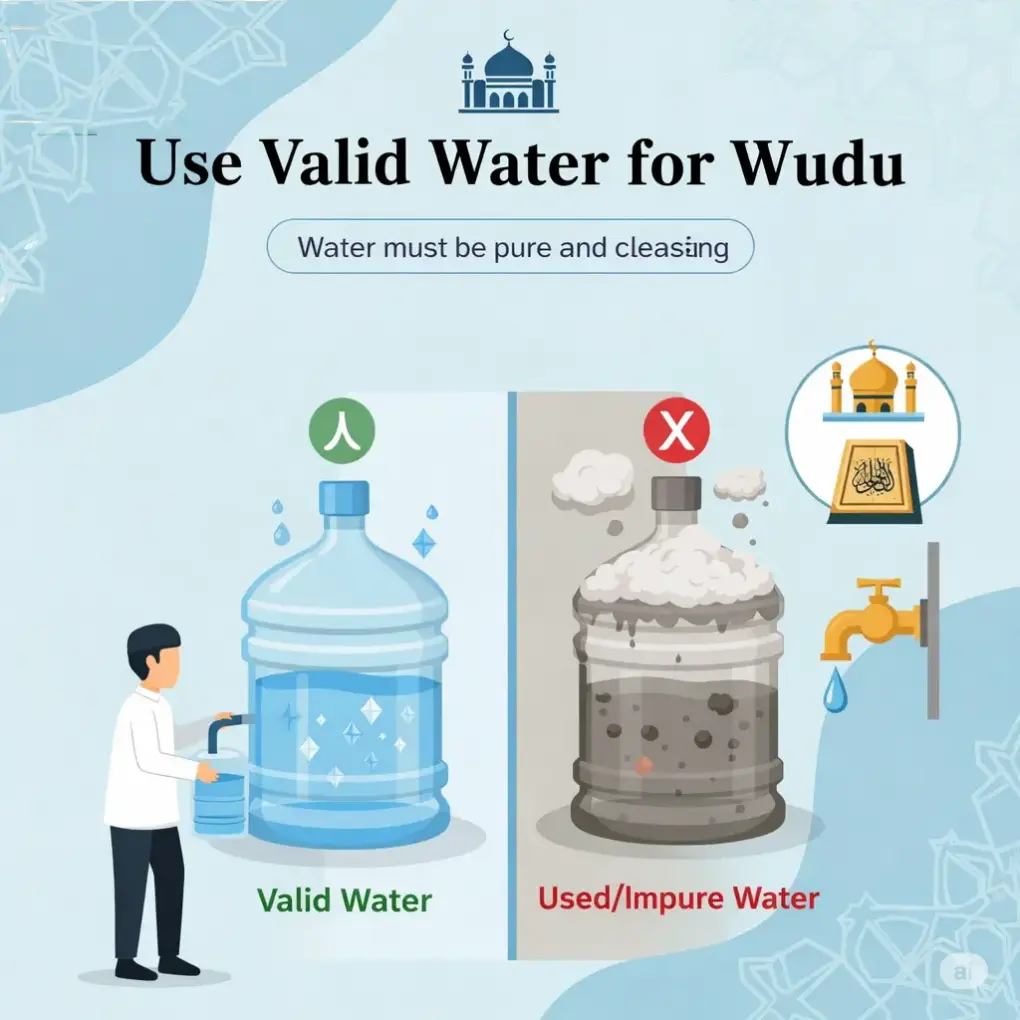
9. Utilizing Valid, Purifying Water
The only acceptable medium is water that is inherently pure and retains the capacity to purify (al-mā’ al-ṭahūr). In fiqh, this is classified as mutlaq water (absolute water), such as rainwater or standard tap water that has not been fundamentally altered in its core properties.
10. No Alteration of the Water’s Properties on the Body
No substance present on your limbs should alter the intrinsic properties of the water during the wash. If unrinsed soap on your arm mixes with the water—rendering it soapy and fragrant—the water transitions into altered water (mā’ mutaghayyir) and loses its purifying capability for that specific limb.
11. Ensuring the Water Flows Properly
Water must physically flow (yujriya al-mā’) over the entirety of the obligatory limbs. Merely wiping a limb with a damp hand is insufficient. Flowing water guarantees that microscopic surface areas receive adequate coverage.
Special Conditions for Chronic States
12. Entering Prayer Time
Individuals suffering from continuous impurity (dā’im al-ḥadats), such as chronic incontinence, face an additional stipulation. Their ablution is valid only if initiated after the time for a specific prayer has officially commenced. They must also perform proper cleansing (istinja) immediately beforehand to minimize the impurity.
13. Continuous Washing / Muwalah
For those in a state of continuous impurity, washing the limbs consecutively without interruption (al-muwālāh) is mandatory. They must wash the subsequent limb before the previously washed limb dries. This strict condition ensures their ritual purity is maintained as closely to the prayer as physically possible.
Conclusion
Mastering the 13 conditions for valid wudu according to the Shafi’i school is an intellectual and spiritual endeavor that safeguards our daily prayers. By consciously applying these principles—grounded firmly in the authoritative Arabic dalil—we cultivate a profound state of mindfulness. This meticulous adherence to Islamic jurisprudence ensures that our ritual purification remains legally sound and spiritually elevating.
Frequently Asked Questions (FAQ)
What happens if I forget to remove a small barrier, like a dot of paint, before making wudu?
If you discover a waterproof barrier on an obligatory limb after completing your ablution, that specific wudu is rendered invalid. You must remove the barrier and repeat the ablution properly before performing any acts of worship.
Can I use water from a swimming pool to fulfill the conditions for valid wudu?
It depends on the water’s state. If the pool water is in a large volume (more than two qullahs) and its core properties (taste, color, smell) have not been drastically altered by heavy chemicals to the point where it is no longer recognized as normal water, it is valid. Otherwise, standard tap water is required.
If I am unsure whether a substance on my skin is waterproof, what should I do?
In Islamic jurisprudence, certainty cannot be removed by doubt. However, to ensure your worship is valid, you should take the precautionary step of washing or scraping the substance off. Substances like natural henna that only leave a stain (without a physical layer) are completely fine.
Reference
Ibn Ḥajar al-Haytamī, Al-Minhāj al-Qawīm: Sharḥ al-Muqaddimah al-Ḥaḍramiyyah, pp. 94–95 (Dār al-Minhāj).


