
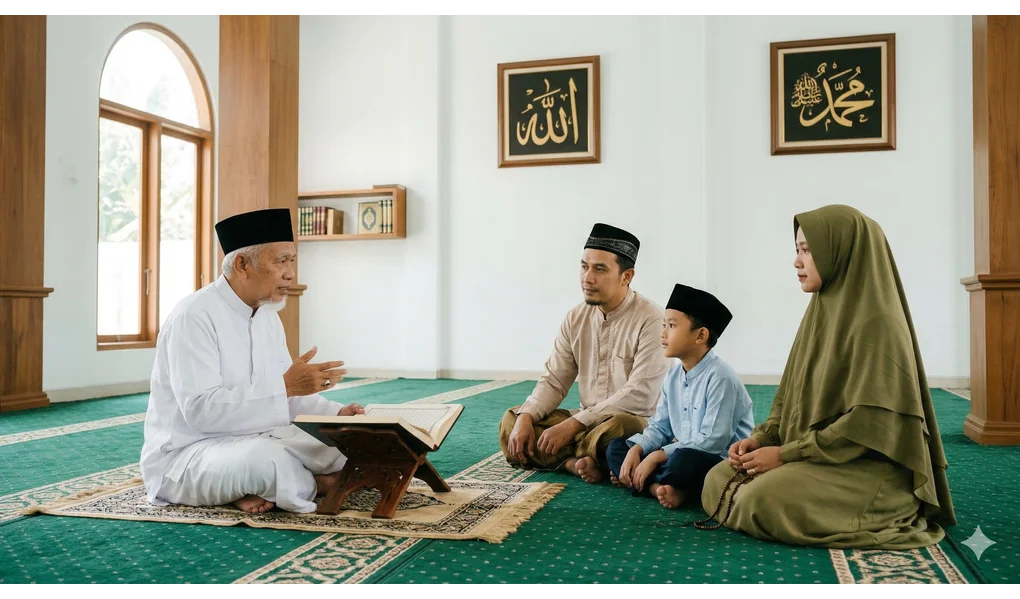
Examining the foundations of religious practice requires us to refer to primary textual evidence, one of which is the Hadith of Jibril. Scholars refer to this hadith as Umm al-Sunnah (the mother of the Sunnah) because it contains the straightforward methodology of practicing the religion. In the historic dialogue between the Angel Jibril and the Messenger of Allah ﷺ, fundamental questions and answers regarding the tenets of faith were articulated, where the pillars of Islam occupied the first position as the foundation of outward, physical actions.
Understanding the meaning of Islam linguistically and terminologically is the very first stepping stone before comprehensively exploring the branches of Islamic jurisprudence (fiqh). This concept is not merely a written identity; rather, it is the tangible manifestation of a servant’s submission to the Creator.
Why Did Angel Jibril Ask About Islam First?
Angel Jibril came to the gathering of the Messenger of Allah ﷺ employing a question-and-answer method to teach the companions present. In the narration of Umar bin Khattab (may Allah be pleased with him), the first question posed focused on Islam, which was then followed by questions regarding the pillars of faith (rukun iman) and spiritual excellence (ihsan).
This sequence perfectly aligns with the human reality of practicing religion. Outward actions (Shariah) serve as the initial gateway mandated for a morally responsible individual (mukallaf). A person’s adherence to Islam is judged by what is outwardly apparent, while matters of the inner heart are left entirely to Allah.
There are various textual arrangements in the narrations of hadith scholars. Ibn Hajar al-Haytami, in his commentary Al-Fath al-Mubin, cites a comparison of these narrations:
في رواية الترمذي تقديم الإيمان كما في رواية “الصحيحين” عن أبي هريرة رضي الله عنه، قيل: وهي أولى؛ لموافقتها القرآن في نحو: {ليس البر} الآية، {إنما ألمؤمنون} الآيتين أول (الأنفال) ولعل الأولى رواية بالمعنى.
“In the narration of At-Tirmidhi, there is a precedence of faith (iman), as also found in the narration of the Sahihayn from Abu Hurairah (may Allah be pleased with him). It is said: This is more appropriate due to its conformity with the Quran in verses such as {Righteousness is not…} and {The believers are only those…}. Perhaps the first narration (of Umar) is a transmission by meaning (riwayah bil ma’na).”
Scholars hold the view that the narration prioritizing faith (iman) indeed corresponds better with the sequence mentioned in the Quran. However, the narration of Umar bin Khattab carries its own profound wisdom, namely guiding the Muslim community to establish physical, outward Shariah practices first, before ascending to the perfect, inner stages of conviction, such as true faith in Allah.
The Etymological Meaning of Islam (Linguistic Definition)
Experts in Islamic law consistently begin the exposition of scientific principles with an Arabic linguistic review. This practice ensures that the meaning of a Shariah term does not deviate from its original root word. The meaning of Islam is rooted in a word that conveys the message of submission. The commentary text affirms:
قوله: (الإسلام) هو لغة: الطاعة والانقياد
“(Islam) linguistically is: obedience (at-tha’ah) and submission (al-inqiyad).”
The word at-tha’ah refers to the willingness to execute commands without resistance, while al-inqiyad illustrates a state of total surrender. A true Muslim is an individual who submits their personal ego, desires, and worldly logic under the shade of Divine revelation.
The Terminological Meaning of Islam (Shariah Definition)
Shifting to the terminological definition, the essence of Islam according to fiqh scholars centers on the actualization of the aforementioned linguistic obedience into the physical form of worship. The commentary text defines the meaning of Islam in Shariah as follows:
وشرعا: الانقياد إلى الأعمال الظاهرة؛ كما بين ذلك صلى الله عليه وسلم بقوله: أن تشهد أن لا إله إلا الله…
“And in Shariah: Submission to outward actions; as explained by the Prophet ﷺ in his statement: (That you testify that there is no deity worthy of worship except Allah…).”
It must be understood that this outward submission cannot stand alone if it is to bear the fruit of reward in the Hereafter. An absolute condition for the acceptance of deeds is the synchronization between physical movements and the conviction of the heart. Scholars emphasize this firmly:
أما الإسلام بمعنى الأعمال المشروعة. . فلا يمكن أن ينفك عن الإيمان؛ لاشتراطه لصحتها
“As for Islam in the meaning of legislated actions… it cannot be separated from faith (iman); because it (faith) is a condition for its validity.”
The quote above refutes the notion that mere physical acts of worship are sufficient for a person’s salvation. Without the heart’s validation (tasdiq), physically excellent worship will lose its spiritual value and fall short of true acceptance.
A Comprehensive Explanation of the Five Pillars of Islam
Based on the response of the Messenger of Allah ﷺ to Jibril, the articulation of this outward submission is summarized into five main pillars. Understanding the pillars of Islam reveals that these five obligations must be fulfilled by every sane individual who has reached puberty:
- Shahadah: The oral and heartfelt testimony stating, “Ashhadu an la ilaha illallah, wa anna Muhammadan rasulullah”. This sentence of monotheism (Tawhid) is the gateway to the religion. Uttering the Shahadah requires a person to disassociate from any deity other than Allah and to acknowledge the divine message of Prophet Muhammad ﷺ.
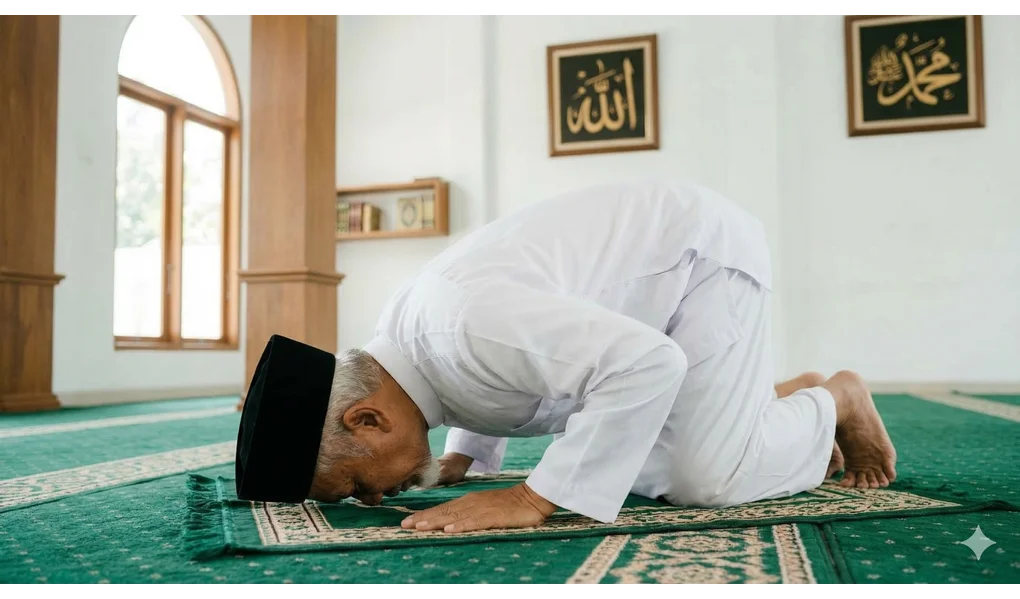
- Salah (Prayer): The hadith text states, “Wa tuqimas-salah” (And you establish prayer). The Shariah uses the word “establishment” (iqamat), not merely “doing” (fa’ala) to simply get it over with. Establishing Salah means maintaining its consistency, its foundational pillars, and its prerequisites for validity, which is technically always opened with the Takbiratul Ihram and concluded with the Salam.
- Zakat: The phrase “Wa tu’tiyaz-zakah” mandates the handing over of specific wealth to entitled groups. In essence, the meaning of Zakat carries the function of purification (tathhir) for the soul from stinginess, as well as providing the function of growth (nama’) in the form of divine blessings upon the remaining wealth.
- Sawm (Fasting): The Messenger of Allah ﷺ mentioned, “Wa tasuma Ramadan”. The practice of fasting (sawm) demands the servant to completely restrain themselves (imsak) from eating, drinking, and other invalidating acts from the break of true dawn until sunset.
- Hajj: Unlike the other pillars, the Hajj pilgrimage (“Wa tahujjal-baita inistata’ta ilaihi sabila”) is strongly bound to the condition of capability (istitha’ah). This capability refers to the availability of a safe route, adequate provisions (zad), and a mount or reliable vehicle (rahilah).
Summary Table: The Essence of the Pillars of Islam
| Religious Pillar | Aspect of Worship | Primary Meaning and Objective |
| Shahadah | Oral & Heart | The pledge of Tawhid and the gateway of acknowledging the Shariah. |
| Salah | Physical & Heart | Daily communication (supplication) and the physical manifestation of submission. |
| Zakat | Wealth (Maliyah) | Purification of wealth (tathhir) and the growth of blessings (nama’). |
| Sawm | Physical (Restraint) | Controlling worldly desires and training in patience (imsak). |
| Hajj | Physical & Wealth | The ultimate sacrifice of wealth and physical energy towards the Baitullah. |
Conclusion: Continuous Total Submission
A person’s Islam is not merely a citizenship status or a cultural identity inherited from their parents. Studying the commentary of the Hadith of Jibril opens our eyes to the fact that Islam demands the continuous, lifelong realization of righteous deeds.
This outward submission becomes the ultimate proof of the honesty of faith within the chest. When a Muslim guards their Shahadah, establishes Salah, pays Zakat, fasts in the month of Ramadan, and departs for Hajj when capable, they are essentially actualizing the true meaning of obedience (at-tha’ah) and total submission (al-inqiyad) at the most noble level in the sight of Allah.
Frequently Asked Questions (FAQ)
What is the main difference between Islam and Iman based on the Hadith of Jibril?
Islam focuses on physical submission or outward actions (such as Salah and fasting), whereas Iman focuses on inner conviction and the validation within the heart (such as believing in the angels and divine decree). Both are complementary and inseparable.
Is a person’s worship valid if they practice the pillars of Islam but possess no faith (Iman)?
It is not valid. Islamic scholars strictly emphasize that Iman is an absolute prerequisite for the validity and divine acceptance of all legislated Islamic actions.
Why does the Hajj pilgrimage have the condition of “if capable” (istitha’ah), while Salah does not?
Salah is an absolute daily obligation where the method of execution can be flexibly adjusted to physical conditions (standing, sitting, or lying down). Conversely, Hajj requires financial readiness, route security, and prime physical health; therefore, the Shariah provides a concession (rukhshah) for those who have not yet met this capacity.
References
Ibn Ḥajar al-Haytamī, Aḥmad ibn Muḥammad. al-Fatḥ al-Mubīn bi-Sharḥ al-Arbaʿīn. Edited by Aḥmad Jāsim Muḥammad al-Muḥammad, Quṣayy Muḥammad Nūrūs al-Ḥallāq, and Abū Ḥamzah Anwar ibn Abī Bakr al-Shaykhī al-Dāghistānī. 1st ed. Jeddah: Dār al-Minhāj, 2008.


