

Islam, as a religion of mercy to all the worlds (rahmatan lil ‘alamin), possesses a robust foundation that supports all of its teachings. This foundation is known as the Pillars of Islam. Understanding these principles is a crucial obligation for every Muslim, as these five pillars constitute the fundamental acts of worship mandated as a manifestation of obedience to Allah SWT.
The Five Pillars of Islam are not merely empty rituals; they are a series of profound actions that shape moral character, instill self-discipline, and strengthen both a servant’s vertical relationship with the Creator and their horizontal relationship with fellow human beings. Practicing these pillars sincerely is the physical actualization of one’s articles of faith (rukun iman).
A fundamental question often arises: how many pillars are there? The answer is clear and definitive: there are exactly five. These five pillars are obligatory for every sane Muslim who has reached the age of puberty (baligh), with a specific condition of capability (istita’ah) applied to the fifth pillar (Hajj). Let us examine each of these sacred pillars in detail.
Exploring the Five Pillars of Islam
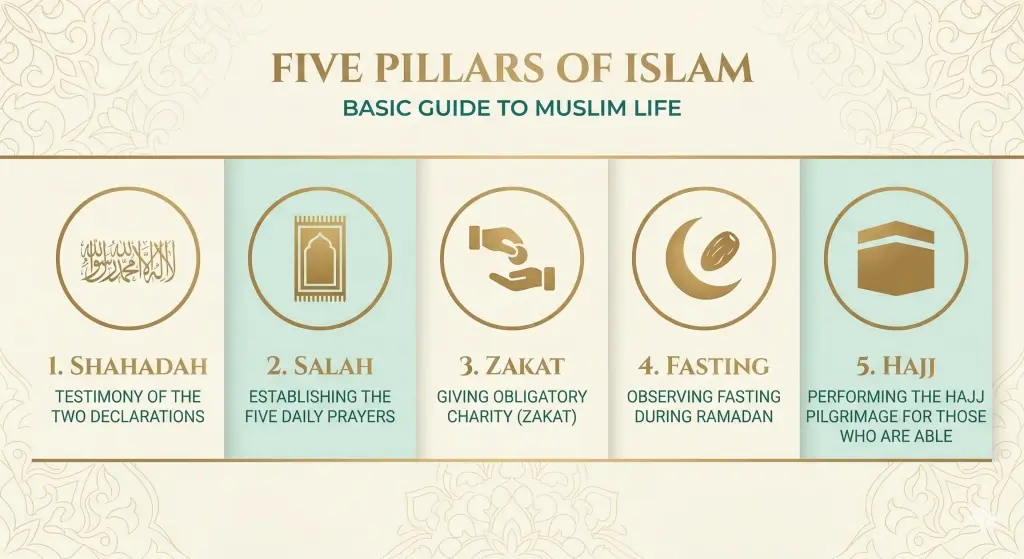
As universally agreed upon by Islamic scholars (Ulama) across the Ahlus Sunnah wal Jama’ah tradition, the sequence of these pillars carries deep meaning. It begins with the declaration of faith and culminates in the spiritual pinnacle of the Hajj pilgrimage. Below is a detailed explanation of each pillar:
1. Shahadah: The First Pillar and Gateway to Islam
The first and most foundational of the Five Pillars of Islam is the Shahadah. Literally, Shahadah translates to “testimony” or “witness.” It is a Muslim’s pledge of conviction—spoken by the tongue, affirmed in the heart, and acted upon through physical deeds. The fundamental pillars of the Shahadah consist of two inseparable declarations:
أَشْهَدُ أَنْ لَا إِلَهَ إِلَّا اللَّهُ
Ashhadu an la ilaha illallah (I bear witness that there is no deity worthy of worship except Allah)
This sentence affirms the absolute oneness of Allah SWT. Nothing in existence is truly worthy of worship, adoration, or ultimate reliance except Him. This is the core of Islamic monotheism (Tawhid), requiring absolute faith in Allah and the rejection of all forms of polytheism (shirk).
وَأَشْهَدُ أَنَّ مُحَمَّدًا رَسُولُ اللَّهِ
Wa ashhadu anna Muhammadan Rasulullah (And I bear witness that Muhammad is the Messenger of Allah)
This declaration acknowledges that Prophet Muhammad ﷺ is the servant and final messenger of Allah, entrusted with divine revelation. Recognizing his prophethood signifies a readiness to follow his teachings, abandon his prohibitions, and emulate his noble character in every aspect of life.
The recitation of these two testimonies is the absolute prerequisite for anyone wishing to embrace Islam. Beyond mere words, the Shahadah is a lifelong commitment to making Allah the sole object of worship and Prophet Muhammad ﷺ the ultimate exemplar.
2. Salah: The Second Pillar and the Foundation of Religion
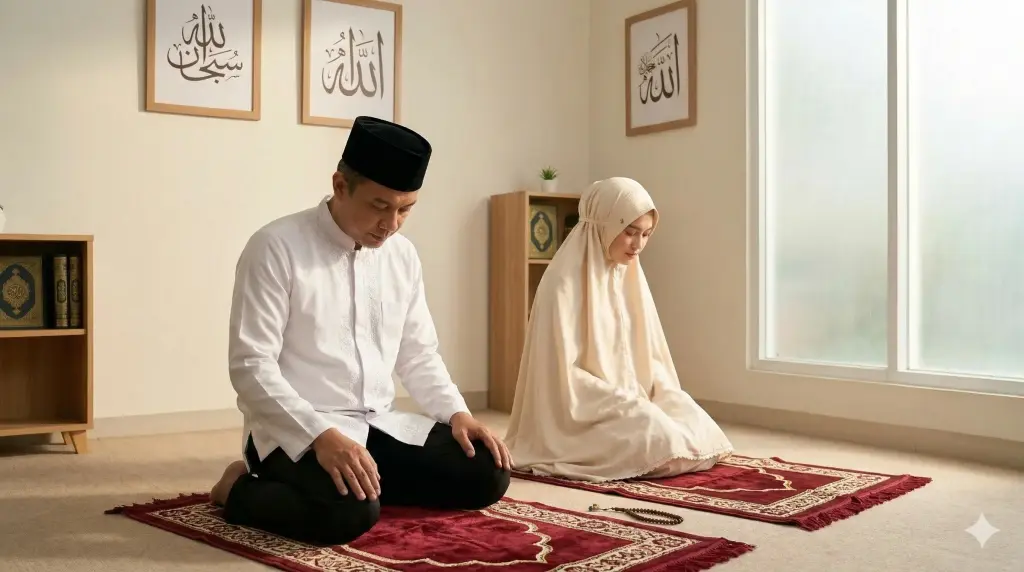
Following the Shahadah, the second obligatory pillar is Salah (Prayer). Linguistically, the definition of Salah is “supplication.” However, in Islamic jurisprudence (fiqh), Salah refers to a specific series of physical movements and recitations that begin with the Takbiratul Ihram and conclude with the Salam.
Every adult Muslim is obligated to perform the five daily prayers: Fajr, Dhuhr, Asr, Maghrib, and Isha. Salah is often described as the “pillar of the religion”; if the prayer is established, the religion remains upright. Its central role includes:
- Direct Communion: Salah provides a direct, unmediated moment for a servant to communicate with their Creator, offering praise, supplication, and repentance.
- Prevention of Vice: When performed with devotion (khushu’) and adherence to its legal prerequisites, Salah cultivates mindfulness and restrains the worshiper from committing shameful and unjust deeds.
- Discipline: Observing the strictly designated prayer times trains a Muslim in rigorous time management and self-discipline.
- Purity: The prerequisites of Salah demand physical purification (Wudu/Ghusl) and spiritual cleansing from negative traits.
3. Zakat: The Third Pillar, Purifier of Wealth and Soul




The third pillar is Zakat. Linguistically, the meaning of Zakat revolves around “growth, blessing, and purification.” In Islamic legal terminology, Zakat is a specific portion of wealth that a qualifying Muslim must distribute to designated eligible recipients (mustahiq) once certain conditions—such as the minimum threshold (nisab) and the passing of a lunar year (haul)—are met.
Zakat serves multiple profound functions:
- Purifying Wealth: It cleanses one’s assets from the inherent rights that the poor and needy have over that wealth.
- Purifying the Soul: Fulfilling Zakat trains the soul in generosity, eradicates greed, and nurtures profound empathy for others.
- Social Welfare: Zakat is systematically distributed to the impoverished, those heavily in debt (gharim), travelers in need, and others striving in the path of Allah.
4. Sawm (Fasting): The Fourth Pillar, Cultivating Self-Discipline
The fourth pillar is Sawm (Fasting). The linguistic meaning of fasting is “to abstain.” In the Shari’ah, it means abstaining from food, drink, and sexual relations, from the break of dawn until sunset, accompanied by a sincere intention (niyyah) for the sake of Allah SWT. The obligatory fasting occurs during the holy month of Ramadan.
Ramadan fasting is a unique act of worship with immense wisdom, including:
- Elevating God-Consciousness (Taqwa): Fasting trains the soul to be obedient, patient, and entirely sincere in following Allah’s commands.
- Mastering Self-Control: Restraining basic human appetites and guarding one’s tongue and actions against vain behavior develops extraordinary self-discipline.
- Fostering Empathy: By experiencing genuine hunger and thirst, a Muslim intimately understands the plight of the less fortunate, generating gratitude and social solidarity.
5. Hajj: The Fifth Pillar, The Sacred Pilgrimage
The final pillar is the Hajj pilgrimage. The definition of Hajj encompasses traveling to the sacred House of Allah (Baitullah) in Mecca to perform a series of specific rituals during the designated Islamic month of Dhu al-Hijjah.
It must be emphasized that Hajj is only obligatory for those who are physically and financially capable (istita’ah). This capability includes having sufficient provisions for the journey, leaving adequate maintenance for dependents back home, possessing physical health, and ensuring a safe route. Hajj represents the pinnacle of a Muslim’s worship, symbolizing:
- Universal Unity: Millions of Muslims gather, wearing simple, uniform Ihram garments that erase all distinctions of wealth, race, or nationality.
- Following Prophetic Footsteps: The rituals closely retrace the historic struggles of Prophet Ibrahim AS, Hajar, and Prophet Muhammad ﷺ.
- Complete Forgiveness: An accepted pilgrimage (Hajj Mabrur) promises the expiation of past sins, allowing the pilgrim to return as pure as a newborn.
Conclusion
Understanding and diligently practicing the Five Pillars of Islam is the foundational duty of every Muslim. These five pillars—Shahadah, Salah, Zakat, Fasting, and Hajj—construct a comprehensive framework for religious practice that guides a Muslim toward a better life in this world and the Hereafter. They are the driving force behind developing an excellent moral character (akhlakul karimah).
Executing the Five Pillars of Islam goes far beyond merely checking off religious obligations; it is the definitive path to achieving inner peace, daily blessings, and the ultimate pleasure of Allah SWT.
Frequently Asked Questions (FAQ)
What are the Five Pillars of Islam in order?
The Five Pillars of Islam are: 1) Shahadah (Declaration of Faith), 2) Salah (Five Daily Prayers), 3) Zakat (Obligatory Charity), 4) Sawm (Fasting during Ramadan), and 5) Hajj (Pilgrimage to Mecca).
Is Hajj obligatory if a person is in debt?
According to Shafi’i fiqh, the obligation of Hajj relies on capability (istita’ah). If a person has outstanding debts that are due, paying off the debt takes priority. Hajj becomes obligatory only when one has surplus wealth after settling debts and providing for their dependents.
Can Zakat be given to anyone in need?
No, Zakat cannot be given to just anyone. The Quran (Surah At-Tawbah 9:60) explicitly specifies eight categories of eligible recipients (mustahiq), which include the poor (fuqara), the needy (masakin), those in debt (gharimin), and travelers stranded without means (ibn al-sabil). For a deeper understanding, you can read it at 8 Asnaf of Zakat Recipients (Mustahiq) and Guidelines.
Reference
Ibn Ḥajar al-Haytamī, Aḥmad ibn Muḥammad. al-Fatḥ al-Mubīn bi-Sharḥ al-Arbaʿīn. Edited by Aḥmad Jāsim Muḥammad al-Muḥammad, Quṣayy Muḥammad Nūrūs al-Ḥallāq, and Abū Ḥamzah Anwar ibn Abī Bakr al-Shaykhī al-Dāghistānī. 1st ed. Jeddah: Dār al-Minhāj, 2008.


